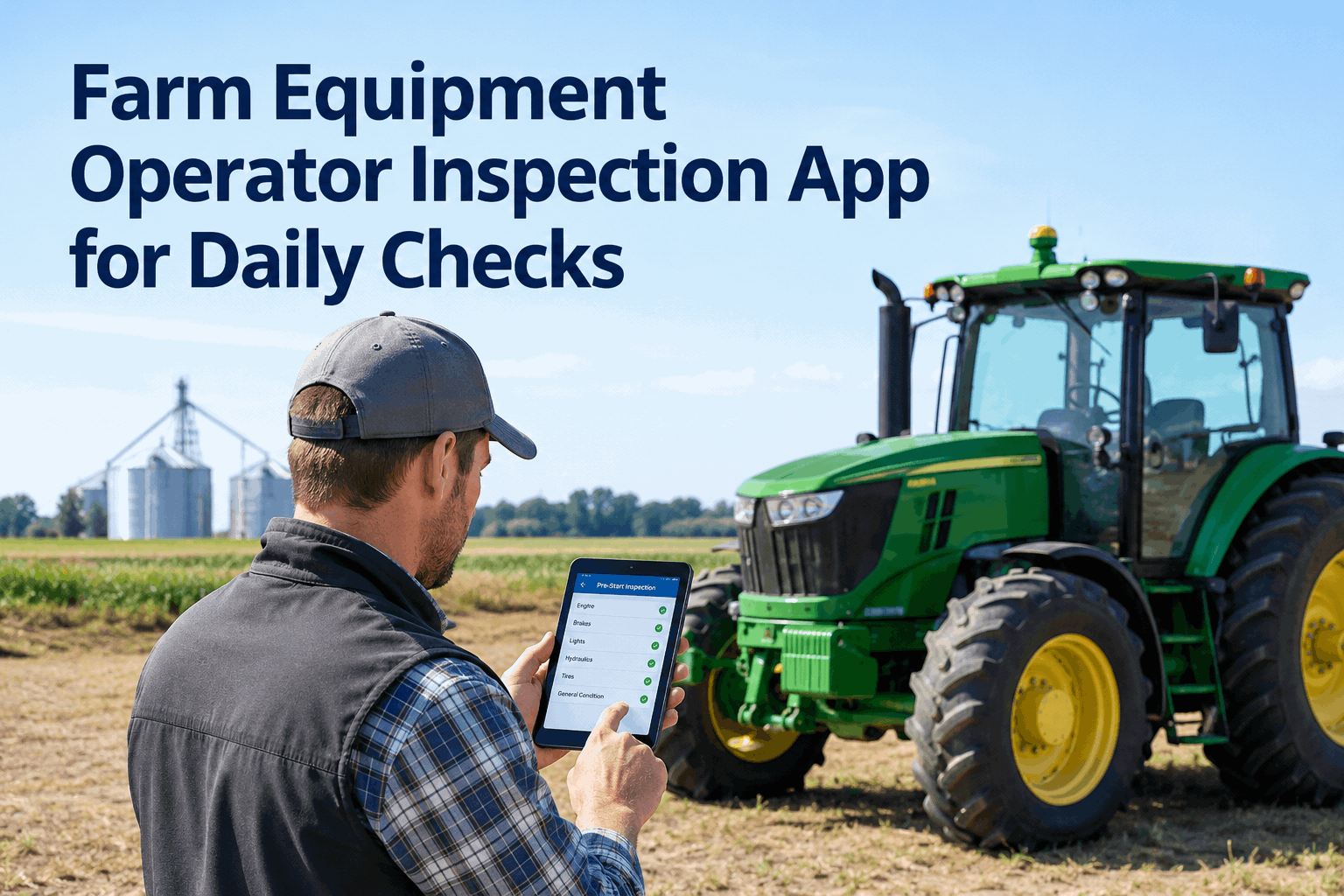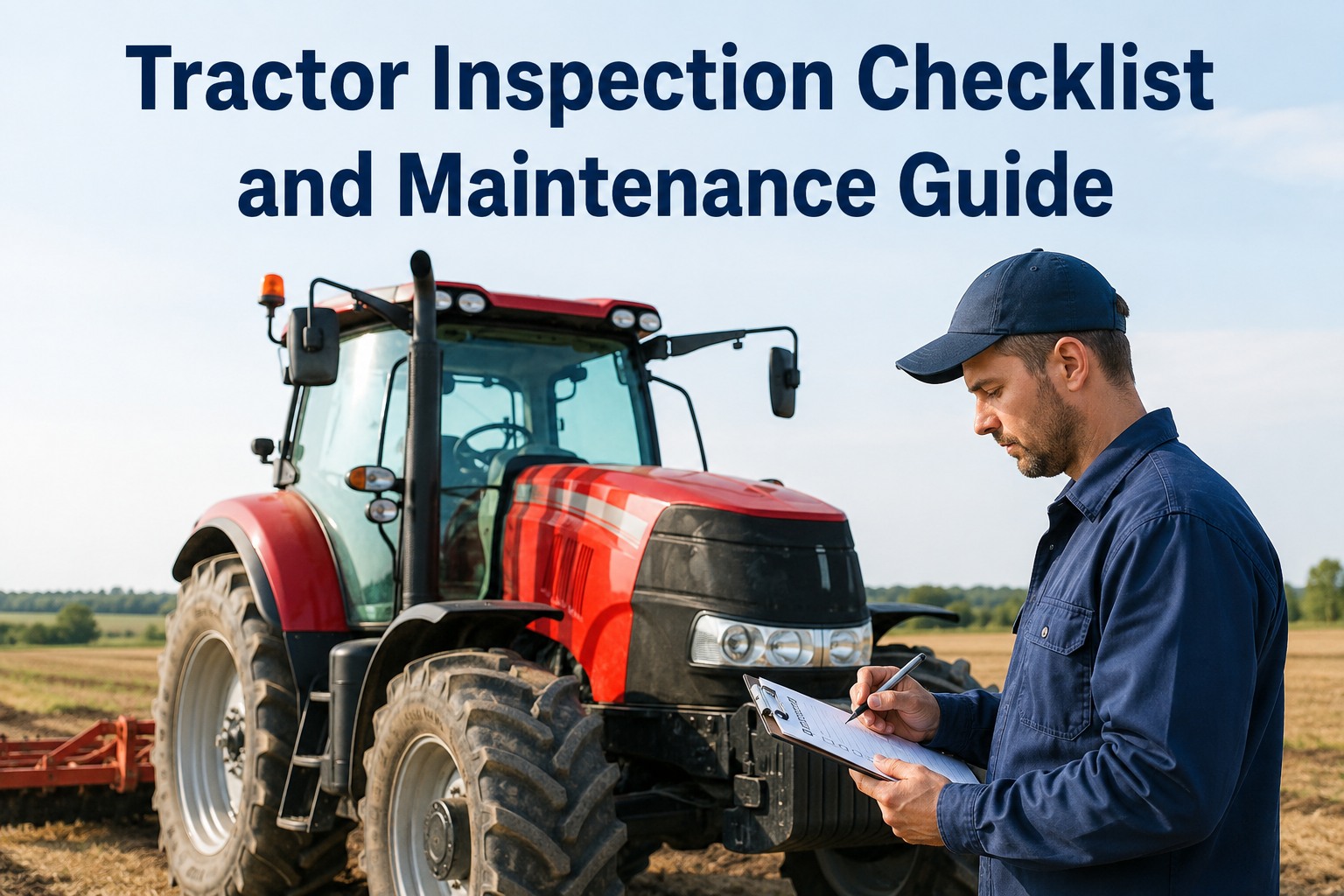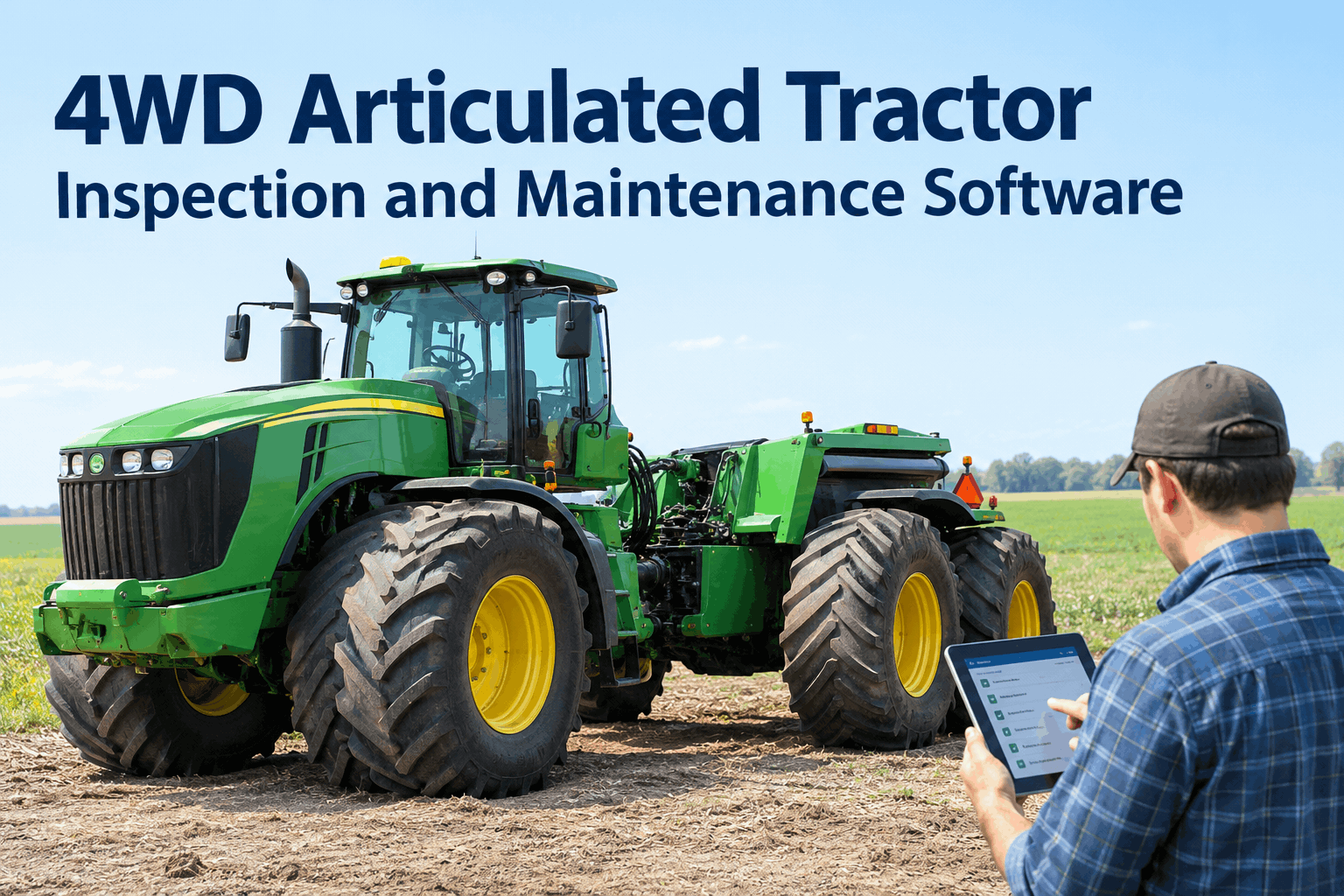
Three days into planting, your tractor starts fighting every headland turn — steering's gone soft, there's a knock through the center hinge, and nobody's sure if it's the pin or the cylinder. A real 4WD articulated tractor inspection would have caught it in the shed. Here's the checklist that actually covers this machine, zone by zone.
4WD Articulated Tractor Inspection: Every Zone That Actually Fails, Covered
Articulated tractors break differently than straight-frame machines — the center hinge, the dual driveline, and the steering cylinders carry stress no standard checklist accounts for. HVI builds the digital inspection around what this specific machine actually does to itself.
- 1Center articulation joint — hinge pin & steering cylinders
- 2Front axle & tires — tread, rims, undercarriage
- 3Driveline & differentials — dual-path transmission
- 4Cab, engine & controls — ROPS, brakes, gauges
- 5Hydraulics & PTO — outlets, flow, shaft speed
Why a Generic Checklist Misses Most of a 4WD Articulated Tractor Inspection
A straight-frame tractor steers through its front axle. An articulated 4WD bends in the middle instead — and that single difference is where most generic checklists fall apart.
One solid frame. The front axle alone carries every steering input — simple, and simple to inspect.
Two frame halves, one hinge pin, two steering cylinders — taking every ounce of load, every turn, all day.
Power runs the same way: front and rear differentials plus a center driveshaft crossing the hinge itself, so a knock while turning can mean a worn bushing or a slipping transmission — and a generic checklist can't tell you which. Book a demo and we'll build your checklist around the hinge, driveline, and cylinders by name.
Before any of that helps: start free and add your first articulated tractor as a digital asset — everything below only works once the machine is in the system.
The 4WD Articulated Tractor Inspection Checklistzone by zone, built around how this machine actually fails
This is the structure worth building your pre-start and pre-season walkaround around — five zones, each tied to a real failure mode on articulated machines rather than a generic "check fluids" line. Start free and build this exact checklist for your own fleet so every operator runs the identical inspection, on their phone, before the tractor leaves the yard.
Center Articulation Joint
- Grease the hinge pin and bushings before checking for play — a dry pin masquerades as a worn one
- Cycle full left-right steering lock and listen for a knock or clunk at the joint itself
- Check fresh grease for metal shards or discoloration, a clear sign of accelerating wear
- Look for wandering, looseness, or a tendency to drift straight — often a bent or worn main pin
Driveline & Differentials
- Confirm both front and rear differentials show no leaks at seals, housings, or breather caps
- Engage 4WD and listen for a knock from the output shaft, which can signal transmission slip
- Check the center driveshaft that crosses the hinge for wear at its universal joints
- Log hours since the last differential fluid change — this is a part that's expensive to ignore
Hydraulics, Steering & PTO
- Inspect both steering cylinders for leaks, scoring, or slow response on full lock
- Count remote hydraulic outlets and confirm flow rate matches the attachment you're running
- Check all hydraulic lines for cracks, chafing, or soft spots near the hinge, where flex is highest
- Run the PTO at idle and confirm the shaft speed (540 or 1000 RPM) matches the implement spec
Tires, Rims & Undercarriage
- Check tread depth and even wear across all four tires — uneven wear often traces back to the hinge or alignment
- Inspect rims for cracks, especially near valve stems and weld seams on fluid-filled tires
- Confirm air pressure matches the field vs. road setting for the implement you're pulling
- Look underneath for grease buildup mixed with dirt, a sign of a leaking seal nearby
Engine, Cab & Controls
- Confirm the ROPS structure and seatbelt are intact and undamaged before every shift
- Check the air filter restriction gauge rather than guessing at the replacement interval
- Test service brakes, park brake, and all warning lights and gauges from a cold start
- Look for coolant, fuel, or oil leaks at the engine block and surrounding hose connections
Build the Service Schedule Around Engine Hours, Not the Calendar
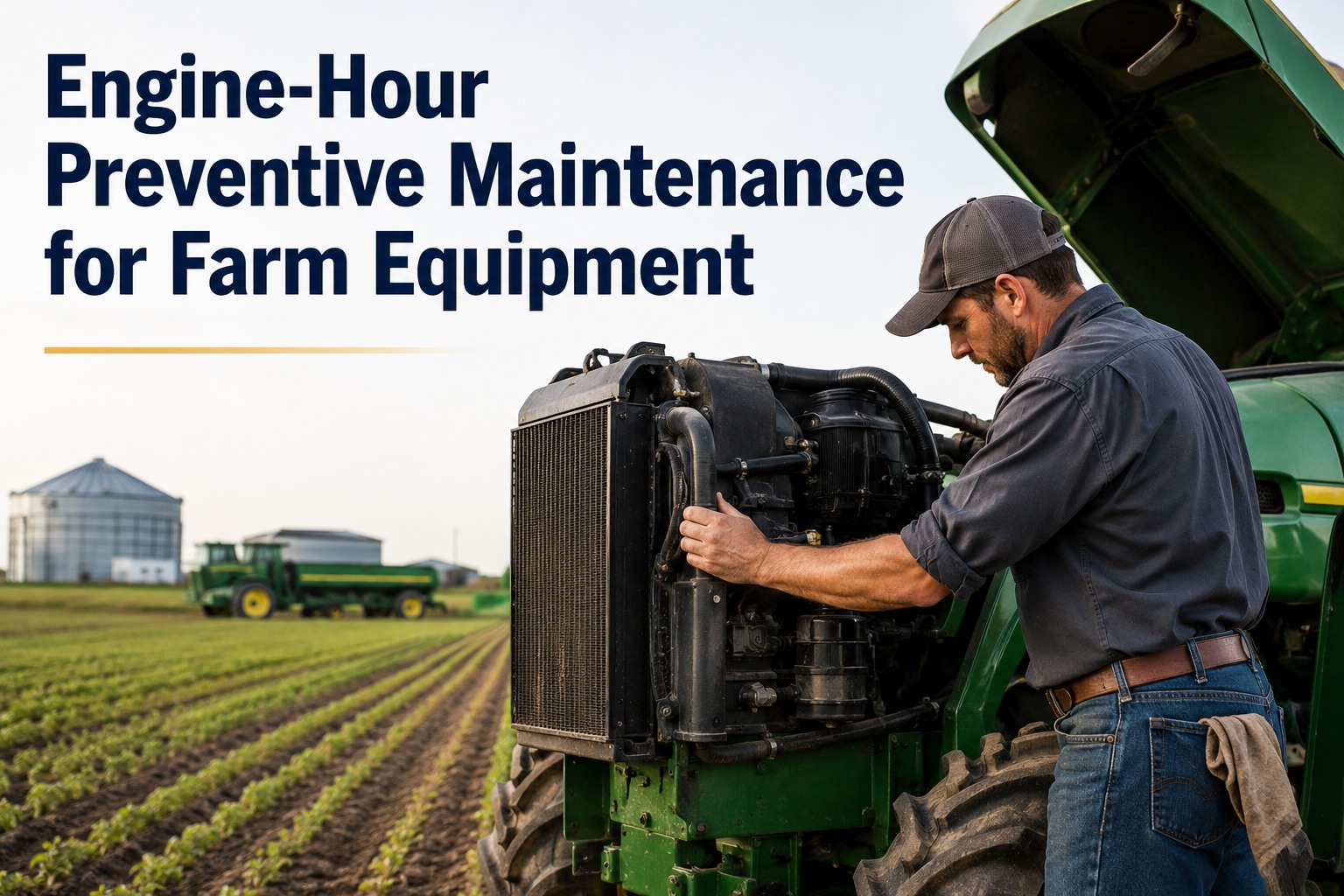
Ag equipment wears out on hours, not months — and a 4WD articulated tractor can rack up most of its annual hours inside a six-week planting window. HVI's preventive maintenance scheduling triggers off the meter reading that actually matters: engine hours.
Pre-start walkaround
All five inspection zones, fluid levels, tire pressure, ROPS and seatbelt check before the engine ever starts.
Grease & torque check
Re-grease the center hinge, steering cylinder pins, and driveline u-joints; recheck wheel lug torque.
Air filter & fluid sampling
Replace or inspect the air filter based on the restriction gauge; pull an oil sample if one's due.
Hinge & differential service
Full center-pin wear check, differential fluid inspection, and a hydraulic pressure test on both steering cylinders.
Comprehensive service
Full driveline teardown points, cab and ROPS structural check, and a complete inspection-history review before the next season.
What That Knock, Leak, or Soft Steering Is Actually Telling You
Four symptoms, read correctly before a technician ever touches a wrench:
None of this shows up on a paper form filled out from memory at hour 14. Book a demo and see a flagged symptom turn into a work order instantly, photo attached, so the next operator sees it before they climb in.
From a Maintenance Manager Who Lost a Week to a $40 Part
We had a Steiger down for six days mid-planting over a grease fitting that nobody had been hitting for three seasons. By the time the pin showed play, the bushing was already scored and we were into a real repair instead of a $40 fitting and twenty minutes.
Now every operator runs the same checklist on their phone before the tractor leaves the yard, and the hinge is its own line item with its own photo requirement. I track engine hours per tractor instead of guessing, and I haven't lost a planting week to something this avoidable since.
One inspection, one defect log, one service history — book a demo and see your own tractor fleet on one dashboard, tractor by tractor.
Frequently Asked Questions
How often should the center articulation joint be greased?
Most OEM manuals call for greasing the hinge pin and bushings every 50 hours, with a full wear and torque check around every 100 to 250 hours. Dusty or wet field conditions can shorten that interval, so check the grease itself for metal shards at every service.
What's different about inspecting an articulated tractor versus a standard 4WD?
A standard 4WD steers through its front axle, while an articulated tractor steers by bending at a center hinge driven by hydraulic cylinders. That joint, the driveshaft crossing it, and the cylinders themselves are unique wear points that a generic checklist built for a straight-frame tractor simply doesn't cover.
Why does my articulated tractor knock when turning?
A knock or clunk specifically on turns usually traces back to wear in the center hinge bushings or slip in the transmission, not the engine itself. It's worth inspecting before the next field pass rather than continuing to run the same turning pattern that's aggravating it.
Is ROPS required on all agricultural tractors?
In the US, OSHA 1928.51 requires rollover protective structures on agricultural tractors manufactured after October 25, 1976, along with a functioning seatbelt. Checking that the ROPS and seatbelt are intact belongs on every pre-start inspection, not just an annual review.
Can digital inspection software be customized for a specific tractor model?
Yes — HVI's digital checklists are built around the actual asset rather than a generic template, so an articulated tractor's checklist can include the center hinge, dual driveline, and steering cylinders by name instead of a vague "steering system OK?" line item.
An articulated 4WD tractor inspection that skips the hinge, the driveline, or the cylinders is inspecting a different machine. Build it around the five zones that actually fail, run it off engine hours, and put it on your operators' phones.
Stop inspecting your articulated tractors with a checklist built for a different machine
HVI turns your pre-start and pre-season walkaround into a digital inspection built around the center hinge, driveline, hydraulics, tires, and cab — with a flagged defect becoming a tracked work order automatically, and a full engine-hours service history for every tractor in the fleet.
- Checklist built around your tractor's exact asset list
- PM scheduling by engine hours, not the calendar
- Flagged defects become work orders instantly
- Full service history filed under each tractor
No credit card · Works on the phone your operators already carry · Built for every tractor in your fleet