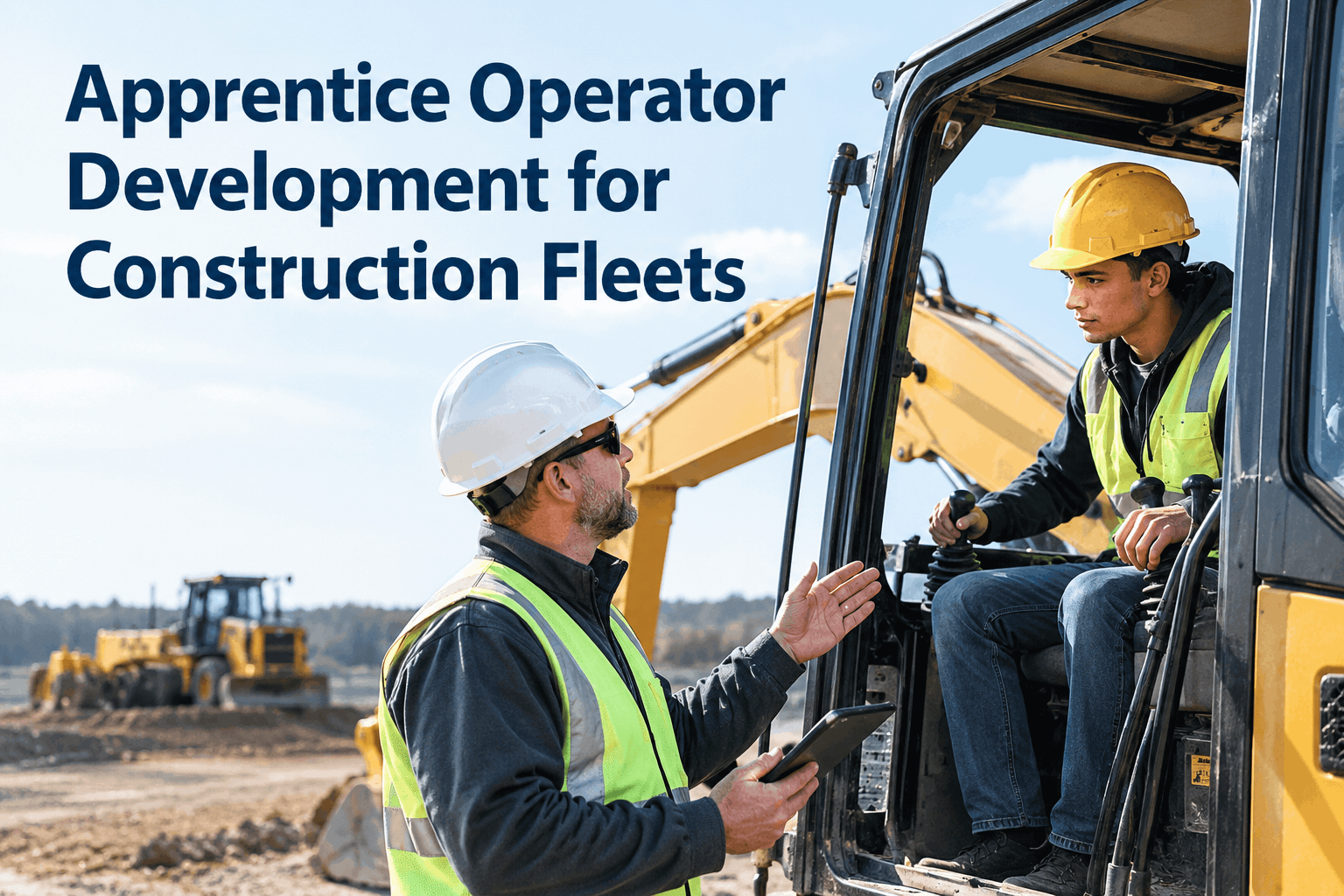
You can't hire your way out of the operator shortage, so more contractors are building operators from scratch. A good apprentice operator program takes someone green and turns them into a skilled, loyal operator who stays — cheaper and stickier than poaching finished talent. But the programs that work don't just teach someone to run a machine; they build the habits that protect it. This page lays out how to structure one, and where equipment care belongs in it. Book a demo of the apprentice-progress view.
Can't hire operators? A strong apprentice operator program grows them
Take someone green, run them through real stages, and build an operator who's skilled, loyal, and careful with your iron. The best programs teach machine care from day one — and let you see the progress.
An apprentice operator program isn't a two-week orientation and a hard hat. It's a structured climb from green to competent, with checkpoints along the way — and the contractors who treat it as a real pipeline, not a formality, are the ones filling seats the market can't.
Why grow your own operatorsthe case for an apprentice operator program over open-market hiring
Building operators takes longer than hiring them — but in this market, it's the move that actually works. Here's what a program gives you that a job posting can't.
They stay
An operator you trained from scratch feels invested in — loyalty and retention beat a finished hire who'll leave for the next offer.
They cost less
No bidding war for scarce finished operators. You pay a developing wage while they contribute real work, not a premium for someone else's training.
They learn your way
Your safety culture, your machines, your standards — baked in from day one instead of unlearning habits picked up somewhere else.
With 88% of construction firms reporting open craft positions (AGC/NCCER 2025) and nearly half of new hires quitting shortly after starting, the open market is a leaky bucket. A program that builds loyalty is how you stop refilling it. This is the "grow your own" half of the answer to the Read our guide on the equipment operator shortage.
The 4 stages of an apprentice operator programa development roadmap from green hire to mentor
Safety, basics & machine care
Ground school before the seat. Site safety, machine familiarization, and — critically — how to inspect a machine properly. The daily walk-around is taught here, not assumed later. An apprentice who learns to spot a hydraulic leak on day one becomes an operator who protects your fleet for a career.
Supervised hours on real work
Seat time under a mentor's eye, on actual tasks, not a cone course. They log real operating hours, run their own pre-shift inspections, and build the muscle memory of careful operation. Mistakes happen here, cheaply, with someone watching.
Running solo, owning the walk-around
Cleared to operate independently. They own their machine's condition — the inspection, the defect report, the handover — as a professional, not a checkbox. This is where the day-one care habit pays off in a fleet that lasts.
Training the next apprentice
The loop closes. A competent operator becomes a mentor, and your pipeline becomes self-sustaining. The careful habits you built in get passed down — including how to treat the equipment that keeps everyone working.
Notice equipment care threads through every stage — it's not a module, it's a habit built from the first week. That's the difference between an operator who runs a machine and one who looks after it. Book a demo to see how inspections become a teachable skill.
What a strong apprentice operator program builds inthe competencies that separate a seat-filler from a professional
Most programs over-index on production and treat equipment care as common sense picked up later. Flipping that — teaching the walk-around early — is what produces operators who don't grind your fleet into the ground. Explore HVI's digital equipment inspections to see the habit you're building, or Book a demo to make inspection a core competency.
Apprentice operator development checklistthe milestones to track as a green hire becomes competent
A program without milestones is just time passing. These are the checkpoints that prove an apprentice is actually developing, grouped by the stage they belong to.
Half these milestones are equipment-care records — inspections run, defects caught, damage avoided — which means your maintenance platform doubles as your apprentice scorecard. Sign up free and track development milestones, or Book a demo to see the apprentice progress view.
Why an apprentice operator program pays offthe workforce math behind growing your own
An apprentice operator program solves two problems at once: it fills the seats the market can't, and — if you teach equipment care from the start — it produces operators who protect the fleet instead of wearing it out. The payback runs for the length of a career.
From an owner who built his bench instead of buying it
We stopped trying to out-bid everyone for finished operators and started growing our own. The thing that surprised me wasn't that they stayed — it was how much better they treated the machines. We made the daily inspection part of training from week one, so to them it's just how you run equipment, not a chore someone forces on you. Three years in, my first apprentice is now training the new ones, and our repair bills on his machines are the lowest in the yard. You build the operator and the fleet gets a caretaker.
Build an apprentice operator program that produces careful operators
The seats the market can't fill, you can grow — and if you teach equipment care from day one, you build operators who protect your fleet for a career. HVI makes the daily inspection a trackable skill your apprentices practice and you can prove, turning your maintenance platform into your development scorecard too.
No credit card · No hardware · Apprentice progress view from day one
Apprentice operator program — FAQs
What is an apprentice operator program?
It's a structured path that develops a green hire into a competent equipment operator through stages — trainee, developing, competent, mentor — combining safety and machine-care basics, supervised seat time, and solo operation. It's how contractors grow operators instead of hiring finished ones.
How long does it take to develop an apprentice operator?
It varies by machine and program, but a common arc is a few weeks of ground school, several months of supervised hours, and solo competence around 6–18 months. Mentoring readiness usually follows in the second year once the habits are solid.
Why grow operators instead of hiring them?
Because the market can't supply them — 88% of firms report open positions and about half of new hires leave fast. Apprentices you develop are cheaper, more loyal, and trained to your standards, including how to care for your equipment.
Should equipment inspection be part of operator training?
Absolutely, and from day one. Teaching the daily walk-around early builds an operator who protects the fleet for a career rather than one who grinds it down. Equipment care is a core competency, not something to pick up later by osmosis.
How can software support an apprentice operator program?
It makes the daily inspection a trackable skill apprentices practice, and every completed check, flagged defect and clean record becomes evidence of their progress. Your maintenance platform doubles as a development scorecard, showing who's ready to advance.