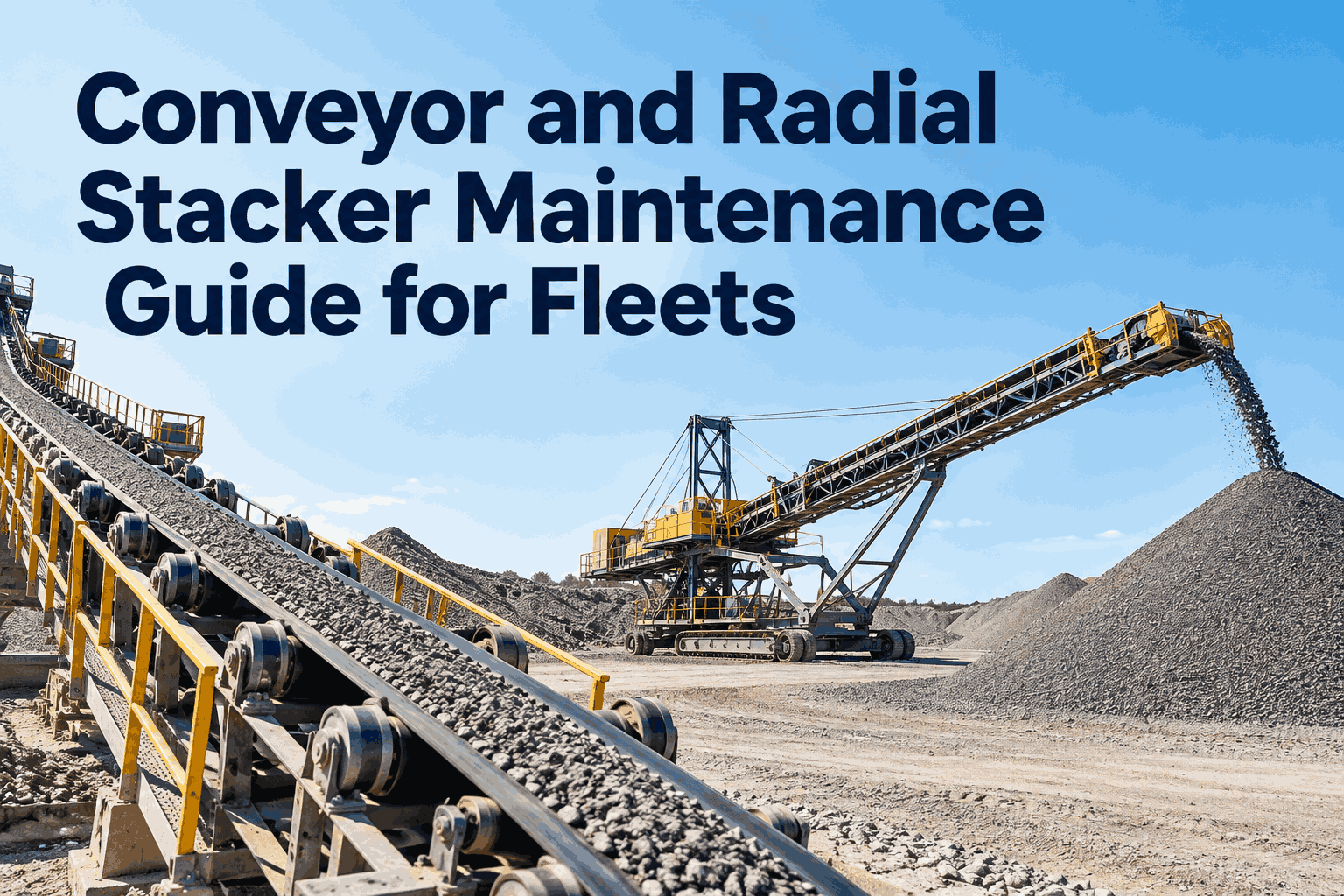
Conveyor stacker maintenance is where jobsite downtime hides in plain sight. A radial stacker looks simple — a belt on a frame — but a single seized idler or a belt drifting half an inch off track can shred a $6,000 belt, spark a friction fire, or bury a shift's production in a mistimed pile. The failures almost always start small and travel down the run. Book a demo to see belt, idler, and drive checks tracked on one program.
Conveyor stacker maintenance follows the belt path
Every failure has a location on the run — the tail, the idlers, the drive pulley, the radial pivot. Inspect it as a path, not a pile of parts, and you catch a wandering belt before it tears instead of after.
A conveyor or radial stacker isn't a machine you inspect standing still — it's a system where a fault at one point rides the belt to another. A little material buildup on a return idler throws the belt off track; the off-track belt frays its edge; the frayed edge becomes a tear that scraps the whole belt. This guide walks the run end to end: what to check at each point, the failures that cascade, and the extra wear a radial stacker earns because it moves.
The six inspection points on the runwhere conveyor stacker maintenance time actually pays off
A stacker has hundreds of parts but six systems carry the risk. Know what fails in each and your conveyor stacker maintenance stops being guesswork — you're watching the handful of things that actually strand a shift.
Belt & splice
The most expensive wear part. Watch the edges for fraying, the surface for cuts and cover wear, and the splice — mechanical or vulcanized — for cracking or separation. A drifting belt destroys its own edge fast.
Check: daily tracking · monthly spliceIdlers & rollers
A single seized idler stops turning and the belt grinds across it — friction that burns the belt and, on a hot dusty pile, can start a fire. Listen for noise, feel for heat, spin-check the doubtful ones.
Check: daily noise · weekly seizurePulleys & lagging
The drive pulley's rubber lagging is what grips the belt. Worn, glazed, or peeling lagging lets the belt slip — weak throughput and a belt that heats and wears. Inspect lagging and replace it before it's bald.
Check: daily wear · replace when wornDrive, gearbox & motor
Motor, gearbox, couplings, and backstop are the powertrain. Watch for vibration, misalignment, and heat; sample and change gearbox oil on schedule. A failed backstop lets a loaded incline belt run backward — dangerous and destructive.
Check: monthly align · oil per OEMGuarding & safety
Nip-point guards, emergency pull-cords, and belt-drift switches are the parts crews remove for access and forget to refit. Missing guarding is an injury waiting to happen and a citation waiting to be written. Verify every guard and cord functions.
Check: daily · never run unguardedRadial travel & frame
This is what makes a stacker a stacker. The wheels, axles, slew pivot, and undercarriage take load and rough ground as the unit swings to build the pile. Grease the pivot, check wheel bearings and tire condition, inspect the frame for cracks.
Check: weekly pivot & wheelsFive of these are shared with any belt conveyor; the sixth — radial travel — is the stacker's own, and the one a fixed-conveyor checklist misses. Book a demo to see each point tracked per machine with photo evidence.
How a small fault rides the beltwhy a five-minute check saves a whole belt
The reason conveyor failures get expensive is that they don't stay put. One neglected point feeds the next, and by the time the belt fails you're replacing far more than the part that started it. Two cascades cause most of the big bills.
Both chains break at step one — a daily walk that catches buildup and a seized roller before either travels. Start free and put the daily belt-and-idler walk on every stacker today.
The radial stacker earns extra wearit's a conveyor that moves — maintain the motion too
A fixed conveyor sits still. A radial stacker swings through an arc to build a rounded stockpile, so it carries a whole undercarriage a plain conveyor never has — and that undercarriage is where radial-specific maintenance lives.
- Belt — tracking, edges, splices, cover wear
- Idlers — seizure, noise, material buildup
- Pulleys & lagging — grip, glazing, wear
- Drive train — motor, gearbox, backstop, oil
- Slew pivot — grease and check for play as it swings
- Wheels & axles — bearings, tires, alignment under load
- Undercarriage & frame — cracks from rough-ground travel
- Radial drive — the mechanism that moves the pile
Run a stacker on a fixed-conveyor checklist and the entire moving half goes uninspected until a wheel bearing or the pivot fails mid-arc. Book a demo to give the radial undercarriage its own checklist items.
The conveyor stacker maintenance scheduledaily to quarterly, on one clock
Here's the program laid out by cadence. Treat it as a starting frame — a dusty, high-tonnage aggregate duty cycle pulls every interval shorter, and your OEM manual sets the exact gearbox and bearing service.
| When | What to check | Why it matters |
|---|---|---|
| Daily | Belt tracking, idler noise, guards & pull-cords, spillage | Catches the faults that cascade |
| Weekly | Idler seizure, lagging, fasteners, clean buildup | Stops friction and mistracking |
| Weekly | Radial pivot grease, wheels & bearings | Keeps the moving half sound |
| Monthly | Belt splices, take-up travel, drive alignment | Prevents splice and drive failures |
| Quarterly | Vibration analysis, thermal scan, gearbox oil sample | Finds wear before it strands a shift |
| As needed | Proactive idler swap in high-wear zones | Cheaper than a belt burn |
None of it is complicated — the hard part is doing every layer, on every stacker, and proving it happened. That's where a scattered fleet of stackers usually falls down. Start free and load this schedule onto every conveyor in the yard.
How HVI keeps conveyors from stranding a shift
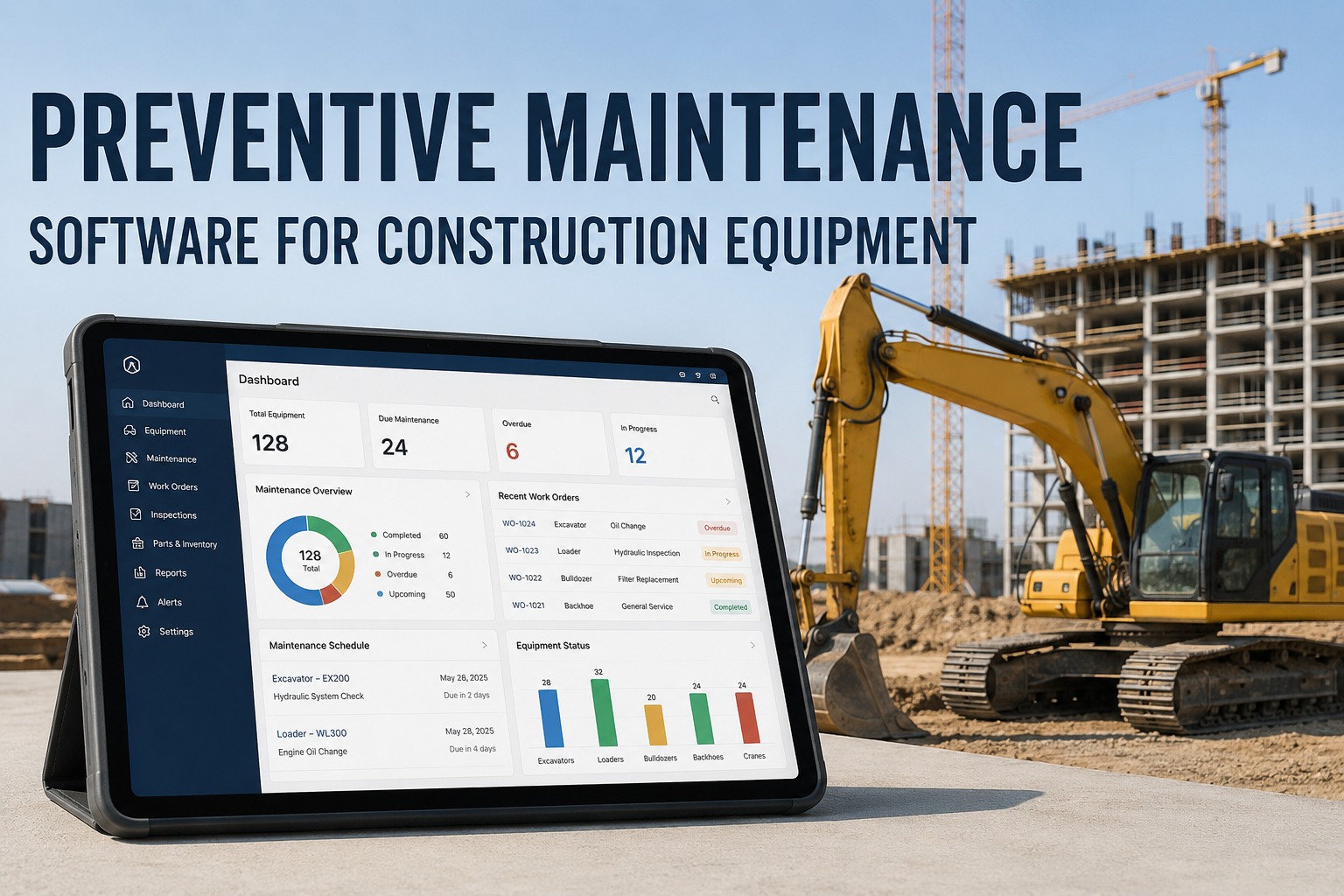
The gap in most conveyor stacker maintenance isn't knowing what to check — it's turning a daily walk into a closed repair and a provable record. HVI links inspection, preventive maintenance, and repair tracking so nothing spotted on rounds gets lost.
Inspect the run
Crews walk the belt path on a phone — tail, idlers, belt, drive, guarding, radial gear — flagging a seized idler or worn lagging with a photo, offline if the pit has no signal.
Flag to a work order
A defect becomes a repair work order on the spot, assigned and tracked to close — so the idler spotted at 7am is fixed, not forgotten by the next shift.
Schedule & prove
Belt, gearbox, and radial intervals fire on their own clock, and the full service and repair history exports on demand for audits, insurance, and resale.
It's the same discipline behind our crusher monthly maintenance checklist and batching plant daily checklist — applied to the conveyors and stackers that tie a plant together. It runs on HVI's preventive maintenance scheduling and fleet inspection with defects flowing straight into repair work orders.
We lost a stacker belt to a seized return idler that somebody had heard squealing for two days and never wrote down. By the time it let go the belt had ground a flat spot, jumped the track and torn — a new belt, a splice crew, and most of a day with the crushing circuit backed up behind it.
Now the daily walk is on the phone and a bad idler turns into a work order before the operator leaves the machine. We haven't lost a belt since, and when the insurer asks about fire prevention I pull the guarding and idler history in about a minute.
Conveyor stacker maintenance FAQsthe questions plant crews ask most
What does conveyor stacker maintenance involve?
Inspecting and servicing the belt path end to end: belt tracking and splices, idlers and rollers, pulley lagging, the drive train, guarding and pull-cords, plus the radial stacker's own wheels, pivot, and undercarriage. It runs on a daily-to-quarterly cadence, with defects turned into tracked repairs.
What is the most common conveyor failure?
Belt mistracking and seized idlers. A drifting belt frays its edge and tears; a seized idler creates friction that burns the belt and can start a fire. Both begin as a small daily-check item, which is exactly why a walk-the-run inspection prevents the expensive version.
How often should a radial stacker be inspected?
Daily for belt tracking, idler noise, and guarding; weekly for idler seizure, lagging, and the radial pivot and wheels; monthly for splices and drive alignment; quarterly for vibration analysis and gearbox oil. Shorten every interval on heavy dust or high tonnage.
Why does a radial stacker need extra maintenance versus a fixed conveyor?
Because it moves. On top of all the belt and drive items, a radial stacker has a slew pivot, wheels, axles, and an undercarriage that take load and rough ground as it swings to build a pile. A fixed-conveyor checklist skips that entire moving half.
Can maintenance software track conveyor and stacker repairs?
Yes. HVI logs the daily belt walk, flags a defect into a repair work order, schedules belt, gearbox, and radial intervals, and keeps the full history. So a seized idler spotted on rounds becomes an assigned, tracked, closed repair — with a record for audits and insurance.
Stop losing belts you could have caught on rounds
Walk the belt path on a phone, turn every seized idler and worn splice into a tracked repair, and schedule the belt, gearbox, and radial intervals that keep a stacker running. HVI makes conveyor stacker maintenance a record that protects you with insurers and auditors. Live for your fleet in days.
No credit card · load your first stacker's schedule on day one