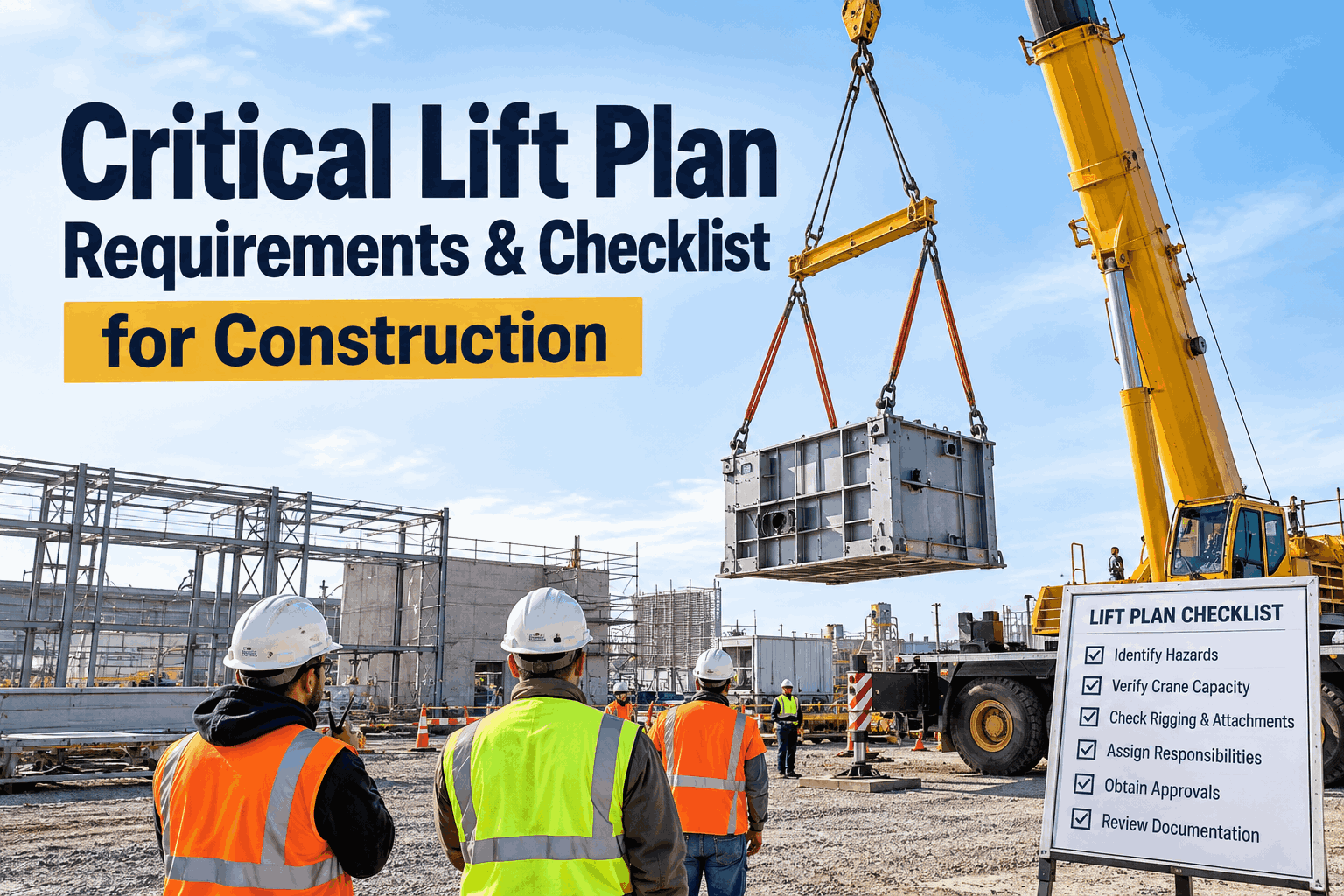
Not every crane lift needs a plan on paper — but the ones that do are exactly the ones that hurt people when they go wrong. A critical lift plan is the formal, approved document that turns a high-consequence pick into a controlled operation: the load classified, the weight and rigging verified, the crane and ground checked, the roles assigned, and the whole thing signed off before the crane sets up. A half-filled or unsigned plan isn't a plan — it's a non-conformance found too late. This page covers what makes a lift critical, what the plan must contain, and how to make it complete before mobilization. Book a demo to see critical lift plans gated before mobilization.
Is It a Critical Lift? Then It Needs a Plan.
Over 75% of capacity, multi-crane, over people, blind, or non-routine — and the lift crosses the line to critical. That means a documented, approved plan, signed off before the crane sets up. Not a form filled in after the boom's already loaded.
A critical lift is any pick where a small planning gap can become a serious incident — and the plan exists to force the team to confirm the lift is engineered, briefed, and controlled before the crane mobilizes, rather than discovering a problem after it's already set up. The classification comes first: get that right, and everything else follows.
What Makes a Lift "Critical"
Exact criteria vary by employer and site, but the triggers are consistent across the industry. If a lift meets any one of these, it crosses from routine to critical — and a documented plan becomes mandatory.
The most common threshold. When the load approaches the crane's rated limit for the configuration, the margin for error shrinks and a plan is required.
Two or more cranes sharing a load means load-sharing, synchronization, and far more that can go wrong — always a critical lift.
Any time people are lifted or work under a suspended load, the consequence of failure is life-safety — the highest planning bar applies.
When the operator can't see the load or landing and relies entirely on a signal person, communication becomes safety-critical and a plan is required.
Picks over active work areas, near buildings, or close to overhead power lines carry consequences that demand engineered controls and exclusion zones.
Unusually heavy, awkward, or high-value loads, or any lift the competent person deems non-routine, can be classified critical at discretion.
The classification isn't a judgment call to make on the fly — it's the first controlled decision of the lift, and it should be documented. Getting it wrong in the "it's probably fine" direction is exactly how a lift that needed a plan goes ahead without one. When in doubt, classify up. Book a demo to see lift classification captured up front.
What a Critical Lift Plan Must Contain
Formats differ between contractors, but the minimum components are the same everywhere. A plan missing any of these isn't complete — and an incomplete plan is a gap someone has to catch before the lift, not after.
Weight & center of gravity
Verified or calculated load weight including all rigging, hooks, and spreaders; the center of gravity identified and accounted for in the rigging arrangement.
Rigging selection & condition
Slings, shackles, hooks, and spreaders rated for the load and sling angles, inspected before use, with pick points and attachment hardware verified.
Crane config & load chart
Crane make, model, boom length, counterweight, jib, and outrigger setup recorded — with the load chart for that exact configuration and the planned radius.
Ground & site conditions
Ground bearing capacity, cribbing or mats, crane level, and proximity to structures, lines, or occupied areas — the conditions the lift depends on.
Exclusion zone & communication
The exclusion and fall zone boundaries, stop points, the communication method the crew will use, and the emergency actions if something goes wrong.
Roles & approval
Named operator, signal person, rigger, and lift director, plus the competent-person approval and any required permits or engineered calculations.
Every one of these is a component an auditor will look for and an incident investigation will ask about. The value of the plan isn't the paperwork — it's that filling it forces the team to actually confirm each of these before the crane moves, turning assumptions into verified facts. Start free and build the plan from a required component set.
Who's Responsible — and Who Approves
A critical lift isn't one person's call. It runs on defined roles, each owning a piece of the lift, with a competent person holding the approval. Everyone needs to know their role before the pick.
Crane operator
Operates the crane within the plan and the load chart, and has the authority to stop the lift if conditions don't match the plan.
Signal person & rigger
A qualified signal person directs the lift, especially on blind picks; the rigger selects and inspects the rigging and attaches the load correctly.
Lift director
Oversees the lift execution, confirms the plan is followed, runs the pre-lift meeting, and coordinates the crew and stop-work authority.
Competent person / approver
Reviews and approves the plan before mobilization, and confirms the lift meets the criteria and controls for a critical operation.
The approval step is the one that can't be skipped: an approved plan means a competent person has verified the lift is engineered and controlled and put their name to it. That signature is both the safety gate and the accountability record — which is why it has to happen before the crane sets up, not as a formality afterward. Book a demo to see approval captured before the lift.
The Pre-Lift Meeting
Even a perfect plan on paper doesn't control the lift until the crew has walked through it together. The pre-lift meeting, held immediately before the critical lift, is where the plan becomes shared understanding.
Walk the crew through the load, rigging, crane setup, and lift sequence, confirming everyone has the same picture of how the pick will go.
Every person confirms their role and the signal or communication method — who directs, who watches, who can stop the lift.
Agree the exclusion and fall zones, the stop points in the sequence, and that anyone holds stop-work authority if something looks wrong.
Confirm what happens if a component fails, weather turns, or a load shifts — the emergency response agreed before, not improvised during.
The meeting is where planning gaps surface while there's still time to fix them — a rigger flags a sling angle, an operator questions the ground, a signal is clarified. Skipping it, or treating it as a signature exercise, throws away the last chance to catch a problem on the ground instead of in the air. Start free and record the pre-lift briefing on the plan.
Why the Plan Has to Be Signed Before Mobilization
The entire value of a critical lift plan comes down to timing: it has to be complete and approved before the crane sets up. A plan finished after mobilization has already missed its whole purpose.
A non-conformance found too late
The crane's mobilized, the load's rigged, and only then does a missing calculation or wrong config surface. Now fixing it means de-rigging and re-planning under pressure — or worse, proceeding anyway because it's "nearly done."
The gap caught on paper
Every component confirmed and the plan signed before the crane moves means any gap is caught while it's cheap to fix — on the ground, at a desk, before anyone's under a load. The lift starts controlled.
That's the difference between a plan that protects people and one that just documents them. An approval gate before mobilization isn't bureaucracy — it's the mechanism that guarantees the confirming happened before the lifting, which is the only order that keeps a critical lift safe. Book a demo to see the approval gate enforced.
How HVI Runs the Critical Lift Plan as a Checklist
A plan is only as good as whether it's actually completed and approved every time — and on paper, that's exactly what slips. Three capabilities make the plan enforceable instead of optional.
Every component a required field
Load weight, center of gravity, rigging, crane config, ground, exclusion zone, roles — each a mandatory step, so the plan can't be marked complete with a component missing.
Approval gate before mobilization
The competent-person sign-off is captured, and the plan can't reach "ready" until it's complete and approved — so an unsigned plan never reaches the crane.
Audit trail & crane records
Every plan, sign-off, and pre-lift briefing is timestamped and kept on the crane's record with its inspections and certifications — the proof the lift was planned before it happened.
The result is that the critical lift plan stops being a form someone might forget and becomes a gate the lift has to pass: complete, approved, briefed, and on the record before the crane sets up. That's what an audit checklist manager is built to enforce — the confirming, before the lifting, every time. Book a demo to see it on your lifts. Start free and gate your critical lifts.
From a safety manager who's stopped a lift over a missing plan
We had a tandem lift about to go ahead on a verbal plan and a nod — two cranes, no signed document, because everyone "knew the job." I stopped it, and the load weight nobody had verified turned out to be 15% over what they'd assumed. On paper it would've been caught in the first component. Now no critical lift moves until the plan's complete and signed. It's not slower — it's just not a guess anymore.
Frequently asked questions
What is a critical lift plan?
A critical lift plan is a formal, documented, and approved plan required before a high-consequence or non-routine crane lift. It captures the load weight and center of gravity, rigging selection, crane configuration and load chart, planned radius, ground and site conditions, exclusion zones, roles, communication method, and emergency actions — all confirmed and signed off by a competent person before the crane mobilizes. Its purpose is to force the team to verify the lift is engineered, briefed, and controlled beforehand, rather than discovering a problem after the crane is already set up.
What makes a lift a "critical lift"?
Exact criteria vary by employer and site, but common triggers are: the load exceeds about 75% of the crane's rated capacity for its configuration; multi-crane or tandem lifts; personnel lifts or work under a suspended load; blind lifts where the operator can't see the load or landing; lifts over occupied areas, structures, or power lines; and unusually heavy, awkward, high-value, or otherwise non-routine loads. A lift meeting any one of these should be classified critical and requires a documented plan. When it's borderline, the safe practice is to classify up.
What must a critical lift plan include?
The minimum components are consistent across the industry even when formats differ: verified load weight including rigging, the center of gravity, rigging selection and inspection, crane make/model and configuration with the matching load chart, the planned radius, ground bearing and site conditions, exclusion and fall zones, the communication method and stop points, emergency actions, named roles (operator, signal person, rigger, lift director), and competent-person approval. A plan missing any of these isn't complete — and the gaps are exactly what an audit or incident investigation looks for.
Who approves a critical lift plan?
A competent person or designated authority reviews and approves the plan before crane setup begins — confirming the lift meets the critical-lift criteria, the plan is complete, and the controls are adequate. Depending on the lift, approval may also require engineered calculations, customer or site authorization, and permits. The approval is both the safety gate and the accountability record: an approved plan means someone qualified has verified the lift is controlled and signed their name to it, which is why it must happen before mobilization, not afterward.
Why is a pre-lift meeting required for a critical lift?
Because a plan on paper doesn't control the lift until the crew shares the same understanding of it. The pre-lift meeting, held immediately before the critical lift, walks everyone through the approved plan, confirms roles and the communication method, sets the exclusion zones and stop points, and covers emergency actions. It's the last chance to surface a planning gap — a questionable sling angle, a ground concern, an unclear signal — while it can still be fixed on the ground rather than discovered in the air. Skipping it removes that final safety check.
Make Every Critical Lift Planned, Approved, and Provable
Run the critical lift plan as an approval-gated checklist — every component required, the competent-person sign-off captured, the plan un-closable until complete and approved, and the pre-lift briefing on the record. So no critical lift reaches the crane on a half-plan, and every one leaves an audit trail. Live in under two weeks, trusted by 25,000+ users worldwide.
No credit card · No hardware · Critical lift plan templates ready on day one