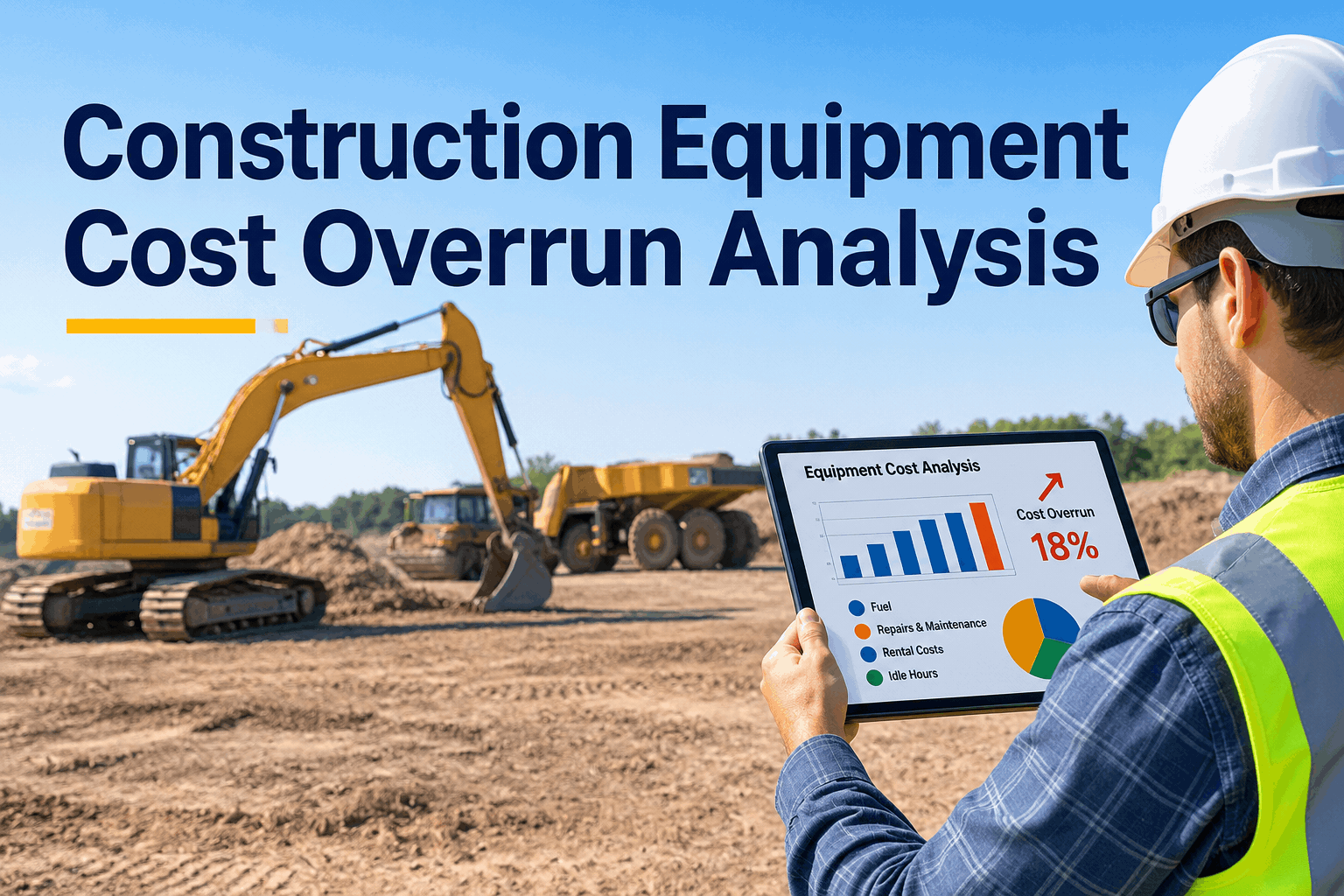
A construction equipment cost overrun happens when actual spending on machines exceeds the approved equipment budget for a project or reporting period. The problem is rarely one invoice: idle rentals, unexpected repairs, fuel variance and extended operating hours often combine. This guide explains how to isolate the variance, calculate its causes and turn equipment records into corrective actions.
Find the cost leak before it becomes the next budget overrun
Compare planned and actual costs by machine, cost category and project. Separate a genuine rate increase from excess hours, unexpected repairs or equipment standing idle.
Where construction equipment overruns actually begin
Start with the cost category and the operating decision that created the difference. A useful variance review does more than say the project spent too much.
Rental extensions
A rented excavator stays on site after its planned task finishes, or minimum billing periods exceed productive use.
Check off-rent dates and standby hoursUnplanned repairs
Repeated faults, urgent parts purchases and breakdown labor push maintenance above the allowance.
Check work orders and defect historyFuel and idling
Long idle periods, rework, haul-route changes or incorrect fuel assumptions increase cost per productive hour.
Check fuel use against operating hoursSchedule drift
Weather, access restrictions and sequencing changes extend machine presence beyond the planned duration.
Check revised schedule and deploymentCalculate equipment budget variance without hiding the cause
Use the same project period, cost categories and equipment scope in both columns. Separate committed but uninvoiced costs from amounts already paid.
| Cost category | Budget | Actual | Variance | What to investigate |
|---|---|---|---|---|
| Equipment rentals | $36,000 | $47,000 | +$11,000 | Extra weeks, idle rental days |
| Fuel | $28,000 | $34,000 | +$6,000 | Operating hours, price, idle time |
| Repairs and parts | $24,000 | $35,000 | +$11,000 | Repeat faults, emergency work |
| Ownership and other | $32,000 | $34,000 | +$2,000 | Allocation basis, fees |
| Total | $120,000 | $150,000 | +$30,000 | 25% above budget |
Illustrative example only. Costs, allocation methods and accounting treatment vary by contractor and project.
Separate price variance from usage variance
When a machine costs more than planned, ask whether its hourly rate increased, it worked more hours, or both. That distinction determines the corrective action.
Worked excavator example
At the planned rate, the extra 40 hours account for $4,800. The $10 hourly increase across 240 actual hours accounts for another $2,400.
Ask the right follow-up
- Extra hours: Did productivity fall, quantities increase or the project sequence change?
- Higher rate: Did rental pricing, repair allocation or fuel assumptions change?
- Equipment fit: Was the machine oversized, undersized or waiting on another trade?
- Evidence: Which daily logs, expenses and work orders support the explanation?
Follow the overrun from warning signal to corrective action
A practical review connects the variance to an owner, a decision and a verification date. Do not treat every red number as an instruction to cut maintenance.
Flag
Actual plus committed cost exceeds forecast.
Trace
Locate the machine, job and expense category.
Decide
Repair, redeploy, off-rent or revise the plan.
Verify
Check next-period spend and availability.
Understand which machines are driving maintenance and equipment costs
Explore how HVI supports fleet asset records, expense tracking, inspections and maintenance history so your team can investigate cost variances with better supporting data.
12-point equipment cost overrun analysis checklist
Use this during a weekly equipment cost review or before the monthly project forecast is finalized.
Validate the numbers
- Confirm approved equipment budget and revisions.
- Include committed rental and repair costs.
- Use consistent dates and machine IDs.
- Separate additional scope from original scope.
- Check fuel, labor, parts and rental coding.
- Reconcile actual and forecast operating hours.
Act on the variance
- Rank machines by absolute dollar variance.
- Review repeated repairs and open defects.
- Identify idle or underused rental equipment.
- Confirm equipment assignment and demand.
- Assign an owner and deadline to each action.
- Review whether next-period variance improves.
For a broader comparison of hourly equipment costs, combine this review with your construction fleet right-sizing approach and equipment resale timing decisions where those pages are published.
Build a repeatable weekly and monthly cost-control rhythm
Equipment costs change daily, but the management cadence should be predictable. Review exceptions often enough to make decisions before a rental period or project phase ends.
Capture the evidence
Record machine assignments, meter readings, inspection defects, downtime and major expenses. Confirm which machines are working versus waiting.
Review exceptions
Compare planned and actual hours, investigate unexpected repairs, and decide whether to redeploy or return equipment.
Refresh the forecast
Reconcile actual costs, committed charges and the remaining workload. Update expected cost at completion and communicate changes.
How HVI supports equipment cost variance investigations
HVI is a fleet and equipment management platform, not a replacement for your construction accounting or estimating system. It helps organize operational records that explain why equipment spending changes.
Expense tracking and cost analysis
Associate relevant equipment expenses with assets and review cost patterns over time. Align those records with your project budget outside HVI as needed.
Equipment asset management
Maintain consistent equipment identities and records so managers know which machine generated a cost or service event.
Inspections and maintenance history
Review inspection findings, service records and recurring problems when explaining repair-related cost increases.
Analytics and reporting
Use available fleet and maintenance reports to spot cost trends and prepare evidence for management reviews.
Want to see how these records fit your equipment cost-control process? Book a demo of HVI equipment expense tracking or sign up free to explore HVI.
Make the next equipment budget review more useful
Bring together equipment identities, expenses, inspections and maintenance history to support better decisions on repairs, utilization and future project planning.
Construction equipment cost overrun FAQs
What is a construction equipment cost overrun?
It is the amount by which actual equipment spending exceeds the approved budget for the same scope and period. It may include rental, fuel, repairs, labor, ownership charges and other properly allocated equipment expenses.
How do you calculate equipment cost variance?
Subtract the equipment budget from actual cost. Divide that difference by the budget and multiply by 100 for the percentage. A $150,000 actual cost against a $120,000 budget creates a $30,000 unfavorable variance, or 25%.
What causes unexpected heavy equipment cost overruns?
Common causes include rental extensions, unplanned repairs, excessive idle time, fuel consumption changes, incorrect cost assumptions, schedule delays and scope changes. Analyze each cause using asset-level records rather than assumptions.
How often should contractors review equipment costs?
Capture significant operational data daily, investigate major exceptions weekly and update the project forecast monthly. Higher-risk or rapidly changing projects may need more frequent reviews.
Can HVI replace construction project accounting software?
No. HVI supports fleet asset management, inspections, maintenance records and equipment expense visibility. Contractors should use their financial and project systems for approved budgets, general ledger accounting and formal project cost reporting.