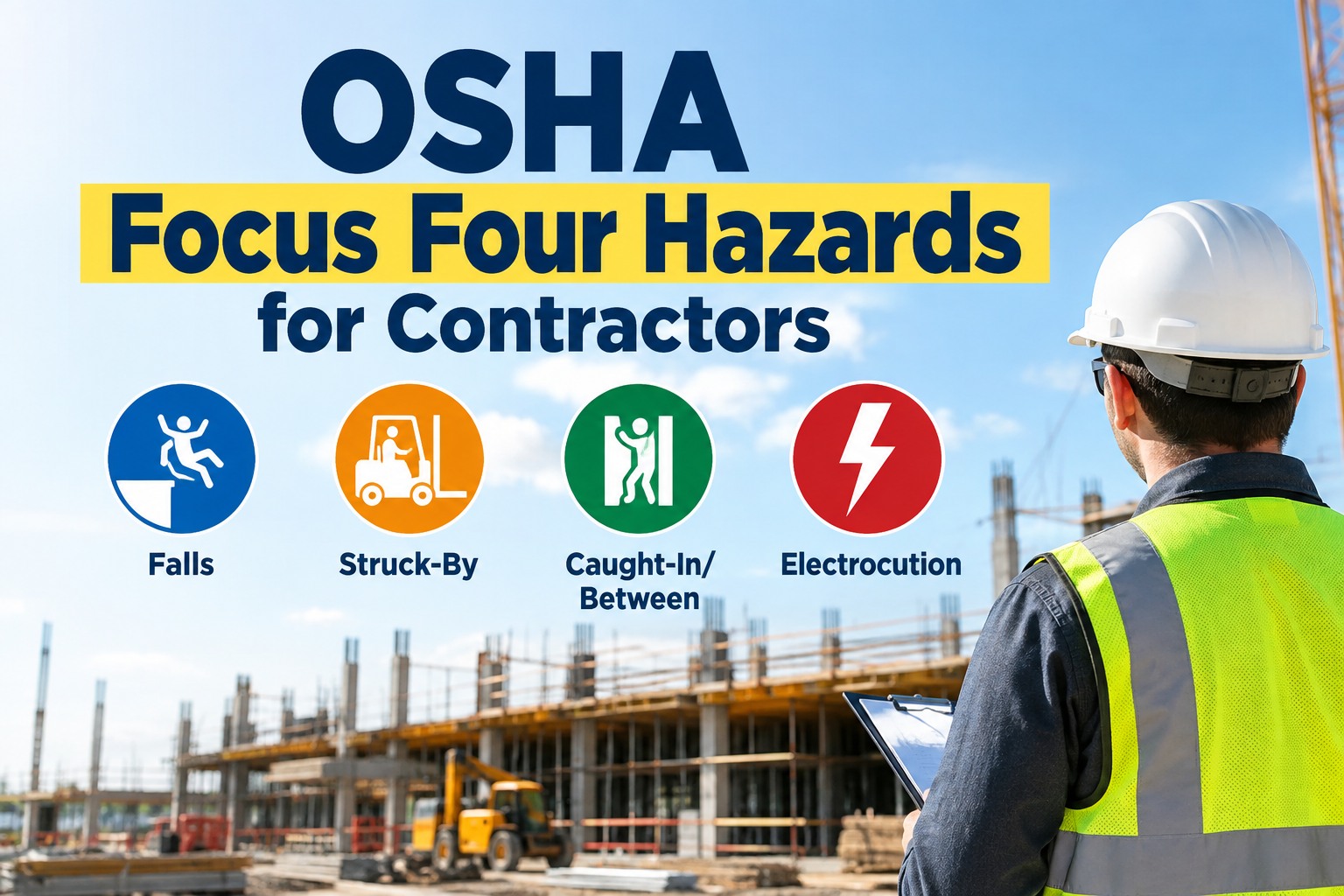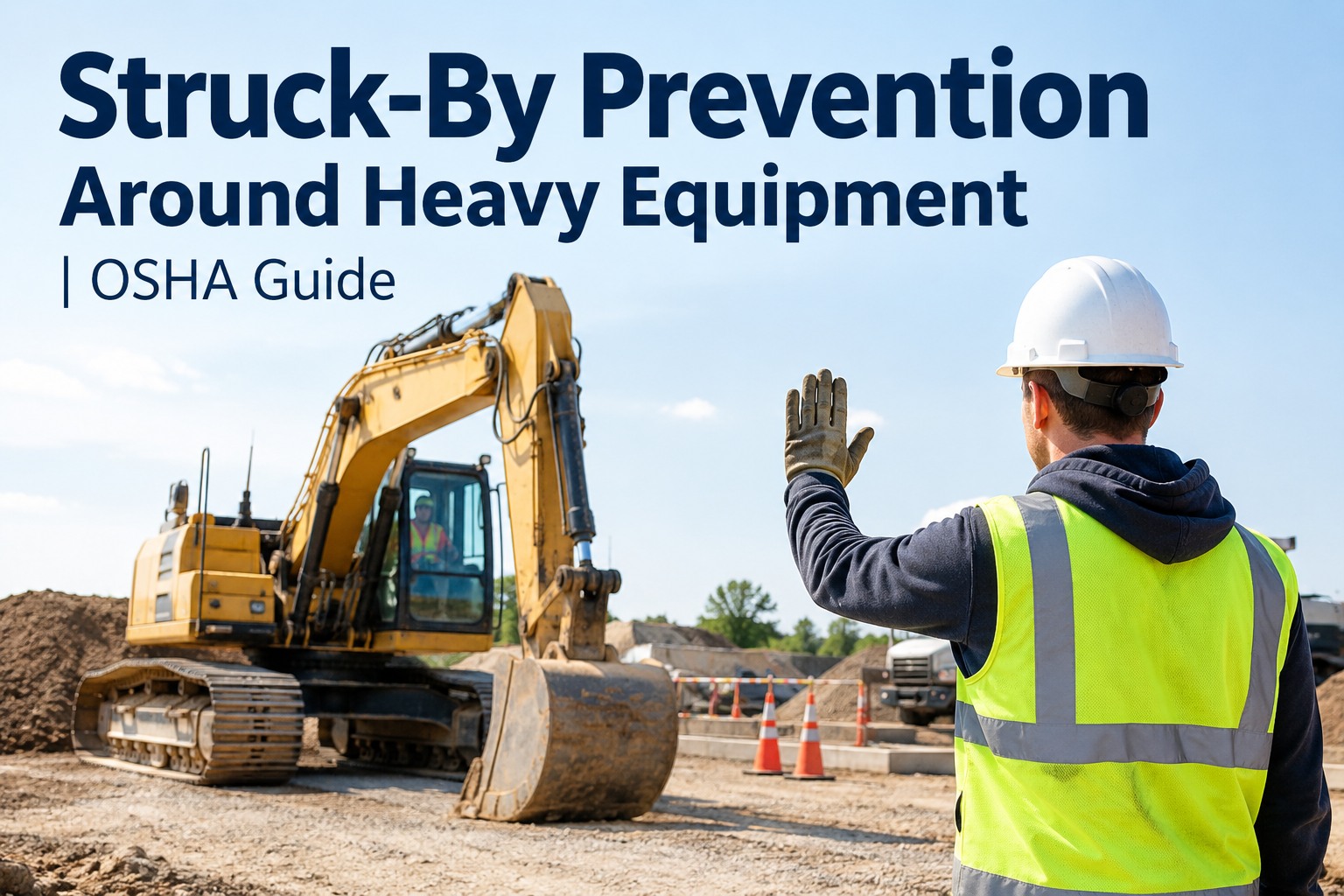
The worker who gets struck rarely sees it coming, and the operator almost never does — a person steps into the blind spot behind a backing dump truck, or into an excavator's swing, and has a second or two that isn't enough. Struck-by prevention around heavy equipment is about closing that gap before it opens, because struck-by is the second-deadliest hazard in construction and roughly three of four struck-by deaths involve a vehicle or machine. See how equipment and jobsite checks build an audit-ready record
Every Piece of Heavy Equipment Has a Zone Where You're Invisible
Behind it, around its swing, in its path — each is a place the operator may never see you. Tap a zone to see the hazard and the control.
Hazard: a backing truck or loader has an obstructed rear view, and a worker on foot behind it is invisible. Control: a working backup alarm and a spotter, minimized backing, and a firm no-walk-behind rule — never stand behind a backing machine.
Hazard: an excavator or crane counterweight sweeps its full radius fast — a worker in it can be struck or pinned against a wall. Control: barricade the swing radius, keep clear of it entirely, and mark the zone so no one enters on foot.
Hazard: a worker crossing or standing in an equipment travel route can be struck by a machine that can't stop in time. Control: separate routes for people and equipment, marked pedestrian-free zones, and eye contact with the operator before entering.
Struck-by isn't random bad luck — it happens in predictable places, for predictable reasons, and it's preventable with layered controls. Below is why workers end up in an equipment's path, the separation and spotter controls that keep them out, and the daily inspections that make sure the safeguards are actually working.
Why workers end up in the strike zone
Nobody steps behind a backing loader on purpose. Struck-by incidents around heavy equipment happen because of a handful of recurring failures — and understanding them is the first step to designing controls that actually hold.
Blind spots the operator can't clear
Every machine has areas the operator simply can't see — directly behind, low along the sides — and mirrors and cameras don't cover all of them.
Backup-alarm complacency
When alarms sound constantly across a site, workers tune them out — an alarm becomes background noise instead of a warning, which is why it can't be the only control.
Mixed foot and equipment traffic
When people on foot and moving machines share the same ground with no separation, it's only a matter of time before their paths cross at the wrong moment.
Assuming you've been seen
A worker assumes the operator knows they're there — but a hi-vis vest, mirrors, and cameras don't guarantee the operator has actually seen them.
The through-line in all four is a broken assumption: that the operator can see the worker, or the worker will hear the machine. Effective struck-by prevention removes the need for those assumptions entirely, by keeping people and equipment apart and confirming awareness directly. Start free and keep equipment and jobsite hazard checks in one place.
Separation and exclusion zones — the first line of defense
The most reliable struck-by control isn't a warning — it's distance. If a worker on foot can't get near a moving machine, they can't be struck by it. Designing the site to keep people and equipment apart does more than any single device.
Separate routes for people and equipment
Marked, physically separated paths for foot traffic and machines — internal traffic control — so the two rarely need to occupy the same ground.
Exclusion & swing-radius barricades
Barricade the swing radius of excavators and cranes and the areas beneath overhead work, with tape and hard barriers — and enforce them, not just mark them.
Pull-through staging to cut backing
Lay out delivery and staging areas so trucks pull through instead of reversing — the less backing on site, the fewer chances for a back-over.
Exclusion zones only work if they're respected, which means barriers that actually stop people, and a culture where crossing one is unacceptable rather than a shortcut. The goal is a site where being struck requires someone to breach a control, not just to be in the wrong place. Start free and track jobsite hazard checks against each work area.
Spotters, signals, and the eye-contact rule
Where people and equipment do have to work close, the control shifts to communication — and here there's one rule that matters more than any device on the machine. It's simple, and it saves lives: if you can't see the operator's face, the operator can't see you.
Make eye contact with the operator before entering any equipment work zone. Never assume the operator knows you're there — not because of a hi-vis vest, not because of mirrors or cameras. Confirm the operator has seen you and signaled it's safe, every time.
Around backing and tight work, a trained spotter is the backbone of that communication — and OSHA treats a spotter as an alternative to a backup alarm for equipment with an obstructed rear view, though the two together are stronger. A spotter only works if the operator and spotter have agreed their signals in advance, the spotter stays in view and out of the path, and the operator stops the moment they lose sight of the spotter. Book a demo to record spotter assignments and toolbox-talk sign-offs.
Visibility, alarms, and safe backing
The equipment-side controls are the layer that catches what separation and communication miss. None of them is sufficient alone — that's the whole point of layering — but each removes a way a worker stays invisible.
High-visibility apparel
Hi-vis clothing appropriate to the light and setting — typically ANSI Class 2 for construction, Class 3 near roadways — so workers are as visible as possible.
Working backup alarms & cameras
Reverse alarms audible above site noise, plus cameras and mirrors — verified working, not assumed, because a dead alarm gives false confidence.
Safe backing practices
Minimize reversing, use a spotter when backing, and enforce the rule that no one walks behind a backing machine — ever, even briefly.
The trap with equipment-side controls is treating any one of them as the answer. A backup alarm doesn't replace a spotter; hi-vis doesn't replace an exclusion zone. Struck-by prevention works because the layers overlap — when one fails, another still stands between the worker and the machine. Start free and verify safety devices on every pre-use inspection.
The inspections that keep the safeguards real
Every control above assumes the equipment's safety devices actually work — and that assumption is only safe if it's checked. A backup alarm that failed yesterday, a camera caked in mud, a horn that doesn't sound: each turns a safeguard into a false sense of security. The pre-use inspection is what catches them.
Pre-shift equipment check
Inspect brakes, tires, horn, steering, backup alarm, mirrors, cameras, and controls at the start of each shift — the safeguards struck-by prevention relies on.
Daily jobsite hazard walk
Check that exclusion zones, barricades, traffic routes, and staging are set up as planned before work — controls drift as the site changes.
Flag, fix, and record
A failed alarm or breached zone is corrected before equipment runs — and the check, the finding, and the fix are documented.
That documentation does double duty: it's how a superintendent knows the safeguards are genuinely in place, and it's how a contractor demonstrates diligence if OSHA asks. An inspection that isn't recorded is one you can't prove happened — and after a struck-by incident, the records are exactly what gets examined. A complete inspection trail is what shows the safeguards were verified, not assumed. Book a demo to see pre-use inspections and defects tracked per machine.
The struck-by prevention checklist
Run this before and during any work around heavy equipment on site. Use this struck-by prevention checklist online free, with each equipment and jobsite check recorded automatically.
Separate people and equipment routes
Marked pedestrian paths and equipment-only routes so foot traffic and machines rarely share ground.Barricade swing radius & exclusion zones
Hard barriers around excavator and crane swing and beneath overhead work — enforced, not just marked.Spotter and agreed signals for backing
A trained spotter and pre-agreed signals whenever backing or working close — and no walking behind a backing machine.Eye contact before entering a work zone
Confirm the operator has seen you and signaled safe — never assume hi-vis, mirrors, or cameras did it.Hi-vis apparel for the setting
ANSI Class 2 for general construction, Class 3 near roadways — matched to light and traffic conditions.Inspect safety devices each shift & record
Backup alarm, mirrors, cameras, horn, and brakes verified working before the shift, with the check documented.
From a site superintendent who redrew the traffic plan
We had a near-miss that still makes my stomach drop — a laborer walked behind a backing dump truck to grab a tool, and the driver stopped maybe six feet short because a spotter happened to be watching. No injury, but I saw exactly how a fatality happens, and it wasn't carelessness. It was a site where foot traffic and trucks were sharing the same lane and everybody had gotten used to the alarms.
We redrew the whole thing: separate pedestrian routes, pull-through staging so trucks barely back up, spotters mandatory for what backing was left, and a pre-shift check on every alarm and camera that gets logged. The eye-contact rule became non-negotiable. It changed how the site feels — and when I can pull up every equipment inspection and hazard check on demand, I sleep better and so does my safety record.
Frequently asked questions
What is a struck-by hazard in construction?
A struck-by hazard is one where a worker is injured by forcible contact with a moving object — most often a vehicle, piece of heavy equipment, or a swinging or falling load. It's one of OSHA's "Fatal Four" and the second-leading cause of construction fatalities. Around heavy equipment, the danger comes from backing machines, an excavator or crane swing radius, workers in a machine's travel path, and dropped loads. Roughly three of four struck-by fatalities involve heavy equipment or vehicles, which is why equipment-related prevention is such a priority.
What are the main controls for struck-by around heavy equipment?
They layer, because no single one is enough. The strongest is separation — keeping people and equipment on different routes with exclusion zones and swing-radius barricades so a worker on foot can't get near a moving machine. Next is communication: a trained spotter with agreed signals for backing or close work, and the rule to make eye contact with the operator before entering any work zone. Then equipment-side controls: hi-vis apparel, working backup alarms and cameras, and minimizing backing. And underneath it all, pre-use inspections that confirm the safety devices actually work.
Is a backup alarm enough to prevent back-overs?
No. OSHA allows a vehicle with an obstructed rear view to be backed either with a reverse alarm audible above surrounding noise or with a spotter who signals it's safe — but a backup alarm alone is the weaker option. On busy sites, alarms sound so often that workers tune them out, so the alarm stops functioning as a warning. A trained spotter is a far more reliable control when the rear view is obstructed, and many contractors require both. The safest approach is to minimize backing in the first place through site layout.
Why is eye contact with the operator so important?
Because it's the only way to confirm the operator actually knows you're there. A worker can assume they've been seen — hi-vis vest, mirrors, cameras — but none of that guarantees the operator has registered them, especially in a blind spot. The rule "if you can't see the operator's face, the operator can't see you" removes the assumption. Making eye contact and waiting for a safe signal before entering a work zone verifies awareness directly rather than trusting the equipment's safeguards did the job.
What inspections support struck-by prevention?
Pre-shift equipment inspections are central: brakes, tires, horn, steering, backup alarm, mirrors, cameras, and controls checked at the start of each shift, since these are the safeguards the whole strategy depends on. A daily jobsite hazard walk confirms exclusion zones, barricades, traffic routes, and staging are set up as planned before work, because conditions drift. Any failed device or breached zone is corrected before equipment runs, and each check, finding, and fix is documented — to confirm the safeguards are real and to demonstrate diligence if OSHA reviews the site.
Keep the safeguards that stop a struck-by verified and on record
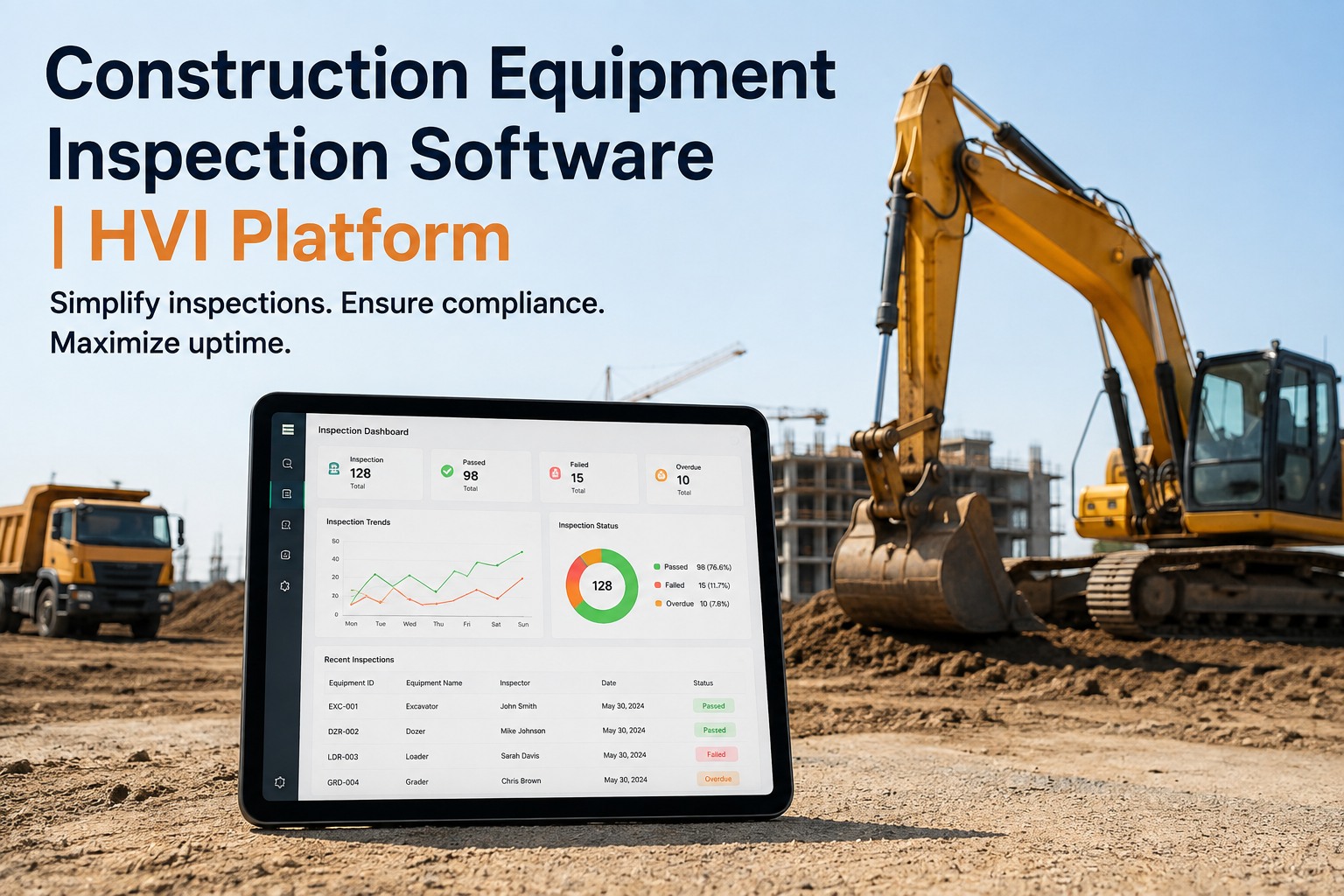
HVI captures the pre-use equipment inspection and daily jobsite hazard check — backup alarms, cameras, mirrors, exclusion-zone setup — against each machine and each day, retained and retrievable for an OSHA review. So the controls that keep workers out of the strike zone are verified working before the shift, defects are flagged, and the proof is there when it matters most.
No credit card · Pre-use inspections & hazard checks · Audit-ready records