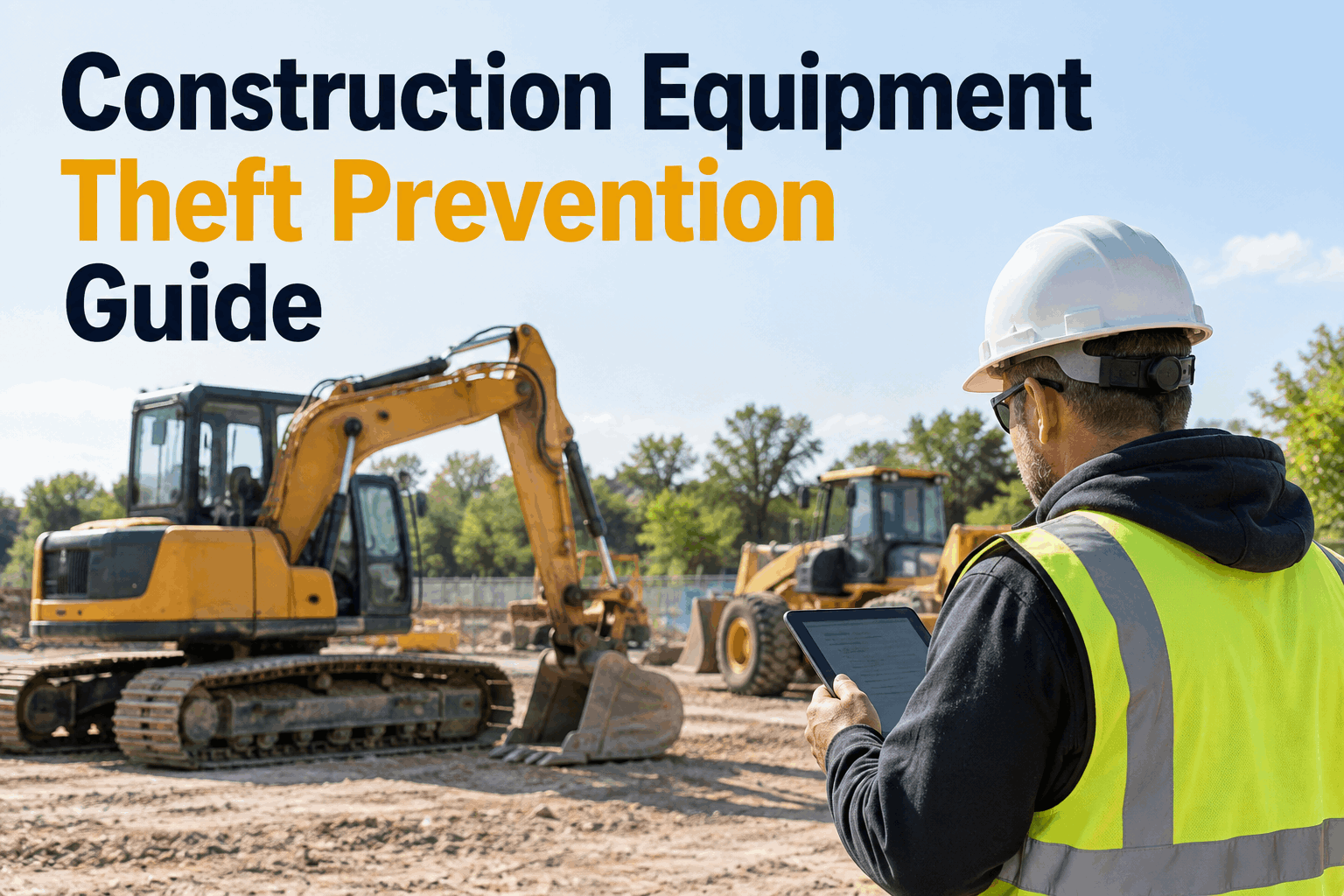
You pull into the yard Monday and the skid steer's gone — gate cut, no camera on a plate, and when the insurer asks for the serial number, nobody has it. That's equipment theft prevention in a nutshell: the machines are easy to move, slow to miss, and once gone, fewer than a quarter are ever recovered. The fix isn't one gadget — it's layers, and the one most fleets skip is the simplest: knowing what you own, where it is, and who's accountable. Book a demo to see where HVI fits.
You can't protect — or recover — what you can't account for.
Theft prevention is layers: identify, secure, control access, track, and account. HVI owns the layer most fleets skip — a complete asset register, assignment tracking and the ownership records that turn a police report and an insurance claim from guesswork into proof.
Heavy equipment is a thief's ideal target: a machine worth tens of thousands sits unattended in an open yard or a half-finished site, moves on a trailer in minutes, rarely has an alarm, and often isn't missed until the next shift needs it. Prevention works the way site safety does — not one control, but layers, so that defeating one still leaves others in the way. Most fleets invest in the visible layers (fences, cameras, trackers) and neglect the one that makes all of them pay off when it matters: knowing precisely what they own and who's responsible for it. Here's how the layers stack up, and where the gap usually is.
Why equipment theft is so hard to beatthe numbers behind the construction equipment theft problem
Before the strategies, the scale — because it explains why prevention has to be deliberate, and why recovery so rarely bails you out after the fact.
That last figure is the quiet one. Loaders, skid steers, backhoes and towable generators top the stolen list, and the makes thieves target most — Bobcat, John Deere, Caterpillar, Case — are exactly the machines sitting in your yard. The difference between a recovered machine and a write-off is almost always whether the owner could hand police and the insurer a serial number, a photo and proof of ownership on the spot. Book a demo to see your fleet's records ready before you need them →
The five layers of equipment theft preventiona defense-in-depth approach to jobsite equipment security
No single measure stops a determined thief. A layered strategy means each control backs up the others — and it makes clear which layers you buy as hardware and which you run as a system. HVI powers three of the five.
Identify & mark
Every asset logged with make, model, serial/PIN and photos, plus visible ID markings. The foundation for deterrence and recovery.
Secure storage
Fencing, lighting, locked compounds, wheel locks and immobilizers. The visible deterrent that makes a thief move on.
Control access
Key control and clear assignment — who has which machine, on which site, right now. Accountability stops the quiet walk-off.
Track
GPS/telematics for live location and geofence alerts. HVI doesn't replace a tracker — it integrates with one as the system of record.
Account & recover
Complete records to prove ownership, file the police report and back the insurance claim — the layer that pays off after a theft.
The physical and GPS layers are hardware you buy; the identify, access and account layers are a system you run — and that system is where HVI lives. It even ties the layers together, since HVI integrates with GPS/telematics so location data sits alongside the asset record. Start free and build the accountability layer first →
Why most stolen equipment is never recoveredthe records gap that turns a theft into a write-off
Recovery doesn't usually fail because police can't find the machine — it fails because the owner can't prove the machine is theirs. Without a serial number, a photo and ownership documentation ready to hand, a recovered loader can't be matched back to you, and the insurer can't settle fast. This is the gap HVI closes.
- No serial/PIN to give police or enter in a theft database
- No photos to identify the machine if it's found
- No proof of ownership for the insurance claim
- Slow, contested payout — often a full loss
- Serial/PIN on file, ready for police and NER-style databases
- Photos and spec on the asset record
- Ownership documents attached and exportable
- Fast claim, real chance of recovery and re-matching
This is HVI's lane — not a tracker or a fence, but the equipment records and assignment history that make every other layer worth having. The same register that proves ownership also tells you the instant a machine goes unaccounted for, because you know who signed it out and where it should be. Book a demo to see recovery-ready records on your fleet →
Asset accountability, tracked in HVIevery machine, its ID and who's accountable — in one register
Here's the payoff: one asset register with each machine's identity, assignment and ownership records — so construction asset management becomes real accountability instead of a spreadsheet nobody trusts.
The moment a machine isn't where its assignment says it should be, you see it — with the serial, photos and ownership docs already attached if it's gone for good. That register is the backbone of your construction fleet management, and it feeds the reporting and analytics you already run. Start free and register your fleet →
Jobsite equipment theft-prevention checklistthe accountability habits that deter theft and speed recovery
Here's a baseline theft-prevention routine, grouped by the layers HVI powers — each item a standing practice, not a one-time setup.
- Every asset logged with make, model, serial/PIN
- Current photos on each asset record
- Visible ID markings & hidden ID applied
- Ownership documents attached
- Each machine assigned to a site & operator
- Key control tied to the assignment
- End-of-day check-in / accounted status
- Unaccounted machines flagged fast
- Records exportable for police & insurer
- GPS/telematics linked to the asset record
- Theft reported with serial to a registry
- Claim filed with full documentation
On a spreadsheet this falls apart the week someone's out and a machine moves sites unlogged; in HVI the register is live, assignments are current, and the records are one export away when you need them most. It runs with the rest of your equipment management. Book a demo to load your fleet register →
From a construction equipment manager
We lost a skid steer off a site over a long weekend. The painful part wasn't the theft — it was realizing we didn't have the serial number written down anywhere. The insurer wanted proof it was ours and we spent two days digging through purchase paperwork while the trail went cold.
Now every machine is in one register with its PIN, photos and papers, and it's assigned to a site and a person. If something's not checked in, we know by the end of the day. We haven't beaten theft entirely, but we're no longer the easy, untraceable target — and a claim takes minutes to document, not days.
Equipment theft prevention — FAQs
What's the most effective way to prevent equipment theft?
Layers, not a single fix. Combine physical security (fencing, lighting, immobilizers), GPS tracking, and — the layer most fleets skip — identification and accountability: a complete asset register with serial/PIN and photos, clear assignment of who has each machine, and recovery-ready ownership records. The layers reinforce each other; the records layer is what makes recovery and insurance work after the fact.
Is HVI a GPS tracker for equipment?
No. HVI isn't a GPS tracker or a physical security device — it's the asset-management system of record that complements them. It holds each machine's identity, assignment and ownership documentation, and it integrates with GPS/telematics so location data sits alongside the asset record. The tracker tells you where a machine is; HVI proves it's yours and tells you who was accountable for it.
Why is stolen construction equipment so rarely recovered?
Under 25% of stolen construction equipment is recovered, largely because owners can't quickly produce the serial/PIN, photos and proof of ownership that let police and insurers act. Older machines may lack a standard PIN, and once identifiers are removed, tracing is nearly impossible. Keeping identity records on file before a theft is the single biggest factor in recovery.
How does asset assignment tracking deter theft?
When every machine is assigned to a site and a person and checked in at end of day, a machine going missing is noticed in hours, not at the next shift — and accountability itself discourages the quiet internal walk-off. Fast detection narrows the window a thief has to move and sell equipment, which is often the difference between a recovery and a write-off.
What records do I need to recover stolen equipment and file a claim?
At minimum: the make, model and serial/PIN; current photos; and proof of ownership. You'll want them exportable to hand to police, enter in a theft registry, and submit to your insurer. HVI keeps all of it on each asset's record so a claim is documented in minutes and a recovered machine can be matched back to you.
Stop being the easy, untraceable target
HVI gives equipment theft prevention its missing layer — a complete asset register with serial, PIN, photos and ownership docs, live assignment tracking so nothing walks off unnoticed, and records that turn a theft into a claim you win. Pairs with your fences, cameras and GPS. Live on your fleet in under two weeks.
See it on your own fleet · Integrates with GPS/telematics · Records ready from day one