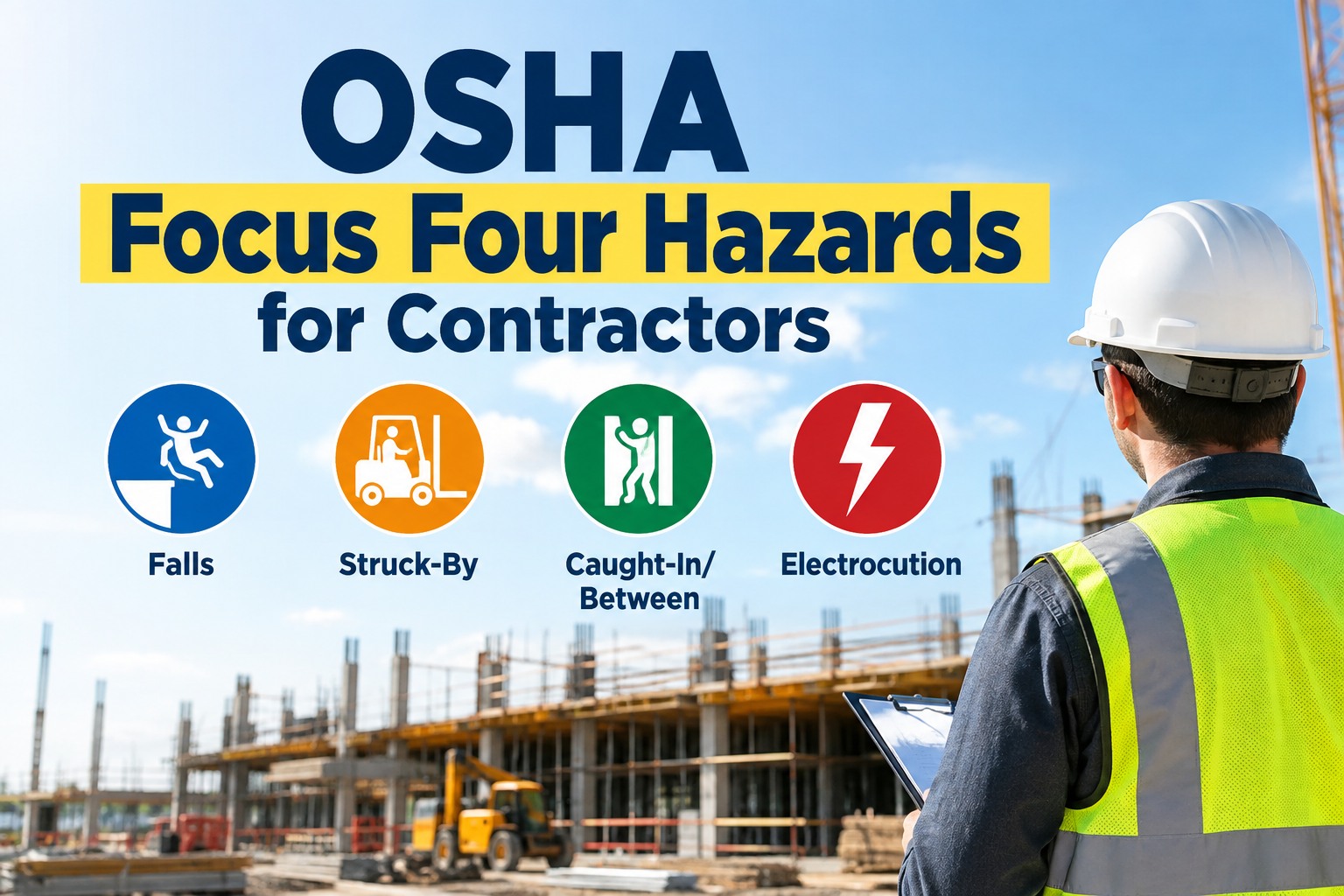
Four hazards cause most of the deaths in construction — not dozens, four. OSHA's Focus Four — falls, struck-by, caught-in/between, and electrocution — account for roughly six in ten construction fatalities, which means a safety program that genuinely controls these four is doing most of the life-saving work available to it. The point of naming them isn't awareness for its own sake; it's to aim your inspections, training, and controls where the fatalities actually happen. See how a Focus Four program stays inspected and documented
Four Hazards Cause Most Construction Deaths. Here's Where to Aim.
Each bar is that hazard's share of construction fatalities. Tap one to see what it is and the control that matters most.
The hazard: unprotected sides, edges, holes, and work on ladders, roofs, and scaffolds. The core control: fall protection is required at 6 feet in construction — guardrails, safety nets, or personal fall arrest, plus covered holes and trained workers.
The hazard: falling or swinging objects and, most often, moving vehicles and heavy equipment. The core control: exclusion zones, spotters, high-visibility apparel, and keeping workers out of equipment paths and swing radii.
The hazard: trench and excavation collapse, unguarded moving machine parts, and being pinned between equipment and a fixed object. The core control: protective systems in excavations, machine guarding, and lockout/tagout during servicing.
The hazard: contact with overhead or underground power lines, exposed wiring, wet conditions, and poorly maintained tools and cords. The core control: maintain clearance from power lines, ground or double-insulate equipment, use GFCIs, and follow OSHA electrical standards.
OSHA named the Focus Four in 1994 after decades of fatality data pointed at the same four causes year after year. They're not equally common, and they don't share the same fixes — so a real program treats each on its own terms. Below is each hazard and its core controls, then how to pull them into one inspected, documented contractor program.
Falls — the hazard to fix first
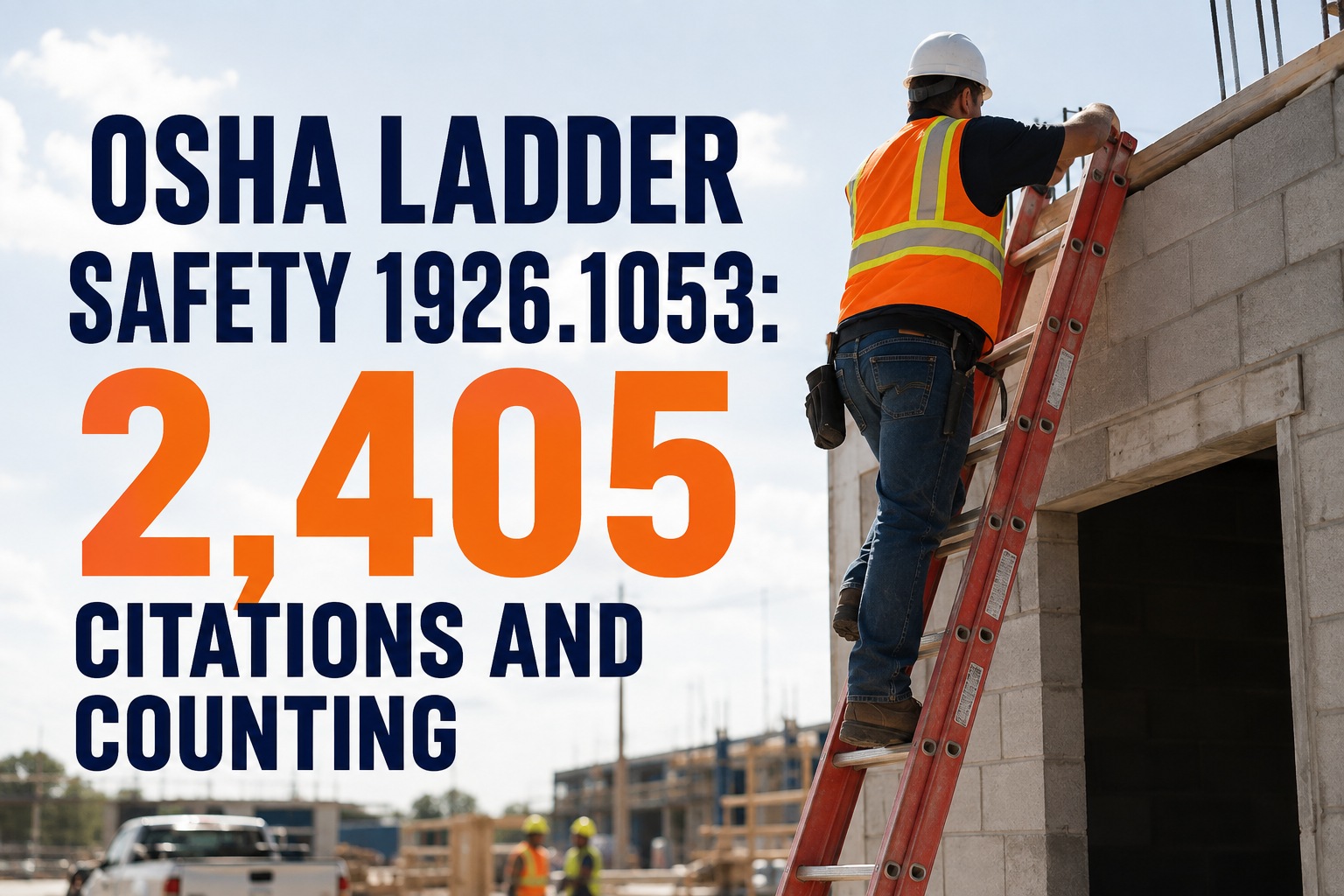
Falls are the leading cause of death in construction by a wide margin, accounting for roughly a third of all fatalities year after year. They're also among the most preventable, which is why they're where a Focus Four program earns the most ground fastest. The rule that anchors it: fall protection is required whenever a construction worker is six feet or more above a lower level.
Protect edges & holes
Guardrails on unprotected sides and edges, and covers over holes — the openings where most falls originate.
Ladders & scaffolds
Correct selection, setup, and use of ladders and scaffolds, inspected before use — a leading source of fall injuries.
Fall arrest at 6 feet
Guardrails, safety nets, or a personal fall arrest system whenever a worker is six feet or more up — and workers trained to use them.
Because falls are so dominant in the fatality data, a program that inspects for edge protection, checks ladders and scaffolds before use, and verifies fall-arrest equipment is doing the single highest-value safety work on the site. Everything else in the Focus Four builds on getting this one right. Book a demo to see fall-protection checks logged per jobsite.
Struck-by — mostly about equipment
Struck-by is the second-deadliest of the four, and the large majority of struck-by fatalities involve vehicles and heavy equipment — a backing truck, an excavator swing, a moving loader. The rest come from falling and swinging objects: dropped tools, failed rigging, shifting materials.
The controls center on separation and awareness: exclusion zones and separate routes for people and equipment, spotters and the rule to make eye contact with the operator before entering a work zone, high-visibility apparel, and working backup alarms. Because equipment struck-by is such a large, specific problem, it's worth treating in depth — see our full guide to struck-by prevention around heavy equipment.
For the Focus Four program overall, the takeaway is that struck-by prevention leans heavily on site layout and the daily verification that safety devices — alarms, cameras, mirrors — actually work. Start free and verify equipment safety devices each shift.
Caught-in / between — trenches and machinery
Caught-in and caught-between incidents are less common than falls but among the deadliest when they happen, because there's rarely a second chance. They cluster around two situations: excavations that collapse, and machinery that catches a worker.
Trench & excavation protection
Protective systems — sloping, shoring, or shielding — in excavations, with spoil kept back from the edge and a competent person inspecting.
Machine guarding
Guards kept in place on moving parts, so workers can't be drawn into rotating or reciprocating machinery during operation.
Lockout / tagout
Energy isolated and locked out before servicing equipment, so a machine can't start up on a worker doing maintenance.
The common thread is stored or unexpected energy — a wall of soil, a spring-loaded part, a machine that restarts. The controls put a barrier between the worker and that energy: a protective system, a guard, a lock. Inspecting that those barriers are in place before work is the front line. Book a demo to see excavation and equipment checks documented.
Electrocution — the invisible hazard
Electrocution rounds out the Focus Four, and what makes it dangerous is that the hazard is often invisible until contact. A power line looks the same energized or not; a frayed cord gives no warning. The controls are about maintaining distance and integrity.
Keep clear of power lines
Maintain safe clearance from overhead and underground power lines — identify them before work, and treat every line as energized.
Ground or double-insulate, use GFCIs
Ground or double-insulate equipment, protect circuits with ground-fault protection, and keep electrical work dry.
Inspect tools & cords
Remove damaged cords and poorly maintained tools from service — a frayed cord or defective tool is a lethal hazard that a pre-use check catches.
Electrocution controls reward diligence over drama: a utility locate before digging, a clearance check before a crane lift, a cord inspection before a tool is plugged in. None is complicated — but each has to actually happen, every time, which again makes it an inspection-and-habit problem. Book a demo to add tool and cord checks to your pre-use inspections.
Building a Focus Four contractor program
Knowing the four hazards is the easy part; running a program that controls them across a live jobsite, every day, is the work. Four elements turn Focus Four awareness into a program that actually reduces fatalities — and each produces the records that prove it.
Hazard recognition & pre-task planning
Identify which of the four hazards each task exposes workers to, before work starts, and plan the controls — the competent-person habit that prevents most incidents.
Training & toolbox talks
Ongoing Focus Four training and short, regular toolbox talks keep the hazards front of mind — not just at onboarding, but throughout a worker's time on site.
Daily inspections
Jobsite hazard inspections and pre-use equipment checks that verify the controls for all four hazards are actually in place as conditions change through the day.
Incident & near-miss reporting
A system to capture incidents and near-misses so recurring hazard patterns surface and get fixed before the next one becomes a fatality.
What ties these together is documentation. Each inspection, toolbox talk, and report is both a safety action and a record — and after an incident, or during an OSHA visit, those records are what demonstrate the program was real. A Focus Four program that isn't documented can't be shown to have existed, which is why the recording isn't overhead; it's part of the control. Book a demo to see the whole Focus Four program tracked in one place.
The Focus Four program checklist
Use this to confirm your program covers all four hazards with real controls and records, not just a training slide. Use this Focus Four checklist online free, with each inspection, talk, and report tracked per site automatically.
Fall protection at 6 feet
Guardrails, nets, or fall arrest wherever workers are six feet up, plus protected edges and covered holes.Struck-by separation & devices
Exclusion zones, spotters, hi-vis, and verified backup alarms around vehicles and equipment.Excavation, guarding & lockout/tagout
Protective systems in trenches, machine guards in place, and energy isolated before servicing.Electrical clearance & tool checks
Clearance from power lines, grounding and GFCIs, and damaged cords and tools removed from service.Training, toolbox talks & planning
Ongoing Focus Four training, regular toolbox talks, and pre-task hazard planning for each crew.Inspect, report & document
Daily hazard inspections, near-miss and incident reporting, and every check and talk recorded.
From an EHS manager who focused the program
We used to spread our safety attention evenly across a hundred things, and our incident numbers weren't moving. When we reframed the whole program around the Focus Four — put the most inspection time on falls, tightened up equipment separation, got serious about trench protection and cord checks — the numbers finally started dropping. We were aiming at where people actually get hurt.
The other half was making it provable. Every fall-protection check, toolbox talk, and near-miss now gets logged, so I can see across every site whether the controls are really in place, and I can hand an OSHA inspector a complete record instead of promises. Focusing on four hazards made the program simpler and the documentation stronger at the same time.
Frequently asked questions
What are the OSHA Focus Four hazards?
The OSHA Focus Four — also called the Fatal Four — are the four leading causes of construction worker deaths: falls, struck-by, caught-in/between, and electrocution. OSHA identified them through decades of fatality data and launched the Focus Four initiative in 1994 to concentrate prevention where the deaths actually happen. Together they account for roughly 60% of all construction fatalities, so a program that genuinely controls them addresses most of the fatal risk on a jobsite. Each hazard has its own controls, so they're managed individually rather than as one problem.
Which Focus Four hazard causes the most deaths?
Falls are the leading cause of death in construction by a wide margin, accounting for roughly a third of all construction fatalities year after year — more than the other three Focus Four hazards. Struck-by is second, driven largely by vehicles and heavy equipment, followed by electrocution and then caught-in/between. Because falls dominate the fatality data and are highly preventable, they're where a Focus Four program usually delivers the most life-saving impact fastest, anchored by the rule that fall protection is required whenever a worker is six feet or more above a lower level.
Why did OSHA create the Focus Four initiative?
OSHA launched the Focus Four initiative in 1994 because Bureau of Labor Statistics fatality data consistently showed the same four hazard categories were responsible for the majority of construction deaths, year after year. Rather than treat every possible hazard equally, the initiative concentrates awareness, training, and prevention on the four that cause the most fatalities, on the logic that eliminating them would save the most lives. Every OSHA 10-hour and 30-hour construction course dedicates significant time to these hazards, and they remain the backbone of construction safety training and program design.
How do you build a Focus Four safety program?
A Focus Four program has four working parts. First, hazard recognition and pre-task planning to identify which hazards each task exposes workers to before work begins. Second, ongoing training and regular toolbox talks that keep the four hazards front of mind throughout a worker's time on site. Third, daily jobsite inspections and pre-use equipment checks that verify the controls are actually in place. And fourth, incident and near-miss reporting so recurring patterns surface and get fixed. Each element also produces documentation, which demonstrates the program was real if OSHA reviews the site.
Why does documenting a Focus Four program matter?
Because the controls only count if you can show they were in place. After an incident or during an OSHA visit, inspections, toolbox talks, training records, and incident reports are the evidence the program existed and was followed — a program that isn't documented can't be shown to have happened. Documentation also helps day to day: recorded inspections let a manager see across every site whether fall protection, equipment separation, trench protection, and electrical controls are genuinely in place, and near-miss records reveal recurring patterns before they become the next fatality.
Aim your safety program where the fatalities are — and prove it
HVI keeps a Focus Four program inspected and documented — jobsite hazard inspections, pre-use equipment checks, toolbox-talk and training completion, and incident reporting — tracked per site and retained for an OSHA review. So the controls for falls, struck-by, caught-in/between, and electrocution are verified in the field every day, and the record that proves it is a search away.
No credit card · Jobsite & equipment inspections · Audit-ready Focus Four records