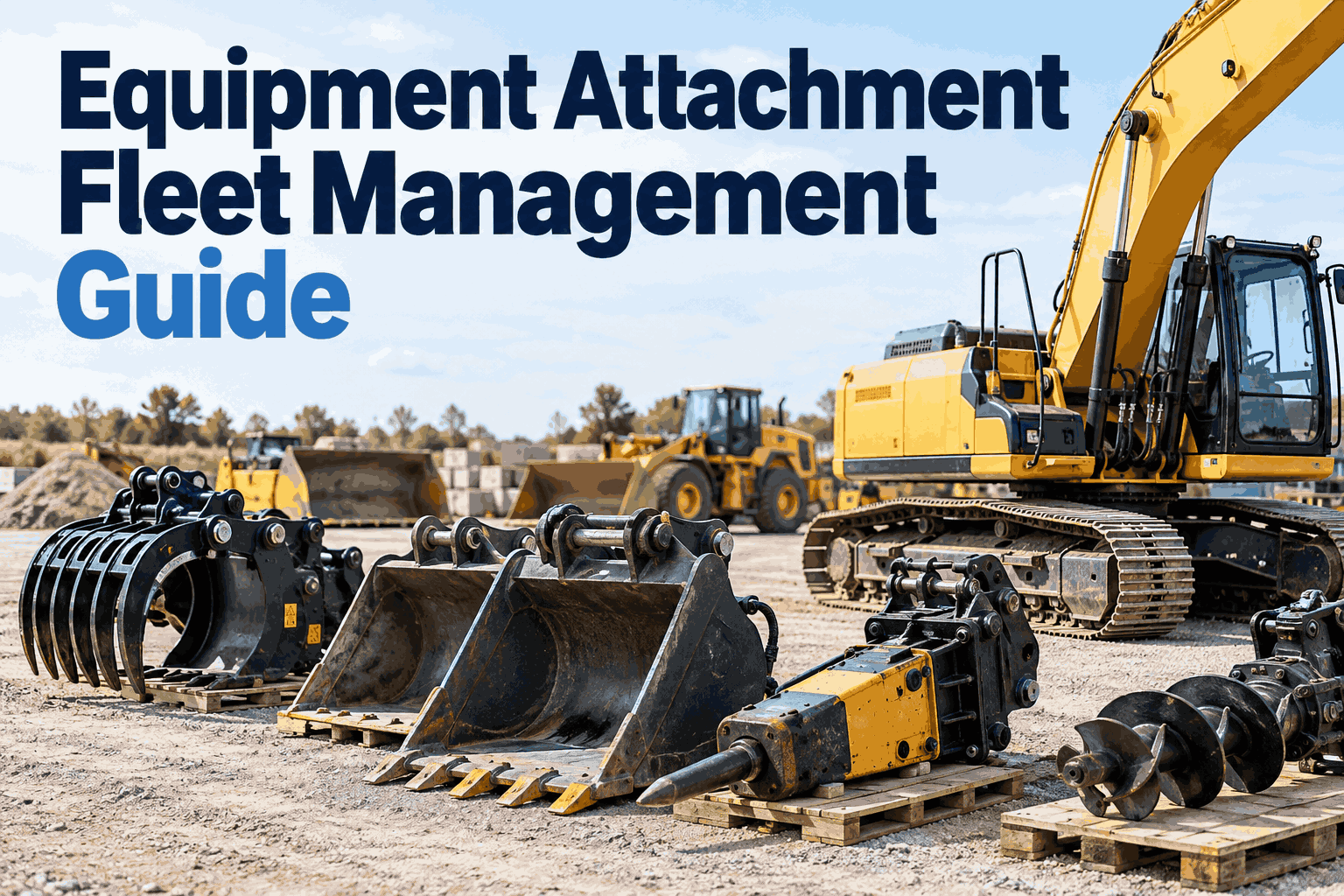
Hydraulic breakers, buckets, grapples and augers can move between machines and jobsites faster than the paperwork that follows them. Good attachment fleet management gives each attachment its own identity, location, inspection history and maintenance record—so your team knows what is available, what fits and what needs attention. Book a demo to see how HVI can organize attachments across your jobsites.
The Machine Is Easy to Find.
What About Its Attachment?
Treat hydraulic attachments as individual fleet assets instead of accessories that disappear between machines, yards and projects.
Why attachment fleet management needs its own system
A contractor may know exactly where every excavator is while still spending half an hour trying to locate the breaker that should be attached to it.
Attachments behave differently from the machines that power them. They move frequently, may sit unassigned for days, can be shared across compatible carriers and often have wear items or hydraulic components that need attention on their own schedule. If the attachment only exists as a note against an excavator, its history becomes fragmented every time it moves.
It leaves the machine
A breaker moves from one excavator to another or returns to the yard after a project.
The record stays behind
Inspection notes and repair history remain associated with an old machine, spreadsheet or paper form.
The next crew starts guessing
Location, condition, compatibility and previous repairs have to be reconstructed before work starts.
Give it an ID, current assignment, compatible-machine information, inspection record, service history and status that stay with the attachment—not whichever machine happened to use it last.
What should follow an attachment from site to site?
The useful record is not just “where is it?” It connects identity, assignment, condition and maintenance so the next decision does not begin with a phone call.
If your crews are still calling the yard to ask which site has a breaker or grapple, start free and build a searchable attachment register in HVI.
Track the movement, not just the inventory count
Knowing that you own six hydraulic breakers is only the beginning. A construction fleet needs to know which ones are available, where each unit is located, which machine has it and whether it is actually ready for the next job.
Inspection completed before dispatch.
Current machine and project become visible.
Defect follows the attachment into repair.
This assignment history matters when several crews share the same attachment pool. Instead of treating a transfer as an informal handoff, record it against the asset. The next supervisor can see the attachment's last assignment and status without searching messages or asking three different people.
HVI's asset-management workflow supports multi-site tracking and asset transfers with assignment history. That makes the same asset record useful whether the attachment is in the yard, on a machine or waiting for maintenance. Book a demo to see how a multi-jobsite attachment register could work for your fleet.
“Where is it?” is only useful if you also know “will it fit?”
Attachment compatibility should be verified against manufacturer requirements and the specific carrier configuration—not assumed because two machines look similar.
A compatibility record is a decision aid, not a replacement for the attachment or machine manufacturer's instructions. Record the information your operation needs to verify the pairing—such as approved carrier, coupler or interface information and applicable hydraulic requirements—and have the responsible person confirm the setup before use.
Attachment maintenance starts before the attachment reaches the machine
A pre-use attachment inspection should match the attachment type and the manufacturer's requirements. A bucket does not need the same checks as a hydraulic breaker, grapple or auger. The goal is to catch visible wear, damage, leaks or connection problems before the attachment enters production.
Hydraulic connections
Check hoses, fittings, couplings and visible leakage according to the attachment's inspection procedure.
Wear components
Inspect the attachment-specific wear points, tools, edges, teeth, pins or bushings where applicable.
Structure & mounting
Look for visible damage and verify mounting or coupling points using the applicable manufacturer procedure.
Condition record
Record the result against the attachment itself, adding photos or defect details when something needs attention.
The record is what turns inspection into attachment fleet management. When a defect is tied to the attachment ID, the maintenance team can see which asset needs attention even after it is disconnected from the carrier. HVI's digital inspection workflow can capture inspection findings and connect maintenance activity to the asset record.
Build attachment maintenance history that survives every reassignment
An attachment can work on several carriers during its life. That makes machine-only maintenance records incomplete: the attachment's wear does not reset when it is disconnected from one excavator and installed on another.
Inspection is recorded against the attachment ID before use.
Photos and notes give the shop context before the attachment arrives.
Repair activity becomes part of the attachment's permanent service history.
The next crew can see previous work instead of inheriting an unknown asset.
Preventive maintenance intervals should follow the applicable OEM guidance, attachment type, operating conditions and your own maintenance policy. The software's role is to make those requirements repeatable: schedule the activity, show what is due and preserve the completed service record. See how HVI can connect attachment inspections and preventive maintenance in a live demo.
The attachment register can also expose what you are not using
Poor visibility creates two opposite problems. A crew may rent an attachment because nobody knows an owned unit is sitting at another site, while another attachment may remain unused for months without anyone questioning whether the fleet still needs it.
Assignment and movement records give managers better evidence for those conversations. They help show which attachments are regularly deployed, which remain idle and where sharing between projects may be possible.
Assignment history is not automatically the same as precise operating-hour utilization. If exact attachment hours or cycles matter, capture them from a suitable meter, telematics source or operating process rather than assuming that “assigned” means “working.”
What to record for each construction attachment
Asset ID, serial number, manufacturer, model and attachment category.
Yard, project, site or other operational location.
Which carrier currently has the attachment and its assignment history.
The information your team uses to verify approved machine-and-attachment pairings.
Pre-use checks, condition notes, photos and identified defects.
Scheduled service, repairs, parts and completed maintenance records.
One attachment record from inspection to repair
HVI connects the operational record instead of leaving location, inspection and maintenance in separate files.
Create the attachment as an identifiable fleet asset.
Record its location and current machine or project.
Capture condition and defects against the attachment.
Schedule service and document completed repairs.
Move it again without losing its previous history.
Want to see this workflow with your own attachment types? Book an HVI walkthrough for your construction fleet.
Attachment Fleet Management FAQs
What is attachment fleet management?
Attachment fleet management is the process of managing construction attachments as identifiable assets rather than loose accessories. It can include asset identification, location and assignment tracking, machine compatibility information, inspections, defects, preventive maintenance, repairs and service history. The goal is to preserve visibility as attachments move between machines, yards and jobsites.
Which construction attachments should be tracked individually?
Contractors can individually track valuable, frequently moved or maintenance-sensitive attachments such as hydraulic breakers, grapples, augers, compactors, shears, couplers, specialized buckets and other shared equipment. The appropriate level of tracking depends on the attachment's value, risk, maintenance needs and how often it moves through the fleet.
How should contractors track attachment compatibility?
Keep the relevant compatibility information with the attachment record and verify each pairing against the machine and attachment manufacturers' requirements. Depending on the equipment, that may include approved carrier information, mounting or coupler configuration and applicable hydraulic requirements. A fleet record helps crews find the information, but it should not replace manufacturer instructions or a proper compatibility check.
Can attachment tracking help reduce unnecessary rentals?
Better location and availability visibility can help managers check whether a suitable owned attachment is already available elsewhere before arranging another rental. Assignment history can also highlight attachments that appear to spend long periods unused. Actual rental decisions should still consider transport cost, project timing, compatibility and operational requirements.
How can HVI support equipment attachment management?
HVI can keep attachment information within the same operational environment used for fleet assets, inspections and maintenance. Teams can maintain identifiable asset records, track locations and assignments, document inspections and defects, organize preventive maintenance and preserve service history so information remains available when an attachment moves between machines or sites.
Know what you have, where it is and whether it is ready for the next job.
HVI brings attachment records, locations, inspections and maintenance into the same workflow as the rest of your construction fleet—so the history stays with the asset even when the attachment moves.