A five-gallon can of gasoline sitting next to the site trailer looks harmless right up until someone asks whether it's actually an approved safety can or just whatever container was closest at the last supply run. Jobsite fuel storage rules aren't complicated in principle, but they change hard at specific quantity thresholds — and most violations trace back to nobody realizing which threshold they'd already crossed. Book a Demo
The container rule changes at three specific quantities
Switch below. How you're allowed to store flammable liquids depends almost entirely on how much of it you're storing.
For one gallon or less, OSHA's flammable liquids standard permits storage, use, and handling in the original shipping container. No safety can is required at this quantity — the threshold that triggers a special container comes above one gallon.
For quantities up to 5 gallons, an approved safety can or DOT-approved container is required. A safety can is specifically defined as a closed container of 5 gallons or less with a flash-arresting screen, a spring-closing lid and spout cover, and a design that safely relieves internal pressure if exposed to fire. Highly viscid liquids that are extremely hard to pour are exempt and may stay in their original shipping containers regardless.
More than 25 gallons stored in a room requires an approved flammable storage cabinet — either a fire-rated wooden cabinet built to specific plywood-thickness and construction standards, or an approved metal cabinet, labeled in conspicuous lettering: "Flammable – Keep Fire Away." Quantities beyond an approved indoor storage room's limits move to outdoor storage requirements entirely.
Most jobsite fuel storage findings happen because a quantity crept past one of these three thresholds without anyone updating the container or cabinet to match. Start Free Trial
Jobsite fuel storage rules exist because a site's fuel inventory rarely stays constant — a few cans for small equipment turn into a job-box's worth by mid-project, and a single 5-gallon container becomes six sitting together in the same spot. The rule doesn't care how the quantity got there; it cares what's actually being stored, right now, in what.
Jobsite Fuel Storage Rules Under OSHA 1926.152the general rules that apply regardless of quantity
Beyond the container-size thresholds, 29 CFR 1926.152 sets baseline rules that apply to flammable liquid storage on every construction site, at every quantity.
- Only approved containers and portable tanks may be used for storage and handling — a container that "should be fine" isn't the same as one that's actually approved
- Flammable liquids can't be stored in areas used for exits, stairways, or normal passage — a fuel can staged next to a doorway is a violation regardless of its size
- Transferring flammable liquid from one container to another requires the containers to be electrically bonded, to prevent a static discharge from igniting vapors during the pour
- Outdoor storage above indoor-room quantity limits shifts to a separate set of requirements, including spill containment such as a curb or earth dike around the storage area
This is federal U.S. baseline; construction sites in Canada, the UK, and Australia operate under their own equivalent flammable-liquids frameworks, so confirm the governing standard for your jurisdiction rather than assuming these specific numbers transfer directly. Book a Demo
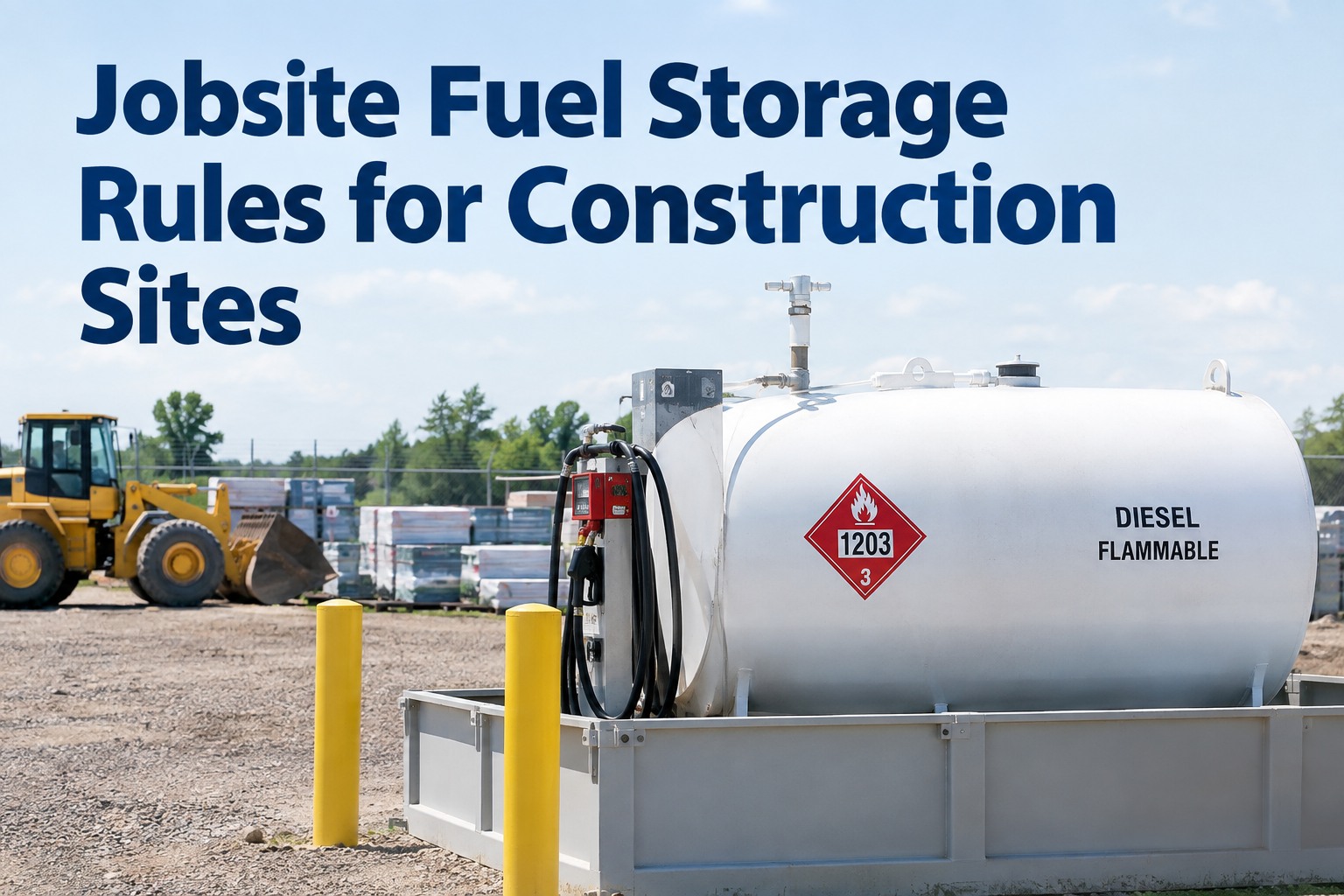
Jobsite Fuel Storage Rules for Bulk Tanks and Fuel Trailersa 500-gallon tank isn't a bigger version of a 5-gallon can
Once a site moves from cans to a bulk tank or a fuel trailer, the inspection points change entirely — leak detection, containment integrity, and grounding become the focus instead of container approval and cabinet labeling. A commonly used inspection cadence for bulk fuel storage looks like this.
Visible leak check around the tank, valves, and dispensing point — the fastest check, and the one most likely to catch a developing problem early.
Leak detector function, hose and fitting condition, spill containment clear of debris, and gauge and meter operation.
Tank body inspected for cracking or corrosion, water accumulation in the tank bottom, electronic leak detection function, and signage legibility.
Structural soundness of the tank and its supports, grounding wire attachment, dispenser filter condition, and fuel quality checked for microbial growth or contamination.
A bulk tank that passes every daily glance can still fail on a grounding connection nobody's checked since installation — which is exactly the kind of gap a layered inspection schedule is built to catch. Start Free Trial
Refueling a Tool Isn't the Same Rule as Transferring Fuela nuance that trips up more sites than the storage rules themselves
Bonding requirements apply to container-to-container transfer, not end-use refueling
OSHA has directly clarified this distinction in a published standard interpretation: the electrical bonding requirement under 1926.152 applies specifically to transferring flammable liquid from one storage container to another storage container — not to dispensing fuel from an approved safety can directly into the tank of a tool like a generator, saw, or trimmer for immediate use. Refueling at the point of final use is governed by a separate set of provisions in the standard.
That distinction doesn't relax the container requirement itself — a safety can is still required for handling flammable liquid in quantities of 5 gallons or less — it just means the bonding step applies to a different action than most crews assume.
Getting this nuance backwards in either direction — skipping the safety can, or over-applying a bonding requirement that doesn't govern refueling — is a common, avoidable source of confusion on active sites. See how HVI tracks fuel intake and storage together as part of one fuel record instead of two separate processes.
From a safety manager who stopped guessing at on-site quantities
We had six separate 5-gallon cans staged around one site that nobody had counted together as a single total. Individually each one looked fine — a safety can, sitting away from the trailer entrance. Together, they'd quietly crossed into territory that needed a real storage cabinet, and nobody had noticed because nobody was adding them up.
Now every can gets logged when it comes on site, so the running total is a number, not an estimate. We caught the same kind of creep on a different project last month before it became a real problem, just because the count was actually visible for once.
Rosa's team didn't need fewer fuel cans — they needed a running count nobody had to do in their head. Start Free Trial
Frequently asked questions
What container is required for storing gasoline on a construction site?
For one gallon or less, OSHA permits storage in the original shipping container. For quantities up to 5 gallons, an approved safety can or DOT-approved container is required — a safety can is specifically defined as a closed container with a flash-arresting screen, a spring-closing lid and spout cover, and a design that safely relieves internal pressure under fire exposure. Highly viscid liquids that are extremely difficult to pour are an exception and may remain in original containers regardless of quantity.
How much fuel can be stored indoors before a storage cabinet is required?
No more than 25 gallons of flammable liquid may be stored in a room outside of an approved storage cabinet. Quantities exceeding 25 gallons must be kept in an approved cabinet — either a fire-rated wooden cabinet meeting specific construction standards or an approved metal cabinet — labeled with conspicuous lettering reading "Flammable, Keep Fire Away." Quantities beyond what an approved storage room permits generally move to outdoor storage requirements instead.
Where are flammable liquids prohibited from being stored on a jobsite?
Flammable liquids cannot be stored in areas used for exits, stairways, or areas normally used for the safe passage of people, regardless of the quantity involved or the container type. This applies even to a single approved safety can, since the concern is keeping escape routes clear rather than the container's compliance status.
Does refueling a generator or power tool require electrically bonded containers?
No. OSHA has clarified that the electrical bonding requirement applies specifically to transferring flammable liquid from one storage container to another storage container, not to dispensing fuel from an approved safety can directly into a tool's tank for immediate use. Refueling at the point of final use is governed by a separate provision of the standard. An approved safety can is still required for the fuel itself; the bonding step simply doesn't apply to that particular action.
What should a bulk fuel tank inspection cover on a construction site?
A layered inspection typically includes a daily visible leak check, weekly checks of the leak detector, hoses, fittings, and spill containment, monthly inspection of the tank body for cracking or corrosion and any water accumulation, and an annual review of structural supports, grounding connections, and fuel quality. Bulk tanks and fuel trailers involve fundamentally different failure points than portable containers, so they warrant their own dedicated inspection routine rather than being folded into a general site walkthrough.
Follow Jobsite Fuel Storage Rules Without Chasing Down a Count by Hand
HVI logs every fuel intake, container, and bulk storage inspection against the site and asset it belongs to, so your running on-site quantity, container compliance, and inspection history are always one search away. Live in under two weeks.
No credit card · Fuel intake & storage logs included · Ready on day one