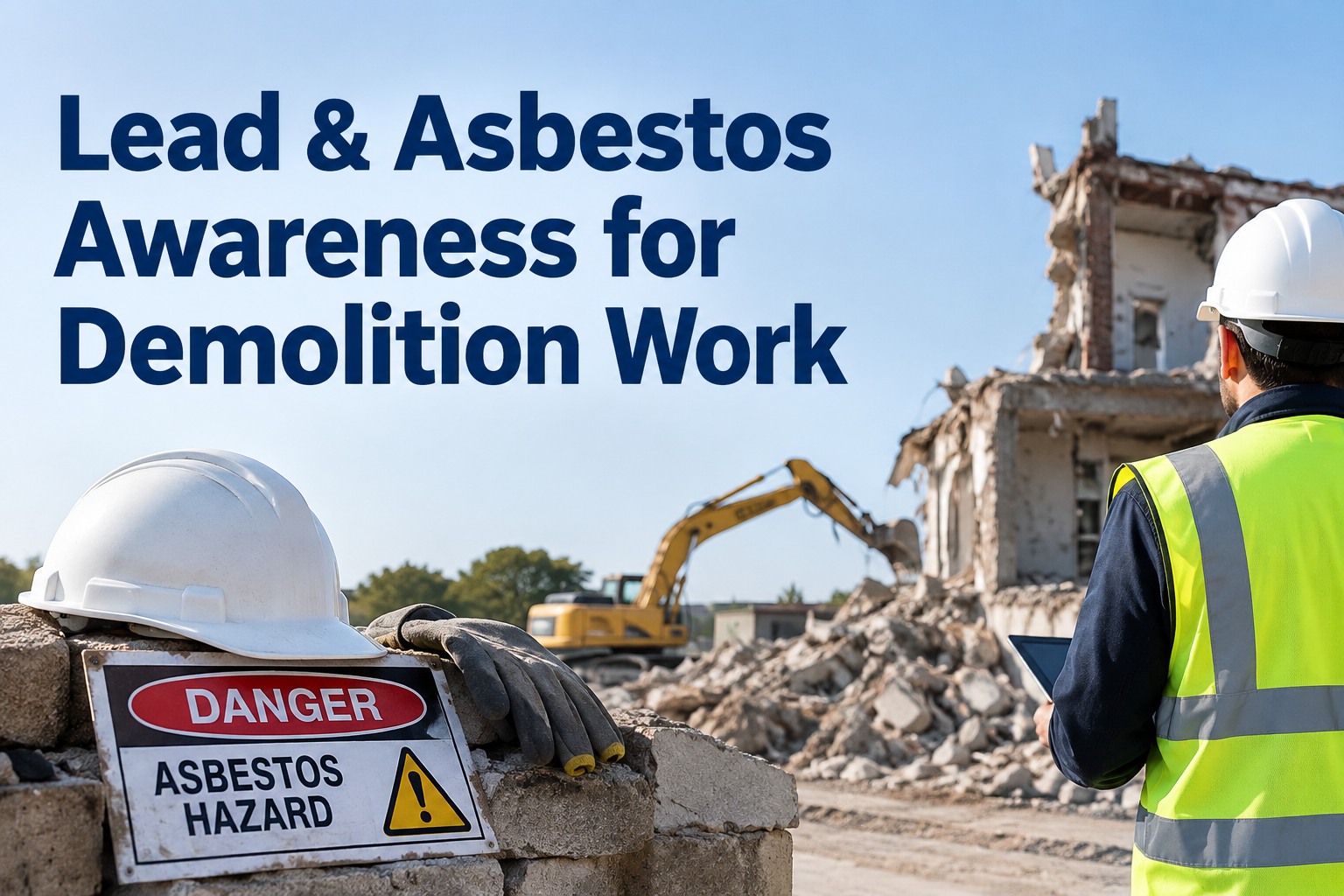
The wall doesn't announce what's in it. A contractor swinging a sledgehammer into 1960s plaster has no way of knowing, just by looking, whether that dust is ordinary drywall debris or something that belongs in a hazmat report. Demolition lead asbestos exposure isn't a rare edge case — it's the default risk on any structure old enough to have been built before either substance was restricted, which is most of the building stock a demolition crew actually works in. The surveys, the notifications, and the records exist because "it looked fine" has never been a legal defense.
Lead and Asbestos Awareness in Demolition Work: What Has to Happen Before You Break Ground
Two hazards, two regulatory frameworks, and a set of surveys and notifications that have to be in place before the first wall comes down.
This is a practical overview, not legal or industrial hygiene advice. Lead and asbestos requirements involve overlapping federal, state, and local rules that change and vary by jurisdiction — confirm current requirements with OSHA, EPA, your state environmental agency, and a licensed inspector or consultant before making compliance decisions.
Before Anything Comes Down: The Surveys That Aren't Optional
Two separate written surveys generally have to exist before demolition work begins, and they answer two different questions. Skipping either one is where most preventable citations — and most preventable exposure — actually originate.
Engineering survey (1926.850(a))
A competent person documents the condition of framing, floors, walls, and load-bearing elements before demolition starts. This single requirement accounts for more than half of all preparatory-operations citations on demolition sites — it's the most commonly skipped or shortcut step in the entire process.
Asbestos inspection (NESHAP)
A certified inspector evaluates the structure for asbestos-containing material before demolition or renovation, regardless of the building's age or apparent condition. The written survey typically has to accompany the demolition notification, not follow it.
Neither survey substitutes for the other — a building can pass a structural engineering survey and still contain regulated asbestos, and vice versa. Start a free trial to see both surveys documented and stored against the same project record instead of living in two disconnected files.
Lead: Assume It's There Until You Prove It Isn't
Under OSHA's construction lead standard, 29 CFR 1926.62, manual demolition of structures with lead-containing coatings or paint is explicitly named as a task that triggers protective measures — before an exposure assessment even confirms the level. In practice, this means treating pre-assessment demolition work on older painted structures as a lead exposure until proven otherwise, not the reverse.
Structures built before the late 1970s are commonly assumed to carry a meaningful risk of lead-based paint, which is why an exposure assessment — not an assumption that the building "looks fine" — is the step that actually satisfies the standard. Book a demo to see how lead exposure assessments get tracked per project and per task before demolition crews start manual work.
Asbestos: Classes of Work and the 10-Day Clock
OSHA's asbestos standard, 29 CFR 1926.1101, sorts work into four classes based on how likely it is to disturb asbestos-containing material — demolition and removal of regulated material generally falls into the higher-risk Class I or Class II categories, which carry the strictest work practice and monitoring requirements.
Separately, EPA's Asbestos NESHAP generally requires written notification to the appropriate agency — often a state or local air quality authority — at least 10 working days before most demolitions, even when the inspection finds no asbestos present. Renovations involving threshold quantities of regulated material carry the same 10-day expectation; a shorter notice period, sometimes as little as one day, generally only applies when a building has been officially declared structurally unsound and at risk of imminent collapse. Some states and localities set their own notification windows on top of the federal minimum, so the 10-day figure should be treated as a floor to confirm against your specific jurisdiction, not a universal number.
Two Agencies, Two Rulebooks — Confirm Which Applies
The reason this area trips up experienced contractors isn't ignorance of the hazard — it's that OSHA and EPA are answering different questions with different paperwork. OSHA's standards exist to protect the people doing the work: exposure limits, monitoring, respirators, and medical surveillance. EPA's NESHAP requirements exist to protect the surrounding air and community: inspection, notification, and controlled removal before material becomes airborne. A project can be fully compliant with one and still be in violation of the other, which is exactly why both tracks need their own documentation rather than a single combined checklist that quietly drops requirements from either side.
Documentation That Holds Up When Someone Asks
When an inspector — OSHA, EPA, or a state environmental agency — shows up on a demolition site, the sequence is predictable: they ask for the engineering survey, then the asbestos inspection report, then the notification confirmation, then exposure assessment and training records for the crew. A project that can produce all four in the order they're asked for reads as a controlled operation. A project that has to go looking for them reads as one that got lucky so far. Start a free trial to see a project's full compliance record pulled up in one view instead of assembled under pressure while an inspector waits.
What a Safety Manager Actually Deals With
Every older building we take down, someone on the crew asks if we really need the asbestos survey again — "it's just an old garage." The honest answer is yes, every time, because the one time we skip it is the time it matters.
What changed for us wasn't the surveys themselves, it was where they live. Everything's tied to the project now — survey, notification, exposure assessment — so when a question comes up mid-project, I'm not digging through email threads from three months ago.
Frequently Asked Questions
What is required before demolition regarding lead and asbestos?
Before demolition, contractors generally need a written structural engineering survey under OSHA's 1926.850(a), a written asbestos inspection performed by a certified or accredited inspector under EPA's Asbestos NESHAP, and a lead exposure assessment under OSHA's 1926.62 when lead-containing materials may be present, such as on structures with older painted surfaces. Written notification to the applicable environmental agency is also generally required before most demolitions. Requirements vary by jurisdiction, so confirm the specific obligations for your project location.
How much advance notice does EPA require before a demolition involving asbestos?
EPA's Asbestos NESHAP generally requires written notification to the delegated agency at least 10 working days before most demolition operations, even when the pre-demolition inspection finds no asbestos-containing material present. Renovations involving threshold quantities of regulated material generally carry the same expectation. Some jurisdictions set shorter windows for emergency situations, such as a structure declared imminently unsafe by a government official, and some states or localities apply their own notification periods on top of the federal minimum — confirm the applicable timeline with your state or local air quality agency.
What are OSHA's exposure limits for lead in construction?
Under 29 CFR 1926.62, OSHA sets a permissible exposure limit (PEL) of 50 micrograms of lead per cubic meter of air, averaged over an 8-hour workday, and an action level of 30 micrograms per cubic meter that triggers monitoring and other compliance requirements. Certain tasks, including manual demolition of structures with lead-containing coatings or paint, are specifically named in the standard as requiring interim protective measures until an employer completes an exposure assessment.
What's the difference between OSHA and EPA requirements for lead and asbestos?
OSHA's standards, including 1926.62 for lead and 1926.1101 for asbestos, are focused on protecting workers through exposure limits, monitoring, protective equipment, and medical surveillance. EPA's Asbestos NESHAP is focused on protecting the surrounding air and community through pre-demolition inspection, advance written notification, and controlled work practices during removal and disposal. A demolition project generally needs to satisfy both frameworks independently, since compliance with one does not automatically satisfy the other.
What records should a contractor keep for lead and asbestos compliance on a demolition project?
A defensible record set generally includes the written structural engineering survey, the written asbestos inspection report, confirmation of the required advance notification to the applicable environmental agency, lead exposure assessment results where applicable, and training or medical surveillance records for exposed workers. Keeping these documents connected to the same project, rather than scattered across separate files or agencies, makes it far easier to respond quickly when an inspector or auditor requests them.
Start a free trial to keep pre-demolition compliance in one record
HVI's configurable inspection templates capture engineering surveys, lead and asbestos assessments, and safety records in the field — offline where you need it — so your documentation is ready the moment anyone asks for it.
No credit card · No hardware · Templates ready to configure on day one