Spoil pile placement is one of the simplest rules on an excavation site and one of the most cited when it goes wrong. The dirt you just dug out is heavy, and parked at the trench edge it does two dangerous things: it can roll back in on a worker, and its weight presses on the wall until the wall fails. This page covers the setback rule in plain terms, why depth changes the number, and what a documented spoil setup looks like. Start a free trial to log trench-edge safety.
Where the Dirt Goes Decides Who Goes Home
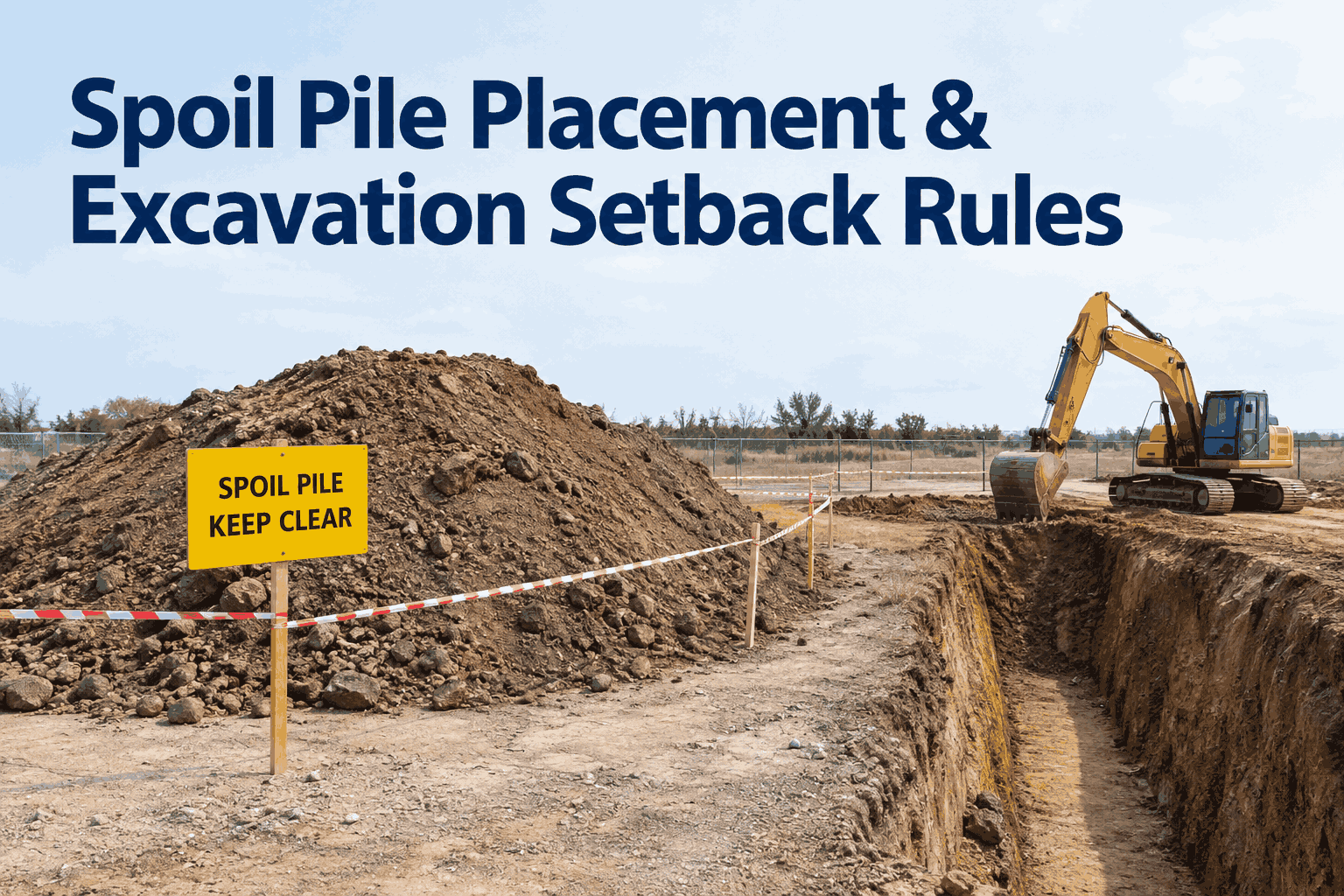
Excavated spoil is a load. Keep it back from the edge and it's just a pile; leave it at the lip and it becomes a surcharge on the wall and a rolling hazard for the crew below. Here's the zone that has to stay clear — and how to prove it did.
Most crews know spoil goes "back a bit." Fewer know why the number exists, or that a pile which looks fine can still be failing the wall from above. The rule isn't arbitrary — it's guarding against two separate hazards at once.
Why Spoil Pile Placement Is a Two-Part Hazard
A spoil pile at the edge isn't one risk with one fix. It's two different failure modes, and the setback distance is what handles both. Miss either and the pile that looked harmless becomes the reason a trench collapses.
Falling & rolling
Loose soil, clods, and stones at the lip roll straight back into the trench onto whoever's working below. It doesn't take a collapse — a single rock off a pile at head height is enough to injure.
Surcharge load
This is the quiet one. The weight of the pile presses down on the soil beside the trench, adding stress to a wall that's already unsupported. That surcharge is a leading contributor to cave-ins — the pile fails the wall without ever touching it.
That second hazard is why sloping the pile or "it looked stable" is never an accepted defense — a documented safety history of enforcement actions makes clear that setback or a retaining device is required regardless of how neat the pile looks. Spoil placement sits right alongside sloping and shoring in a complete safety management program. Book a demo to see trench hazards checked before entry.
The Setback Rule: The Floor and the Real Number
There's a hard minimum everyone quotes, and there's the number that actually keeps a deep trench safe. Both matter, and confusing them is where crews get caught.
OSHA 1926.651(j)(2) requires spoil and equipment kept at least 2 feet (0.61 m) from the edge — or restrained by a retaining device. This is an absolute floor that applies to every excavation, regardless of depth or soil.
For deeper trenches, best practice and stricter state rules push the setback out to at least the depth of the excavation. An 8-ft trench in unstable soil wants spoil roughly 8 ft back — well beyond the 2-ft floor — to keep the surcharge off the failure wedge.
The trap is treating the 2-ft minimum as the target. Two feet stops a rock rolling in; it does little about surcharge on a deep, soft-soil wall. Read the trench, not just the rule — and where you can't get the distance, a retaining device or spoil box is the compliant answer. A competent-person daily excavation inspection captures exactly this judgment — book a demo to see it per trench.
The Spoil Pile & Trench-Edge Safety Checklist
This is what a compliant spoil setup confirms before anyone enters the trench — and what a competent person re-checks through the shift, since a pile grows and an edge sloughs as digging continues.
- Spoil kept at least 2 ft from the edge — more on deep or soft-soil trenches
- Setback measured to the base of the pile, not its slope toe
- Equipment and materials also outside the keep-back zone
- Where distance isn't possible, a retaining device or spoil box used
- Trench walls sloped, benched, or shielded per soil classification
- No surcharge from spoil, vehicles, or stockpiles near the edge
- Edge checked for tension cracks, sloughing, or spoil creep
- Standing water and soil-condition changes noted since last check
- Competent person named and sign-off captured
- Photo of the spoil setup and trench edge attached
- Re-inspection logged after rain, vibration, or added depth
- Any unsafe condition escalated as stop-work with a timestamp
The checklist itself is nothing new — every safety program has a version. What changes the outcome is that it gets run every shift, that a missed setback can't be quietly checked off, and that months later you can pull the photo proving the edge was clear. That's the difference between a policy and a practice. Book a demo to see the trench-safety checklist in the field.
What Actually Gets Cited on the Spoil Pile
Spoil-pile violations follow a pattern, and knowing it helps a crew avoid the citation and the cave-in behind it. Three mistakes come up again and again.
"We sloped it, so it's fine"
Sloping or shaping the pile is not an accepted substitute for setback. The rule calls for distance or a retaining device — a tidy pile at the edge is still a violation and still a surcharge on the wall.
"There wasn't room"
A curb, a road, or a tight site is not a defense — it's the trigger to use a retaining device, a spoil box, or haul-off. Tight quarters are exactly where inspectors expect an engineered control, not spoil crowded to the lip.
"It was fine this morning"
A pile grows and an edge sloughs as the dig continues. Setback that was compliant at 7am can be gone by noon. Without a re-inspection record, "it was fine earlier" is a claim you can't back up.
Every one of these is a documentation problem as much as a digging one — the difference between a crew that gets cited and one that doesn't is often just proof that the check happened and the condition was caught. That proof is what field-logged daily operator reporting creates automatically. Start free and build the record as the crew works.
From a safety manager who's stood in the trench
The spoil pile is the thing everyone underestimates. It's just dirt, right? Then you do the math on a pile of wet clay sitting three feet off a nine-foot wall and realize you've put tons of surcharge on soil that's holding a person up.
What fixed it for us wasn't a new rule — it was making the setback check a photo on every trench, every shift. Now if a pile creeps toward the edge as the dig goes deeper, it gets flagged that shift instead of after an incident. And when a client asks how we manage it, I show them the record instead of telling them a story.
Frequently asked questions
How far should a spoil pile be from a trench edge?
OSHA requires excavated material and equipment to be kept at least 2 feet (0.61 m) from the edge of an excavation, or restrained by a retaining device. That 2 feet is an absolute minimum for every excavation. For deeper trenches, best practice and stricter state rules push the setback out to at least the depth of the excavation, because a deep, unsupported wall is far more sensitive to the surcharge load of the pile.
What is a surcharge load in excavation?
A surcharge load is any extra weight placed near the top of a trench — a spoil pile, a vehicle, stacked materials — that presses down on the soil beside the excavation and adds stress to the unsupported wall. It's one of the leading contributors to cave-ins, and the reason spoil setback matters even when nothing is visibly rolling into the trench. The pile can fail the wall from above without ever touching it.
Is it enough to just slope the spoil pile?
No. Sloping or shaping the pile neatly is not an accepted substitute for the setback requirement. Enforcement decisions have consistently held that spoil must be kept back the required distance or restrained by a retaining device, regardless of how stable or well-shaped the pile appears. A tidy pile at the edge is still a violation and still a surcharge on the wall.
What if there isn't room to set the spoil back?
A tight site — a curb, a road, or a narrow easement — isn't a defense; it's the signal to use an engineered control instead. That means a retaining device to hold the spoil, a spoil box, or hauling the material off site entirely. Inspectors expect crowded conditions to be met with a control, not with spoil pushed up to the trench lip because there was nowhere else to put it.
How often should spoil placement be re-checked?
Every shift, and again after any change — rain, added depth, vibration from traffic or equipment, or visible spoil creep. A pile grows and an edge sloughs as digging continues, so a setback that was compliant in the morning can be lost by afternoon. A competent person should re-inspect and, ideally, log the check with a photo so the condition at that time is documented rather than remembered.
Turn Trench-Edge Safety Into a Record You Can Prove
A required daily trench inspection on every phone: spoil setback, edge clearance, sloping or shoring, soil and water condition — each item photo-backed and timestamped. Re-inspection prompts after rain or added depth, stop-work escalation, and an audit-ready history against every excavation. Live in under two weeks.
No credit card · No hardware · Trench & excavation safety templates ready on day one