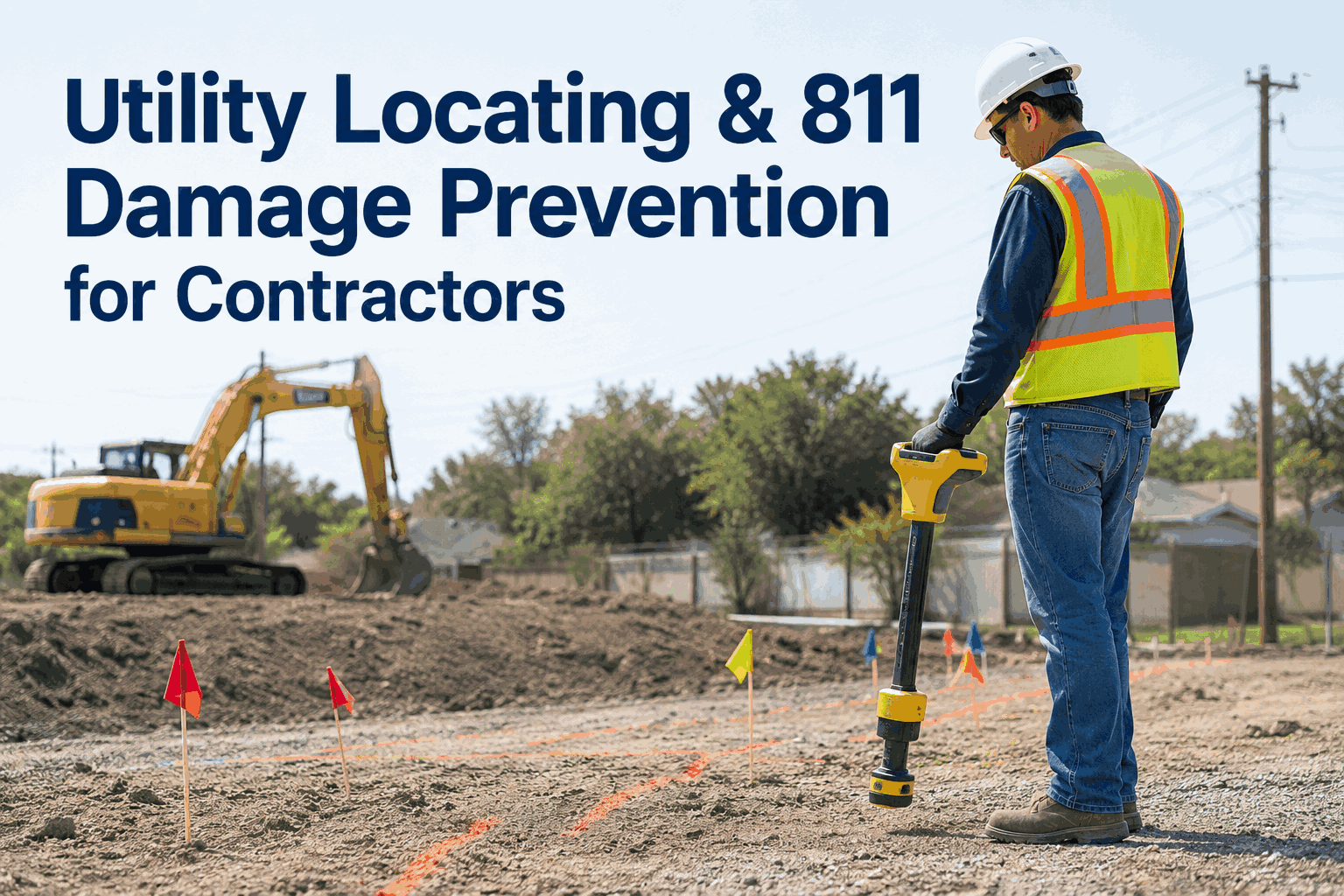
Underground utility locating is the step that stands between your excavator bucket and a struck gas line — and every year hundreds of thousands of crews get it wrong. Buried utilities are damaged in well over 400,000 events a year in the US, most of it preventable. This page walks through the 811 damage-prevention process, the color code, and how to turn every locate into a record you can prove. Book a demo to see locate verification logged per job.
Know What's Below Before the Bucket Drops
Utility locating turns a jobsite full of unknowns into marked, color-coded, verified lines. The paint tells the story — here's the code every crew has to read the same way, and how to make sure the marks were checked before anyone digs.
Utility locating isn't one phone call — it's a chain of steps, and a break anywhere in that chain is where a strike gets born. The DIRT data is blunt about it: most damage traces to just three failures, and every one of them happens before the dig even starts.
Why Utility Strikes Actually Happen
Strikes feel like bad luck on the day. In the data, they're almost never random — the Common Ground Alliance attributes roughly three-quarters of all damage to the same three root causes, all of them upstream of the excavator.
No 811 notification
The single biggest cause. Someone dug without calling the one-call center first, so the lines were never marked. Professional crews know 811 exists — they still skip the ticket under schedule pressure.
No potholing / clearance
The lines were marked, but the crew never exposed them to confirm depth, or dug too close with machinery inside the tolerance zone. Marks got treated as exact when they're only approximate.
Marks wrong or missing
Locator error, outdated maps, or lines owned by a non-member utility that 811 never notified. The crew trusted marks that were inaccurate, faded, or simply not there.
Notice what these share: none of them is a digging mistake. They're all planning-and-verification failures that a disciplined locate process catches before a machine ever moves. That's why the strongest damage prevention isn't better operators — it's a repeatable, documented locate routine, the kind an audit checklist enforces the same way every job. Book a demo to see that routine on your jobs.
The 811 Utility Locating Process, Start To Finish
Damage prevention is a sequence with a clear order. Run it fully, in order, on every dig — and the three root causes above lose their grip.
White-line the dig area
Mark the planned excavation footprint in white paint or flags so locators know exactly where you'll dig — a small step that sharply improves locate accuracy.
Call 811 and wait
Contact the one-call center, describe the job, and wait out the state-required window. Keep the ticket number, date, and expiry — it's your notification record.
Locators mark the lines
Member utilities send locators to paint and flag approximate positions by the color code. Confirm every notified utility responded — blocked or "no response" tickets are stop-work items.
Verify and pothole
Check marks against the site plan, then soft-dig to confirm depth and position where it matters. This is the step that turns approximate marks into confirmed lines — covered in our soft dig verification guide.
Record, then dig with controls
Log the ticket, the marks, the verification, and a spotter assignment. Escalate anything unmarked or conflicting before mechanical excavation begins.
Every step here produces something worth keeping — a ticket number, a photo, a sign-off. On paper, those scatter across trucks and clipboards and vanish by the time anyone needs them. That's the gap a digital locate record closes. Start free and keep the whole locate chain on one record.
The Utility Locating Damage-Prevention Checklist
This is what a defensible locate looks like before the first bucket. It's ordered the way the DIRT root causes tell you to prioritize — notification, verification, then controls — so the three biggest failure modes each get closed.
- Dig area white-lined before the locate request
- Valid 811 ticket on file, matching the work area and in date
- All affected utility owners notified or cleared — including private lines
- Every notified utility has responded; no open or blocked tickets
- Paint and flags present, legible, and matching the color code
- Marks checked against the site plan and known conflicts
- Depth and position confirmed by potholing where required
- Unmarked, faded, or conflicting lines escalated as stop-work
- Tolerance zone marked; soft-dig-only rule understood by crew
- Dedicated spotter assigned with clear view of the dig
- Operator-spotter communication method agreed
- Whole locate record photographed, timestamped, and stored
The value isn't the checklist itself — every safety manager has one on paper. The value is that it can't be closed with a box left unchecked, and that months later you can pull the whole thing up in seconds when a line is damaged and the question becomes who verified what. That's the difference an audit checklist manager makes. Book a demo to see the locate checklist enforced in the field.
Why the Record Is the Real Damage Prevention
Every contractor calls 811. The ones who don't get burned are the ones who can prove what happened after the call. Here's what a documented locate protects you from.
Disputed strikes
When a line is hit and the owner comes back at you, a timestamped record of the ticket, marks, and verification shows exactly what was known and done before the dig.
Audits & compliance
Regulators and clients increasingly ask for locate documentation. A complete, retrievable record answers the request in seconds instead of a scramble through clipboards.
Fleet-wide patterns
When every crew logs the same locate steps, a fleet manager can see which jobs skipped verification and coach it out — before it becomes a strike, not after.
Underground damage carries an estimated societal cost near $30 billion a year, and rising excavation activity only pushes it up. The locate itself keeps the crew safe today; the record is what keeps the company safe tomorrow. See how it fits your operation on the daily operator reporting feature, or book a demo to run it against your jobs.
From a fleet manager who tracks locate compliance
We had the 811 tickets. What we didn't have was any way to know, across forty crews, whether the marks actually got verified before they dug. You find out you had a gap when a backhoe finds a fiber line and the client wants to see your process.
Putting the locate steps on a phone changed the whole picture. Every crew logs the ticket, the mark check, the pothole, the spotter — and I can see across the fleet who's cutting corners before it turns into a strike. The tickets were never the problem. Knowing what happened after the ticket was.
Frequently asked questions
What is utility locating?
Utility locating is the process of finding and marking the approximate position of buried utilities — gas, electric, water, sewer, telecom — before excavation, so crews can dig without striking them. It starts with an 811 one-call request; member utilities then send locators to paint and flag their lines by a standard color code. It's the first and most important step in underground damage prevention.
What does calling 811 actually do?
811 connects you to your state's one-call notification center. You describe your dig, and the center notifies the utility owners whose lines may be in the area, who then send locators to mark them. You typically white-line your dig area first and wait a state-set window before digging. It's free, required by law before excavation, and the single most effective damage-prevention step — skipping it is the leading cause of utility strikes.
What do the utility locating paint colors mean?
They follow the APWA uniform color code: red for electric, yellow for gas, oil, or steam, orange for communications and fiber, green for sewer and drain, blue for potable water, purple for reclaimed water, white for the proposed dig area, and pink for temporary survey or unknown markings. Every crew reads them the same way, which is why a faded or wrong-color mark is a stop-work signal, not a guess.
Why do utility strikes still happen if crews call 811?
The Common Ground Alliance attributes most damage to three causes: no 811 notification at all, failure to pothole or keep clearance from marked lines, and marks that are wrong or missing due to locator error or non-member utilities. Marks are only approximate, so treating them as exact, or skipping verification, causes strikes even on jobs where 811 was called. Verification and documentation close that gap.
Do contractors need to document utility locates?
Increasingly, yes. Beyond the crew's safety on the day, a documented locate protects the company when a strike is disputed, when a client or regulator asks for proof, and when a fleet manager wants to see which crews are skipping verification. A record with the ticket, marks, potholing, and spotter sign-off — timestamped and retrievable — turns a safe practice into defensible proof.
Turn Every 811 Locate Into Proof You Can Pull In Seconds
A required locate checklist on every phone: white-line, ticket, utility responses, mark verification, potholing, and spotter sign-off — each step photo-backed and timestamped. Fleet-wide visibility into which crews verify and which cut corners, and an audit-ready record against every job. Live in under two weeks.
No credit card · No hardware · Locate & damage-prevention templates ready on day one