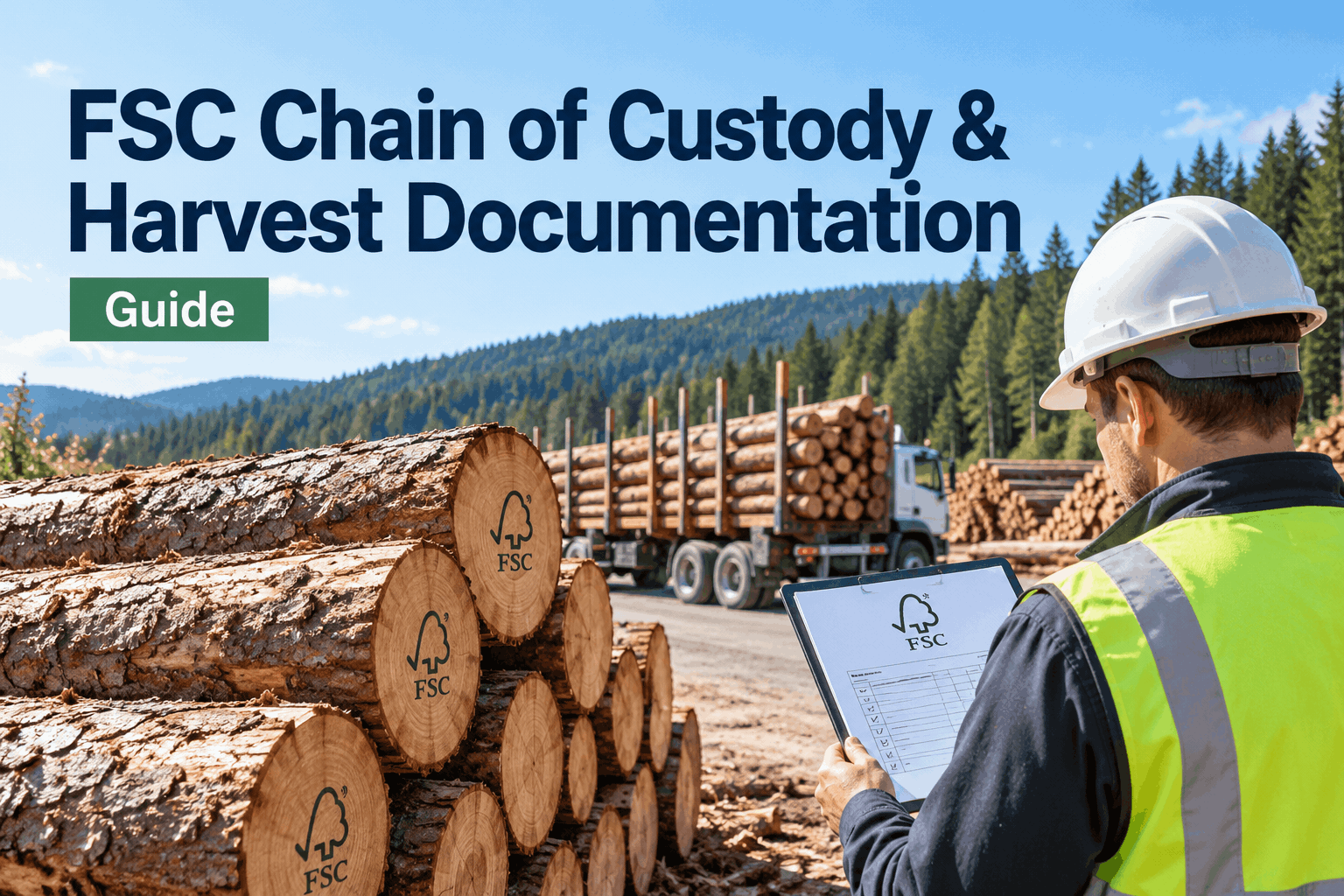
An FSC label on a board makes a promise: this wood traces back to a responsibly managed forest with no gaps. FSC chain of custody is the system behind that promise — an unbroken chain of records following certified material through every owner from stump to shelf. Break one link and the claim can't carry forward. That chain is made of documents, and this guide shows how it holds together and how to keep it audit-ready. Book a demo of traceability recordkeeping to see where it fits.
The claim is only as strong as its weakest link
FSC chain of custody follows certified timber through every handoff in the supply chain. Each link is a record — one missing document and the chain breaks, and the certified claim drops with it.
Chain of custody is the bridge between a certified forest and a certified product. Forest management certification says the trees were grown responsibly; chain of custody proves the specific material reaching a buyer actually came from there, tracked through every company that touched it. Below is why a single broken link voids the claim, the three ways material is controlled, the document that proves each handoff, and how to keep the whole chain audit-ready.
One linkwhy a single missing record breaks the whole chain
The chain isn't a metaphor — it behaves like one. Four links can be perfect, and a fifth missing document still drops the certified claim to the floor.
That's the hard rule of chain of custody: it's not about whether the timber was genuinely certified, it's about whether you can prove it at every step. Most failures aren't fraud — they're a load ticket that never got filed. See how HVI supports forestry operations, or book a demo of gap-free load logging.
Three laneshow FSC controls certified material through your operation
FSC recognizes three control systems — think of them as three lanes material can run in. Which lane you use shapes the paperwork, but all three demand a clean trail.
Certified and non-certified material kept physically apart. Output claim matches input exactly — simplest to document, standard for loggers and haulers.
Certified and controlled material mixed, with the certified percentage calculated and claimed proportionally across outputs over a period.
Certified volume banked as credits and drawn against output claims, so a share of product carries the claim without physical mixing rules.
Most harvesting and transport contractors run the transfer lane — keep certified material identified and separate, and prove what left matches what came in. Whichever lane you run, the record discipline is identical. See digital logbook and checklist tools that keep material records clean.
The paper trailthe document that proves custody at each handoff
Walk the chain and a specific record has to appear at every transfer. Here's the trail, stop by stop — and the document the auditor wants at each.
Origin, species, volume and certified status of what was cut — the trail begins.
Load ticket and delivery note carrying the FSC claim and certificate code from site to mill.
Sales document stating the FSC claim and certificate number — the formal handoff of the claim.
Certified volume in matched to certified volume out — no inflation, claim holds.
The common failure is mundane: a load ticket left in a cab, a claim dropped off an invoice, a harvest sheet never filed. Any one breaks the trail for that material. Sign up free and digitize your load records, or book a demo of the document trail.
Audit checklistwhat an FSC chain of custody audit asks you to evidence
Before the auditor arrives, run your operation against these. Each is a record you'll be asked to show.
Material & sourcing
- Certified inputs from valid CoC suppliers
- Supplier certificate codes verified on file
- Certified material identified and separate
Documentation
- Harvest, transport and sales records complete
- FSC claims stated correctly on invoices
- Records retained for the required period
Volume & claims
- Input and output volumes reconcile
- Claims never exceed certified input
- Control system applied consistently
People & system
- Responsible person named for CoC
- Staff trained on handling and records
- Procedures documented and followed
Captured digitally against each load and asset, every line becomes an exportable record — the evidence an auditor wants, without a filing-cabinet dig. Book a demo of audit preparation that turns the checklist into a report.
Chain strengthpaper trail vs digital trail at audit time
Same forestry, same certified wood — the difference at audit is entirely in how the records were kept.
- Tickets scattered across truck cabs
- Claims remembered, not always recorded
- Reconciliation rebuilt from memory
- Audit prep: a week of chasing paper
- Every load logged at the point of loading
- Claim and certificate code captured in-field
- Volumes reconciled automatically
- Audit prep: one exported record pack
The certification is the same credential; the records are what make keeping it effortless instead of dreaded. That's the honest, narrow place a records platform earns its place. See load and equipment records that export audit-ready.
From the compliance desk
Our first FSC audit, the gap wasn't our forestry — it was the paper trail. A handful of loads had transport tickets that never made it back to the office, so on paper the chain had holes even though the wood was legitimate. We moved harvest and load logging onto phones in the field, capturing the claim and certificate code at loading. Now the chain documents itself as we work, and audit day is an export, not a week of chasing tickets.
FSC chain of custody FAQs
What is FSC chain of custody?
It's the tracking of FSC-certified material through every stage of the supply chain — from the certified forest through harvest, transport and processing to the final product — so an FSC claim can be made. Each company that handles the material holds its own CoC certification and documents its link in the chain.
What are the main requirements?
A documented system that identifies certified material, controls it through a recognized method, records inputs and outputs, states FSC claims correctly on sales documents, and reconciles volumes so claims never exceed certified input. A responsible person and trained staff round it out, all verified by audit.
What are the three control systems?
Transfer (certified material kept separate, output claim matches input), percentage (certified and controlled material mixed, claimed proportionally), and credit (certified volume banked as credits drawn against output). Most harvesting and transport contractors use the transfer system — the simplest to document.
What documents does an audit check?
Harvest records showing origin and volume, transport documents carrying the FSC claim and certificate code, invoices stating the claim, and volume reconciliation proving certified in equals certified out. Missing or incomplete records — not the forestry itself — are the most common reason a chain fails.
Does HVI provide FSC certification?
No — FSC certification comes from accredited certification bodies, not software. What HVI does is keep the records a chain of custody depends on: harvest and load logs, transport documentation and equipment records, dated and exportable, so proving an unbroken chain at audit is straightforward rather than a reconstruction.
Keep your chain of custody from breaking on paperwork
HVI keeps the records FSC chain of custody depends on — harvest and load logs, transport documentation, equipment and inspection records — captured in the field, dated and exportable. It won't issue your certification, but it makes proving an unbroken chain at audit effortless. Live in under two weeks.
No credit card · Field logbook and checklists from day one