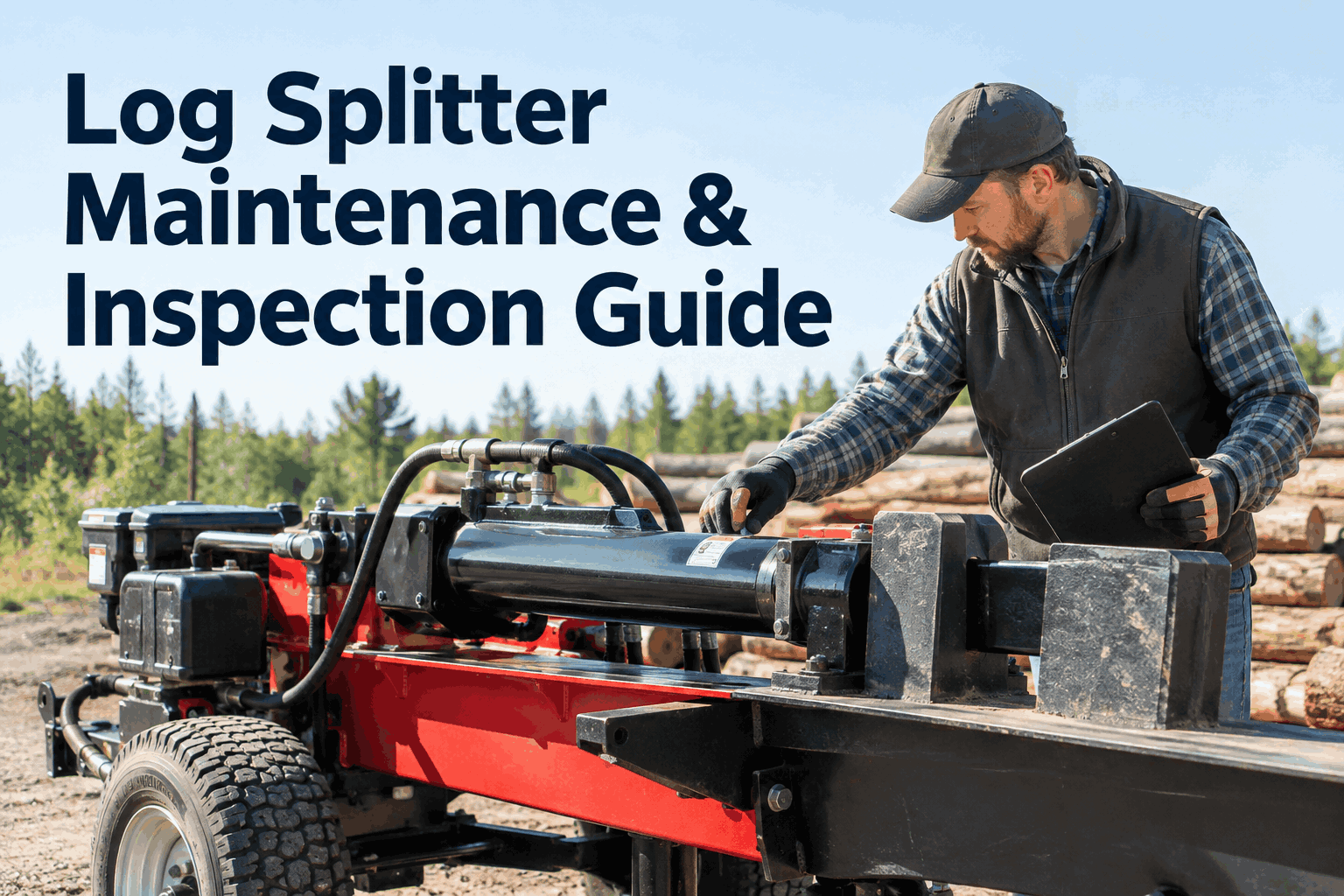
Log splitter maintenance comes down to protecting one thing: the force path. Power leaves the engine, the pump builds pressure, the valve sends it to the cylinder, the ram drives the log onto the wedge. Every weak hose, low fluid level or worn seal along that chain bleeds force — and a splitter that's lost pressure doesn't quit, it just gets slow, erratic and dangerous. Book a demo to see log splitter checks tracked by component. Here's how a forestry crew keeps that path clean, sealed and safe.
Log Splitter Maintenance Is Really Force-Path Maintenance
Engine to pump to valve to cylinder to wedge — pressure only reaches the log if every link holds. A low reservoir, a cracked hose or a scored cylinder robs force long before the machine actually fails. Catch each link on a schedule.
- Engine & pump build pressure
- Valve & cylinder direct it
- Ram & wedge do the work
A commercial log splitter runs on high-pressure hydraulics with sharp edges and pinch points — which makes it both a performance problem and a safety one. Fluid degrades, hoses age, seals score, the wedge dulls and controls drift out of adjustment. A real log splitter maintenance program checks each of these on its own interval instead of waiting for the ram to stall mid-cycle.
6components your log splitter inspection has to cover, in order of the force path
Work the machine the way the pressure travels. Each stage has its own failure mode and its own check — and a problem upstream shows up as weakness everywhere downstream, so order matters when you're chasing a soft ram.
The lifeblood of the whole system. Check level and condition, change on interval, and replace the filter — dirty or low fluid starves everything downstream.
Level each use · change on intervalBuilds the pressure everything else depends on. Watch for weak output, overheating and the whine of a pump that's cavitating on low or aerated fluid.
Per engine service scheduleThe highest-risk part on the machine. Inspect for leaks, cracks, bulges and seepage — a hose that bursts at full pressure is both downtime and an injury.
Visual every useWhere pressure becomes force. A scored rod or a worn seal shows up as a slow, drifting or erratic ram — and leaking fluid past the piston.
Watch stroke & sealsA dull wedge demands more force for every split and strains the whole chain. Keep it sharp, clean of sap, and check the beam and ram slide for wear.
Sharpen when it dragsControl levers, the auto-return valve and the emergency shut-off are what keep hands clear of the wedge. Test every one — this is the check you never skip.
Function-test every shiftCovering all six in force-path order is what makes a log splitter maintenance routine reliable instead of reactive. Book a demo to see the full force path on one inspection.
A slow ram has a short list of causeswork the force path and you find it fast — guess and you replace the wrong part
"The splitter feels weak" is the most common complaint, and it almost always traces to one of four points along the chain. Checking them in order saves you from swapping a good cylinder because the real problem was a low reservoir.
Low level or air in the system causes a slow, erratic ram. Top up and bleed air by cycling the ram before blaming anything mechanical.
A worn or cavitating pump can't build full pressure. Often shows alongside overheating and a rising whine under load.
A worn control valve bleeds pressure back to tank instead of to the cylinder — the ram creeps or stalls under hard knots.
Fluid slipping past a worn piston seal means force never reaches the rod. The last place to look — and the most expensive to fix.
Logging which point it was each time builds a history that tells you whether a machine has a recurring weak spot. Book a demo to see weak-ram findings tracked per machine.
The log splitter maintenance schedulethree cadences, from the pre-use safety check to the full fluid change
Hydraulics and safety items don't share an interval. The practical approach runs three cadences — a fast pre-use check, a periodic service and a fluid-system overhaul — each catching the items that belong at that frequency.
Fluid level, visual hose and fitting check, wedge condition, and a function test of controls and the emergency shut-off.
Engine service, hose and cylinder inspection, wedge sharpening, bolt and fastener torque, frame crack check, grease moving parts.
Full hydraulic fluid replacement and filter change on the manufacturer's interval — plus a drain-down before long storage.
HVI holds all three cadences against each splitter so the safety test never gets skipped in a rush. Sign up free and put every splitter on a schedule.
The checks that protect hands, not just uptimea log splitter is a pinch-point machine — these never come off the list
Performance checks keep the machine working; safety checks keep the operator intact. On a splitter the two overlap — worn hydraulics and loose controls are both a downtime risk and an injury risk — but these items earn their own section because they're the ones you never defer.
Levers must move freely and the ram must auto-return when released — no sticking, no drift toward the wedge.
Test that the kill switch actually stops the machine every shift — a shut-off you've never tested isn't a safety device.
A burst high-pressure hose injects fluid and sprays hot oil. Cracks, bulges and seepage get the machine tagged out until fixed.
Loose bolts and a cracked beam let parts shift under load. Verify fasteners are tight and the frame is sound before every job.
How a crew runs log splitter maintenance in HVIinspection to work order to a service history that builds itself
The point isn't a tidier checklist — it's that a weeping hose or a failed shut-off test doesn't live in one operator's memory. It becomes a work order, a part on order and a line in the machine's history, automatically.
One digital log splitter inspection on the phone — fluid, hoses, cylinder, wedge, controls — same every shift, every operator.
A cracked hose or soft ram becomes a work order with the part and priority attached — and a failed safety test can tag the machine out.
Every fluid change, hose swap and PM lands on the asset — a complete record for cost, warranty and planning the next service.
This sits alongside the rest of the forestry fleet — the roadside processing heads in delimber and processor maintenance, and the wood-yard side in debarker maintenance and inspection. Book a demo to see the inspection-to-history flow on your splitters.
From a forestry equipment manager
Our splitters are the machines everyone assumes are fine until one of them isn't. We had a crew fighting a slow ram for two days — swapped the cylinder, no change. Turned out to be a low reservoir and air in the line. A thirty-second fluid check would have caught it.
What changed things was making the pre-use check a real logged step, safety test included. Now the weak-ram calls come with a history, so we look at fluid and the valve before we pull a cylinder. And nobody runs a splitter with an untested shut-off anymore.
TP Tom P.Equipment Manager · Forestry contractor
Log splitter maintenance FAQs
What does log splitter maintenance involve?
It follows the hydraulic force path: fluid and filter, engine and pump, hoses and fittings, cylinder and ram, wedge and beam, and the controls and safety devices. Each has its own check and interval, from a pre-use fluid-and-safety look to a full fluid change. A good program tracks all of them against the machine, not just the obvious ones.
How often should a log splitter be serviced?
Run three cadences. Check fluid level, hoses, the wedge and the safety controls before every use; do engine service, hose and cylinder inspection, wedge sharpening and fastener torque on a periodic PM; and replace hydraulic fluid and the filter on the manufacturer's interval, with a drain-down before long storage. Always follow your machine's owner's manual for exact intervals.
Why is my log splitter slow or weak?
Work the force path in order. Low or aerated hydraulic fluid is the most common and easiest cause — top up and bleed air first. If it persists, look at a weak or cavitating pump, a control valve leaking internally, then a cylinder with worn piston seals. Checking them in sequence avoids replacing an expensive part that was never the problem.
What are the key log splitter safety checks?
Test the control levers and auto-return, verify the emergency shut-off actually stops the machine, inspect hoses and fittings for burst risk, and confirm fasteners are tight and the frame is sound. A splitter is a pinch-point machine under high pressure, so these safety checks belong on every pre-use inspection and should tag the machine out when they fail.
How does HVI help with log splitter maintenance?
HVI standardizes the splitter inspection so every operator checks the same points, turns any defect into a work order with the part attached, schedules preventive maintenance by date or usage, and keeps a full service history on the asset. HVI supports the inspection and maintenance workflow; it doesn't replace the manufacturer's service and safety requirements for your machine.
Run Log Splitter Maintenance on a Schedule, Not a Breakdown
Make log splitter maintenance a standardized inspection, catch fluid and hose problems before they become failures, and keep a full service history on every machine — so the ram stays strong and the safety checks never get skipped.