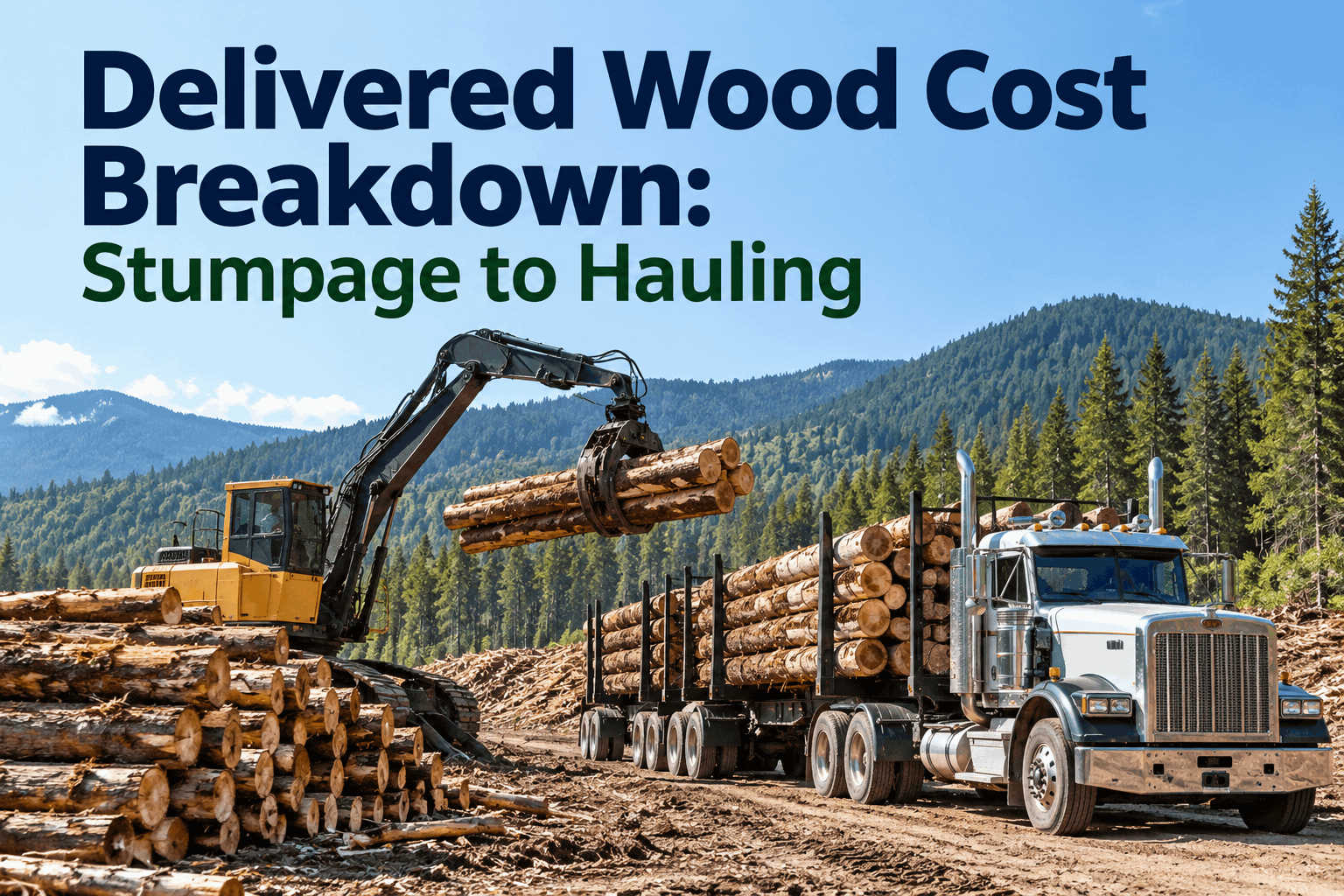
Delivered wood cost is the price of a ton of timber by the time it reaches the mill gate — and it's a lot more than what you paid for the standing trees. Between the stump and the scale, the wood picks up cost at every stage: the stumpage to buy it, the machines to cut and process it, the loading, and the haul to the mill. Understanding how that cost builds up, stage by stage, is the first step to knowing where your margin actually goes — and which stages you can do something about. Book a demo of equipment cost tracking.
Delivered Wood Cost Builds Up Stage by Stage from Stump to Gate
The trees are just the start. Every step from standing timber to the mill scale adds cost — and seeing where it accumulates is how you find the margin you're losing.
Timber is bought standing and sold delivered, and almost everything that determines whether a job made money happens in between. A contractor can win a sale at a great stumpage price and still lose on it because the ground was steep, the haul was long, or the machines ate more fuel and repairs than planned. The delivered wood cost is the sum of every one of those stages, and most operators carry it in their heads rather than on paper — which is exactly why so many are surprised at the end of a job. Break the cost into its stages and the surprises turn into numbers you can see coming.
Stump to gatethe journey a ton of wood takes, and the cost at each stop
Follow a ton of timber from the standing tree to the mill scale and you pass through the stages that make up delivered wood cost. Each one adds its share before the wood earns a cent.
- 1StumpageWhat you pay for the standing timber — set by the sale and the market. The starting cost everything else stacks on.
- 2HarvestingFelling, skidding and processing — the machines, fuel, crew and maintenance that turn standing trees into logs at the landing.
- 3LoadingGetting the wood onto the truck — loader time, fuel and labor at the landing.
- 4HaulingTrucking to the mill — fuel, truck maintenance, driver time, and the empty return. Grows fast with distance.
Stages 2, 3 and 4 are where the machines do the work — and where fuel, repairs and maintenance quietly determine whether the delivered cost lands where you bid it. Those are also the only stages you truly control, which is why they're worth tracking closely. Go deeper on the equipment slice you control, and book a demo of equipment cost tracking.
The cost stageswhat each part of delivered wood cost covers
Each stage of delivered cost has its own drivers and its own line items. Knowing what sits in each is how you move from a single scary delivered number to a breakdown you can manage.
The price of the standing timber itself, set by the timber sale and market conditions. Largely outside your control — you negotiate and bid, but the market sets the range.
Felling, skidding and processing — the feller buncher, skidder, processor and loader, plus the fuel, maintenance, repairs and crew behind them. The biggest operational cost, and the most controllable.
Getting logs onto the truck at the landing — loader hours, fuel and labor. Smaller than harvesting or hauling, but it stacks up across every load.
Trucking to the mill — fuel, truck maintenance, driver time and the deadhead return. Scales directly with haul distance, so a far mill can swing the whole delivered cost.
Insurance, permits, admin, equipment payments and the margin you need to stay in business. Spread across every ton, so low production per day inflates it.
The harvesting and hauling stages are where the equipment lives — and where fuel, repairs and maintenance make or break the delivered number. The haul side has its own cost logic worth knowing; see our log trucking cost per mile and per turn guide. Start a free trial and track the equipment stages.
What moves itthe factors that swing delivered wood cost most
Two jobs with the same stumpage can deliver at very different costs. These are the factors that move the number — some you choose, some the site hands you.
You can't change the haul distance or the timber you bought, but you can make sure the machines moving it are as efficient as possible — and that's the half of delivered cost tracking actually improves. See how fuel cost per ton is tracked.
Do you know yoursthe delivered-cost readiness checklist
You can only build an accurate delivered cost if the pieces are tracked. Run your operation against this list — any "no" is a stage you're estimating instead of knowing.
- You know your stumpage cost per ton per job
- Harvesting and loading cost can be separated out
- Haul cost is tracked, not lumped into "operations"
- Fuel is logged per machine, with price
- Repair and maintenance spend is tracked per machine
- Operating hours and idle are visible per machine
- Tons delivered are recorded per job
- Costs can be divided by tons to get per-ton figures
- You can see delivered cost build up by stage
- You bid jobs knowing your real delivered cost
- You can tell a profitable job from a losing one early
- A stage creeping up is caught before it eats the margin
Twelve confident "yes" answers mean delivered cost is a number you build on purpose — not one you discover after the job is done. Start a free trial and track the equipment stages.
Market vs yourswhich delivered-cost stages you can actually influence
Not every stage is yours to change. Sorting the market-set stages from the operational ones shows you where effort pays back — and where it's wasted.
- Stumpage — the timber sale and market
- Delivered price the mill will pay
- Fuel price per gallon
- Haul distance to the available mill
- Fuel burn and idle time per machine
- Repair cost through preventive maintenance
- Machine utilization and tons per day
- How well each machine is matched to the job
The operational stages — harvesting, loading, hauling — are the equipment-cost half of delivered cost, and the only half tracking can shrink. That's the slice worth the attention. Read how to measure and manage the equipment slice. Book a demo of stage-cost tracking.
The stages on recordthe equipment cost behind delivered wood cost, tracked
HVI can't price your stumpage or your haul rate — but the equipment-cost pieces of the harvesting and hauling stages read off one view, ready to build into your delivered cost. Here's that record.
That view is the operational half of delivered cost, measured instead of guessed — the piece you can actually act on. It's built from the records HVI already keeps for fuel, repairs and hours. Explore per-machine maintenance records.
From a logging contractor owner who started breaking down delivered cost
I used to think about delivered cost as one lump sum and just hoped it came in under the mill price. The problem was I could never tell which jobs actually made money until the books closed. When I started breaking it into stages — stumpage, harvesting, hauling — I could suddenly see that a couple of far-mill jobs were killing me on haul cost, and that one crew's equipment was costing way more per ton than the other's. The stumpage was fine; it was the stages I controlled that were off. I can't change the mill price, but I can run my machines tighter, and now I know exactly which stage to look at when a job's margin gets thin.
Delivered wood cost — FAQs
What is delivered wood cost?
It's the total cost of a ton of timber by the time it reaches the mill gate — stumpage for the standing trees plus harvesting, loading and hauling to deliver it. The delivered price the mill pays has to cover all of these stages and still leave the contractor a profit.
What are the main stages of delivered wood cost?
Stumpage (buying the standing timber), harvesting (felling, skidding, processing), loading onto the truck, and hauling to the mill — plus overhead and profit spread across every ton. Cost accumulates stage by stage from the stump to the gate.
What makes delivered wood cost go up the most?
Haul distance is often the biggest swing, followed by small or scattered timber, steep or wet terrain, and low daily production that spreads fixed cost thin. Machine efficiency and fuel and repair costs move the equipment stages directly.
Which parts of delivered cost can a contractor control?
Stumpage, the mill's delivered price, fuel price and haul distance are largely market-set. The harvesting and hauling equipment — its fuel burn, repairs, maintenance and utilization — is the part a contractor controls, which is why it's worth tracking closely.
How does HVI help with delivered wood cost?
HVI doesn't price stumpage or hauling rates — it tracks the equipment-cost pieces of the harvesting and hauling stages: fuel, repairs, maintenance and hours per machine. That gives you the operational half of delivered cost as real numbers to build on, instead of estimates.
Build your delivered cost on numbers, not guesses
Stumpage and mill price are the market's to set. The harvesting and hauling stages — fuel, repairs, maintenance and hours per machine — are yours, and they decide whether delivered cost lands where you bid it. HVI tracks that half so you build delivered cost on real data. Start free and see the stages you control.
No credit card · No hardware · Track equipment-stage cost per machine from day one