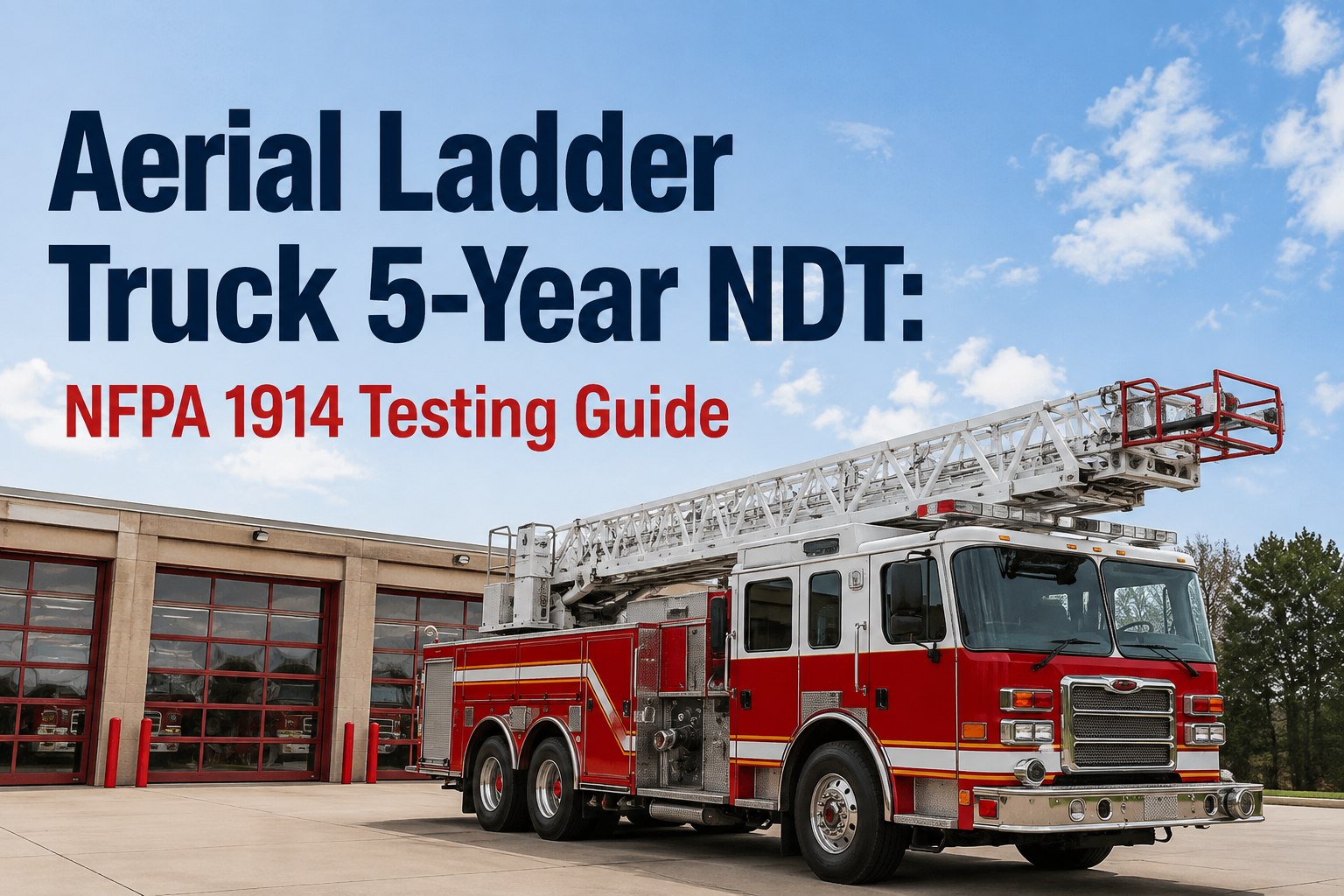
The call comes at 02:30 and the ladder truck rolls to a working fire, but somewhere in the back of the officer's mind is a question: when was the last time the aerial had its five-year non-destructive testing? Under NFPA 1914, aerial ladder NDT is a hard five-year clock, and if the test interval lapses, the apparatus is supposed to be placed out of service. Most departments running Pierce Ascendant or E-ONE HP aerials juggle these compliance windows in spreadsheets and paper binders, which is exactly how critical intervals get missed. If your current system makes you dig through a filing cabinet to prove the last test, it might be time to walk through it on your own units before the next audit finds the gap first.
Is Your Aerial Ladder NDT Window About to Expire?
Every aerial ladder truck carries a five-year non-destructive testing deadline under NFPA 1914, plus annual load tests and biennial weld inspections. When the interval lapses, the apparatus is out of service — not because of a mechanical failure, but because of missing paperwork. HVI tracks every test window automatically, across every rig in the fleet.
What NFPA 1914 Aerial Testing Actually Demands
NFPA 1914 breaks aerial inspection into layered intervals. Missing any one of them can pull the truck out of service during a compliance audit or, worse, at the scene of an incident where the aerial is needed most. Here is how the intervals stack up and what each test is really looking for.
Non-Destructive Testing of Aerial Sections
Full NDT sequence on all structural aerial sections using Magnetic Particle (MT), Liquid Penetrant (PT), or Ultrasonic (UT) methods. Targets load-bearing welds, section joints, rung attachments, and torque box connections for fatigue cracks and internal flaws. This is the test most commonly missed because the interval is long and the documentation is buried.
Load Test and Operational Test
Annual load test verifies the aerial's load capacity at full extension and various angles, combined with an operational test of elevation, rotation, extension, and stabilization systems. Often done by an outside test service, which means the certificate has to make it back into your records system — and stay findable for four years.
Weld Inspection
Biennial visual and tactile inspection of structural welds on the aerial, turntable, pedestal, and mounting hardware. Looks for cracking, corrosion, deformation, and loose fasteners. Frequently combined with the annual load test cycle but tracked as a separate compliance event under NFPA 1914.
NDT Methods Used in Fire Aerial Certification
The five-year test is not a single procedure. It is a sequence of methods chosen by what each component needs to reveal. Understanding which method is applied where helps you verify that the testing vendor actually did the work the certificate claims.
Magnetic Particle (MT)
Used on ferromagnetic steel sections and load-bearing welds. Detects surface and near-surface cracks in aerial box sections, turntable mounts, and torque box joints. Requires magnetizing the part and applying fine iron particles that cluster at cracks.
Dye Penetrant (PT)
Applied to non-magnetic materials and stainless welds where MT will not work. A colored or fluorescent liquid seeps into surface-breaking defects, then a developer draws it back out to reveal the crack. Common on aluminum aerial sections and rung attachments.
Ultrasonic (UT)
Uses high-frequency sound waves to detect internal flaws and measure wall thickness on aerial sections and pins. Finds subsurface defects that MT and PT cannot reach. Often specified on critical pivot pins and section overlap areas on tower ladders.
How Common Aerials Stack Up on the 5-Year Test
Different aerial platforms carry different NDT footprints because of their construction and reach. A 107-foot Pierce Ascendant is not the same test job as a 75-foot midship ladder. The table below maps what to expect across the aerials most departments run.
| Aerial Platform | Max Reach | 5-Yr NDT Scope | Key Risk Areas |
|---|---|---|---|
| Pierce Ascendant | 107 ft | Full MT/PT sequence on all sections, turntable, and torque box | Section overlap welds, fly section extension cables, torque box cracks |
| E-ONE HP 100 | 100 ft | MT on structural welds, UT on critical pivot pins | Pedestal base welds, ladder section joints, rung-to-rail welds |
| E-ONE HP 95 | 95 ft | MT/PT on aerial sections and platform boom | Boom articulation pins, platform mount welds, hydraulic cylinder eyes |
| Spartan Gladiator Ladder | 75 ft | MT on midship ladder sections, PT on rung welds | Bed-to-section transitions, halyard attachment, rung welds |
| Rosenbauer T-Rex | 109 ft | Full MT/PT/UT sequence on articulated platform boom | Articulation joint pins, boom welds, chassis mounting bolts |
What Happens When an Aerial Goes Out of Service
When an aerial truck fails a compliance check or an inspector finds the NDT certificate expired, the apparatus is tagged out of service for aerial operations. That does not mean the truck cannot drive — it means the ladder cannot fly. In a department running two aerials, losing one halves your elevated stream capacity. Here is what that really costs.
A department running a single 107-foot Pierce Ascendant that misses its five-year window faces a double hit: the direct NDT invoice, plus weeks or months where the truck cannot perform aerial rescue, elevated stream operations, or roof access. If your current tracking system is a spreadsheet maintained by one person, the interval failure rate climbs sharply — and you may want to see how a purpose-built CMMS handles it before the next cycle catches you off guard.
The Paper-Based Aerial Inspection Record Is Failing You
Most departments still track NFPA 1914 compliance in a three-ring binder or a shared spreadsheet. The system works perfectly until the person maintaining it retires, transfers, or simply forgets to flag the next five-year window. Here is where paper-based aerial ladder inspection tracking breaks down compared to a digital record.
Manual Spreadsheet Tracking
- One person holds the master spreadsheet — when they are out, nobody knows the next test date
- NDT certificates live in a filing cabinet, taking hours to locate during a compliance audit
- No automatic alert before the five-year window expires — you find out when it is already late
- Load test and weld inspection dates tracked separately, creating gaps in the compliance picture
- Photos of defects and test results stored on individual phones, never centralized
Automated NDT Compliance Windows
- Every aerial carries a visible countdown to its next NDT, load test, and weld inspection
- Automatic alerts at 90, 60, and 30 days before any compliance interval expires
- NDT certificates, photos, and vendor reports attached directly to the asset record
- One dashboard shows every aerial in the fleet and its compliance status at a glance
- Audit-ready records pulled in seconds for ISO, insurance, or department leadership review
How HVI Tracks Aerial Ladder NDT Across Every Rig
HVI is built for fleet-heavy operations where compliance windows are measured in years, not days, and where missing one means an apparatus goes out of service. Instead of relying on one person's memory, HVI turns the five-year NDT cycle into a tracked, alerted, and documented workflow tied to each asset. Here is what that looks like in practice, and you can book a 30-minute walkthrough to see it on your own fleet.
Preventive Maintenance Scheduling by Engine Hours
Schedule the five-year NDT, annual load test, and biennial weld inspection as recurring PM events keyed to each aerial's calendar date. HVI sends due and overdue alerts at 90, 60, and 30 days out, so the NDT vendor is booked before the window closes — not after.
Photo-Backed Inspection Records
When the NDT vendor completes the test, the certificate, photos of flagged welds, and the vendor report are attached directly to the apparatus record in HVI. No more digging through a filing cabinet during an audit — every document is timestamped and searchable.
Defect-to-Work-Order Conversion
If NDT reveals a crack or defect requiring repair, the finding converts instantly into a work order inside HVI. Parts are pulled from inventory, the repair is tracked to completion, and the re-test is scheduled — all in one system instead of across group chats and sticky notes.
Fleet-Wide Compliance Dashboard
One screen shows every aerial in the fleet, its current NDT status, the next test date, and whether any rig is within the alert window. Department leadership and safety officers see compliance rates in real time, and you can start logging inspections free to see the dashboard populate on your own apparatus.
See Every Aerial's NDT Status on One Screen
Stop guessing which rig is due for its five-year test. HVI tracks every compliance window automatically and gives you audit-ready records in seconds.
What a Missed Aerial NDT Window Really Costs
Consider a department running two aerials — a 107-foot Pierce Ascendant and a 75-foot midship ladder — where the Ascendant's five-year NDT is tracked in a spreadsheet maintained by the shop foreman. The foreman retires, the spreadsheet is not handed off cleanly, and the five-year window passes with no test booked. Here is the cascade.
That figure does not include the operational risk of showing up to a fire with one fewer aerial than the incident commander planned for. If this scenario feels familiar, it is worth taking 30 minutes to walk through how HVI handles the alerting before the next five-year window closes on your fleet.
Aerial Ladder NDT Is a System, Not an Event
The departments that never miss an NFPA 1914 deadline are not the ones with the biggest budgets. They are the ones that treat aerial ladder inspection compliance as a tracked system rather than a reactive scramble. The five-year NDT cycle, annual load test, and biennial weld inspection are layered intervals that require layered tracking — and that tracking has to survive staff turnover, shared drives, and filing cabinet reorganizations.
Track All Three Intervals Together
The five-year NDT, annual load test, and biennial weld inspection are separate compliance events under NFPA 1914. They need to be tracked on a single timeline per apparatus so no interval slips through.
Automate the 90-Day Alert
NDT vendors need lead time. An alert at 90 days gives you room to book the slot, prep the truck, and stage the documentation before the window closes. A spreadsheet that somebody checks monthly is not an alert system.
Attach the Certificate to the Asset
The NDT certificate, vendor report, and defect photos belong on the apparatus record, not in a filing cabinet. When an auditor asks for proof, the answer should take seconds, not an afternoon of searching.
HVI was built to do exactly this — track long-cycle compliance windows across mixed fleets and make the records audit-ready without the paper chase. If your current system cannot show you every aerial's NDT status on one screen, you can start logging inspections free and see the difference inside a week.
"I used to track our five-year NDT windows on a whiteboard in the shop. It worked fine until I went on vacation and nobody looked at the board for two weeks — we almost missed the load test on the E-ONE. Now the alert comes to my phone at 90 days out whether I am in the shop or not. That is the only reason I sleep at night."
NFPA 1914 Aerial Testing Questions Answered
What does NFPA 1914 require for aerial ladder NDT testing?
How often does an aerial ladder need a load test?
What happens if the five-year NDT interval is missed?
Which NDT method is used on which aerial components?
How does HVI track aerial ladder compliance intervals?
Track Every Aerial NDT Window Without the Paper Chase
See HVI running on your own fleet — book a 30-minute demo and watch a five-year compliance window get set up in real time.
Free to start - Works on any phone - No card needed