A bucket truck can have a spotless odometer and still be illegal to dispatch on an energized line — because the boom's dielectric certificate expired eleven months ago and nobody was tracking that date against anything mileage-related. Real bucket truck maintenance runs on five separate clocks at once, and only one of them cares how many miles the chassis has driven. Book a Demo
A bucket truck is never running on just one maintenance schedule
Five intervals, five different triggers, all live on the same unit at the same time — and none of them wait for the others to catch up.
Miss which one applies and you don't get a warning light — you get a unit that looks perfectly serviceable right up until someone asks for the certificate. Book a Demo
Every one of those five intervals is real, but the exact numbers, test procedures, and documentation requirements depend on the specific manufacturer's guidance, the applicable ANSI A92.2 provisions, and the regulatory framework governing that unit and jurisdiction — treat everything below as the shape of the programme, and confirm the specifics against your own equipment and governing standard.
Why Vehicle Mileage Can't Drive Bucket Truck Maintenancethe chassis and the aerial device wear out on completely different clocks
A bucket truck that drives ten miles to a job site and spends six hours with the boom extended racks up almost no mileage and a full day of aerial device wear. A fleet tracking this equipment purely by odometer reading is measuring the wrong thing entirely for the boom, the hydraulics, and the rotation system underneath it.
The frequent inspection interval — every three months or 150 hours, whichever comes first — only works as a trigger if those hours are actually being tracked as boom or PTO operating hours, separate from the chassis odometer. Bucket truck hour-based PM has to run on its own meter, not borrow the truck's mileage as a proxy for how hard the aerial device has actually been worked. Sign Up Free
Dielectric Testing: The Test That Decides Whether the Boom Is Actually an Insulatora fiberglass boom that fails this test is just an expensive stick
What dielectric testing verifies, and where to confirm the specifics
Dielectric testing checks that the insulating fiberglass-reinforced components on a bucket, boom, or digger derrick extension are still properly dissipating electrical current — confirming the boom can genuinely act as the barrier between an energized line and the ground. Insulated aerial devices generally require this test at least every 12 months, though the exact frequency, test method, and pass/fail criteria depend on the applicable ANSI A92.2 provisions, the manufacturer's requirements for that specific unit, and any additional standards imposed by the jurisdiction or utility.
Some operators run more frequent testing than the baseline interval requires, particularly for units working transmission-class voltages. Confirm the current requirement for your specific class of device and application before setting the interval — this is not a number to guess at.
Because this test runs on its own annual clock, separate from the frequent inspection and separate from vehicle service, it's the interval most likely to quietly lapse on a truck that otherwise looks well maintained. See the full ANSI A92.2 inspection tier structure for how the frequent, annual, dielectric, and major structural intervals relate to each other.
Boom, Outriggers, and Hydraulics: The Aerial-Specific Checks a Standard DVIR Skipsnone of this shows up on a generic commercial vehicle inspection form
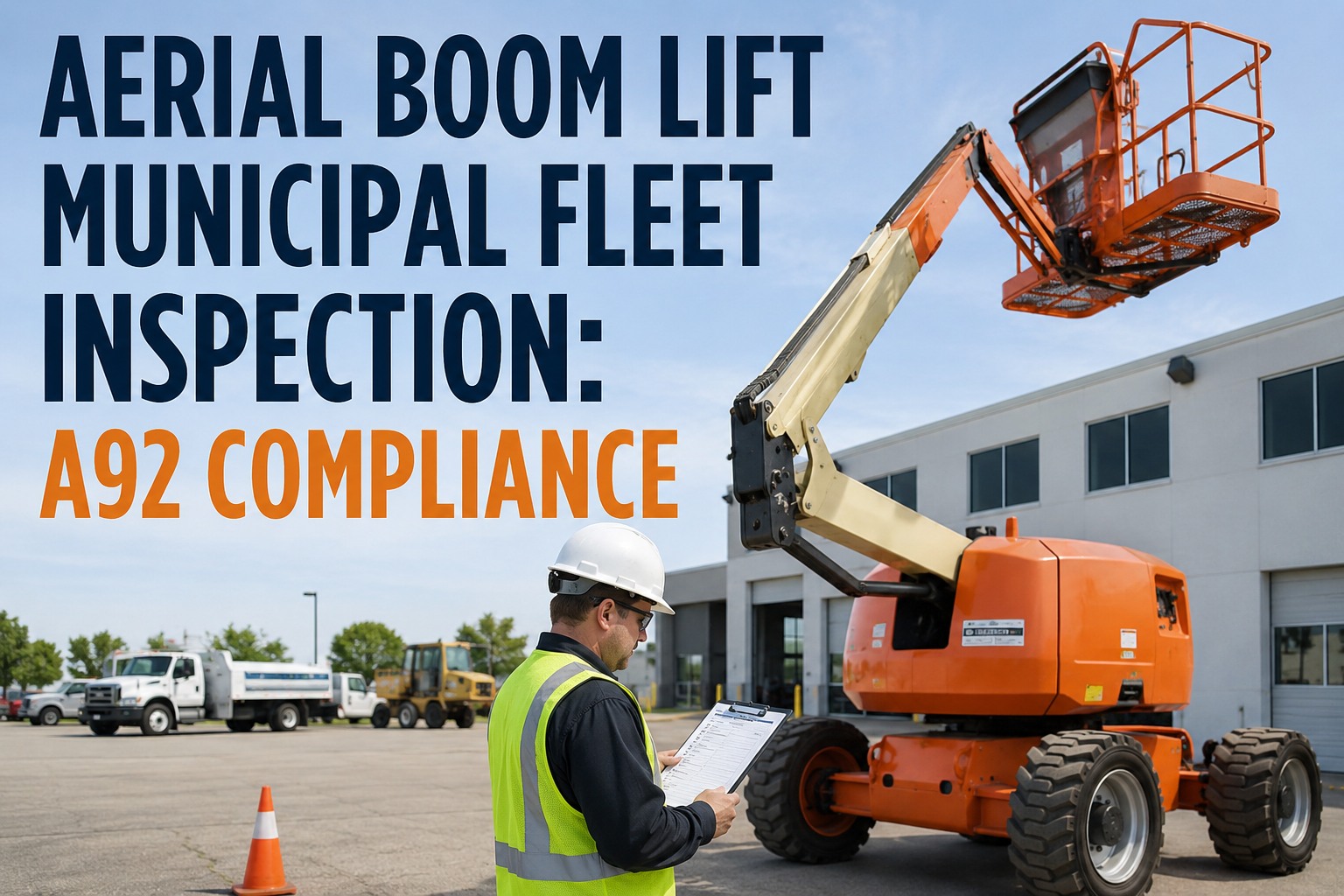
A standard chassis DVIR was never built to catch an aerial device failure — it wasn't designed to. These three systems need their own dedicated checkpoints, separate from anything covering brakes, tires, or lights.
Boom, cylinder & rotation
Structural condition of boom sections, cylinder leaks or drift, rotation bearing play, pin and bushing wear, and secondary stow devices that prevent the boom shifting in transit.
Outriggers & stability
Full extension and locking on every outrigger, ground pad condition, and interlock systems that prevent boom operation without proper stabilization — a stability failure at height has nowhere soft to land.
Hydraulic hoses & controls
Hose and fitting condition under the pressures an aerial device actually generates, upper and lower control function, and emergency lowering system operation — controls a lineman may need to rely on immediately.
A defect in any one of these three areas is a reason to ground the unit, not a note for next week's service. See the aerial-specific failure modes a generic checklist typically misses. Book a Demo
Operator Qualification and Certificate Retentionthe truck can be perfect and the file can still fail
Aerial device operation typically requires documented operator training specific to that class of equipment, separate from a standard commercial driver's license. Keeping that qualification record current, alongside every inspection, dielectric test, and major structural certificate, is what turns a well-maintained truck into a defensible one if a regulator, insurer, or internal reviewer asks for proof.
Some jurisdictions and utilities layer additional requirements on top of the baseline ANSI and OSHA framework — enhanced elevated-operator rules, utility-specific commission requirements, or climate-driven maintenance provisions in extreme-heat regions are a few examples that show up in practice. None of these replace the core interval structure; they add to it, which is exactly why the specific requirements for your fleet's jurisdiction and application need to be confirmed rather than assumed from a generic guide.
One Truck, Five Clocks: What Bucket Truck Maintenance Actually Has to Trackand why it usually has to happen without a signal
A lot of aerial device work happens in exactly the places cellular coverage doesn't reach — rural line easements, storm-damaged areas, remote utility corridors. An inspection workflow that depends on live connectivity to log a defect or confirm a dielectric certificate is a workflow that quietly stops working right when a crew is furthest from help.
Keeping boom hours, frequent inspections, the annual inspection, dielectric certificates, and major structural records all attached to one asset — captured whether or not the crew has signal at the time — is what actually makes bucket truck maintenance manageable at fleet scale instead of five separate spreadsheets nobody fully trusts. See how utilities keep this workflow running during storm deployments.
From an equipment manager who stopped tracking dielectric dates by memory
We had a truck pulled from a storm deployment because the dielectric cert had lapsed two weeks earlier, and nobody caught it because the truck itself was running great — new tires, recent PM, nothing wrong mechanically. The cert just wasn't on anyone's radar.
Now every unit has its own five-clock record, and the dielectric date gets flagged well before it's due, completely separate from whatever the chassis service schedule is doing. We haven't had a surprise expiration since, and during the last storm season every truck we dispatched had current paperwork to back it up.
Tomás didn't need a stricter policy — he needed the dielectric clock tracked as seriously as the oil change. Book a Demo
Frequently asked questions
What are the main inspection intervals for bucket truck maintenance?
Bucket trucks with insulated aerial devices generally follow a layered structure: a daily pre-use operational check, a frequent inspection every three months or 150 operating hours (whichever comes first), an annual periodic inspection typically due within 12 to 13 months, an annual dielectric test on insulated components, and a major structural inspection after the equipment's first 15 years of service and roughly every 10 years after that. The exact requirements should always be confirmed against the specific manufacturer's guidance and the applicable ANSI A92.2 and regulatory provisions for that unit.
Why can't bucket truck maintenance be scheduled off vehicle mileage alone?
A bucket truck's chassis and its aerial device wear at completely different rates relative to mileage. A unit can drive very few miles while the boom, hydraulics, and rotation system accumulate significant operating hours from extended aerial work. Scheduling maintenance purely off the odometer misses this entirely, which is why aerial device intervals are generally tied to accumulated operating hours or a calendar interval, tracked separately from chassis mileage.
How often does an insulated boom need dielectric testing?
Insulated aerial devices generally require dielectric testing at least every 12 months under ANSI A92.2, though some operators test more frequently, particularly for equipment used on higher transmission-class voltages. The test verifies that the fiberglass-reinforced insulating components are still properly dissipating electrical current. Exact test procedures and acceptance criteria should be confirmed against the manufacturer's requirements and the applicable standard for that specific device.
What aerial-specific components does a standard vehicle inspection typically miss?
A standard commercial vehicle DVIR is generally built around chassis systems like brakes, tires, and lights, and typically does not cover boom structural condition, cylinder leaks or drift, rotation bearing wear, outrigger extension and interlocks, secondary stow devices, or the hydraulic controls specific to the aerial device. These require their own dedicated inspection checkpoints, separate from the standard vehicle form.
What records need to be kept for bucket truck and aerial device compliance?
A complete record typically includes daily pre-use check logs, frequent inspection results, the annual periodic inspection report, dielectric test certificates, major structural inspection documentation once applicable, and operator qualification or training records specific to aerial device operation. Keeping all of these tied to the individual unit, rather than scattered across separate logs, is what allows a fleet to quickly demonstrate compliance if a regulator, insurer, or internal reviewer requests proof.
Five Clocks, One Record, Zero Surprise Certificates
HVI tracks bucket truck maintenance the way it actually runs — hour-based PM for frequent inspections, configurable templates for boom, outrigger and hydraulic checks, and offline capture for crews working outside cell coverage — with dielectric and structural certificates alerting well before they lapse. Live in under two weeks.
No credit card · Works fully offline in the field · Certificate alerts ready on day one