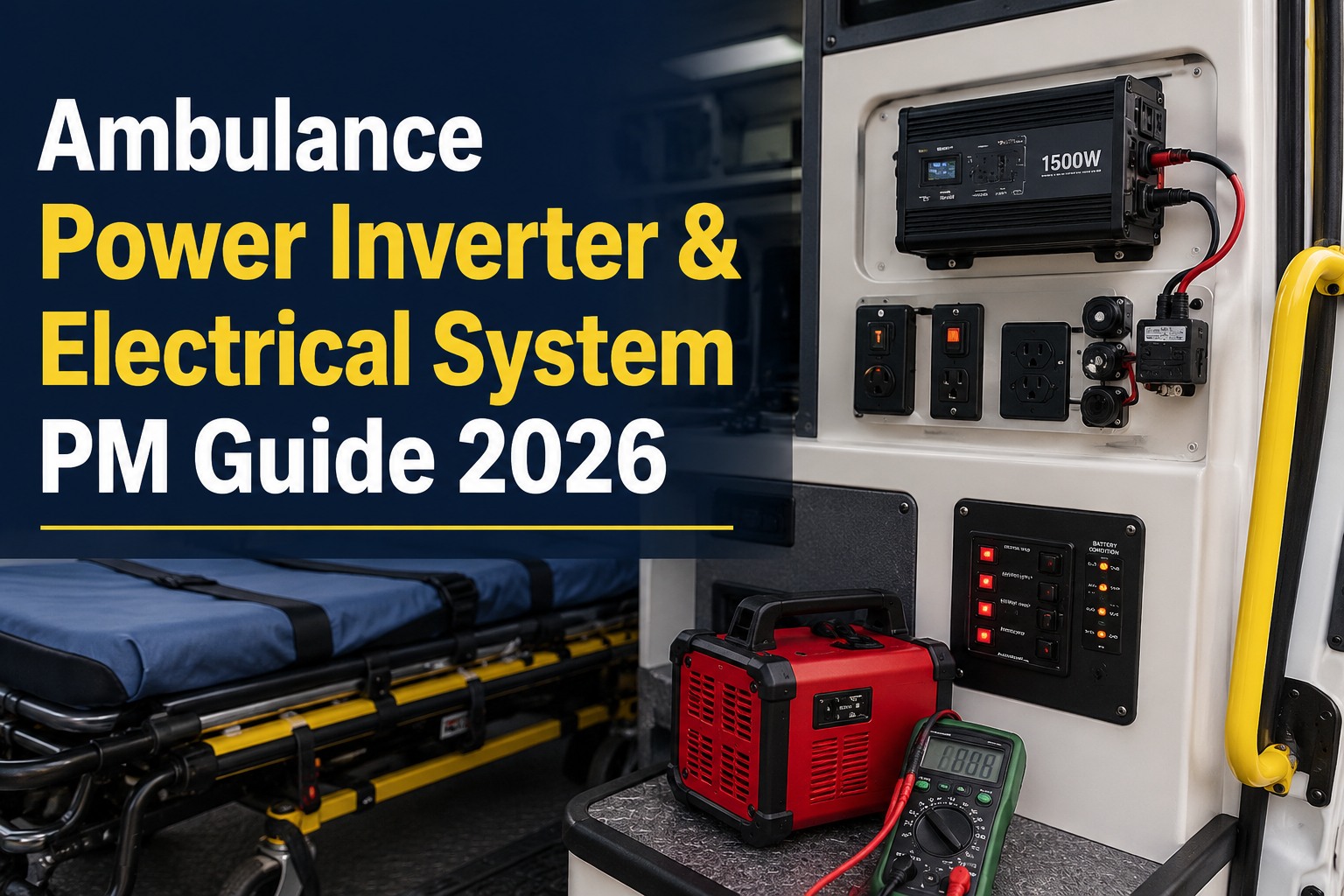
A patient monitor flickering out mid-transport is the nightmare scenario every EMS fleet manager dreads, and it usually traces back to one thing: a neglected ambulance inverter PM schedule. Your module runs 3,000 to 4,000 watts of continuous inverter load between cardiac monitors, ventilators, suction units, and climate control, yet most fleets still track shoreline checks and battery isolator service on a whiteboard or a sticky note. When a Vanner or Xantrex unit fails on scene, you are not just losing a rig for a day — you are risking a patient, a compliance citation, and a crew that no longer trusts the truck. This guide breaks down the exact preventive maintenance intervals for inverters, isolators, shorelines, and battery banks, and shows you how to book a walkthrough of automated electrical PM tracking so nothing slips again.
Ambulance Electrical System PM Guide 2026
Is Your Inverter One Shift Away From Dying Mid-Transport?
Ambulance modules pull 3,000-4,000 watts of inverter load every call. One failed capacitor bank or corroded shoreline connection and your monitors, suction, and climate control go dark with a patient in the back. Here is the PM schedule that keeps every rig powered.
What Electrical Failure Actually Costs You
The Real Numbers Behind Ambulance Electrical PM
Every skipped interval has a price tag. These four figures show what is at stake when inverter, isolator, and shoreline maintenance runs on memory instead of a system.
Component-by-Component Schedule
Ambulance Inverter PM Intervals That Actually Prevent Failures
Each electrical component in your module has its own failure mode and its own clock. Treating them all the same is how rigs end up dark on scene.
Inverter (Xantrex / Vanner)
- Annual: Full thermal imaging scan plus load test at rated capacity. Look for hot spots on capacitors and MOSFET banks.
- Vanner 80 series: Capacitor replacement cycle every 3 years. Electrolytic caps dry out and cause voltage ripple that kills sensitive monitors.
- Monthly: Visual check of cooling fan operation and ventilation clearance. A blocked fan cuts inverter life in half.
- Every PM: Verify low-voltage alarm setpoint and auto-shutdown threshold match your battery bank spec.
Battery Isolator & DC-DC Converter
- Every 2 years: Full isolator bench test. Diode-based isolators drop 0.7V per leg — that is enough to undercharge your module batteries on short runs.
- Quarterly: Torque check on all high-current terminals. Vibration loosens lugs and creates resistance heat that melts insulation.
- Monthly: Measure voltage drop across the isolator under load. Anything above 0.5V means a diode is failing.
- DC-DC converters: Verify output voltage monthly. A drifting converter overcharges AGM batteries and shortens bank life by 40% or more.
Shoreline & 20A GFCI Circuit
- Monthly: Test the 20A GFCI shoreline receptacle. Press the test button, verify trip, reset. A failed GFCI means no shore power and dead batteries by morning.
- Monthly: Inspect the shoreline cord for heat damage, bent pins, and corrosion at the connector. A corroded neutral causes voltage imbalance that damages the inverter charger.
- Quarterly: Verify auto-eject or manual disconnect operation. A shoreline that does not release cleanly tears the inlet off the module wall.
- Annually: Megger test the shoreline circuit insulation to catch moisture intrusion before it trips breakers.
Module Battery Bank
- Monthly: Load test each battery individually. One weak cell drags the entire bank down and the inverter compensates until it burns out.
- Quarterly: Check electrolyte levels on flooded cells and inspect AGM batteries for case swelling — a sign of overcharging from a faulty converter.
- Every PM: Clean and re-torque all intercell connections. Corrosion between batteries creates resistance that shows up as inverter low-voltage alarms.
- Annually: Full capacity test. A bank that reads 12.6V at rest but drops below 11V under a 50% load is done — replace it before it strands a crew.
Where the Money Goes
The Cost of Reactive vs. Scheduled Ambulance Electrical Maintenance
A 10-rig EMS fleet running reactive electrical maintenance typically replaces 3-4 inverters a year at emergency rates. A fleet on a tracked PM schedule replaces 1 — planned, at shop rates, with no downtime.
| Failure Scenario | Reactive Cost | PM-Scheduled Cost | Downtime Difference |
|---|---|---|---|
| Inverter failure (Vanner 80 series) | $1,800 emergency swap + 2 days OOS | $900 planned replacement at capacitor cycle | 2 days vs. 4 hours |
| Battery isolator failure | $650 + tow + missed shift coverage | $280 bench test + planned swap | 1 day vs. 2 hours |
| Shoreline GFCI failure | Dead module batteries + jump-start service call | $0 — caught at monthly test | Half day vs. zero |
| Battery bank failure | $1,200 full bank + inverter stress damage | $400 single battery at quarterly load test | 1 day vs. 1 hour |
| Monitor failure from voltage sag | Equipment repair + potential patient care report | $0 — caught at annual inverter load test | Incalculable vs. zero |
That table is not hypothetical. A 10-rig fleet that moves from reactive to scheduled electrical PM typically saves $8,000-$12,000 per year in emergency parts, overtime, and out-of-service penalties. You can see how automated PM scheduling works on your own fleet in a 30-minute walkthrough.
Stop Tracking Inverter PM on a Whiteboard
HVI schedules every inverter load test, isolator check, and shoreline GFCI test per rig — and alerts you before anything goes overdue.
Step-by-Step Workflow
How to Run a Complete Ambulance Module Electrical Inspection
This is the inspection sequence your technicians should follow at every PM interval. Each step catches a failure mode that the previous one misses.
Shoreline & GFCI Verification
Plug in the shoreline, verify the 20A GFCI holds under load, then press the test button and confirm trip. Check the cord jacket for heat discolouration and the connector pins for green corrosion. A shoreline that passes a visual but fails under load is the most common cause of dead morning batteries.
Battery Bank Load Test
Disconnect the shoreline and apply a 50% rated load to the module battery bank for 15 minutes. Log voltage at start, 5, 10, and 15 minutes. Any battery that drops below 11.8V under sustained load needs replacement — do not wait for it to fail on a call.
Isolator Voltage Drop Test
With the engine running and module loads active, measure voltage on both sides of the battery isolator. A drop above 0.5V means a diode is degrading. On diode-type isolators, this is normal wear — on solid-state units, it signals a failing MOSFET stage.
Inverter Thermal & Load Test
Run the inverter at full rated load (3,000-4,000W depending on spec) for 20 minutes while scanning with a thermal camera. Hot spots above 60°C on the capacitor bank or transformer windings mean the unit is approaching end of life. On Vanner 80-series units past their 3-year capacitor cycle, this test is not optional.
DC-DC Converter Output Check
Verify converter output voltage matches the battery manufacturer spec — typically 14.4V for AGM, 14.7V for flooded. A converter running 0.3V high will cook a battery bank in 18 months. Log the reading and compare it to the last PM to catch drift early.
Document & Schedule Next Interval
Every reading, every photo, every pass/fail goes into the rig's maintenance record with a timestamp. If you are still doing this on paper, start logging electrical inspections free in HVI and the next interval schedules itself.
Common Mistakes
Do and Don't: Ambulance Electrical PM Pitfalls
Do
- Test the GFCI shoreline every month — it takes 30 seconds and prevents the number-one cause of dead module batteries.
- Replace Vanner 80-series capacitors at the 3-year mark even if the unit still passes a load test. Degraded caps fail suddenly, not gradually.
- Log every voltage reading with a timestamp so you can spot drift trends before they become failures.
- Torque all high-current connections at every PM. Vibration is the silent killer of ambulance electrical systems.
- Run the annual inverter thermal scan after a full load test — hot spots only appear under sustained draw.
Don't
- Don't assume a shoreline that clicks into place is actually delivering power. Test the GFCI and verify voltage at the module panel.
- Don't replace just one battery in a bank without load-testing the rest. A new battery next to three weak ones will be dragged down within months.
- Don't skip the isolator bench test because the rig "starts fine." Isolator failure shows up as undercharged module batteries, not starting problems.
- Don't let technicians eyeball inverter health. Without a thermal camera and a load bank, you are guessing.
- Don't track electrical PM intervals in a spreadsheet that nobody checks. Overdue alerts need to come to you, not wait for someone to open a file.
How HVI Helps
HVI Tracks Every Inverter, Isolator, and Shoreline Interval Per Rig
Paper binders and group chats cannot tell you that Rig 7 is 12 days overdue on its capacitor cycle or that the GFCI on Rig 3 failed its last two monthly tests. HVI can.
PM Scheduling by Date, Mileage, or Hours
Set the inverter thermal test at 12 months, the isolator bench test at 24, the capacitor cycle at 36. HVI sends due and overdue alerts to your phone so nothing runs past interval — even across a 20-rig fleet.
Photo-Backed Digital Inspections
Technicians photograph the thermal scan, the voltage reading, the corroded connector — right from their phone at the rig. Every record is timestamped and audit-ready for DOT, insurance, or client review. No more binders, no more texted photos that get lost.
Defect-to-Work-Order in One Tap
A failed GFCI or a voltage drop reading above threshold becomes a work order instantly — assigned, tracked, and closed with parts and labour logged. You see the full cost per rig, per component, per year.
Fleet-Wide Electrical Health Analytics
See which rigs eat the most electrical parts, which inverters are approaching end of life, and what your cost per rig per month actually is. Spot the pattern before the pattern strands a crew. Book a demo and see the analytics dashboard live.
A Worked Example
What One Missed Capacitor Cycle Actually Costs
Here is a real-world scenario that plays out in EMS fleets every quarter. The numbers are conservative.
A 12-rig EMS operation runs Vanner 80-series inverters across the fleet. Rig 9 is 8 months past its 3-year capacitor cycle. Nobody flagged it because the PM schedule lives in a spreadsheet that the shop foreman checks when he remembers.
On a Friday night transfer, the inverter voltage sags under load. The cardiac monitor reboots twice. The crew switches to battery backup on the monitor and completes the transport, but files an incident report. The rig goes out of service.
Emergency inverter swap: $1,800. Rig out of service for 2 days: $1,400 in missed revenue and overtime coverage. Incident report and quality review: 4 hours of management time. Total: roughly $3,500 — for a capacitor kit that costs $220 and takes a technician 90 minutes to install on schedule.
With HVI, the capacitor cycle was set at 36 months from install date. The system flagged Rig 9 as due at month 35, sent an alert to the maintenance manager, and generated a work order. The capacitors were replaced during a scheduled PM on a Tuesday morning. Cost: $220 in parts, $130 in labour, zero downtime. That is a $3,150 difference on one component on one rig. Walk through this exact scenario on a demo call and see how the alert chain works.
Key Takeaways
Your Ambulance Electrical PM Checklist for 2026
If you take nothing else from this guide, take these five points. They cover the failures that strand rigs, endanger patients, and cost the most money.
Inverter: Annual thermal scan plus full load test. Vanner 80-series capacitor replacement every 3 years — no exceptions, even if the unit "seems fine."
Battery isolator: Bench test every 2 years. Measure voltage drop quarterly. A 0.5V+ drop means the diodes are going.
Shoreline GFCI: Test monthly. Thirty seconds per rig prevents the most common cause of dead morning batteries across your entire fleet.
Battery bank: Individual load tests monthly, full capacity test annually. One weak battery kills the bank and stresses the inverter.
Track it all digitally: Ambulance inverter PM is too critical for whiteboards and spreadsheets. Every interval, every reading, every photo — timestamped, searchable, and audit-ready. Set up your first rig free in HVI and see the difference in one PM cycle.
I used to find out about inverter problems when a crew called me from the side of the road. Now I get an alert 30 days before the capacitor cycle is due, and my technician knocks it out during a scheduled PM. Last year we had zero electrical failures on scene. Zero. I track that number personally because two years ago it was five, and one of those was a monitor reboot during a cardiac call. I still think about that one.
Frequently Asked Questions
Ambulance Electrical System PM: Your Questions Answered
How often should you load-test an ambulance inverter?
At minimum, once a year with a full thermal scan at rated load. If your rigs run high call volumes or operate in extreme heat, bump that to every 6 months. The load test should run the inverter at its full rated capacity — typically 3,000-4,000 watts — for at least 20 minutes while you scan for hot spots with a thermal camera. Any component reading above 60°C is a warning sign.
What is the capacitor replacement interval on a Vanner 80-series inverter?
Every 3 years. The electrolytic capacitors in Vanner 80-series units degrade with heat and charge cycles, and they fail suddenly rather than gradually. Replacing the capacitor kit at the 36-month mark costs around $220 in parts and 90 minutes of labour — far less than the $1,800 emergency swap and 2-day downtime when the unit fails on a call. See how HVI tracks this interval automatically.
How do you test an ambulance battery isolator?
Measure the voltage on both sides of the isolator with the engine running and module loads active. A drop above 0.5V indicates a failing diode or MOSFET stage. For a full assessment, pull the isolator every 2 years and bench-test it. Also torque all high-current terminals quarterly — vibration loosens connections and creates resistance heat that accelerates failure.
Why does my ambulance have dead batteries every morning?
Nine times out of ten, the shoreline GFCI has tripped or failed and the module batteries never charged overnight. Test the 20A GFCI receptacle monthly — press the test button, verify it trips, reset it, and confirm voltage at the module panel. Also check the shoreline cord connector for corrosion, which can cause a connection that looks seated but delivers no power. Log your monthly GFCI checks free in HVI so you have a record when patterns emerge.
Can fleet maintenance software track ambulance electrical PM?
Yes — that is exactly what HVI is built for. You set each component's interval (inverter annual, isolator 2-year, capacitor 3-year, GFCI monthly), and HVI sends due and overdue alerts, generates work orders from failed inspections, and stores every photo and voltage reading as a timestamped, audit-ready record. It works on any phone or tablet, so your technicians log results right at the rig. Book a 30-minute demo and see it configured for ambulance electrical systems.
Every Rig. Every Interval. Zero Missed Electrical PMs.
HVI schedules, tracks, and documents every inverter load test, isolator check, and shoreline inspection across your entire fleet — so the next failure never happens on a call.
Free to start — Works on any phone — No card needed