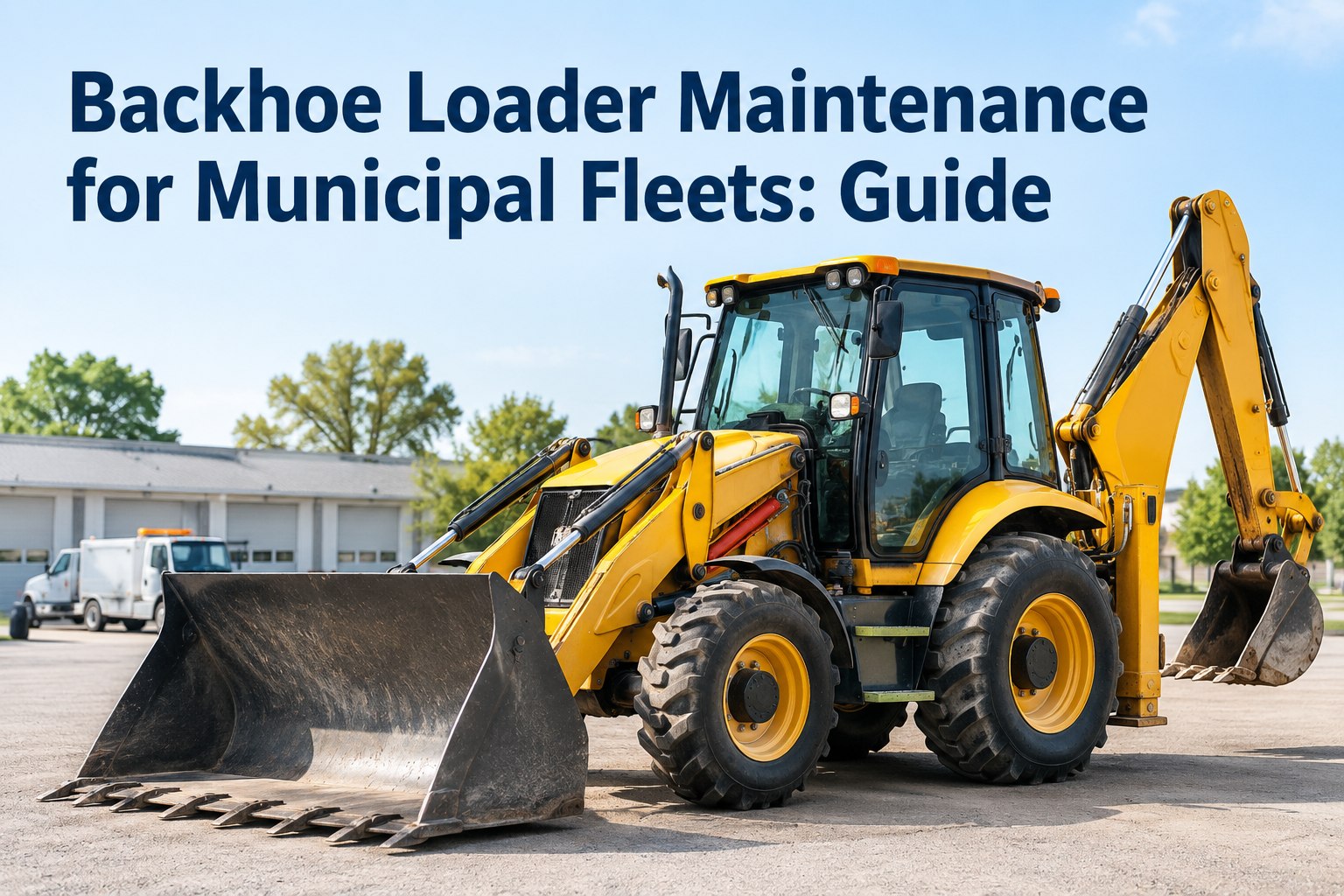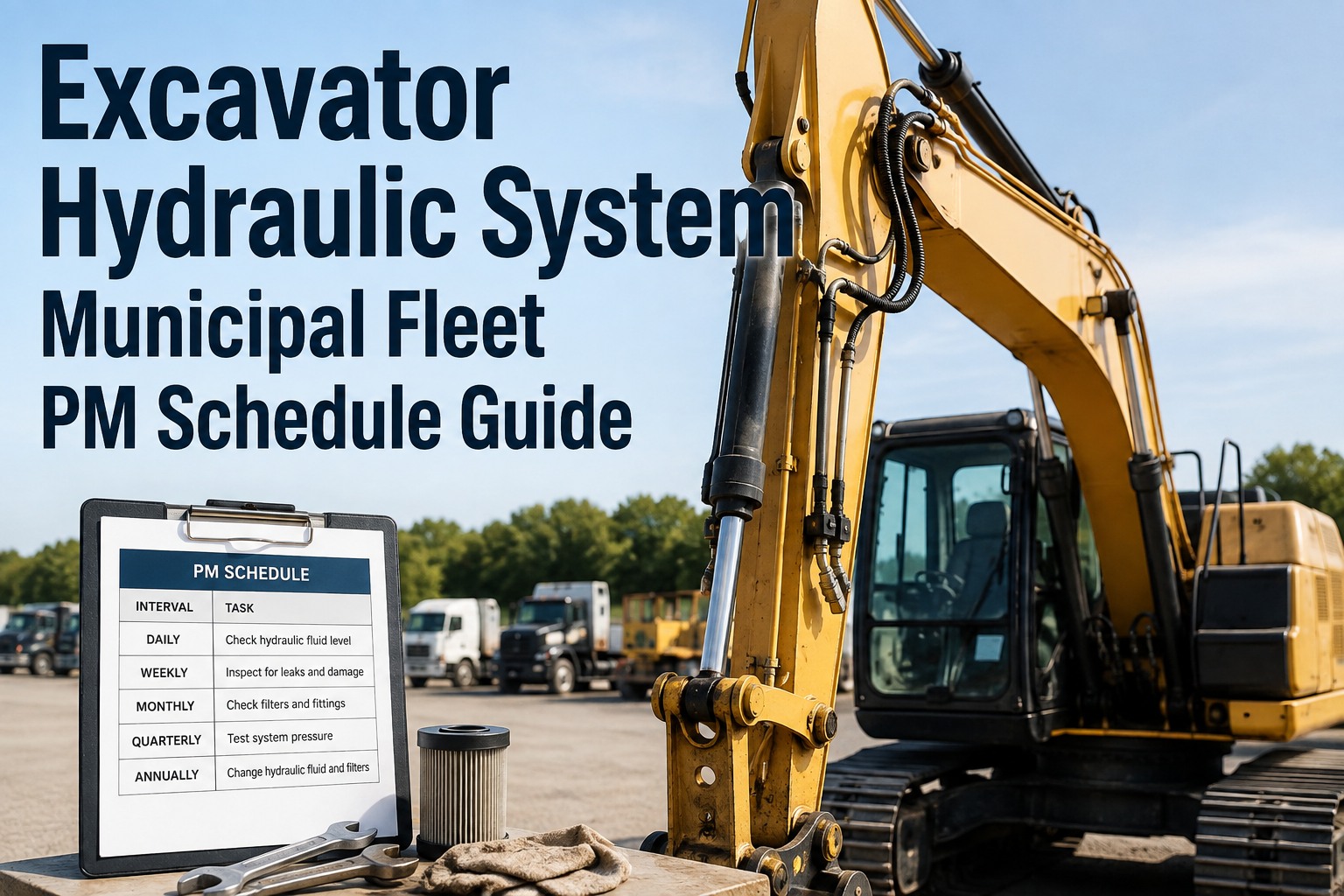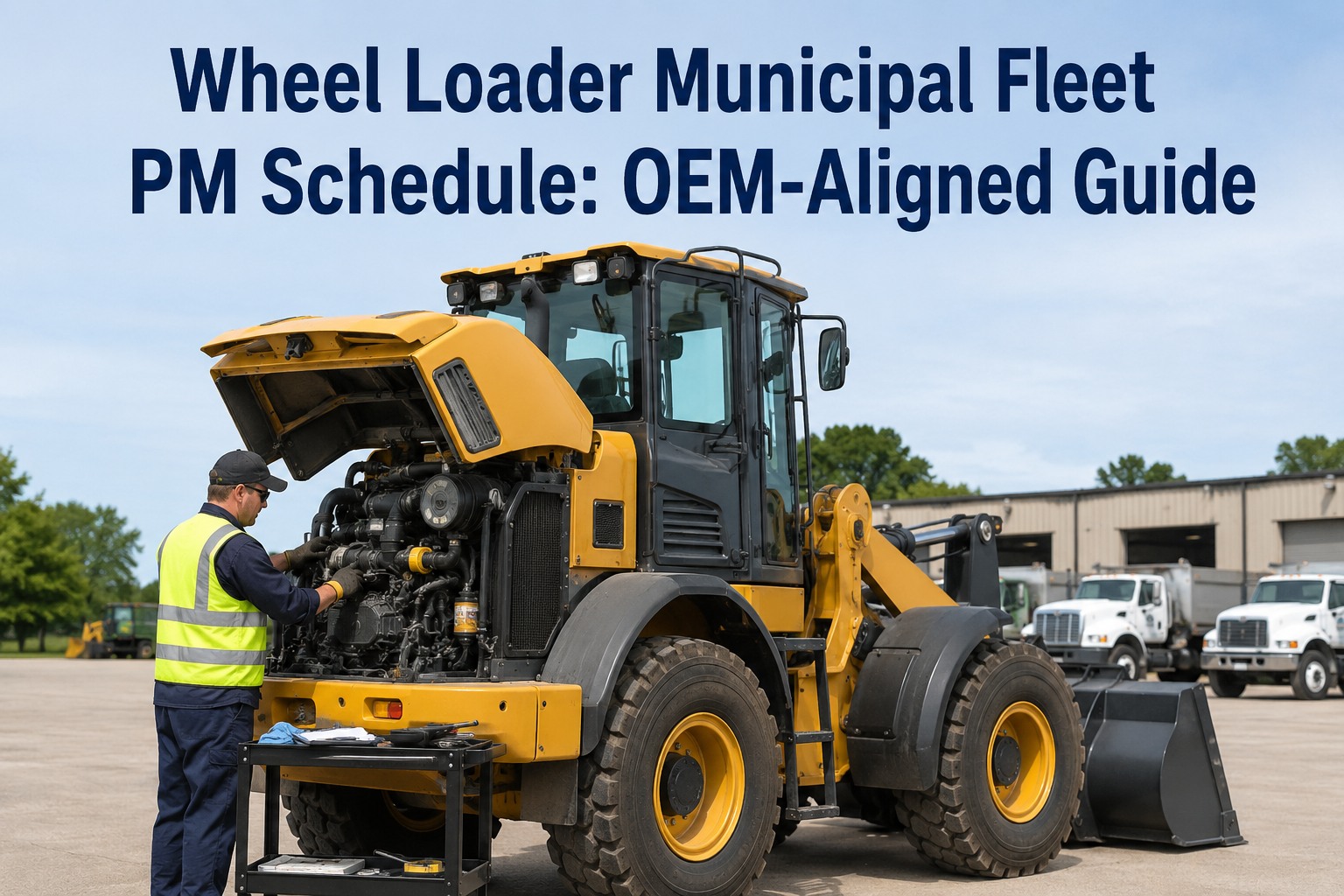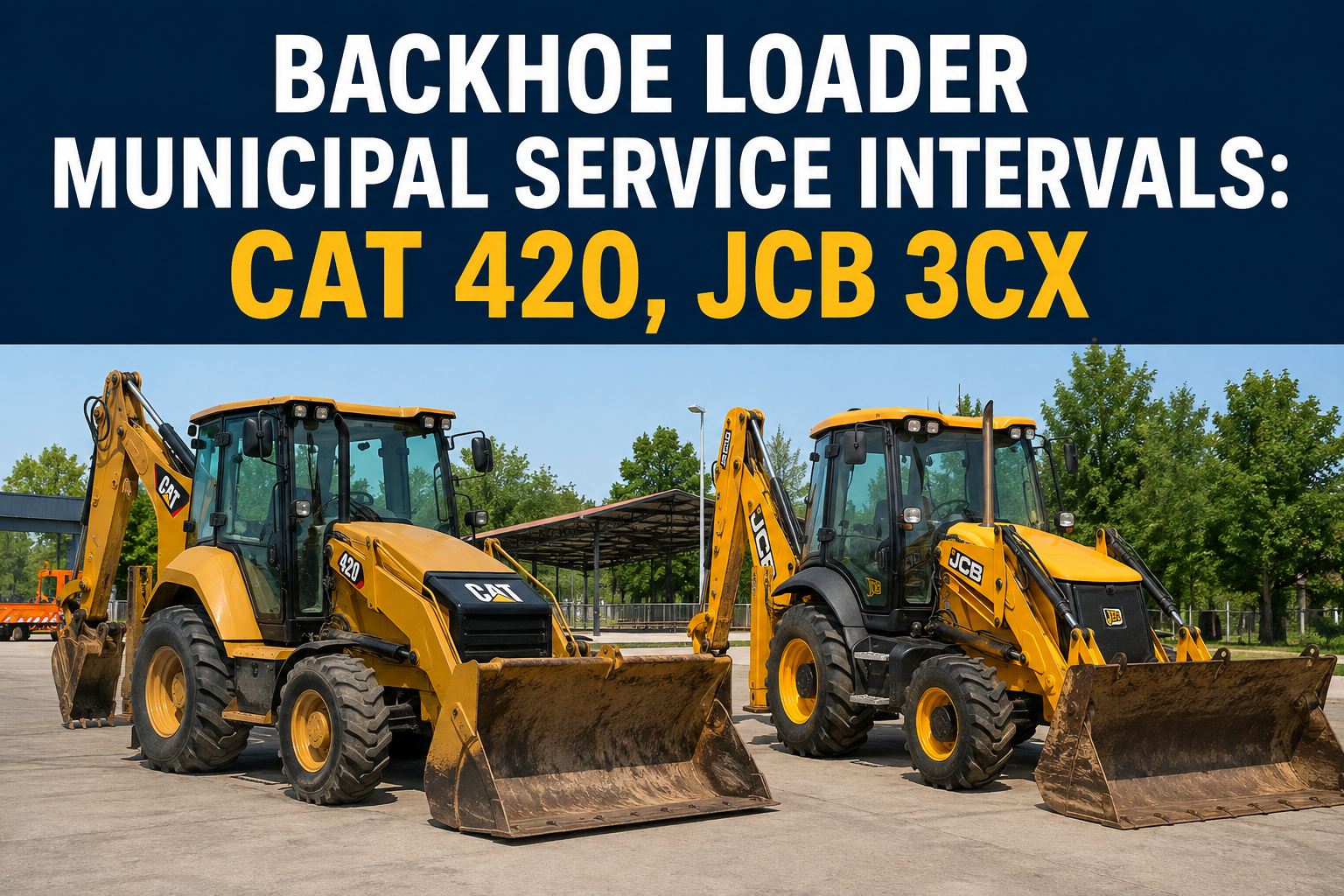
Running backhoe loader maintenance on municipal duty cycles is a different animal from following the OEM service schedule straight off the spec sheet. The workshop manual for a Cat 420, JCB 3CX or Case 580 assumes roughly 1,500 engine hours a year on a commercial construction site, but the average municipal backhoe logs closer to 800 hours a year, split between short road patches, water-main digs, cemetery digs and snow plough mounting in winter. If you service strictly by the book calendar, you are either over-servicing low-hour machines or, more often, missing the silent wear items that fail early on stop-start municipal work. The shops that get this right run a city backhoe CMMS that adjusts PM intervals to the actual duty cycle, not the generic factory table. You can walk through it on your own units and see where the gap hides.
Municipal Backhoe PM
OEM service intervals assume 1,500 hrs. Your muni backhoe averages 800.
Factory PM tables are built for commercial construction duty, not the stop-start, low-hour, high-idle reality of a city fleet. HVI recalibrates every Cat 420, JCB 3CX and Case 580 PM schedule to how your crews actually run, cutting service costs by an average of 28%.
OEM Interval Reality Check
Why factory backhoe service intervals miss municipal duty cycles
OEM manuals are written for a machine pulling a trench eight hours a day on a single site. Municipal backhoes do twenty short jobs a week, idle through a briefing, run a hydraulic breaker for an hour, then sit through a council meeting.
Low-hour, high-cycle wear
A muni backhoe may show 300 hours in a year but cycle the loader arms and outriggers four times as often as a trenching machine. Pin and bushing wear, outrigger pad cracking and extendahoe wear track cycles, not hours.
Dust and idle contamination
Road patching, cemetery digs and seasonal sweeping throw fine dust into intakes. The JCB 3CX 500-hour air filter interval is often too long on municipal road work; hydraulic filter life on a Cat 420 XE shortens when the machine idles through long briefings.
Seasonal attachment shifts
A muni backhoe runs a breaker in winter, a grading bucket in spring and a snow plough mount in December. Each attachment changes the hydraulic demand and the PM profile, and a flat OEM table cannot adjust for that.
Backhoe PM Schedule
Cat 420 vs JCB 3CX vs Case 580: backhoe loader maintenance intervals compared
HVI holds a per-model OEM interval library and then layers your municipal duty-cycle adjustment on top. Below is the baseline OEM schedule for the three backhoes most common in city fleets, with the muni-adjusted column showing where the real interval lands.
| Service Item | Cat 420 XE | JCB 3CX | Case 580 | Muni-Adjusted (HVI) |
|---|---|---|---|---|
| Engine oil and filter | 500 hrs | 500 hrs | 500 hrs | 500 hrs or 6 months |
| Hydraulic filter | 500 hrs | 1,000 hrs | 1,000 hrs | 500 hrs (high-idle fleets) |
| Fuel filter | 1,000 hrs | 1,000 hrs | 1,000 hrs | 1,000 hrs or 12 months |
| Air filter (outer) | 1,000 hrs | 500 hrs | 1,000 hrs | 500 hrs (road work dust) |
| Grease points | 250 hrs | 250 hrs | 250 hrs | 250 hrs or weekly |
| Extendahhe and outrigger pins | 500 hrs | 500 hrs | 500 hrs | 250 hrs (stop-start cycles) |
| Transmission fluid | 2,000 hrs | 2,000 hrs | 2,000 hrs | 2,000 hrs or 24 months |
The muni-adjusted column is where HVI lands after reading the telematics feed and the operator's actual cycle counts. If you want to see how the library maps to your specific serial numbers, book a 30-minute demo and we will pull it up live.
Pre-Shift Checks
Backhoe daily inspection: operator checklist for municipal crews
A backhoe daily inspection on a municipal crew is less about the long DOT walk-around a truck driver does and more about catching hydraulic weeps, pin migration and outrigger damage before the machine leaves the yard for a short, high-cycle job.
Hydraulics and loader end
- Loader arm cylinders for weep at rod seal
- Quick-coupler lock engagement and pin retention
- Hydraulic line chafing at boom pivot
- Bucket teeth and cutting edge wear
Backhoe end and extendahoe
- Extendahoe wear pad clearance and grease
- Dipper stick pin migration and retaining bolt
- Swing tower play and lock function
- Boom lock for transport position
Outriggers and chassis
- Outrigger pad cracks and float retention
- Outrigger cylinder drift over 15 minutes
- Tyre pressure and sidewall damage (all four)
- Stabiliser leg grease points
Engine, fluids and safety
- Engine oil level and coolant level
- Hydraulic sight glass and fluid colour
- Reverse alarm and work-light function
- Seatbelt, mirror and glass condition
You can start logging inspections free and have your operators running these four blocks on their phones by tomorrow morning, with photos attached to every defect.
See HVI running on your own municipal backhoe fleet
Watch a 30-minute demo on a Cat 420, JCB 3CX or Case 580 from your yard, and see how the OEM interval library adapts to your real duty cycle.
The Real Cost Leak
Backhoe cost per hour: where municipal fleets overspend on PM
Backhoe cost per hour is the number every municipal fleet manager gets asked about at budget time. The problem is that most shops calculate it from fuel and oil changes, then get blindsided by the three hidden leaks below.
Over-servicing low-hour machines
If your shop changes engine oil every 250 hours because the calendar says six months, but the machine only ran 180 hours, you are paying for oil, filter and technician time you did not need. On a 15-backhoe fleet that is roughly $4,200 a year thrown away.
Missed hydraulic PM on high-idle units
The Cat 420 XE 500-hour hydraulic filter holds if the machine runs clean, but a backhoe left idling through a two-hour safety briefing pumps the same oil through the same filter. The filter loads early, the pump works harder, and a $90 filter becomes a $2,800 pump swap.
Paper DVIR defects lost in group chats
An operator spots a weeping outrigger cylinder, texts a photo to the foreman, and the photo scrolls away by lunch. The defect never becomes a work order, the cylinder fails on a water-main dig three weeks later, and the machine sits for two days waiting on parts.
Worked Example
A 12-backhoe municipal fleet running at an average $52/hour operating cost, with 3 units over-serviced and 2 units hit by missed hydraulic PM, loses roughly $11,600 per year to schedule drift and lost defect tickets. HVI closes that gap by tying every PM and every defect to the actual hour meter and the actual work order, not a paper file in the cab.
How HVI Helps
City backhoe CMMS: how HVI maps PM to your real duty cycle
HVI runs the OEM interval library per unit, then layers your municipal adjustments on top. Every Cat 420, JCB 3CX and Case 580 in your yard gets a PM profile that reflects how your crews actually run, not a generic factory table.
OEM library + muni override
Every backhoe carries its factory PM table. You override the items that need it, such as moving the JCB 3CX air filter to 500 hrs on road work, and HVI holds both versions so an auditor can see the reasoning.
Outcome: 28% lower service cost, zero missed factory items.
Digital DVIR with photo capture
Operators run the four-block backhoe daily inspection on a phone or tablet. A defect, such as an outrigger pad crack, is photographed on the spot and becomes a work order before the machine leaves the yard.
Outcome: paper DVIRs and group-chat photos gone in one week.
Hour-meter-driven PM triggers
HVI reads the hour meter from telematics or the operator entry and triggers the 250-hr grease, 500-hr hydraulic filter and 1,000-hr fuel filter exactly when the machine needs them, not when the calendar guesses.
Outcome: no over-servicing, no missed PM, full audit trail.
Audit-ready timestamped records
Every inspection, defect, work order and PM completion is timestamped and photo-backed. When a council auditor or insurer asks for proof, you pull the record in seconds instead of hunting a binder.
Outcome: audit prep drops from days to minutes.
Step-by-Step
Backhoe hydraulic PM workflow: from daily check to closed work order
The biggest failure point in backhoe loader maintenance is not the service itself but the gap between the operator spotting a defect and the shop closing the work order. Here is the five-step workflow HVI enforces.
Operator logs pre-shift inspection
The operator opens the HVI app, runs the four-block backhoe daily inspection and photographs any defect, such as a weeping loader arm cylinder or a cracked outrigger pad. The record is timestamped and geo-tagged.
Defect becomes a work order instantly
HVI converts the defect into a work order before the machine leaves the yard. The foreman sees it on the shop dashboard with the photo, the severity and the suggested parts attached.
PM trigger fires on real hour meter
When the hour meter hits the next PM threshold, such as the 500-hr hydraulic filter on a Cat 420 XE, HVI generates the PM work order with the OEM part number and the muni-adjusted interval note attached.
Technician closes with photos and parts
The technician completes the PM, attaches a photo of the old filter or wear pad, and logs the parts used. HVI updates inventory and recalculates the next due date from the new hour reading.
Record is audit-ready, forever
The full chain, inspection to defect to work order to parts to completion photo, sits in the asset history. If you want to see this workflow on your own serial numbers, book a demo and we will build it live.
Key Takeaways
Backhoe loader maintenance: what municipal fleets should do differently
Adjust OEM intervals to duty cycle
The factory schedule is a starting point, not a rule. A muni backhoe averaging 800 hrs a year on stop-start road work needs shorter air filter and pin grease intervals, but can stretch engine oil if the hour meter is honest.
Kill paper DVIRs and group-chat photos
A defect photographed and texted is a defect forgotten. A digital DVIR with instant defect-to-work-order conversion is the single biggest uptime lever for a municipal backhoe fleet.
Track cost per hour, not just fuel
Real backhoe cost per hour includes PM, parts, downtime and the labour to chase paper. The shops that track the full number find 25-30% of it is recoverable through better interval control and defect capture.
Keep every record audit-ready
Council, insurer and DOT audits do not care about your memory. They care about timestamped, photo-backed proof that the PM was done and the defect was closed. HVI holds that chain for every backhoe in the yard.
"We had three JCB 3CX backhoes on road patching and the factory 500-hour air filter was loading up by 350 every single time. Dust off the shoulder, not hours, was killing the filters. Once we moved the interval to 500 hours or monthly, whichever came first, and tracked it in HVI, we stopped replacing hydraulic pumps. That one change paid for the software."
FAQ
Backhoe loader maintenance: questions municipal fleets ask
How often should I service a municipal backhoe loader?
What is the difference between Cat 420 and JCB 3CX service intervals?
What should a backhoe daily inspection include?
How does HVI adjust PM intervals for municipal duty cycles?
Can HVI track backhoe cost per hour for a municipal fleet?
Get your municipal backhoe PM on real duty-cycle intervals
Book a 30-minute demo and see HVI running the Cat 420, JCB 3CX and Case 580 OEM library with your muni adjustments layered on top.
Free to start — Works on any phone — No card needed