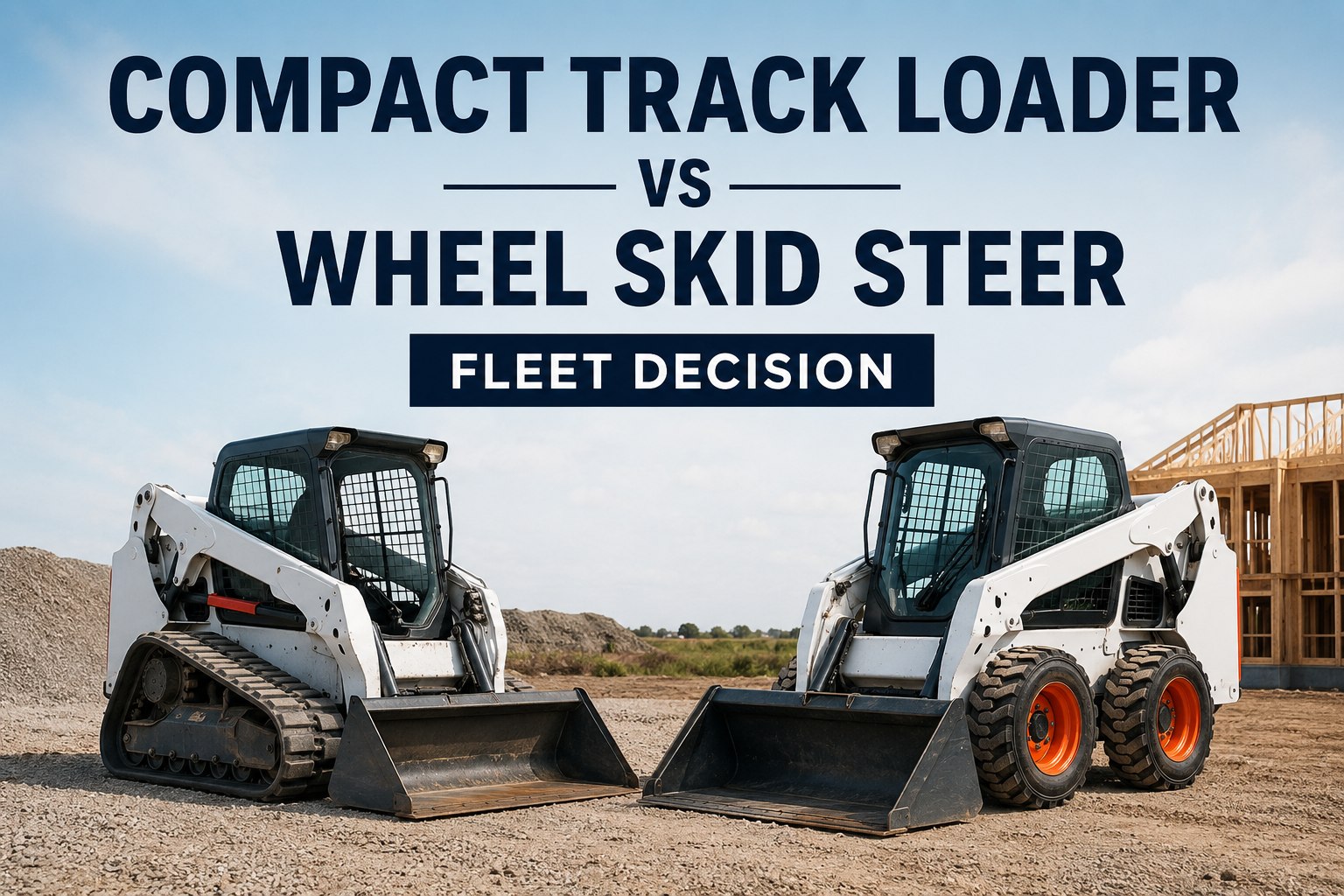
Your crew is standing at the gate at 7 a.m., the skid steer is booked on a wet utility cut, and the ground has already swallowed one machine this month. That is the moment the compact track loader fleet question stops being a brochure debate and becomes a budget line: a CTL costs roughly 42% more up front than a comparable wheel skid steer, yet on soft, muddy or sandy ground it can deliver close to double the productive uptime because it floats where tires spin. The wrong choice does not just hurt once at purchase - it follows you for years in undercarriage rebuilds, tire sets, tow-outs and lost production days. This page breaks the decision down with real numbers: Bobcat T770-class undercarriage life of 1,200-1,500 hours against an $8,000 rebuild, S770-class tire sets at $2,000 every 2,000 hours, and the 900-hour-per-year utilization point where the math flips. If you want to run these numbers on your own units instead of industry averages, you can book a 30-minute walkthrough of the HVI cost-per-hour model and bring your actual hour-meter data.
Tracks or tires? The answer changes at 900 hours a year
One machine eats $8,000 undercarriages. The other eats $2,000 tire sets and loses whole days to mud. Here is the crossover math, the maintenance profile of each, and how to track it asset by asset.
If you buy on price alone
- Wheel skid steer parked every wet week, jobs rescheduled
- CTL bought for a paved yard, tracks shredded on asphalt
- Undercarriage wear invisible until the $8K rebuild lands
- Cost per hour guessed from dealer brochures, not your fleet
If you buy on cost per hour
- Each machine matched to ground conditions and annual hours
- Track wear measured at every PM, rebuilds budgeted ahead
- Tire, sprocket and idler costs logged per asset, per hour
- Replacement timing driven by data, not a breakdown
What the CTL vs skid steer gap actually costs you
Four figures every fleet manager should pin to the wall before signing a purchase order. Each one is a cost you will either plan for - or pay for at the worst possible time.
CTL vs wheel skid steer: the maintenance reality table
Purchase price is the smallest honest number in this decision. What separates the two machines is what wears out, how fast, and what a bad week costs you when the ground turns.
| Factor | Compact Track Loader (T770 / 299 / SVL class) | Wheel Skid Steer (S770 / 262 / SSV class) |
|---|---|---|
| Wear item | Rubber tracks, sprockets, idlers, rollers - one undercarriage system | Four tires, plus rims and occasional axle seal work |
| Typical wear life | 1,200-1,500 hours before a full undercarriage rebuild | Around 2,000 hours per tire set on mixed surfaces |
| Replacement hit | About $8,000 per rebuild - big, but predictable if you track wear | About $2,000 per set - smaller, but sidewall cuts can force early swaps |
| Soft ground uptime | Keeps working in mud, sand, snow and fresh fill - near 2x the productive days in wet seasons | Spins, sinks and gets towed; wet weeks become lost weeks |
| Hard surface wear | Asphalt and concrete grind rubber tracks fast - worst-case duty cycle | Tires handle pavement well; this is where wheels earn their keep |
| Daily PM burden | Track tension checks, undercarriage cleanout, sprocket and roller inspection | Tire pressure, lug torque, sidewall and tread inspection |
| Best fit | Municipal drainage, site prep, landscaping, snow, soft-ground utilities | Paved yards, material handling, snow on hardpack, demolition with solid tires |
The pattern most mixed fleets land on: one CTL for the soft-ground and winter work, one or two wheel skids for yard and pavement duty - then a demo of per-asset cost-per-hour tracking to prove which unit earns its spot.
Compact loader TCO: where 900 hours a year flips the answer
Here is the worked example, using the real wear numbers from the machines above. Run it against your own utilization and the decision usually makes itself.
Wheel skid steer - cost per wear hour
Cheap and simple on pavement. But add the hidden line: every wet week the machine sits, you still pay the operator, the truck, and the schedule slip. If a wheel unit loses just 15 working days a year to ground conditions, at a conservative $450 per lost machine-day, that is $6,750 of invisible downtime - more than three tire sets.
Compact track loader - cost per wear hour
Nearly six times the wear cost per hour - and that is before the 42% purchase premium. The CTL only wins when its uptime advantage is worth more than that gap. On soft ground with 2x the productive days, the same 15 rescued days at $450 each repay $6,750 a year, which covers the wear gap once annual hours climb past roughly 900.
CTL rubber track life: the PM checklist that protects $8,000
Undercarriages rarely die suddenly - they die from skipped 10-minute checks. These are the inspection points that stretch a 1,200-hour undercarriage toward 1,500.
Daily - operator walkaround
- Track tension: sag within OEM spec - overtight tracks eat sprockets and idlers fast
- Cleanout: mud, clay and packed snow removed from the undercarriage frame
- Visual: cuts, exposed cords or missing rubber lugs on both tracks
- Rollers and idlers: listen for grinding, look for oil seep at seals
Weekly - technician pass
- Sprocket tooth wear: hooked or pointed teeth mean the track is next
- Roller flange wear measured against spec, both sides logged separately
- Track alignment: machine tracking straight, no side-loading on idlers
- Hour-meter reading captured against the PM interval, not guessed
At interval - wear measurement
- Track lug height measured and trended - plan the rebuild before failure
- Full undercarriage wear report costed against remaining season workload
- Rebuild scheduled into a planned downtime window, parts pre-ordered
- Cost per hour updated in your CMMS so the TCO model stays honest
The wheel skid side has its own list - pressure, lug torque, sidewall cuts, tread depth - and it is shorter. That difference in PM burden is part of the real cost gap, and it is exactly the kind of per-asset checklist you can see built out in a live HVI demo before you commit a fleet to either platform.
Stop guessing which loader earns its keep
See HVI tracking hours, wear items and cost per hour on machines like yours - in a 30-minute demo built around your fleet mix.
The municipal loader decision: why muni fleets run mixed
Municipal and government fleets face the sharpest version of this choice: one budget cycle, wildly mixed duty cycles, and public scrutiny when a machine sits broken during a storm or a washout.
Map duty cycles before the tender
Pull the last 12 months of job tickets: drainage and ditch work, park and trail grading, snow response, yard material handling. Anything on soft or unpaved ground points to a CTL; pavement and yard work points to wheels. Most muni fleets discover a 60/40 split they never quantified.
Cost both options per hour, not per unit
A $2,000 tire set every 2,000 hours looks cheap until the wheel unit loses two weeks of spring ditching to mud. A CTL's $8,000 undercarriage looks brutal until it works straight through that same spring. Put both on a cost-per-available-hour basis and the tender writes itself.
Spec the PM plan into the purchase
Track tension checks, undercarriage cleanouts and wear measurements belong in the asset's preventive maintenance schedule from day one - by engine hours, with due and overdue alerts. Fleets that set up hour-based PM schedules when they sign up free catch undercarriage wear at 70-80% instead of at failure.
Review the split every budget cycle
Utilization drifts. A CTL bought for ditching ends up loading salt on pavement and grinding its tracks away. A quarterly cost-per-hour review per asset tells you when to rotate duties, when to rebuild, and when the next tender should flip tracks for tires or the other way round.
Run the CTL vs skid steer decision on your own data
HVI is the cloud and mobile CMMS that turns hour meters, inspections and work orders into a defensible cost-per-hour answer for every loader you own.
Hour-based PM scheduling
Preventive maintenance triggered by engine hours with due and overdue alerts, so the 1,200-1,500 hour undercarriage window is planned and budgeted - never a surprise $8,000 work order.
Digital inspections with photos
Operators log track tension, lug wear and tire condition from any phone in the yard, with photo capture that turns a defect into a work order instantly - no paper, no group-chat pictures lost by Friday.
Cost-per-asset analytics
Every tire set, track rebuild and hour worked rolls up into cost per hour per machine, so your next purchase decision - CTL, wheel skid, or one of each - is backed by your fleet's own numbers.
Parts and inventory control
Tracks, sprockets, idlers and tires stocked against known wear intervals across multiple shops, so a planned rebuild never waits three weeks on a parts order while a $450-a-day machine sits.
Most fleets are live in days, not months - and you can walk through it on your own units in a demo before spending anything.
The bottom line on your compact track loader fleet decision
Buy on cost per available hour
The CTL's 42% price premium and $5.93-per-hour undercarriage cost only make sense when soft-ground uptime pays them back. Below roughly 900 annual hours on decent ground, the wheel skid steer's $1-per-hour tire cost wins. Above it, tracks earn their keep.
PM discipline is the real price gap
A CTL demands daily tension checks, cleanouts and measured wear intervals; a wheel skid demands far less. Whichever you choose, the fleets that win are the ones whose inspections actually happen - logged, photo-backed and converted to work orders before wear becomes failure.
Let your own hours make the call
Brochure numbers start the conversation; your hour meters finish it. Track both machine types in one CMMS for a quarter and the compact track loader fleet decision stops being opinion. When you are ready, book a demo and bring your utilization numbers - the math takes minutes.
"We ran a T770 and an S770 side by side for two years before I trusted the numbers. The track machine cost me $5.90 an hour in undercarriage against a dollar in tires - but it worked eleven extra days one wet spring, and those days were worth more than the whole wear bill. My rule now: if a unit loses more than ten days a year to ground, it gets tracks. And I check track sag every Monday myself, because the one rebuild we did early came from a month of overtight tracks nobody logged."
CTL vs skid steer: questions fleets ask before buying
Is a compact track loader worth the extra cost over a wheel skid steer?
How long do CTL rubber tracks and undercarriages last?
Which is better for municipal fleets: tracks or wheels?
What daily maintenance does a CTL undercarriage need?
How do I calculate cost per hour to compare the two machines?
Make your next loader purchase a data decision
Track hours, wear and cost per asset across every CTL and skid steer you run - and walk into the next tender with proof, not opinion.
Free to start - Works on any phone - No card needed