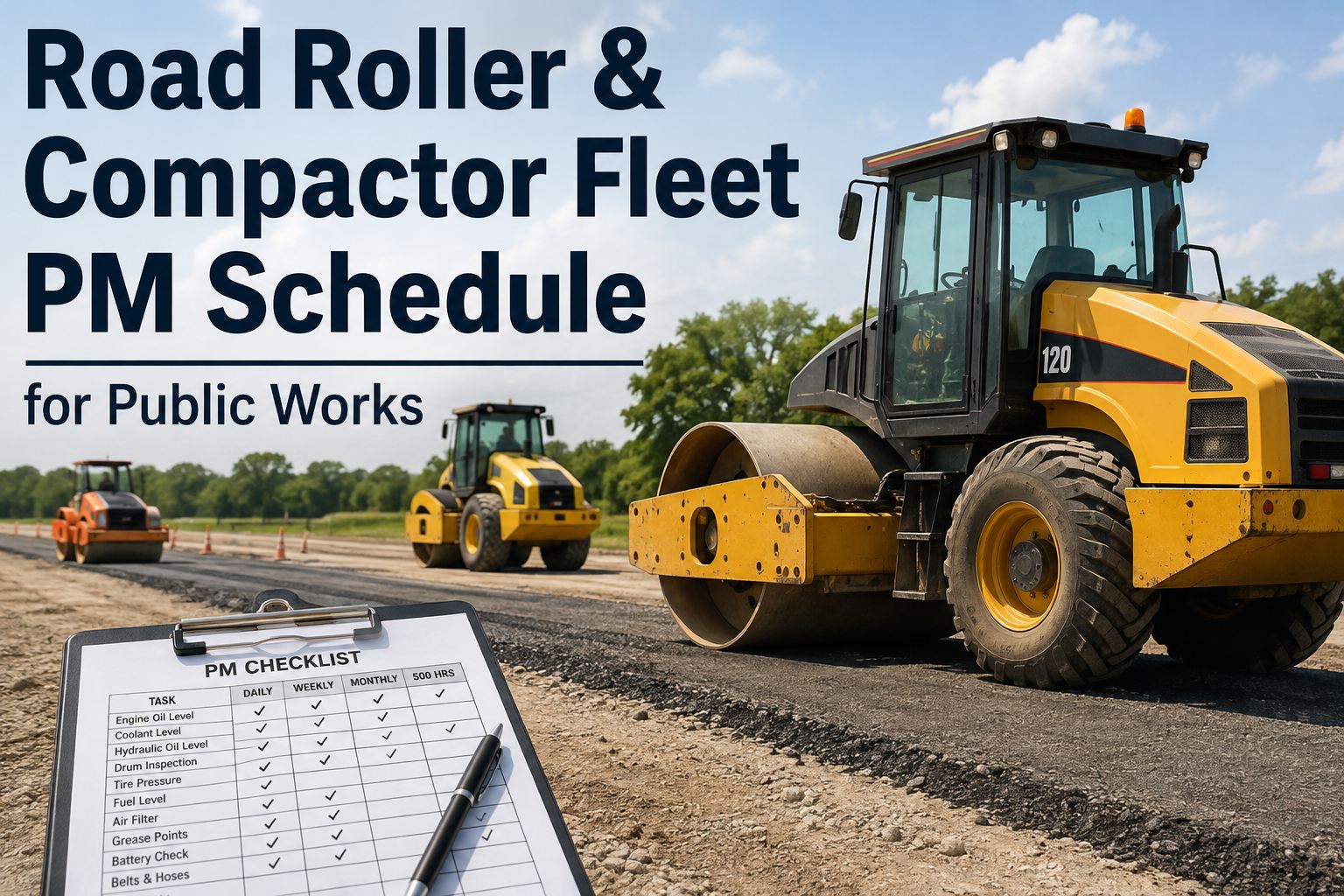
Municipal rollers log around 1,200 vibration hours a year, and most shops find out a drum bearing is failing when a paving crew calls from the roadside saying the machine is shaking itself apart. A proper road roller maintenance schedule, built around auxiliary vibration hours instead of engine hours, is what catches drum bearings, vibrator shafts and water spray pumps before paving season starts. If you are running tandem rollers, walk-behind units and static rollers across a public works yard, a compactor PM schedule built on paper logbooks and memory does not work — drum failures cost you the whole job. You can walk through a roller-specific PM setup on a live call before the next paving window opens.
Vibration-Hour PM for Municipal Rollers
Your roller's drum bearing does not care about calendar dates — track the hours that actually kill it
Paper logbooks miss auxiliary vibration hours. HVI tracks real vibration time, flags the 50-hour grease and 500-hour gearbox intervals, and catches drum failures before a crew is parked on the mat.
The Real Cost of Drum Failure
What missed vibration hours actually cost a municipal yard
1,200
Vibration hours per roller per year
$4,200
Average drum bearing rebuild if caught late
3 days
Paving crew downtime waiting for a swap roller
50 hrs
Grease interval most yards miss on paper
OEM Interval Mapping
Cat CB64, Hamm HD12 and Bomag roller service intervals you cannot run from memory
Every compaction brand has its own weak points and hour thresholds. A compactor PM schedule that treats them all the same will miss the exact service that prevents a breakdown. Here is what the OEMs actually call for on the three most common municipal rollers.
Cat CB64B Tandem Roller
- Drum bearing grease: every 50 vibration hours — miss this and the bearing runs dry, overheats, and seizes on the mat.
- Vibrator gearbox oil: every 500 hours — contaminated oil shreds the exciter shaft bearings and you rebuild the whole drum.
- Water spray system: inspect weekly in season — clogged nozzles let asphalt stick to the drum and tear the mat.
Hamm HD12 Vibratory Roller
- Water pump: seasonal service before paving starts — a failed pump stops the spray bar and you are pulling the roller off the job mid-shift.
- Drum bearing grease: every 50 vibration hours, same critical threshold as the Cat — auxiliary hour tracking is the only reliable way to catch it.
- Articulation joint: inspect every 250 hours — worn steering joints make the roller wander and leave uneven compaction.
Bomag Vibratory Roller
- Exciter shaft: inspect at 250 hours — the exciter shaft is what generates the vibration force, and a failure here destroys the drum housing.
- Vibrator oil: change at 500 hours — metal in the oil is the first sign the shaft bearings are going.
- Hydraulic filter: swap at 250 hours to protect the drive motor that turns the drum.
PM Comparison Table
Vibratory roller inspection schedule by component and hour threshold
Use this as the baseline for your compaction equipment fleet. The key shift is tracking auxiliary vibration hours separately from engine hours, because the drum wears on its own clock. You can see this table built out for your own fleet in a live demo.
| Component | Service Interval | Failure Mode If Missed | Downtime Risk |
|---|---|---|---|
| Drum bearing grease (Cat CB64 / Hamm HD12) | 50 vibration hours | Bearing runs dry, overheats, seizes | Drum rebuild, 3 days down |
| Vibrator gearbox oil (Cat CB64 / Bomag) | 500 hours | Contaminated oil shreds exciter bearings | Full drum teardown |
| Exciter shaft inspection (Bomag) | 250 hours | Shaft failure damages drum housing | Permanent drum damage |
| Water spray pump (Hamm HD12) | Seasonal / pre-paving | Pump fails, spray bar stops, asphalt sticks | Job stopped mid-shift |
| Hydraulic filter (Bomag) | 250 hours | Drive motor contamination | Drum drive failure |
| Articulation joint (Hamm HD12) | 250 hours | Worn steering, uneven compaction | Rework, failed density test |
How HVI Helps
Auxiliary-hour tracking that catches drum failures before paving season
Paper logbooks track engine hours. HVI tracks the vibration hours that actually destroy drum bearings and exciter shafts, then auto-generates the work order before the threshold is crossed.
Auxiliary-hour PM triggers
HVI lets you set preventive maintenance by engine hours, vibration hours or mileage. When a Cat CB64 hits 50 vibration hours, the drum bearing grease work order generates automatically — no foreman chasing a logbook.
Photo-backed digital inspections
Operators run a vibratory roller inspection on their phone — drum condition, water spray flow, oil level, unusual vibration. Every defect with a photo converts to a work order instantly, killing text-message defect reports for good.
Parts inventory across shops
When a 500-hour gearbox service triggers, HVI checks drum bearing kits and vibrator oil stock across every yard. If the part is not on the shelf, the work order flags it before the roller is parked and waiting.
Audit-ready maintenance records
Every inspection, grease interval and water pump service is timestamped and photo-backed. When a council or auditor asks for proof of compaction equipment fleet maintenance, you export it in seconds — no binder hunting.
Seasonal Readiness
Walk-behind roller PM and static roller PM for off-season storage
Municipal yards run more than big tandem rollers. Walk-behind units and static rollers sit idle through winter and then get thrown straight onto a patch job in spring without a check. That is when frozen water pumps crack and stale fuel lines clog. A walk behind roller PM checklist should cover fuel stabilization, drum bearing grease, water system drain and refill, and a vibration test before the machine goes back on the road. Static roller PM is lighter on vibration components but still needs drum surface inspection, scraper bar condition and hydraulic line checks before the season starts. If you want this built into your system, start logging roller inspections free and set the seasonal triggers now.
Storage shutdown checklist
- Drain and blow out water spray system to prevent pump cracking
- Stabilize fuel or run tank dry on walk-behind rollers
- Grease drum bearings fully so they do not seize while sitting
- Disconnect batteries and store in a dry shop
- Cover drums to prevent surface rust on the steel
Spring startup checklist
- Test water spray pump flow and unclog all nozzles
- Check vibrator gearbox oil for water contamination
- Run a 10-minute vibration test and listen for bearing noise
- Inspect scraper bars and replace if worn past 50 percent
- Verify all lights and backup alarms for road travel
Cost Leak Breakdown
Where compaction equipment fleet maintenance loses money
A 10-roller municipal fleet running on paper and memory bleeds money in four places. Here is what that looks like over a single paving season, based on typical shop rates and parts pricing.
$12,600
Late drum bearing rebuilds
3 rollers per season seized at $4,200 each because the 50-hour grease was missed on paper
$8,400
Crew downtime waiting for swaps
2 days per failure at $1,400/day in crew standing time and trucking a replacement roller out
$3,100
Emergency parts shipping
Rush-order drum bearing kits and gearbox oil because inventory was not checked before the season
$2,200
Reworked density tests
Rollers with worn articulation joints leave uneven compaction and the test strip fails
That is roughly $26,300 leaking out of a 10-roller fleet every paving season — and most of it traces back to hour thresholds that were never tracked. You can review your own cost leaks on a 30-minute call and see exactly where HVI pays for itself.
See HVI running on your own roller fleet
Book a 30-minute demo and we will build your drum bearing, vibrator gearbox and water spray intervals into a live PM schedule.
Key Takeaways
What a road roller maintenance schedule needs to actually work
Track vibration hours, not just engine hours
Drum bearings and exciter shafts wear on auxiliary vibration time. If your PM system only reads engine hours, you are flying blind on the components that fail first.
Set OEM-specific thresholds for every roller
Cat CB64, Hamm HD12 and Bomag all have different critical intervals. A single generic schedule will miss the 50-hour grease on one and the 250-hour exciter shaft on another.
Automate the work order before the threshold
The drum bearing grease interval is 50 hours. If the work order generates at hour 50, you are already late. HVI triggers it early so the roller is serviced before it hits the limit.
Keep audit-ready records of every inspection
When a council or safety officer asks for proof of compaction equipment fleet maintenance, photo-backed timestamped records exported in seconds are the difference between a clean audit and a finding.
A road roller maintenance schedule built on HVI ties all four together — and the payback on a 10-roller fleet typically comes inside the first paving season. If you want to see it mapped to your machines, book a walkthrough tailored to your yard.
We were greasing drum bearings by the calendar — every two weeks whether the roller ran eight hours or eighty. Switching to vibration-hour tracking in HVI meant we stopped over-servicing the idle machines and actually caught the ones running double shifts. Two seized bearings in one season was enough.
— Darren Meehan, Maintenance Supervisor, Regional Public Works Fleet
FAQ
Road roller maintenance questions answered
How often should drum bearings be greased on a vibratory roller?
What is the difference between a compactor PM schedule and a standard truck PM?
When should I service the water spray system on a Hamm HD12?
Can HVI track PM intervals for walk-behind rollers and static rollers too?
How does HVI prove compaction equipment maintenance for council audits?
Stop losing rollers to missed vibration hours
Book a 30-minute demo and see your Cat, Hamm and Bomag PM intervals built into a live schedule that catches drum failures before paving season.
Free to start - Works on any phone - No card needed