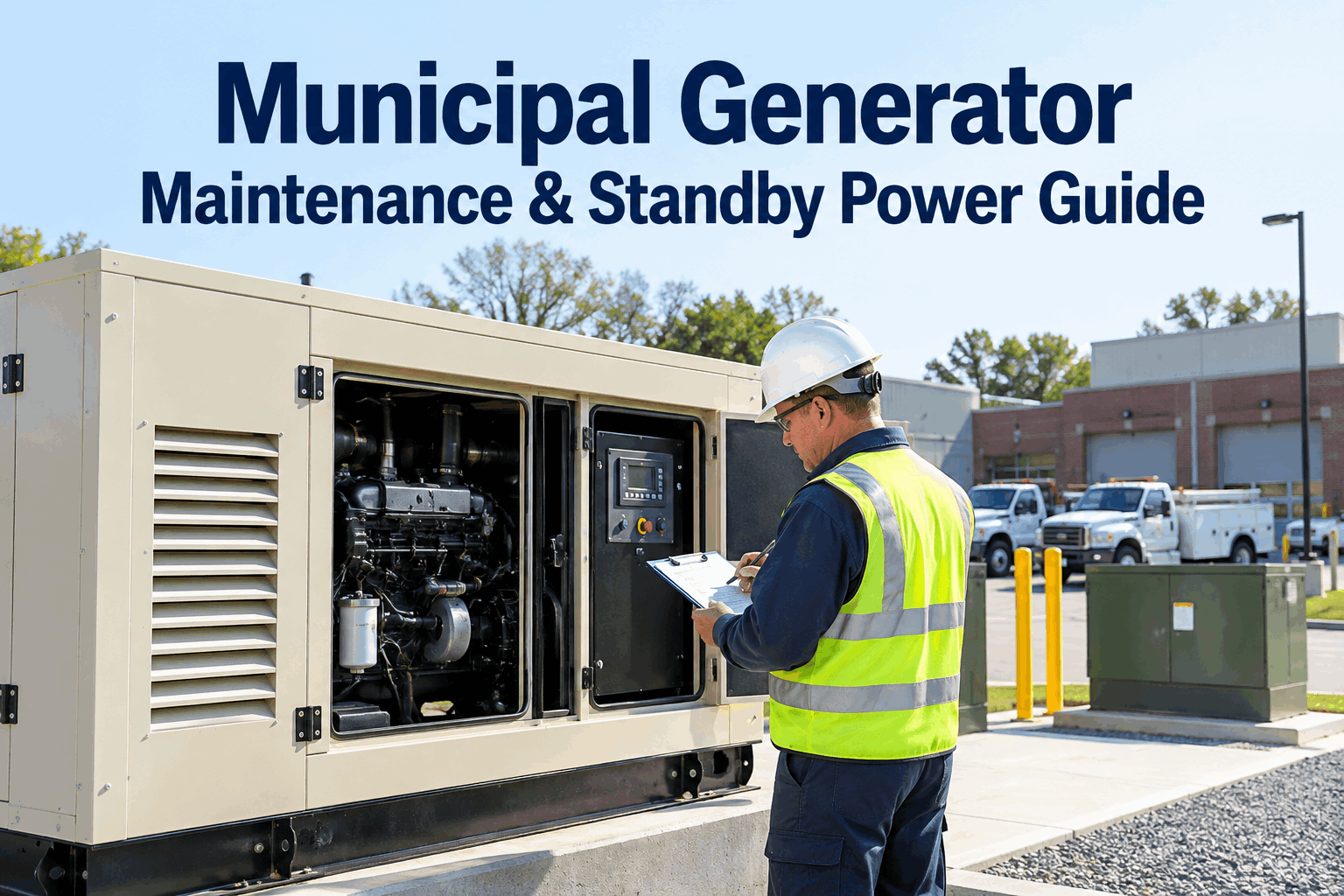
Municipal generator maintenance is a strange job: the equipment you worry about most is the equipment that almost never runs. Your standby generators sit silent at the water plant, the 911 center and city hall for months — until the grid drops at 2am and every one of them has to start on the first crank. The cruel part is that generators fail from sitting, not from working. Here's how to keep a municipal standby power fleet genuinely ready — not just assumed ready — with a program built around readiness.
The asset judged on the day it finally runs.
A standby generator spends almost its whole life idle, then gets graded on a single moment — the outage. You can't earn that reliability during the emergency; you build it with a steady program of exercise, inspection and documented service across every site. Make readiness the thing you manage.
Here's the trap every facilities and fleet manager eventually falls into: the generator passed its install test, it's covered under a service contract, so it must be fine. Then the power goes out during a storm, the lift station floods because its generator cranked and quit, and the after-action report asks when it was last actually run under load. HVI already publishes a detailed generator maintenance checklist for the line items; this guide is the layer above it — how a city runs standby power as a managed readiness program across every facility, so "it should be fine" becomes "here's the record." See every generator's readiness in one place.
Why standby generators fail sitting stillthe idle-failure modes that undermine municipal generator maintenance
A generator that never turns a wheel is still aging — just invisibly. Almost every no-start during a real outage traces back to one of these, and every one is preventable with a schedule instead of an assumption.
Dead batteries
The number-one cause of standby no-starts. Batteries quietly die while the set sits.
Stale, contaminated fuel
Diesel degrades, gels and grows microbial growth over months of storage, clogging filters.
Wet-stacking
A diesel run lightly loaded for short periods never gets hot enough, fouling the exhaust and injectors.
Coolant & block heater
A failed block heater or low coolant means a cold set that won't start or carry load fast enough.
Corrosion, pests & leaks
Months of weather and rodents in an enclosure cause the faults nobody sees without an inspection.
Transfer switch faults
The generator can run perfectly and still never carry the load if the automatic transfer switch doesn't signal.
None of these show up on a clipboard that says "under contract." They show up on a scheduled inspection that someone actually performs and records. See readiness inspections built for standby power.
Here, the calendar beats the hour meterwhy standby generator preventive maintenance runs on time and tests, not usage
Most of your fleet wears out by use, so you schedule on engine hours. Standby generators are the inverse — they wear out by time and neglect, so the schedule is driven by the calendar and by deliberate exercise. The recognized framework for emergency and standby power, NFPA 110, is built around exactly this rhythm.
Visual inspection
Fluids, battery, leaks, enclosure and no active alarms — a quick documented look.
Exercise run
Start and run under load to burn off moisture, cycle fluids and prove it starts.
Service checks
Filters, fuel condition, coolant, connections and transfer-switch operation.
Load-bank test
A full-load test that proves the set can carry real demand — not just idle.
Calendar-based and hour-based scheduling live side by side in HVI, so a generator exercises monthly and still gets service by runtime after a long outage. That blend is the heart of real preventive maintenance for standby power. See the exercise and service cadence run automatically.
One readiness picture across every facilityasset management and digital records for a scattered generator fleet
A city's generators aren't in one garage — they're at the treatment plant, the pump stations, dispatch, the fire halls, the shelter and the signal cabinets, with portable units moving between them. That scatter is why things get missed. Asset management puts every unit on one list with its own schedule and history, so you can see readiness at a glance instead of calling around.
Every exercise and inspection is captured as a time-stamped, signed digital record — the documentation NFPA 110 expects and the proof an after-action review asks for. Pull any unit's full service history in seconds through maintenance management. See every facility's generator on one board.
What a tested, documented program delivers
It starts when it counts
Regular exercise and inspection catch the idle failures before the outage does.
Readiness you can show
A signed record of every test and service — not a verbal "should be fine."
No facility forgotten
Every generator across every site on one list, with overdue units flagged.
Audit-ready documentation
The maintenance history NFPA 110 and your insurer expect, on demand.
It runs from a phone at the generator, so whoever performs the exercise logs it on the spot — no transcribing a clipboard later. Add your standby generators free and build the record from day one.
From a municipal emergency management officer
We learned this the hard way. A bad storm knocked out power to a pump station and the generator started, ran about four minutes, and died — wet-stacked and starved on old fuel because it had only ever been "tested" at no load for a few minutes a year. We had a basement full of water and a council meeting I'd rather forget.
Now every generator in the city is on a schedule — weekly looks, monthly exercise under load, the annual load bank — and it's all logged where I can see it. When someone asks if we're ready for storm season, I don't guess anymore. I pull up the list and every unit's last test is right there. For emergency power, that visibility is the entire job.
Municipal generator maintenance — FAQs
How often should municipal standby generators be maintained?
The widely recognized rhythm, reflected in NFPA 110 for emergency and standby power, is a weekly visual inspection, a monthly exercise run under load, periodic (often quarterly) service checks, and a full annual load-bank test. The exact intervals depend on the equipment, the manufacturer's guidance and your jurisdiction — but the principle holds everywhere: readiness comes from a calendar-driven schedule and real exercise, not from leaving the set alone until it's needed.
Why do standby generators fail if they're barely used?
Because idleness is its own form of wear. Batteries discharge and die, stored fuel degrades and grows contamination, seals dry out, moisture collects, pests get into enclosures, and a diesel that's only ever run briefly at no load wet-stacks. A generator can look perfect and still fail on the first real demand. Scheduled exercise and inspection are what surface these problems while there's time to fix them.
Does HVI run the generator or perform the load test for me?
No — HVI doesn't operate equipment or perform the physical tests. Your staff or your service contractor still run the exercise, inspection and load-bank test. What HVI does is make sure those happen on schedule and get documented: it triggers each task, captures the result as a signed digital record, flags overdue units, and keeps the full history per generator. It's the scheduling and record system, not a replacement for the hands-on work.
Can it handle generators scattered across many facilities?
Yes — that's exactly the problem it solves. Each generator, stationary or portable, sits on one asset list with its own location, schedule and service history. You get a single readiness picture across the water plant, dispatch, fire stations, shelters and signal cabinets, so no site's generator slips through the cracks because it wasn't in anyone's line of sight.
Can it schedule by both calendar and runtime hours?
Yes, and standby power is exactly where you need both. Most generator tasks are calendar-based — weekly, monthly, annual — because the risk is time and idleness. But after a long outage where a set runs for days, you also want service triggered by accumulated runtime hours. HVI supports calendar-based and hour-based scheduling together, so each generator gets whichever trigger comes due first.
Know your municipal generator maintenance is done — don't hope it is
Every standby generator on one list, every exercise and load test on schedule, and a signed record for each one — so when the grid drops, your backup power is ready and you can prove it was. See it on your own facilities in 30 minutes.
Weekly · Monthly exercise · Annual load test — all tracked · Records on demand