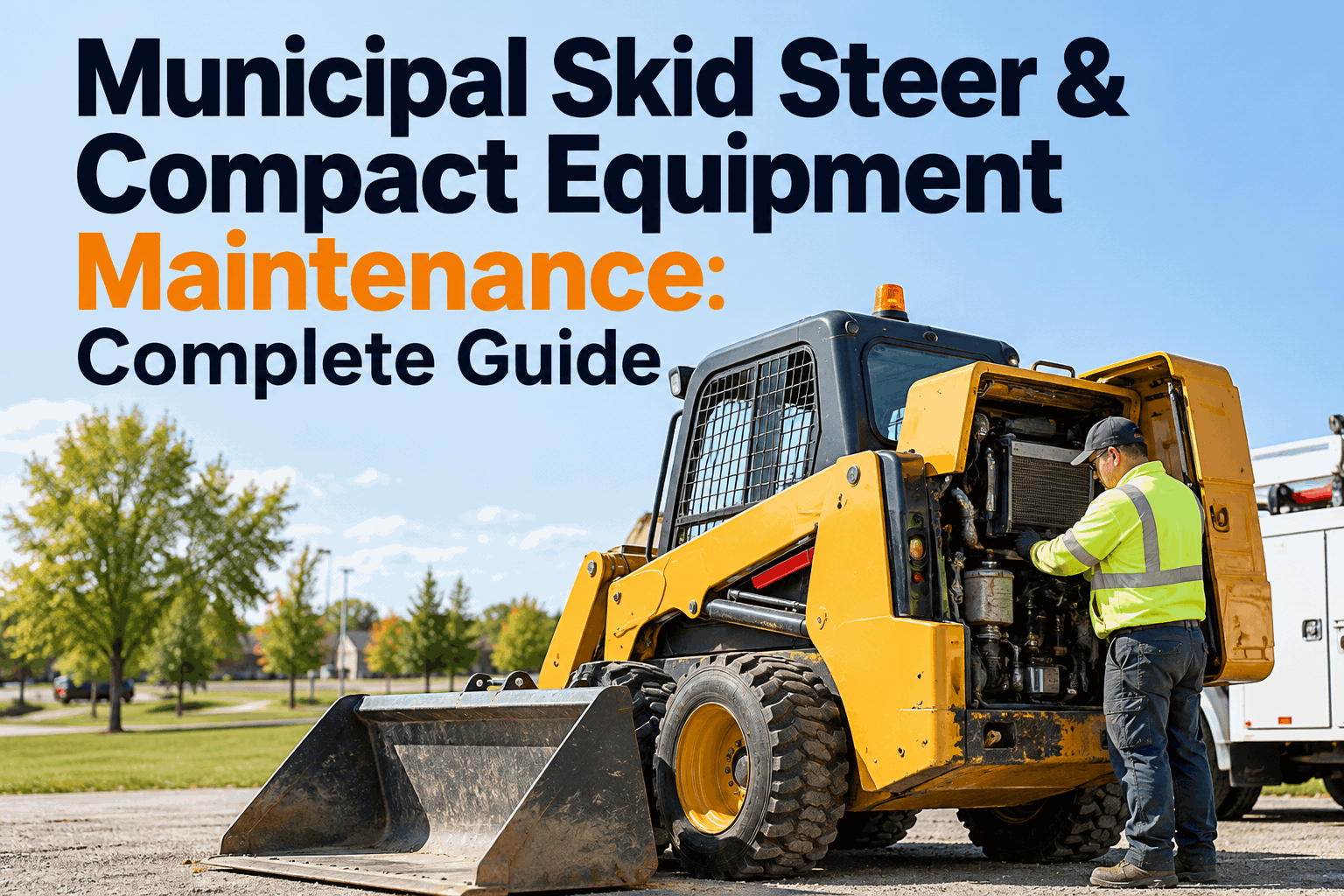
Monday it's grading a trail for parks; Tuesday streets runs a breaker with it; Wednesday utilities borrows it with a grapple. By Thursday nobody can say who checked the oil or what the hour meter read. That's the real problem with municipal skid steer maintenance: the machine is shared across departments, so upkeep belongs to everyone and gets done by no one. The fix isn't a better schedule — it's making the PM follow the machine, not the crew. Start free and give the machine an owner.
Municipal Skid Steer Maintenance Breaks Down on the Machine Nobody Owns
Six crews, six attachments, one unit — and a PM program that assumes a single operator who checks it daily. Here's how to maintain a machine that's shared across your whole public works yard.
- MonPublic works · bucket
- TueStreets · breaker
- WedUtilities · grapple
- ThuParks · broom
Four departments in four days. Every handoff is a chance for the pre-start and the hour log to simply not happen.
A skid steer is the most shared machine in a municipal yard — small, versatile, and passed between departments by the day. That sharing is exactly why its maintenance slips. A truck has a driver; a pooled skid steer has a rotating cast, and when a problem shows up, everyone assumes the last crew flagged it. The whole job is making the machine, not the department, carry its own inspection and PM history.
The handoff gapwhere shared skid steer maintenance falls through
Follow a pooled skid steer through a week and you can see exactly where the cracks open. Each arrow below is a handoff — and each handoff is a moment where the pre-start check, the hour reading, or a flagged defect quietly disappears between one crew and the next.
No one was careless — the information just had nowhere to live. A shared machine needs a shared record, tied to the unit, that every crew reads and writes. Start free and give every crew the same record. This is the municipal twist on the general skid steer and track loader maintenance programme, which covers the core PM intervals in depth.
Every attachment is its own machineone carrier, many tools, many service records
The other thing that makes a municipal skid steer different: it's really one powerhead wearing a dozen hats. The bucket, breaker, grapple, broom and snow blade each have their own wear, their own greasing, and their own failure modes — and each attachment swap pulls contamination through the hydraulic coupler. Track them as assets, not accessories.
Bucket
Cutting edge, pinsBreaker
Tool bushing, N₂ chargeGrapple
Cylinders, tine wearBroom
Bristle wear, motorSnow blade
Cutting edge, trip springsCoupler
Pins locked, flat-face cleanGive each attachment its own service record and its own hours, and the breaker that only runs 40 hours a year stops getting serviced on the same clock as the bucket that runs daily. Book a demo to track attachments as assets.
The handoff checklista shared-machine skid steer maintenance checklist
A pooled machine needs a checklist built around the handoff, not just the shift. The outgoing crew closes the loop; the incoming crew opens it. In HVI both sides are tap-through on the same unit record, so the seep public works noticed is the first thing streets sees.
Outgoing crew — log before you park it
- Record the ending hour-meter reading
- Note any leak, noise or warning seen
- Flag the attachment left on the coupler
- Report damage or a near-miss on the job
- Mark fuel and DEF level left in the tank
Incoming crew — verify before you run it
- Read the last crew's open notes first
- Walk-around for leaks and fluid levels
- Confirm coupler pins locked on the attachment
- Test interlocks and the lift-arm support
- Grease pivots and check tires or tracks
Close the loop at every handoff and the machine stops losing its memory between crews. Book a demo to see the handoff checklist on a shared unit.
The unit's own historyhours, operators and PM, following the machine
Here's what replaces the "who had it last?" phone calls: one screen for the unit, showing who ran it, for how many hours, with which attachment, and when the next service lands — captured offline in the yard and synced back at the shop.
The seep public works saw on Monday is on the record before utilities ever touches it — and the service counts down by real hours, whoever is running the machine.
This is hour-based preventive maintenance doing what a shared fleet actually needs: the schedule and the record live on the machine, so no department can drop the ball unseen. Book a demo to see a pooled unit's history.
From a yard foreman who shares machines across departments
The skid steers were always the hardest to keep straight — a truck belongs to a driver, but the compact stuff gets passed around like a shared tool. We'd find a machine down with a problem three crews had all noticed and nobody had written up, because on paper it wasn't "theirs." Now the record is stuck to the unit, not the department. Whoever picks it up sees what the last crew left, and the service clock runs on the machine's actual hours. The finger-pointing just stopped, because the history is right there.
Municipal skid steer maintenance — quick answers
Why is maintaining a shared municipal skid steer so difficult?
Because no single operator owns it. The machine rotates between departments by the day, so pre-start checks, hour logging and defect reports fall through the gaps between crews. The fix is tying the record to the unit itself, so every crew reads and writes the same history regardless of department.
Should skid steer PM be scheduled by hours or calendar?
By engine hours. A pooled skid steer's usage swings wildly — heavy one week, parked the next — so a calendar either over-services it or misses the interval. Hour-based PM triggers each service when the machine has actually earned it, counting hours no matter which crew logged them.
How should attachments be tracked on a municipal skid steer?
As their own assets, each with its own service record and hours. A breaker that runs 40 hours a year shouldn't share a service clock with a daily bucket. Tracking them separately also catches that every attachment swap is a contamination event at the hydraulic coupler, which drives filter timing.
What should a skid steer handoff check include?
The outgoing crew logs the ending hours, any leak or warning, the attachment left on, and fuel level. The incoming crew reads those notes, does a leak walk-around, confirms coupler pins are locked, tests interlocks and the lift-arm support, and greases pivots. The handoff is where a shared machine keeps or loses its memory.
How does HVI help with municipal skid steer maintenance?
HVI ties inspections, hours, defects and attachment records to the machine, schedules PM off its real hour meter, and captures checks offline for sync later. Any crew sees the last crew's notes, and failed items open work orders. It organizes the shared record — it doesn't replace OEM service specs or operator judgment.
Make municipal skid steer maintenance stick to the machine, not the department
HVI gives your pooled skid steers a single record every crew reads and writes, schedules PM off real engine hours, tracks each attachment as its own asset, and captures it all offline in the yard — so the machine nobody owns finally has a history everybody shares. Live across your compact fleet in under two weeks.
No credit card · No hardware · Shared-unit records from day one