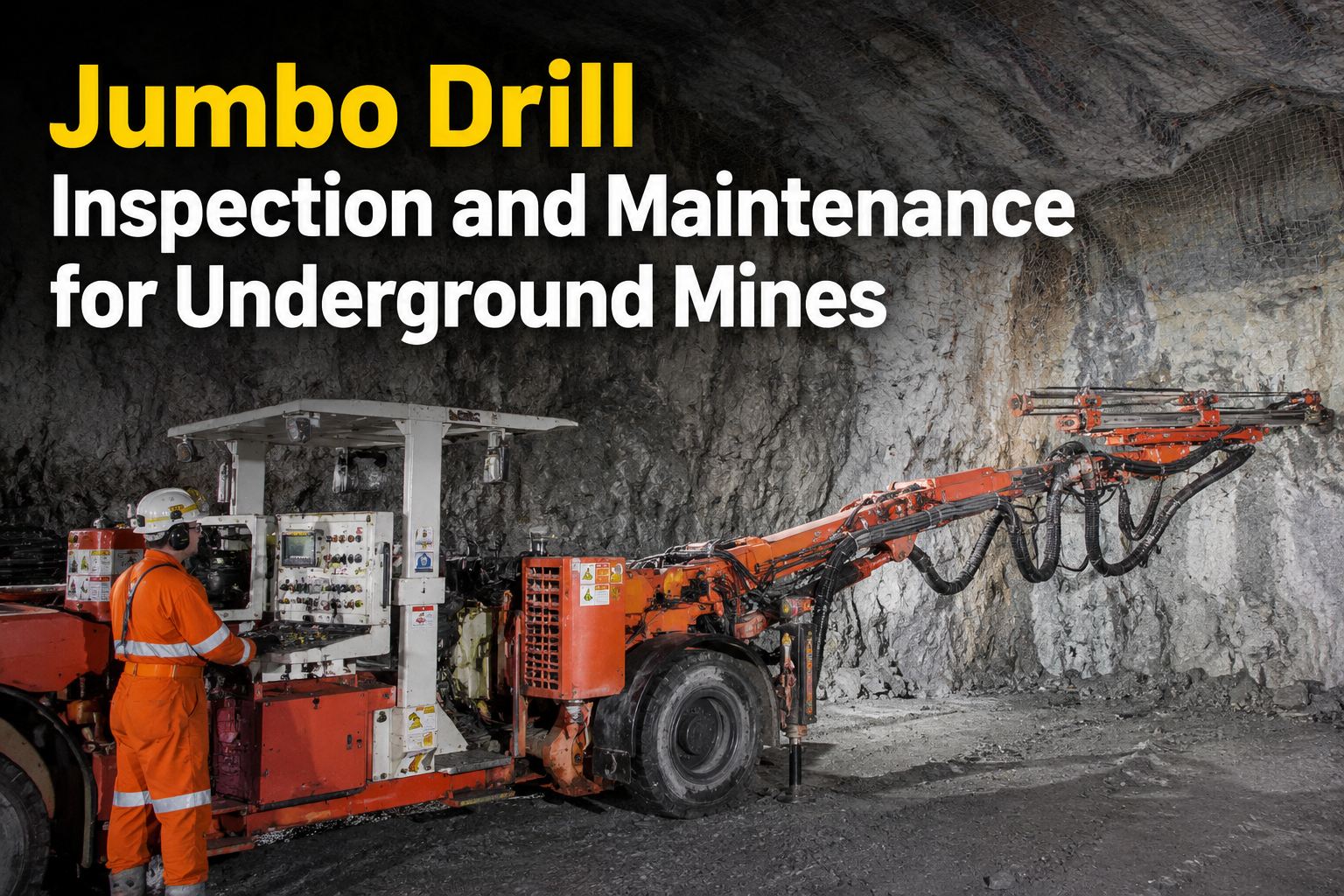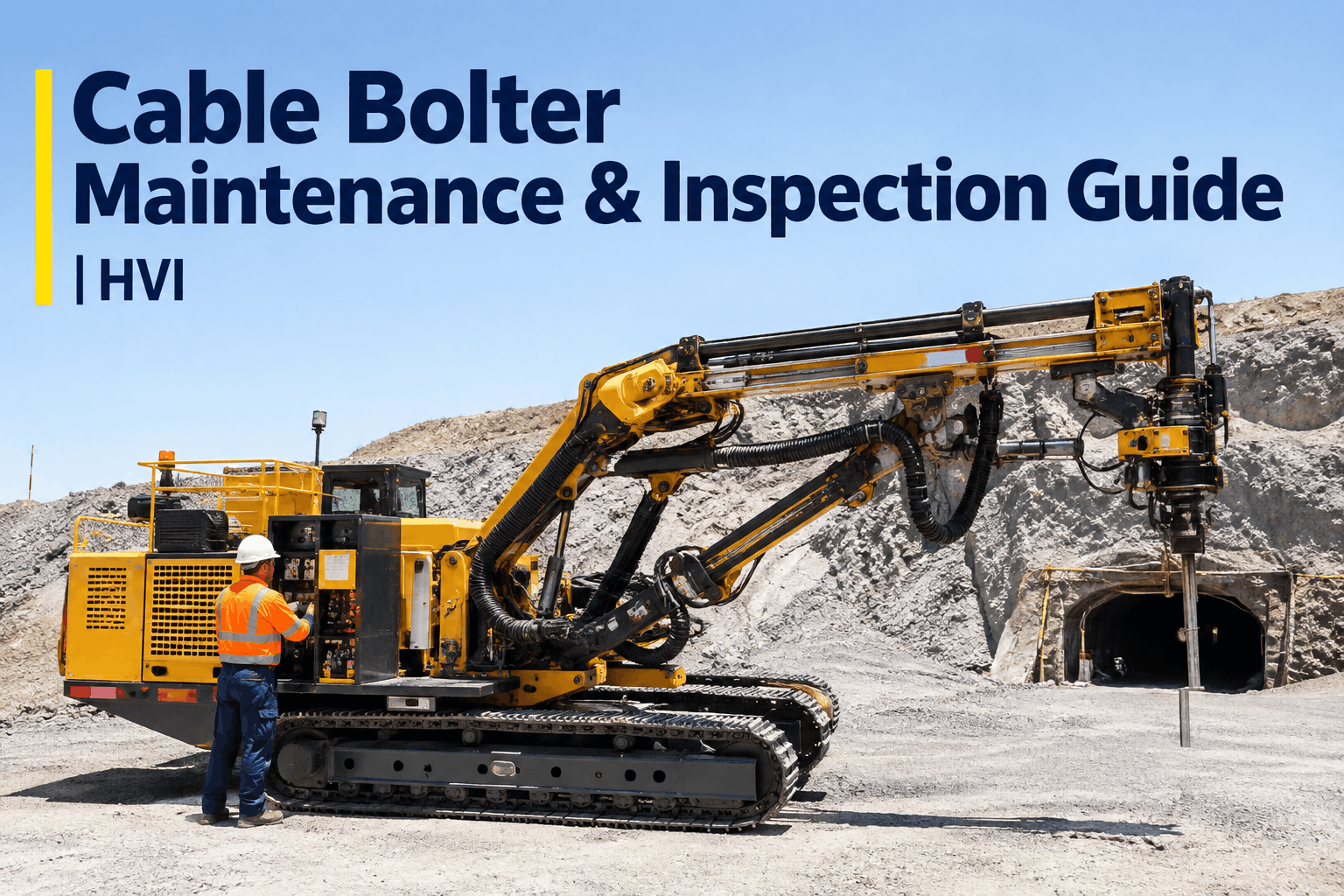
A cable bolter is three machines in one body: a drill that bores long deep holes, a cable system that feeds flexible steel tendons up into them, and a grout plant that mixes and pumps cement to bond it all — all done under freshly exposed, not-yet-supported ground, which is why the operator sits under a certified canopy. Each system fails its own way, and one of them, the grout circuit, will clog itself solid if you look away. Cable bolter maintenance is about keeping all three jobs and the protection around them reliable — because the support the machine installs is only as good as the machine installing it. See cable bolter inspections and PM built per machine
A Cable Bolter Drills, Feeds Cable, and Grouts — and Every Stage Has to Be Maintained
Follow the install sequence and you've mapped the machine's whole maintenance program.
-
1
Drill the holeDrifter, feed, drill steel and rotation — long holes in hard rock
-
2
Feed & push the cableReel, feeder box, and tube that push strand up the borehole
-
3
Mix & pump groutMixer, pump, and hoses that bond the cable — and clog if not washed
The grout circuit is the part that punishes neglect
Of the three systems, the grout circuit is the one that turns a small lapse into a big job. It handles abrasive cement that is engineered to set — and if any is left in the mixer, the pump, or the hoses at the end of a run, it does exactly that, setting inside the machine. A clogged grout line isn't a cleaning task; it's lost hoses, a stripped-down pump, and a bolter out of the cycle.
Wash out the whole grout circuit before it's parked, every time. The single discipline that prevents the most expensive downtime on the machine — and the one most likely to be skipped at the end of a hard shift.
Because the wash-out is easy to skip and costly to miss, it belongs in the maintenance system as a scheduled, signed-off task rather than a habit — and the mixer, pump, and hoses each get their own wear check on top of it. Grout quality also matters directly to safety: a poorly mixed or under-delivered grout weakens the bond that holds the cable, and the support that holds the ground. Book a demo to make grout wash-out a signed task.
The systems that protect the operator under bad ground
A cable bolter works where the ground has just been exposed and not yet supported — the most hazardous moment in the cycle. That's why part of its maintenance isn't about production at all; it's about the systems that keep the operator safe while the machine does its job. These are never "nice to have" checks.
FOPS/ROPS canopy or cabin
The certified protective structure over the operator. Inspect for damage, cracks, and secure mounting — its integrity is what stands between the crew and falling ground.
Boom & feed system
The boom positions the drill and cable head overhead under load. Check hydraulics, hoses, pins, and wear pads for leaks and play before the machine works beneath the back.
Interlocks & remote control
Remote operation keeps the operator out of the danger zone. Verify interlocks, emergency stops, and the remote respond correctly — a failed safety function is a stop-work item.
These checks sit at the front of any pre-shift inspection for a reason: a machine can be mechanically perfect and still be unsafe to run if the canopy is cracked or an interlock is bypassed. Treating operator-protection systems as first-priority inspection items, not afterthoughts, is what makes a cable bolter genuinely fit to work under unsupported ground. Try HVI Free — Put Safety Checks First.
The two sides of a cable bolter inspection
Because the machine does two very different kinds of work — boring holes and pumping grout — its inspection naturally splits into two halves. Run both and you've covered what breaks, wears, and clogs across the whole rig.
Drilling & cable side
- Drifter condition, percussion, and rotation
- Feed system, drill steel, and shanks for wear
- Cable reel, feeder box, and push tube
- Water flush and dust control
- Boom hydraulics, hoses, pins, and wear pads
Grouting & carrier side
- Grout mixer paddles, seals, and cleanliness
- Grout pump wear parts and pressure
- Grout hoses, lines, and nozzle for blockage
- Cement storage and water supply
- Carrier brakes, lights, steering, and canopy
Turning that split into a standard pre-shift inspection — the same one whichever operator is on the machine, with defined limits and a signature — is what makes a cable bolter reliable shift after shift instead of dependent on who happened to run it. And the grout half in particular rewards discipline, because that's where a skipped step compounds fastest. Book a demo to standardise the two-sided check.
Running the rig on a program, not on memory
Everything on this page — the grout wash-out, the safety checks, the two-sided inspection, the deeper service — only holds if it happens every shift, on every rig, no matter who's operating. That consistency is what a maintenance system delivers and a whiteboard can't, and for a cable bolter it rests on three HVI capabilities.
Fleet inspection / DVIR
A single pre-shift check covering drilling, cable, grout, hydraulics, and the FOPS canopy — safety items first, standard for every operator, signed before the rig works.
HVI: Fleet Inspection / DVIRPreventive maintenance
Grout wash-out, drifter service, feed and cable-system upkeep, and hydraulics scheduled on hours or interval and assigned — so nothing critical rides on memory.
HVI: Preventive MaintenanceMaintenance records
Every inspection, wash-out, and service retained against the rig — proof the machine installing your ground support was fit to run, ready for any review.
HVI: Maintenance RecordsHeld together, these turn a demanding three-in-one machine into a routine the system drives: the pre-shift check is standard and safety-first, the grout wash-out and wear services fire on time, and the record is there when a supervisor or auditor asks. On a rig whose work is literally holding up the ground, that's the difference between installed support you can trust and support you hope is sound. Start Free — Run It as a Program.
From a ground control maintenance lead
Cable bolters live and die by the grout system. We used to lose a rig every few weeks to set grout in a hose or pump because a crew skipped the wash-out at end of shift — and a bolter down means an area waiting on support. Once the wash-out and the canopy-and-interlock check went on the system as signed pre-shift tasks, with the drifter and grout-pump service on hours, the clog-ups basically stopped. On a machine holding up the back, knowing it's right beats hoping.
Frequently asked questions
What's the most important cable bolter maintenance task?
Washing out the grout circuit before the machine is parked, every time. A cable bolter pumps cement grout designed to set, so anything left in the mixer, pump, or hoses hardens inside the machine — turning a quick flush into scrapped hoses, a stripped pump, and a rig out of the cycle. No other single task prevents as much expensive downtime. Because it's easy to skip at end of shift, the wash-out should be a scheduled, signed-off step rather than a habit — with the mixer, pump, and hoses each getting their own wear check on top.
What are the main systems to maintain on a cable bolter?
Three working systems plus the operator-protection layer. The drilling system — drifter, feed, drill steel, and rotation — bores the long holes. The cable-handling system — reel, feeder box, and push tube — feeds the strand up the hole. The grout system — mixer, pump, and hoses — bonds the cable and is the most clog-prone. Around all of that sits the safety layer: the FOPS/ROPS canopy, the boom and feed hydraulics, and the interlocks and remote. Each has its own failure mode and check, so a cable bolter is maintained as several connected systems, not one generic service.
Why are the canopy and interlocks a maintenance priority?
Because a cable bolter works under freshly exposed, not-yet-supported ground — the most hazardous point in the cycle — and those systems keep the operator safe while it does. The FOPS/ROPS canopy is the certified structure protecting the operator from falling ground, and the remote and interlocks keep the operator out of the danger zone. A machine can be mechanically perfect and still unsafe if the canopy is cracked or an interlock is bypassed, so these belong at the front of every pre-shift inspection as first-priority, stop-work items, not afterthoughts checked if there's time.
How does maintenance affect the quality of the ground support installed?
Directly. The support a cable bolt provides depends on the grout bonding the strand to the rock, and that bond depends on grout that's properly mixed and fully delivered. A worn or clogged grout system, a mixer that isn't dosing right, or a pump that can't hold pressure can leave a hole under-grouted or the mix weak — weakening the anchorage that holds the cable, and the support holding the ground. So maintaining the grout system isn't just about uptime; it's about the integrity of the reinforcement itself. A well-maintained bolter installs support you can rely on; a neglected one installs support that quietly under-performs.
Why keep maintenance records for a cable bolter?
Because it's safety-critical equipment whose work is literally holding up the ground, so proving it was maintained matters. Records of every pre-shift inspection, grout wash-out, drifter and pump service, and canopy check show the machine was fit to run — for accountability, audits, and after any incident. Records also make the program work: they show when wear parts were changed, flag patterns before they fail, and keep the standard consistent across crews. On a rig installing ground support, a documented history is both a compliance asset and a way to trust the reinforcement it puts in the ground.
Keep the machine that holds up your ground reliably fit to run
HVI puts drilling, cable, grout, hydraulics, and the FOPS canopy on one pre-shift inspection for every cable bolter, schedules grout wash-out and wear services on hours or interval, and retains every record against the rig. So set grout never claims another pump, the safety systems are checked before the machine works under bad ground, and the support it installs is backed by a machine you know was fit.
No credit card · Pre-shift DVIR & grout wash-out per rig · Audit-ready maintenance records