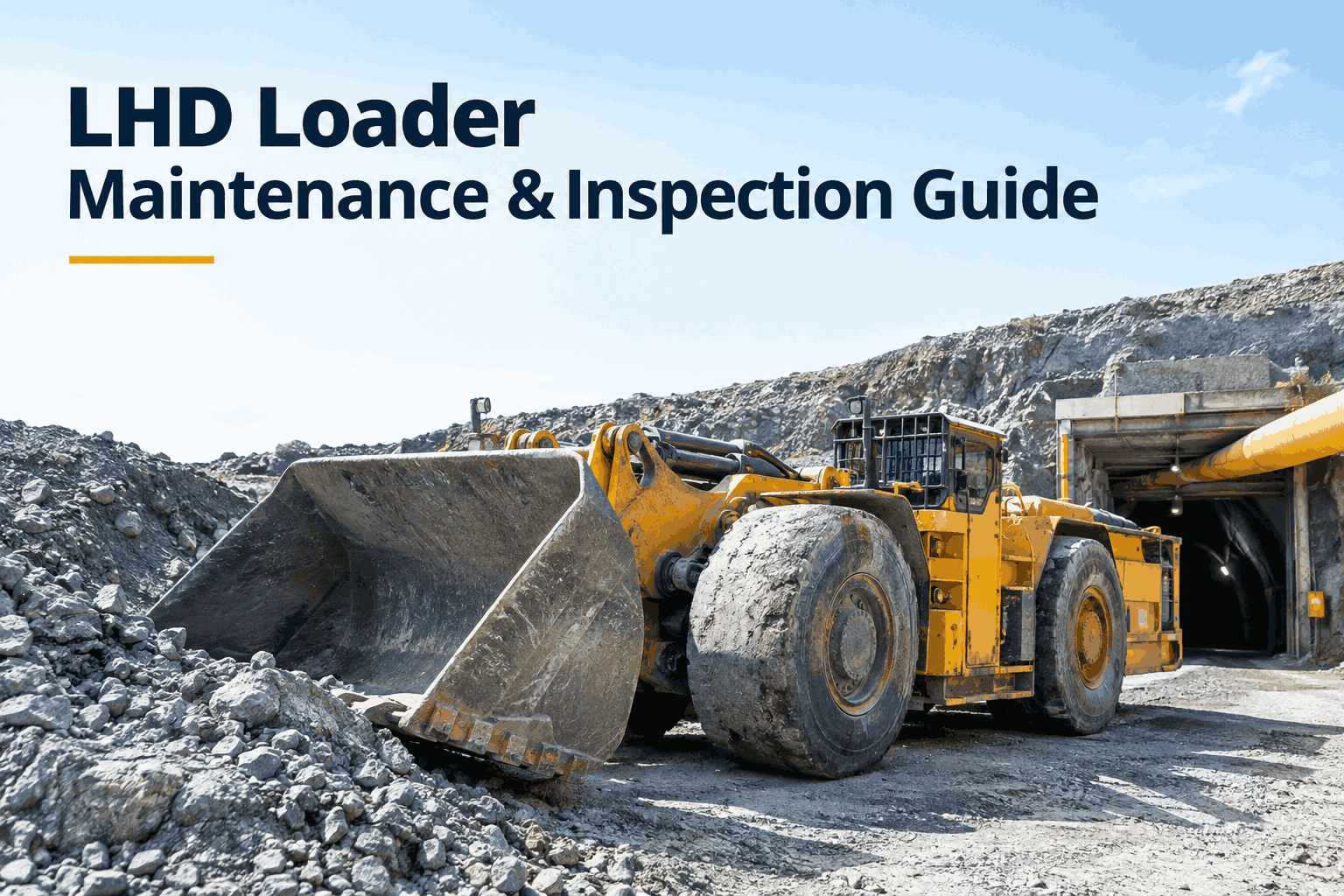
The LHD is the hardest-worked machine in the mine. It loads, hauls, and dumps in a near-continuous cycle through heat, dust, water, and tight drifts — and when it stops, the ore stops with it, because everything from the production face flows through it. That relentless duty is why LHD loader maintenance can't be casual: the articulation joint takes constant torsional load, the wet brakes wear fast on long declines, and the hydraulics run hot and contaminated. Catch that wear early and the machine keeps producing; miss it and a breakdown deep in a drift blocks the whole cycle. See LHD inspections and hours-based PM per machine
An LHD Is Maintained One Hard-Worked Zone at a Time
Pick a zone on the loader to see what wears there and what to check.
The pivot the whole machine steers and twists on, under immense torsional load every cycle. Grease it on schedule and check pins and bushings for wear — a neglected joint fails early and is costly to rebuild.
Spring-applied, hydraulic-released multi-disc brakes that must hold a loaded machine on a decline even if the engine dies. Constant use wears them fast — and enclosed brakes mean catching wear early avoids an axle teardown.
Powers lift, tilt, and steer, running hot and contamination-prone. Watch fluid condition, hose abrasion, seal leaks, and slow cylinder response — the small changes operators tend to work around until they can't.
One of the biggest running costs on the machine, cut and heated by sharp muck and long trams. Check condition, pressure, and cuts every shift — a blowout underground is downtime and a hazard in a tight drift.
Two systems you never run on a guess
Most of an LHD's maintenance is about uptime. Two systems are about lives. On a machine hauling tonnes of rock down grade through a confined drift, the brakes and the steering are the difference between a normal shift and a runaway — and neither is ever a "check it if there's time" item.
The braking system
Test brake response, pressures, and accumulator pre-charge on every pre-shift. SAHR brakes must hold a loaded machine on a decline with the engine off — test them, don't assume them. Wear that's caught on a gauge beats wear found on a ramp.
Articulation & steering
Grease the centre joint on schedule and inspect pins, bushings, and the steering cylinders for play and leaks. The joint carries every turn and the machine's torsional load — failure here means losing steering in the worst possible place.
These two sit at the top of any LHD inspection for the same reason: the machine can be productive and still be unsafe if a brake circuit is soft or a steering pin is worn. Putting them first, tested and signed every shift, is what makes an LHD genuinely fit to load and haul. Book a demo to put brake and steering tests first.
Where the maintenance money and downtime go
Not every system costs the same to keep running. On most LHD fleets, a handful of areas dominate the maintenance spend and the unplanned downtime — and knowing which ones tells you where preventive attention pays back fastest.
Catching wear before it catches you
The single biggest shift a serious LHD program makes is from fixing things when they break to seeing them coming. On a machine this heavily used, the wear signals are there long before the failure — if someone is looking for them and recording what they see. Start free and capture the wear signals per machine.
Fix it when it stops
- Hydraulic response degrades until a cylinder gives out mid-cycle
- Brakes worn to an axle teardown instead of a disc change
- A blown tyre or dropped joint deep in a drift
- Downtime at $5,000–$20,000 an hour, unplanned
See it coming
- Oil sampling and pressure trends flag hydraulic wear early
- Brake wear caught on gauge before the axle has to come apart
- Tyre and joint condition trended shift to shift
- Planned repair at a fraction of the emergency cost
Getting there doesn't take exotic technology — it takes a consistent inspection that captures the readings, a PM schedule tied to hours, and a record that lets you see the trend rather than just today's number. That's how the mine's busiest machine becomes its most predictable one. Book a demo to trend LHD wear before it fails.
From an underground maintenance manager
Our LHDs are the whole production chain — when one's down in a drift, the face stops. We were replacing brakes on axle teardowns and losing hydraulics mid-shift, all reactive. Moving PM to engine hours, testing brakes and greasing the artic joint every pre-shift, and actually recording the oil samples changed everything. Now I catch a soft brake circuit or a hydraulic trend before it strands a machine, and the surprise teardowns are basically gone. On the busiest machine we own, going from hoping to knowing beats any single repair.
Frequently asked questions
What are the most important things to maintain on an LHD loader?
The systems carrying the machine's heaviest and most safety-critical loads: the SAHR wet brakes, the central articulation joint and steering, the hydraulics for lift, tilt, and steer, the drivetrain, and the tyres. Brakes and articulation come first because they're safety-critical — the machine hauls tonnes down grade and steers through tight drifts on them. The articulation joint needs regular greasing and pin-and-bushing checks because it carries the machine's torsional load; brakes need testing every shift because they wear fast and an enclosed-brake failure means a costly axle teardown. Each is a distinct check forming the core of an LHD program.
Why should LHD preventive maintenance be based on hours, not the calendar?
Because an LHD's wear tracks how hard it works, not how many days have passed, and utilisation varies enormously between machines. A loader running double shifts through a heavy mucking campaign wears far faster than one sitting idle waiting on development, so a calendar interval services the busy machine too late or the quiet one too early. Hours-based scheduling ties each service — oil changes, brake inspections, articulation greasing — to actual operating hours, which is why it's the foundational requirement for underground fleet maintenance. It keeps the busiest machines serviced on time without wasting service on idle ones.
Why do LHD brakes wear out so quickly?
Because they're used constantly and hard. LHDs haul heavy loads down grades in a repetitive load-haul-dump cycle, placing continuous demand on the braking system, which causes premature wear. Most use spring-applied, hydraulic-released wet multi-disc brakes for safety, and because these are enclosed and oil-immersed, changing them often means disassembling the axle — considerable time and cost. That's why testing brake response and pressures every shift and tracking wear matters so much: catching it early lets it be planned into a maintenance window rather than forcing an emergency axle teardown that strands the machine and blocks production.
How much does LHD downtime actually cost?
A lot, and more than the repair itself. Unplanned underground downtime is estimated at $5,000 to $20,000 per hour, because an LHD sits at the heart of the production chain — when one breaks down in a drift, it blocks ore flow from the face and the cycle stalls. On top of lost production, preventive maintenance typically costs four to five times less than the emergency repair of the same component. Across the fifteen to twenty unplanned incidents a mid-size fleet might see a year, reactive maintenance runs into serious money — the core reason to catch wear before it breaks.
What should be on an LHD pre-shift inspection?
The safety-critical and high-wear items, checked before the machine works: brake response and pressures, steering and articulation, hydraulic levels and leaks, tyre condition and pressure, ROPS/FOPS integrity, lighting, and fire suppression — plus fluid levels and cooling-area dust buildup. Pre-shift inspections on underground equipment are legally required under MSHA, and the current standard is a digital check with photo capture and an audit trail, not paper that gets lost. Running the same inspection every shift, whichever operator is on the machine, is what makes an LHD reliable and the record dependable.
Keep the machine your whole production runs through always ready
HVI puts the LHD pre-shift check on a standard digital inspection, schedules brake, articulation, and hydraulic service on operating hours, and records every reading so wear shows as a trend before it becomes a breakdown. So the loader at the heart of your ore flow is verified safe each shift, serviced when it's actually due, and far less likely to strand your production deep in a drift.
No credit card · MSHA-ready pre-shift inspection & hours-based PM per LHD · Audit-ready records