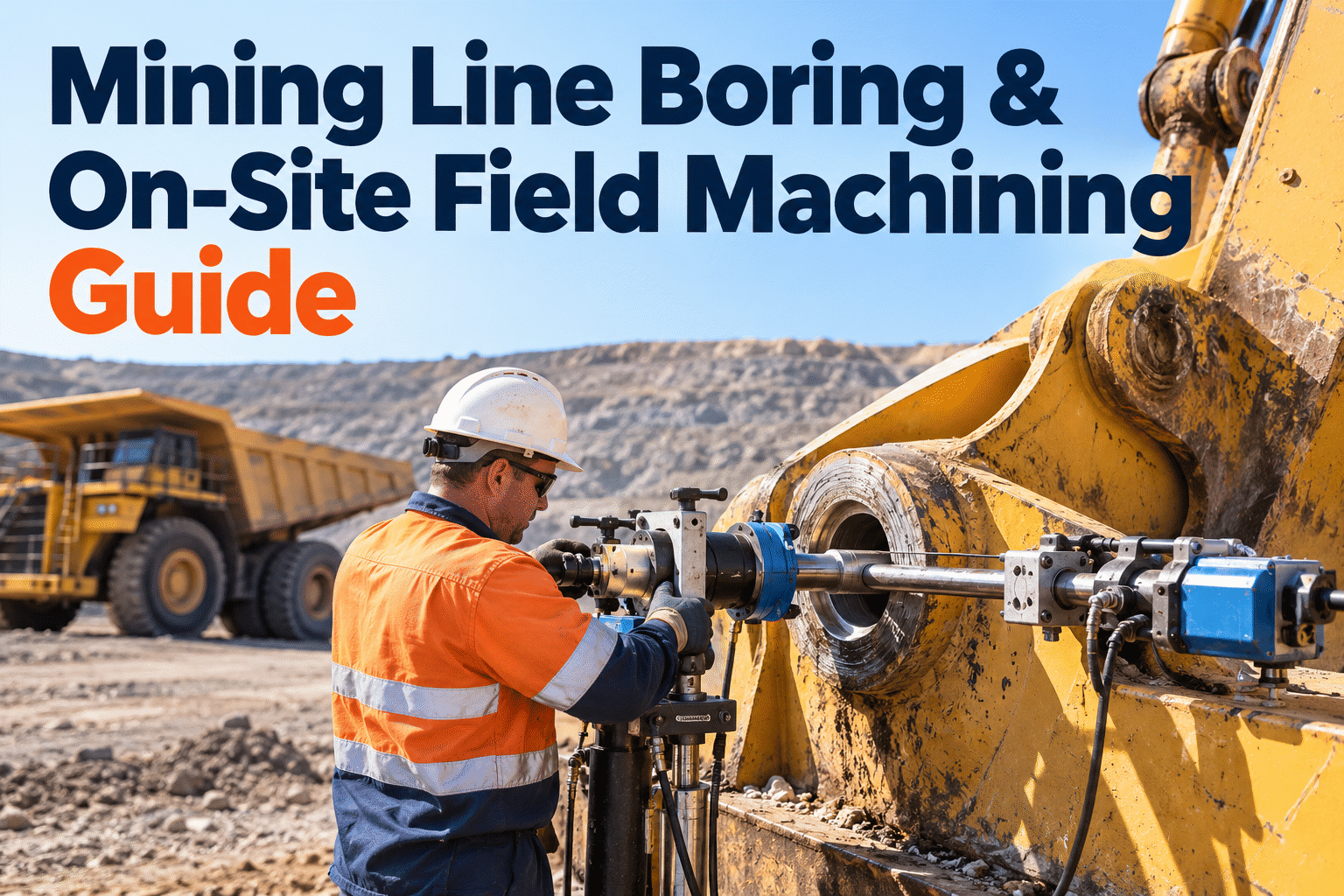
A mine excavator develops movement at its bucket linkage during a production shift. The workshop finds ovalized pin bores, but removing the entire structure could take the machine out of service for days. Line boring mining equipment can restore specified bore geometry at the mine site when a qualified repair team confirms the structure is suitable. This guide covers inspection, repair planning, machining controls and cost decisions—and how to book a demo to organize mining repair work orders in HVI.
Line Boring & On-Site Field Machining for Mining Equipment
Know when to repair worn pivot bores on site, when to replace a component, and how to document every critical measurement and maintenance decision.
Repair acceptance depends on OEM-approved dimensions, alignment, material condition and inspection—not appearance alone.
What is line boring in mining equipment maintenance?
Line boring is a machining process that restores the size, roundness and alignment of one or more bores along a common axis. Portable line boring equipment is positioned on the machine or detached assembly, allowing technicians to machine worn pivot connections without always transporting large structures to a workshop. Typical applications include excavator boom and stick joints, loader bucket linkage, attachment ears, hinge points and selected chassis or support assemblies.
Mining equipment bore repair is not simply a matter of making a hole round again. A successful job starts with identifying why the joint failed, inspecting the surrounding structure and confirming that enough sound material remains for an engineered repair. Worn pins, seized bushings, poor lubrication, contamination and misalignment may all contribute to the original damage. If those causes remain, the repaired bore can deteriorate again.
Consider on-site line boring
Access is safe, the structure is repairable, approved dimensions are available, and avoiding major disassembly offers a practical downtime benefit.
Consider workshop repair
Extensive welding, controlled machining, detailed inspection or specialized fixtures make workshop conditions preferable.
Consider replacement
Cracks, distortion, material loss or repeated failures make repair technically unsuitable or uneconomic after engineering review.
Where there is cracking, load-path damage or uncertainty about weldability, isolate the machine and obtain the appropriate engineering and manufacturer guidance before proceeding. A portable machining setup does not make a structurally unsound component safe.
Five findings that determine whether a bore is repairable
Bore geometry
Measure diameter, ovality, taper and relative position at multiple points using calibrated instruments.
Pin and bushing condition
Check wear, seizure marks, looseness, incorrect fit and lubrication passage condition.
Parent metal integrity
Inspect for cracking, deformation, previous weld repairs and loss of structural material.
Joint alignment
Confirm mating bores can be restored to the specified common axis and fit the connected assembly.
Repair specification
Confirm approved finished dimensions, allowable buildup methods, tolerances and inspection requirements.
Document the initial measurements and photographs before removing more material. A digital inspection record helps preserve the original defect evidence and provides a baseline for the final repair report. Sign up to start recording mining equipment inspections in HVI.
How an on-site line boring repair is planned and verified
Field machining mining equipment requires coordinated isolation, lifting and support arrangements, hot-work controls when welding is involved, and a documented dimensional acceptance plan. The steps below describe the management workflow, not instructions for unqualified personnel to perform machining or welding.
Isolate & assess
Lock out equipment, secure suspended loads, assess access, inspect damage and approve the repair scope.
Establish datum
Record pre-repair dimensions, establish the reference axis and confirm OEM or engineering requirements.
Prepare structure
Remove unsuitable material; carry out authorized weld buildup or other approved restoration as needed.
Machine & measure
Use a qualified field-machining team to restore geometry and verify measurements during the job.
Reassemble & test
Install specified pins and bushings, verify lubrication, complete checks and obtain release approval.
For repeatable repairs, attach the repair scope, permits, measurements, supplier documentation and release authorization to a single maintenance record. Book a demo to see how HVI work orders organize field repair evidence.
Keep inspections, repair work orders and costs connected
Give maintenance teams a consistent record of what failed, what was repaired and when the equipment was released.
On-site machining vs. component replacement: compare total impact
The lowest quoted repair price is not always the lowest-cost option. For a mining excavator, total impact includes production interruption, disassembly, transport, contractor mobilization, replacement parts, post-repair testing and the risk of a repeat failure. Evaluate each option on the same basis, including whether it is technically permissible.
| Decision factor | On-site line boring | Workshop repair | Replacement |
|---|---|---|---|
| Major transport | Often reduced | May be required | Depends on assembly |
| Field access | Essential | Less critical | Depends on removal |
| Dimensional control | Portable setup and inspection | Workshop equipment | New or rebuilt assembly specification |
| Structural repair | Only when approved and feasible | More controlled environment | Avoids repairing rejected structure |
| Downtime drivers | Mobilization, setup, machining | Removal, transport, repair | Parts lead time, installation |
| Acceptance evidence | Measured dimensions and sign-off | Repair inspection report | Part conformity and installation checks |
Direct repair cost = labor + machining + welding + consumables + replacement pins/bushings + contractor costs.
Total decision cost = direct repair or replacement cost + estimated downtime impact + logistics + residual risk.
For example, a remote mine may prefer field repair when mobilizing a specialist is faster than transporting a large attachment. At another site, a ready-to-fit exchange assembly may return the machine to service sooner. Neither approach is universally better. Use site-specific costs, realistic lead times and approved technical criteria, not a generic savings percentage.
Field machining work order: the evidence your team should retain
Excavator EX-204 · Bucket linkage bore restoration
Machine ID, hour meter, location, defect description, photos and operating impact.
Approved repair method, bore drawings, material assessment and engineering sign-off.
Before-and-after diameter, roundness, alignment, fit and instrument references.
Contractor, labor hours, permits, parts, consumables and repair dates.
Final inspection, assembly checks, operational test and authorized return-to-service decision.
Lubrication actions, inspection due date, recurring failure watch and final cost.
Good documentation makes the next repair decision easier. A future technician should be able to tell which bore was restored, what dimensions were accepted, whether a bushing was changed and whether the same joint has failed before. Missing measurement reports can turn an otherwise successful field repair into a weak maintenance history.
Use consistent asset IDs, fault categories and repair codes across crews and contractors. Book a demo to review mining maintenance history and repair tracking in HVI.
How to reduce recurring pin bore damage after repair
Control lubrication
Confirm grease delivery reaches the load-bearing surfaces. Check blocked passages, damaged seals and unsuitable lubrication practices.
Check fit and alignment
Verify the pin, bushing, retainer and adjacent bores meet the approved assembly requirements. Misalignment can accelerate renewed wear.
Review operating conditions
Investigate impact loading, excessive side loading, abrasive contamination and attachment use that exceeds design assumptions.
Trend defects by joint
Track recurring looseness, cracks, grease loss and repair frequency at each pivot rather than only at the whole-machine level.
Set inspection frequency according to duty severity, failure consequence and manufacturer guidance. A recently repaired joint may warrant an additional early follow-up inspection, but the interval should be approved by the responsible maintenance and engineering team. Inspection results should feed the preventive maintenance plan rather than remain isolated in daily checklists.
For fleet managers, the useful trend is not merely how many line boring jobs were completed. It is whether repeated pivot failures, repair lead times and lost production hours are improving. Start free to organize mining equipment inspections and service history.
A practical 30-day plan for better field repair control
Map recurring failures
Identify machines and joints with repeated pin or bushing repairs. Gather prior work orders and photographs.
Standardize inspection
Agree on defect categories, measurement fields, engineering triggers and required repair attachments.
Align repair approvals
Define who approves field machining, welding, contractor mobilization and final equipment release.
Review results
Compare repair duration, costs, repeat defects and missing documentation; refine the workflow.
Begin with one high-impact asset group—such as excavator attachments—rather than rewriting every mine maintenance procedure at once. Involve the workshop supervisor, reliability engineer, operations representative and specialist machining contractor. Their agreement on acceptance criteria is more valuable than adding extra forms nobody uses.
Use HVI to organize the maintenance work around field machining
HVI is a fleet maintenance management platform, not a provider of portable line boring or welding services. Its value is helping mining teams organize the inspections, service requests, work orders, parts activity and repair histories that surround a specialized repair. Specific workflows and available fields should be confirmed during product evaluation.
Digital inspections
Capture worn-joint findings, photographs and inspection follow-up records.
Maintenance work orders
Coordinate repair tasks, assigned personnel, status and supporting documents.
Equipment history
Keep prior repair activity visible when assessing repeated bore or bushing damage.
Maintenance planning
Schedule approved follow-up checks and routine service for repaired assets.
When evaluating software, ask whether your team can attach contractor reports, search repair history by machine, track downtime consistently and export the evidence required by site maintenance reviews. Book a demo to explore HVI for mining field repair management.
Line boring mining equipment: FAQs
When does mining equipment need line boring?
Line boring may be considered when a pivot bore is worn, ovalized or out of alignment and the component is suitable for an approved repair. Qualified personnel must inspect the surrounding structure and compare measured dimensions with the relevant specification.
Can line boring be done on an excavator at the mine site?
Yes, portable line boring can sometimes be performed on site when access, machine isolation, structural condition, tooling, environmental controls and qualified personnel make the work feasible. Some repairs still require removal or workshop processing.
Is weld buildup always necessary before line boring?
No. The restoration method depends on the extent of wear, component design, material properties and approved repair procedure. Welding should not be assumed suitable without appropriate technical assessment.
How do you decide between line boring and replacing an attachment?
First determine which options are technically and safely acceptable. Then compare repair scope, replacement availability, total cost, expected downtime, structural integrity, service life and the likelihood of recurring damage.
What should a mining line boring maintenance record contain?
Keep the asset ID, defect report, photographs, approved scope, original and final measurements, repair documentation, parts used, contractor details, cost, inspection results and authorized return-to-service approval.
Track mining field repairs from inspection to closeout
Connect equipment defects, maintenance work orders and follow-up inspections so critical repair records stay accessible across the mine fleet.