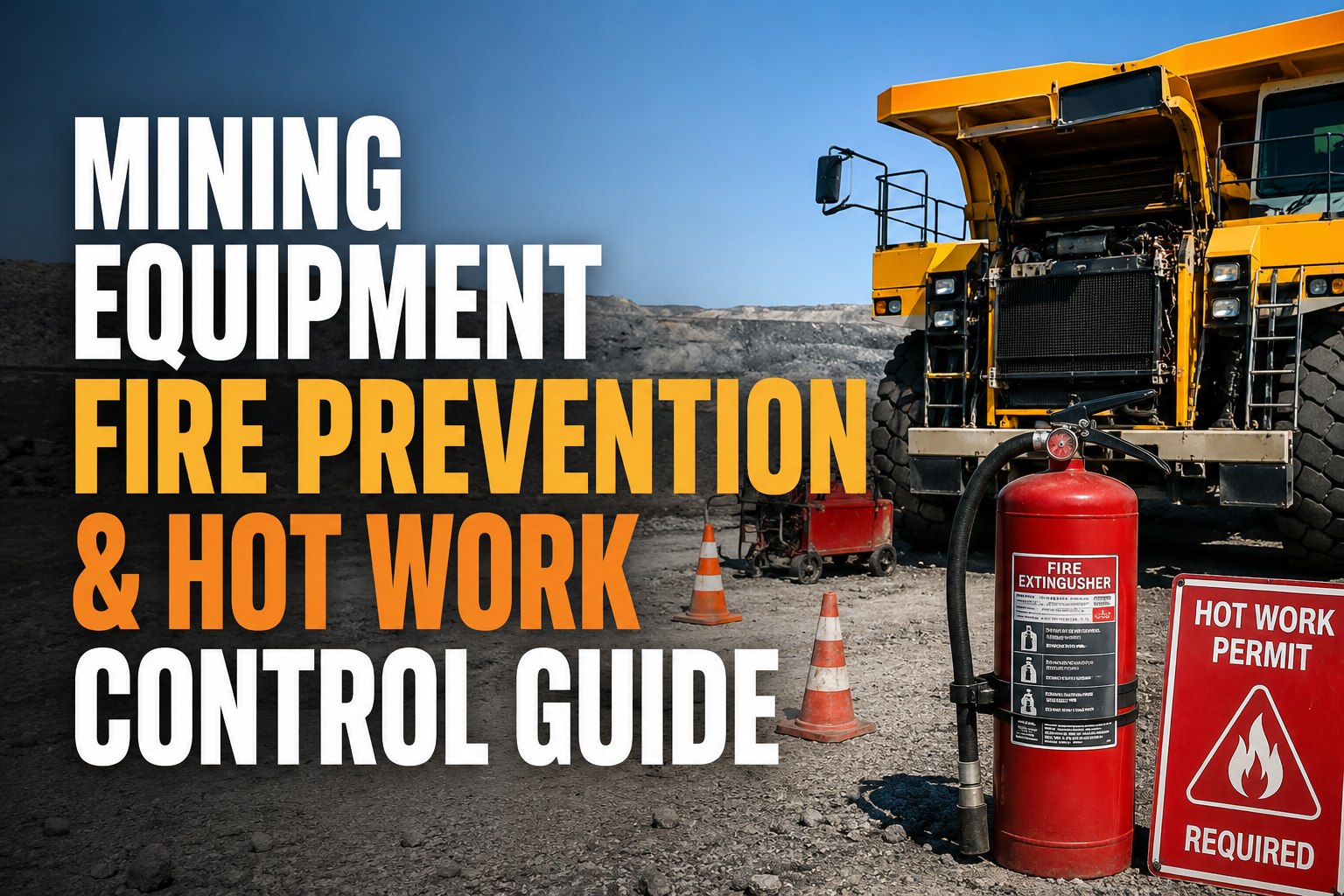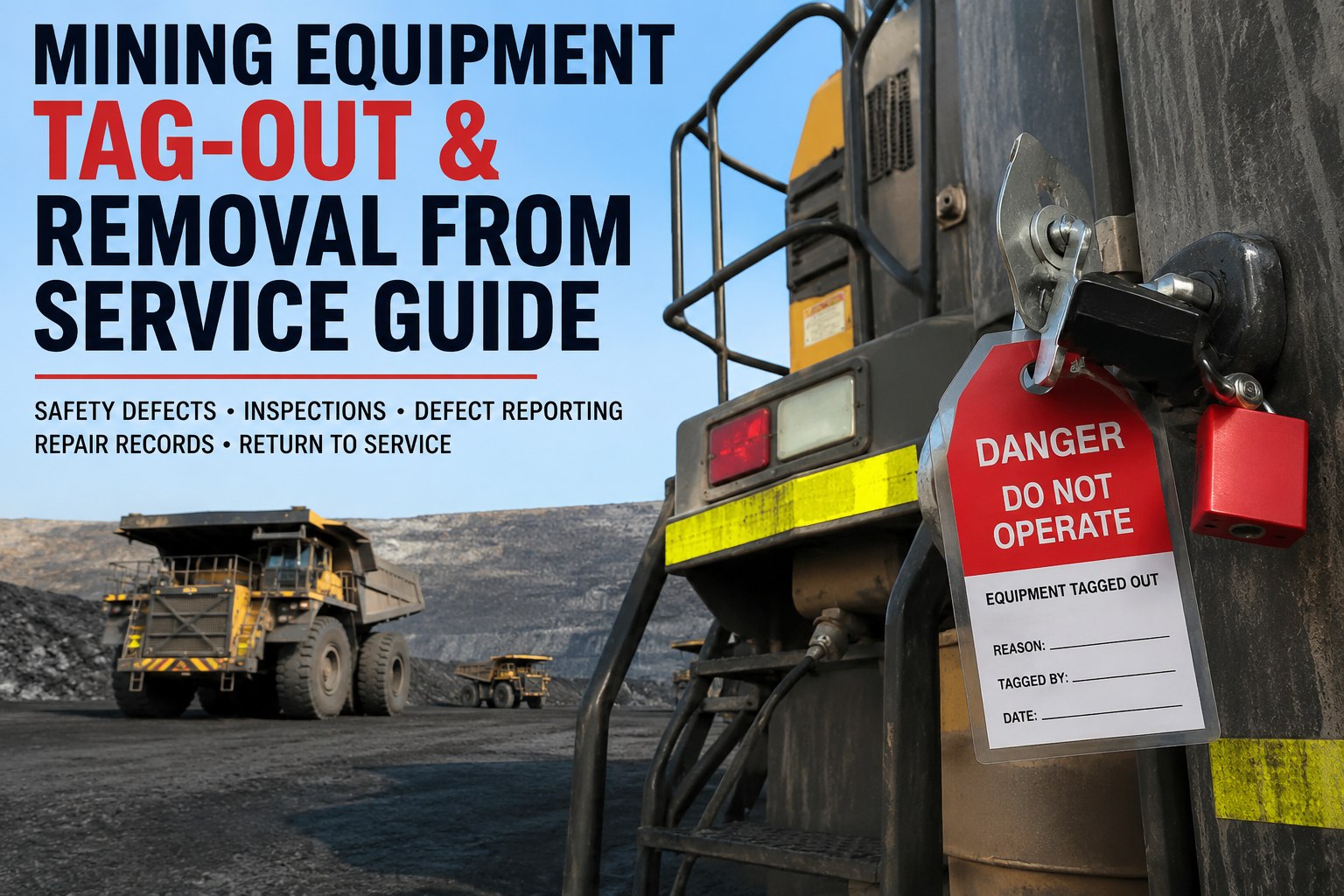
Mining equipment removal from service under 30 CFR 56.14100 (surface metal/nonmetal) and 57.14100 (underground metal/nonmetal) is a specific regulatory workflow, not general safety policy. A defect that affects safety must be corrected in a timely manner; a defect that makes continued operation hazardous requires the equipment to be taken out of service and either placed in a posted designated area or tagged with an effective method until corrected. Getting the lifecycle right — identify, assess, control, repair, verify — is where compliance outcomes diverge. Book a demo .
Mining Equipment Removal From Service — The Six-Stage Defect Lifecycle
Each stage maps to a specific regulatory requirement. Skipping one is not a paperwork issue — it's the difference between a corrected defect and a citation.
-
01Identify Pre-shift inspection captures defect
-
02Assess Does defect affect safety? Is continued operation hazardous?
-
03Report + record Defect not corrected immediately → recorded per 14100(d)
-
04Remove from service Designated area or effective tag per 14100(c)
-
05Repair + verify Work order, corrective action, technician verification
-
06Return to service Documented verification → tag removed → back in operation
The distinction that separates fleets from enforcement risk is not whether they identify defects — every fleet does — but whether the defect lifecycle from identification through return to service is documented, controlled, and complete. 30 CFR 56.14100 and 57.14100 are among the most-cited MSHA standards in metal and nonmetal mining precisely because the paper trail is what the enforcement action references. An inspector reviewing pre-shift inspection records who finds a documented defect on an operating unit — without corresponding removal-from-service action, tag or designated-area control, or corrective work order — has the citation elements already assembled. The record proves the operator knew about the defect and continued to operate. Digital records systems don't change the standard; they change how completely, cleanly, and defensibly the lifecycle is documented across every unit.
Removal-from-service tagging is not lockout/tagout — the distinction that mattersTwo different regulatory frameworks that address different hazards — and get confused constantly
The word "tag" appears in both regulatory frameworks, which is where the confusion originates. But removal-from-service tagging under 56.14100(c) and hazardous-energy lockout/tagout under 56.14105 address different hazards, require different controls, and have different regulatory tests. Book a demo to see HVI's distinct workflows for each
Purpose: Prohibit further use of equipment with a defect that makes continued operation hazardous to persons.
Trigger: A safety defect meets the 14100(c) hazardous-operation test.
Control: Place in designated posted area, OR tag/mark with effective method to prohibit further use.
Duration: Until defects are corrected.
Purpose: Protect workers performing repair or maintenance from unintended startup or release of hazardous energy.
Trigger: Repair or maintenance activity on equipment where hazardous energy could injure workers.
Control: Machinery blocked against motion, controls placed in safe position, power sources isolated, energy sources rendered inoperative.
Duration: Throughout the maintenance activity.
The defect assessment — where the "hazardous to persons" test livesThe judgment that separates 14100(b) timely correction from 14100(c) removal from service
Not every safety defect requires immediate removal from service. The regulation distinguishes between defects that affect safety (14100(b) — correct in a timely manner) and defects that make continued operation hazardous to persons (14100(c) — remove from service until corrected). The assessment sits with the operator; MSHA reviews the outcome. A documented assessment methodology is what makes the judgment defensible if reviewed. Start a free trial to build defect severity assessment into your inspection templates.
Component condition issue that affects safety systems but does not create immediate operating hazard. Common examples: worn but functional brake linings within manufacturer wear range; minor hydraulic seep without volume loss; loose but attached guard hardware; light-fixture damage where alternate lighting exists.
14100(b) response: Correct in a timely manner. Timeframe determined by operator based on hazard assessment, equipment use, and available maintenance windows. Documented in inspection record; tracked to closure.
Defect condition where continued operation would create a hazard to persons. Common examples: brake system defect affecting stopping capability; steering system defect; ROPS/FOPS structural damage; unguarded moving parts near work area; leaking fuel or hydraulic system near ignition sources; failed safety-critical interlock.
14100(c) response: Take out of service. Place in posted designated area OR tag with effective method to prohibit further use. Do not return to service until corrected. Recorded per 14100(d) if not corrected immediately.
The physical control layer — where 14100(c) meets the operating realityTags, designated areas, and access control — the methods the regulation permits and their operational trade-offs
The regulation permits either of two physical control approaches under 14100(c): the defective equipment is placed in a designated area posted for that purpose, or an effective marking method is used to prohibit further use. Neither is universally right; the choice depends on equipment mobility, site layout, defect duration, and operational context.
How it works: Site establishes a physical location clearly posted as an out-of-service area. Defective equipment is moved to that location and remains there until corrected. Location is known to operators, supervisors, and maintenance.
Best for: Extended out-of-service duration where equipment can be relocated; concentrated defective-equipment inventory; sites where designated area layout supports mobility.
Trade-off: Requires ability to safely move defective equipment to the area — not always feasible for equipment with the specific defect (e.g., steering, brake).
How it works: Tag or other effective marking placed on the equipment to prohibit further use. Must be visible, durable, and communicate the out-of-service status to any operator attempting to use the equipment.
Best for: Equipment that cannot be safely moved; short-duration defects; distributed sites where centralized area is impractical.
Trade-off: Depends on tag integrity, operator recognition, and site discipline. Removal of tag by unauthorized person can compromise the control. Physical control needs backup through communication and status records.
Whichever method is used, the control is only effective if paired with clear records of the out-of-service status, the reason, the assigned corrective action, and the eventual verification and return-to-service authorization. The physical tag is one part of the control system — it doesn't replace the records infrastructure that makes the workflow defensible. Book a demo to see how HVI documents the status alongside the physical control
Recordkeeping under 14100(d) — the paper trail that lives at the mineWhat the regulation requires, where records live, and how MSHA reviews them
Subsection 14100(d) is the recordkeeping requirement that transforms defect handling from an operational activity into a regulated compliance activity. Understanding what it requires prevents the common failure mode where operators identify and control defects properly but fail the records test.
Applies to defects on self-propelled mobile equipment affecting safety that are not corrected immediately. Not every defect triggers the record; only defects meeting both conditions: affects safety AND not immediately corrected.
Reported and recorded by the mine operator. Common practice includes: equipment identifier, defect description, date identified, inspection or source event, out-of-service status, corrective action assignment, completion date.
Records kept at the mine or nearest mine office. Physical location matters — records not at the mine or nearest office may not satisfy the recordkeeping test even if they exist elsewhere in company systems.
From the date the defects are recorded until the defects are corrected. Records must remain retrievable throughout the out-of-service duration; digital systems inherently address this where paper systems commonly do not.
Available for inspection by an authorized representative of the Secretary (MSHA inspector). Retrieval speed matters during audit; ability to produce specific records on demand demonstrates program discipline.
Records showing an identified defect without corresponding closure documentation is a common citation source. The record that proves the defect was known and not corrected is what completes the enforcement case. Complete records showing timely closure defend the same equipment history.
Retrieval speed matters at least as much as retention itself — an MSHA inspector requesting the defect history for a specific unit expects records available within minutes, not days. Book a demo to see HVI's per-asset defect history retrieval
From a mine maintenance manager on the defect lifecycle discipline
Our first MSHA citation under 14100 wasn't for missing a defect — our pre-shift inspections found it. The citation was for continuing to operate the unit after the defect was documented, with a paper tag that had been removed without authorization and no records showing when the tag came off or who authorized return to service. We had every element of the workflow except the connective tissue between them.
Moving to a digital defect workflow changed the picture. Every defect gets classified at capture — safety-affecting versus operation-hazardous. Anything meeting the 14100(c) test gets immediate out-of-service status in the system, work order routed to maintenance, and the equipment cannot be marked as "returned to service" without technician verification and supervisor sign-off. The physical tag still goes on the unit — that's the operator control — but the digital record proves the whole lifecycle happened in the right sequence with the right authorizations. Same site, same crew, same defects being found — different audit posture entirely.
Frequently asked questions
When must mining equipment be removed from service under MSHA rules?
Under 30 CFR 56.14100(c) for surface metal and nonmetal mines and 30 CFR 57.14100(c) for underground metal and nonmetal mines, mobile equipment must be taken out of service when defects make continued operation hazardous to persons. The regulation permits two physical control methods: placing the equipment in a designated area posted for that purpose, or tagging or otherwise effectively marking the defective items to prohibit further use until the defects are corrected. Subsection (b) of the same rule addresses defects that affect safety but do not meet the "hazardous to persons" test — these must be corrected in a timely manner rather than immediately removed from service. The distinction between (b) and (c) is a defect assessment made by the operator based on the specific defect, equipment condition, operating context, manufacturer guidance, and site risk assessment. MSHA does not publish a universal defect severity classification; the operator's documented methodology and consistent application are what matter for enforcement defensibility. Coal mines are addressed under 30 CFR Part 77 with different specific provisions. Operators should confirm applicable requirements with MSHA and qualified mine safety personnel for their specific mine type and equipment category.
What is the difference between removal-from-service tagging and lockout/tagout?
The two are separate regulatory frameworks addressing different hazards, and confusing them is a common source of enforcement findings and safety incidents. Removal-from-service tagging under 30 CFR 56.14100(c) or 57.14100(c) is intended to prohibit further use of equipment with a defect that makes continued operation hazardous to persons — the tag or designated area communicates "do not operate" to the workforce until the defect is corrected. Hazardous-energy lockout/tagout under 30 CFR 56.14105 or 57.14105 addresses "Procedures during repairs or maintenance" and requires machinery to be blocked against motion and against hazardous energy release before repair or maintenance work begins — protecting workers performing the repair from unintended startup or energy release. The two can and often do apply together: a haul truck with a serious brake defect requires removal from service under 14100(c), and the technician repairing the brake system requires LOTO under 14105 during the repair. But the controls, documentation, and regulatory tests are separate. Treating them as the same workflow, using the same tag for both purposes, or substituting one for the other creates both compliance risk and worker safety risk. This is a general operational guide; specific compliance matters should be addressed with qualified mine safety counsel.
How long must defect records be kept under 30 CFR 56.14100(d)?
Under 30 CFR 56.14100(d) and 57.14100(d), records of defects on self-propelled mobile equipment affecting safety that are not corrected immediately shall be reported and recorded by the mine operator. The records shall be kept at the mine or nearest mine office from the date the defects are recorded until the defects are corrected. The retention period is defined by the corrective-action closure — not by a fixed number of days or years. Records must remain available for inspection by an authorized representative of the Secretary of Labor (MSHA inspector) throughout the retention period. Common practice includes retaining records beyond the corrective-action closure for internal reference, defect trend analysis, and audit response; some operators retain records for the service life of the equipment. Records physically located outside the mine or nearest mine office may not satisfy the recordkeeping test even if they exist elsewhere in company systems. Digital records systems inherently address the retention-until-correction requirement and simplify retrieval for MSHA inspection response; paper systems commonly fail on retrieval speed or record completeness during audit. Specific records retention practices should follow applicable MSHA guidance, site procedures, and qualified compliance advice.
What are the enforcement risks of operating equipment with known defects?
Continuing to operate mobile equipment with a known safety defect that meets the 14100(c) "hazardous to persons" test is where enforcement risk compounds sharply. The record that proves the defect was known creates the operator-awareness element of the enforcement case; continued operation without out-of-service action creates the failure-to-control element. MSHA's citation framework treats known-defect operation differently from unknown-defect discovery: the presence of a pre-shift inspection record showing the defect, without corresponding corrective action or out-of-service status, is the paper trail that supports the citation. Specific enforcement outcomes depend on the facts and circumstances: type of defect, equipment involved, potential for injury, prior citation history for the operator, whether the defect resulted in an incident, and inspector judgment. Serious defects operated after documentation can support elevated enforcement classifications including significant and substantial (S&S) designations and, in severe cases, unwarrantable failure findings that carry heightened penalty structures. This is a general overview of enforcement patterns based on publicly available MSHA guidance; specific enforcement matters should be addressed with qualified mine safety counsel. Complete defect lifecycle records — identification, assessment, out-of-service action, corrective work order, verification, return to service — are the operational protection against the known-defect enforcement pattern.
How does HVI support the mining equipment defect lifecycle?
HVI provides the digital defect capture, severity classification, status tracking, work order routing, and records retention layer supporting the 30 CFR 56.14100 / 57.14100 defect lifecycle. Features include: configurable pre-shift inspection templates satisfying 14100(a) with equipment-specific check items; defect capture with photo evidence, GPS, and timestamp; configurable severity classification supporting the 14100(b) versus 14100(c) assessment; equipment status tracking including out-of-service status with audit trail; defect-to-work-order routing for corrective action; work order completion tracking with technician verification and supervisor sign-off supporting return-to-service documentation; searchable per-asset multi-year defect history satisfying 14100(d) recordkeeping; and audit-ready records available for MSHA inspection response. HVI is not a physical tag manufacturer, MSHA enforcement authority, mining safety consultant, or hard equipment lockout system. Physical tags, designated out-of-service areas, physical access controls, dispatch integration for hard operation blocking, and specialized safety consulting remain with the equipment operator, site procedures, and qualified professionals in those specific areas. The tag or designated area on the equipment is the operator's physical control; the digital record is the audit-defensible documentation that the defect lifecycle happened in the required sequence with the required authorizations.
The tag on the equipment is the operator control; the digital record is the compliance defense
HVI captures defects with photo evidence, records severity assessment against the 14100(b) vs (c) test, tracks out-of-service status, routes corrective action, and documents return-to-service verification — producing the audit-ready records infrastructure under 14100(d) that separates a well-managed program from an enforcement case.
No credit card · No hardware · Setup in minutes