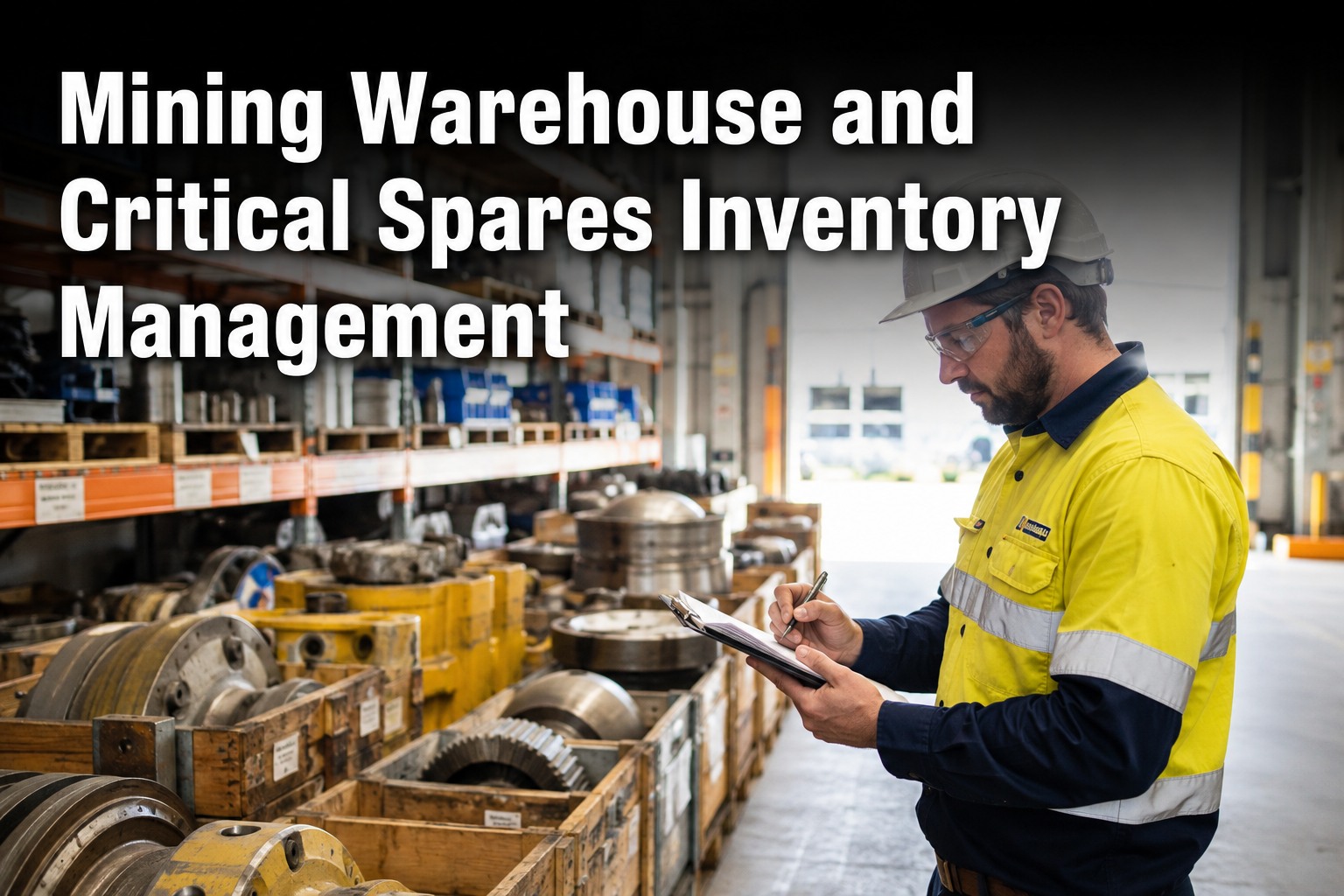
A missing seal can idle a two-million-dollar truck. That is the uncomfortable truth behind mining warehouse management: the part that stops your operation is rarely the expensive one on the shelf, it is the fifty-dollar component nobody reordered because the spreadsheet said there were three in stock and the shelf said zero. Stock decisions in mining should be driven by downtime cost multiplied by lead time, not by part price, yet most mine stores still carry too much of the wrong stock and too little of the right. This page walks through how critical spares analysis, insurance spares, min-max logic and physical stock accuracy actually work on a real mine site, and how a CMMS built for heavy fleets keeps the data honest. If you want to see it running against your own equipment list, you can walk through it on your own units with a 30-minute demo.
Mining Stores and Critical Spares
What does one missing part actually cost your mine?
When a haul truck goes down for want of a component, the meter starts running at thousands of dollars per hour, and the lead time clock runs in weeks, not days. The mines that get this right stock by consequence, not by price.
The Real Cost of Getting Stock Wrong
Why parts inventory at a mine is a downtime problem, not a purchasing problem
Four numbers that explain why experienced maintenance managers lose sleep over the stores shed more than over the workshop.
Critical Spares Analysis
How to decide what belongs on the shelf: critical spares analysis for mining
The question is never "what does this part cost?" It is "what happens if this part is not here when it fails?" Run every candidate part through three gates.
Is failure plausible?
Not likely, just plausible. A final drive on a loaded haul truck, a hydraulic pump on a shovel, a hoist cylinder seal kit. If it has failed anywhere in your fleet or your OEM's fleet, it qualifies.
Is the lead time long?
Measure from purchase order to part-in-hand at your gate, including freight and customs. Anything beyond your acceptable downtime window is long. For most remote mines, that is almost everything OEM-specific.
Is downtime cost severe?
A down water cart is an inconvenience. A down primary crusher or the only 240-tonne truck on a single-lane haul road is a production stop. Severity is measured in lost tonnes per hour, not workshop hours.
A part that passes all three gates is a critical spare and it goes on the shelf regardless of price. A part that fails gate one comes off the shelf and frees up carrying cost. That single discipline is the difference between a store that serves production and a store that just consumes budget. You can book a demo and see this analysis running on your fleet with real failure data behind it.
Insurance Spares and Component Exchange
The insurance spare: why a $40,000 component can be the cheapest decision you make
Major components follow different maths. The carrying cost of holding one spare engine, transmission or final drive is trivial against the exposure of not holding it.
Without the spare on the shelf
- Truck down waiting on a rebuilt final drive: 10-14 weeks typical
- Lost production on one 240-tonne unit: easily $25,000+ per day
- Expedite fees, strip freight and penalty hire of a replacement unit
- Total exposure: comfortably past $1.5M for a single event
With the spare on the shelf
- Component exchange: truck back in service in days, not months
- Carrying cost of the spare: a fraction of one day of downtime per year
- Failed unit goes out for rebuild on your schedule, at standard freight rates
- The spare pays for itself the first time it turns a quarter into a week
Stock when: downtime cost per day x expected lead time in days > annual carrying cost of the part. For a $40,000 final drive against $25,000 per day of downtime, the part pays for itself if it prevents just two days of waiting across its entire shelf life.
Min-Max for Fast Movers
Min-max logic that follows real consumption, not last year's guess
Filters, oils, wear parts, seals, hoses and ground-engaging tools move fast and fail cheap. These belong on min-max reorder logic driven by actual usage, not a number someone typed in three budgets ago.
Set the minimum from real burn rate
Minimum stock = average consumption per week x lead time in weeks, plus a safety buffer for breakdown spikes. If your fleet burns 40 hydraulic filters a month and lead time is six weeks, your minimum is 60 plus buffer, not the 12 the old spreadsheet says.
Set the maximum from carrying cost
Maximum = minimum plus one reorder cycle of consumption. Above that you are paying to store dust. Slow movers creep upward quietly; a quarterly review against consumption history keeps the shelf honest.
Let work orders drive the numbers
Every part issued against a work order updates consumption automatically. That is how the minimum stays tied to what the fleet actually burns through, season by season, instead of drifting on assumption. When you start tracking parts against work orders free, the min-max levels tune themselves within a couple of cycles.
Alert before the shelf is empty
A reorder alert at the minimum, not at zero, is the whole point. Zero is a stockout; the minimum is a decision. The alert should land with the person who raises the purchase order, with the vendor and lead time already attached.
The Physical Accuracy Problem
If the system says three and the shelf says zero, every decision is wrong
Inventory data that does not match the shelf is worse than no data, because it gives false confidence. The fix is boring and non-negotiable: every movement recorded, at the moment it happens, by the person holding the part.
| Store habit | What it looks like on the ground | What it costs you |
|---|---|---|
| Paper issue book at the counter | Technician grabs a part at 2am, writes it down wrong or not at all | Phantom stock, stockouts on critical items, double ordering |
| Weekly spreadsheet reconciliation | Five days of drift between the shelf and the system | Reorder decisions made on stale numbers |
| Annual stocktake only | A year of errors discovered at once, written off in one painful adjustment | Budget shock and zero learning about where the leakage happens |
| Mobile issue at point of use | Part scanned or selected against the work order on the spot, photo if needed | Live accuracy, clean consumption history, audit-ready records |
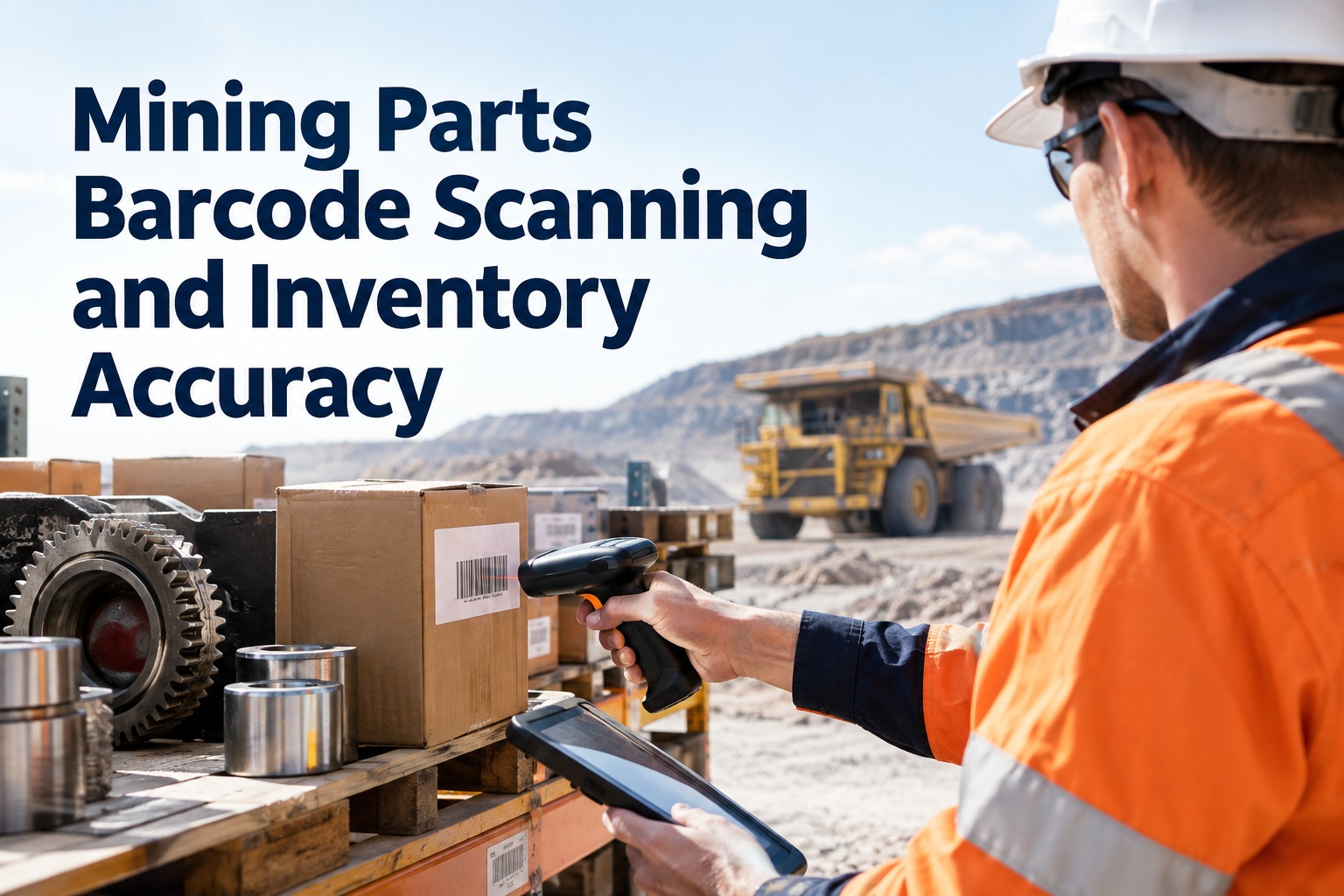
Cycle counts get short and boring when the data is live. Ten minutes a week on a rolling count of high-value bins replaces the dreaded annual stocktake, and the gap between system and shelf shrinks to noise. See how point-of-use issuing works on a phone in the stores shed.
Stop stocking by gut feel. Stock by consequence.
See HVI running on your own fleet: critical spares flagged, min-max levels tied to real consumption, and every part movement recorded at the shelf. Book a 30-minute demo and bring your ugliest inventory problem.
Obsolescence and Ageing Fleets
Parts obsolescence: the quiet tax on older mining fleets
Every mine runs at least one asset the OEM would rather forget. As fleets age, the risk flips: parts get harder to source while the machine gets more likely to need them.
What works
- Flag every part with no movement in 24 months and review it against the remaining fleet that uses it
- Buy lifetime or last-time buys on OEM-discontinued lines while they still exist
- Cross-reference superseded part numbers so a new number does not create a duplicate bin
- Track which assets each obsolete-line part serves, so disposal follows the asset, not the calendar
What bleeds money
- Keeping stock for machines you sold or scrapped three years ago
- Discovering a discontinued part at the moment of failure, with a truck down
- Three bins of the same seal under three part numbers across two sites
- Writing off six figures of dead stock in one audit instead of managing it down gradually
Multi-location visibility matters here. The part that is dead stock at one pit is often the critical spare at another. When you can see stock across every site in one view, transfers replace emergency purchases.
How HVI Helps
How HVI keeps the shelf, the system and the work order in sync
Parts and Inventory with consumption history
Every part issued against a work order builds a live consumption record, so min-max levels reflect what your fleet actually burns. Outcome: stockouts on fast movers drop, and slow movers stop quietly eating budget.
Multi-location stock visibility
See on-hand quantities across the main store, the pit service truck and satellite sites in one screen. Outcome: a transfer from the next site replaces a 12-week emergency order, and duplicate bins get consolidated.
Purchase Management with vendor and lead time tracking
Vendors, quoted lead times and actual delivery performance live on the purchase order, so your criticality analysis uses real lead time, not the catalogue promise. Outcome: reorder alerts fire early enough to matter.
Defect analytics showing what actually fails
Digital inspections and DVIR feed defect trends straight into the parts conversation: if final drive failures cluster at 8,000 hours, the spare is on the shelf before the curve hits. Outcome: you stock for the failures your fleet is actually having.
It all runs on any phone or tablet in the stores shed, at the pit or in the workshop, and every movement is timestamped and audit-ready. Sign up free and load your first store, or book a demo to see it on your own units.
Key Takeaways
Mining warehouse management in five lines
None of this needs a bigger store or a bigger budget. It needs honest data and a system that records movements where they happen. That is exactly what HVI's parts and inventory module was built for, and you can see it working on your own equipment list before you commit to anything.
"I track one number every Monday: parts-related downtime hours. Before we tightened the store, we were losing 30 to 40 fleet hours a month waiting on parts the system said we had. My gripe was never the technicians, it was the spreadsheet. Once issuing moved to the phone at the counter, that number dropped under ten, and the annual stocktake stopped being a horror story."
Daniel Reeves, Maintenance Manager, contract mining and aggregates operation
Frequently Asked Questions
Mining critical spares and parts inventory: common questions
What is a critical spare in mining, and how is it different from a normal spare part?
How do I set min-max levels for fast-moving consumables at a mine site?
When does an insurance spare make financial sense for a major component?
How do I fix inventory records that never match what is physically on the shelf?
Can HVI track parts across multiple mine sites and service trucks?
The next stockout is already on a ship somewhere. Be ready for it.
Put critical spares analysis, live min-max levels and point-of-use issuing behind your store. See HVI on your own fleet in a 30-minute demo, or start free and load your first location today.
Free to start - Works on any phone - No card needed