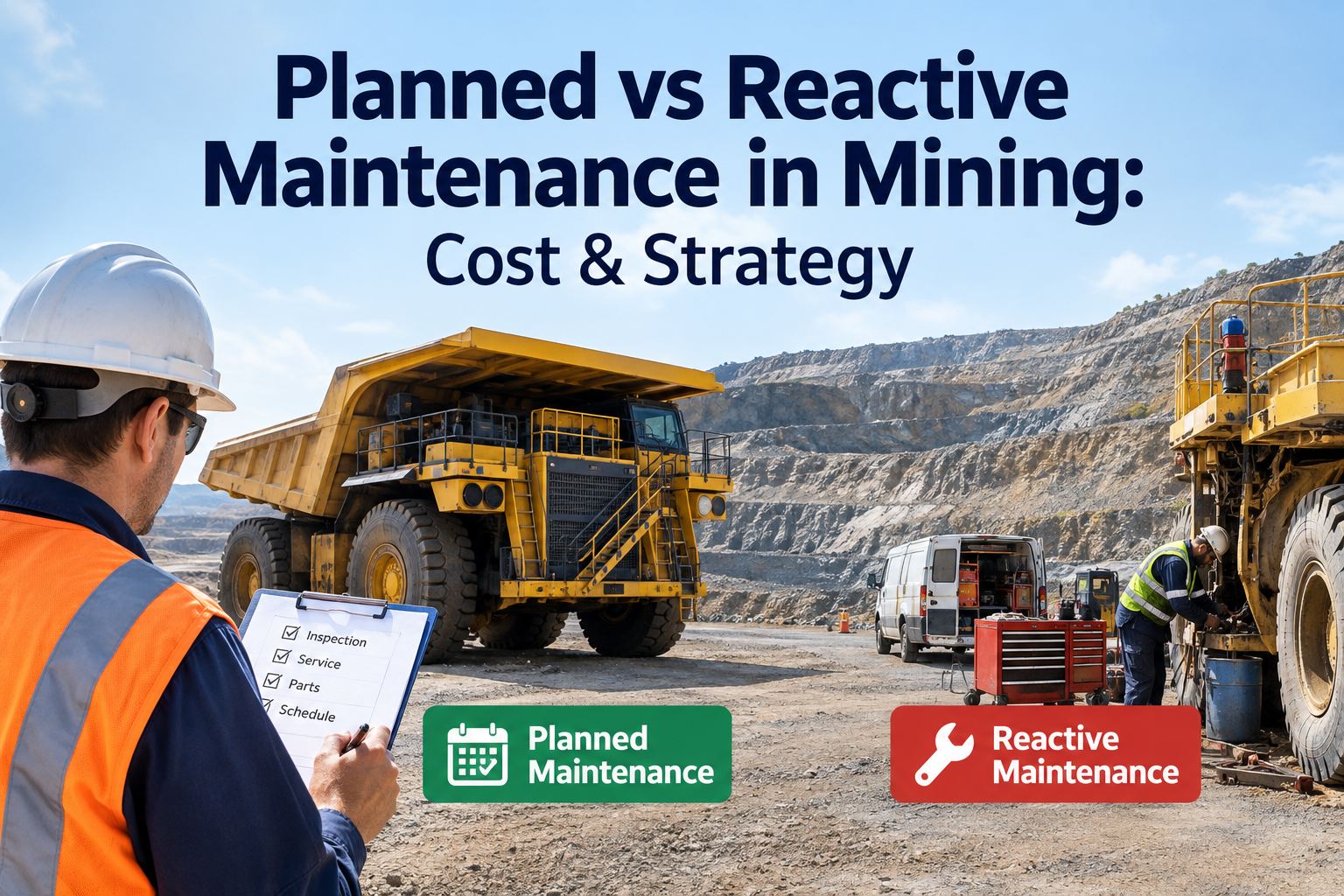
Every mining maintenance team knows the difference between a good week and a bad one. A good week, you're working the jobs you planned — parts staged, machine scheduled out of the pit, techs on day rate. A bad week, a final drive lets go mid-shift, you're paying overtime, air-freighting a part, and three other jobs slide because everyone's on the fire. That gap is the whole story of planned vs reactive maintenance mining teams live every week, and it's where most of a fleet's avoidable cost lives. This page lays out how the two compare, how to measure where you actually sit, and how to move the balance. Book a demo to see planned work built from your inspections.
A component replaced on a planned schedule and the same component replaced after it fails are the same wrench-time. Everything around the reactive one is what costs you.
- Overtime labour rates
- Expedited / air-freight parts
- Extended diagnosis under pressure
- Emergency crew mobilisation
- Collateral damage from the failure
- Lost production while it's down
- Standard labour rates
- Parts ordered ahead at list price
- Diagnosis already done
- Scheduled into a maintenance window
- Failure caught before collateral damage
- Machine pulled when production allows
Nobody chooses reactive maintenance. You fall into it — one breakdown forces overtime, the overtime eats the time you'd have spent planning, the missed planning causes the next breakdown, and the cycle tightens. Breaking out isn't about working harder; the reactive teams are already exhausted. It's about shifting the balance of work from unplanned to planned, one machine and one metric at a time. To do that you first need to be honest about the four kinds of maintenance you're actually running, and which of them is quietly eating your budget.
Planned vs Reactive Maintenance Mining Fleets Run: Four Modes, One to Avoid
"Planned vs reactive" is a useful headline, but the real picture has four modes. Three are legitimate strategies you choose; the fourth is the one that happens to you. Knowing which is which stops you from lumping a smart run-to-failure decision in with a genuine firefight.
Preventive (PM)
Scheduled by meter hours or calendar — oil and filters at 250 hours, undercarriage checks, fluid changes. You decide when, before anything fails.
Predictive (PdM)
Triggered by condition data — oil sampling, vibration, thermography flagging a bearing or turbo before it goes. Still planned, just timed by evidence rather than an interval.
Corrective
A defect found on inspection, then scheduled and fixed before failure. Not preventive, but still controlled — you found it, planned it, and picked the window. This is where inspections earn their keep.
Emergency / breakdown
The machine fails when you need it. No warning, no window, no parts staged. This is the expensive one — and the one a good program shrinks toward zero, without ever quite reaching it.
The key insight most teams miss: corrective maintenance is your bridge. A defect caught on a daily inspection and scheduled for Thursday is planned work — even though the machine had a fault — because you controlled the timing, the parts and the crew. The failure that strands a truck in the pit on Tuesday is the reactive one. The whole game is converting would-be breakdowns into scheduled corrective jobs before they happen. Book a demo to see inspection defects become scheduled work orders
Why the same repair costs more when it's reactivethe panic tax behind planned vs reactive maintenance mining economics
The wrench-time on a failed final drive and a planned final-drive swap is nearly identical. The cost difference is everything stacked around the emergency. Industry estimates for how much more an emergency repair costs vary widely — sources commonly cite anywhere from three to nine times the planned cost of the same job — and the reason it's a range, not a fixed number, is that it depends entirely on how many of these stack up on a given failure.
This is why comparing a maintenance contract fee against a repair invoice in isolation always makes planned work look expensive — it ignores five of these six costs. The honest comparison uses consistent definitions on both sides: total cost including labour, parts, mobilisation and downtime, measured the same way for planned and reactive work. Do that and planned maintenance wins on the assets that matter. Start free and track true cost per work order
Three numbers that tell you where you really standone ratio isn't enough — and it can lie
Most teams reach for a single "planned vs reactive" percentage. It's a start, but on its own it can mislead — a suspiciously high number can mean failures are being miscategorised, not prevented. Three metrics together give the honest picture, because each measures a different thing.
Planned work %
Share of maintenance hours that were planned in advance versus reactive. Measures preparation. Average operations sit near 50%; strong reliability programs run 80–90%; a fleet under ~30% is almost pure firefighting.
Schedule compliance
Of the work you planned and froze for the week, how much actually got done as scheduled. Measures execution. A plan nobody follows is fiction — this is the number that makes planned work real.
Backlog health & aging
The identified-but-not-yet-done work, and how old it's getting. Measures the queue. A growing, aging backlog is planned work quietly turning back into future breakdowns.
Watch them together and read alongside availability and repeat-failure rates. Planned work % tells you how much you prepared, schedule compliance tells you whether you executed, and backlog aging warns you what's about to become reactive if you don't get to it. A team can have a decent planned % and still be sliding, if compliance is weak and the backlog is aging — the ratio alone would never show it. Book a demo to see these tracked automatically from work-order data
Backlog: where planned work goes to become reactive
Backlog deserves its own word because it's the mechanism the reactive spiral runs on. Every deferred job — the flagged hose you kept running, the worn pin you'll get to next window — sits in backlog. Managed well, backlog is just a healthy queue of known work waiting for the right window. Neglected, it ages, and aged backlog is simply breakdowns you've scheduled for yourself without knowing the date. A backlog that grows month over month, or one where the oldest jobs keep getting older, is the clearest early signal that planning or resources are falling behind demand — long before it shows up as a spike in emergency work. Working the backlog down deliberately, converting identified work into planned jobs before it fails, is most of what "getting proactive" actually means in practice.
Getting off the back foota practical path from reactive firefighting to planned maintenance in mining
You don't flip from 40% planned to 85% in a quarter, and any vendor promising that is selling. The shift is gradual and it's a workflow change, not a willpower change. Here's the realistic sequence mining fleets follow.
Notice the pattern: every step turns work that would have arrived as a surprise into work that arrives on a schedule. That's the entire transition in one sentence. The fleets that make it don't have fewer problems — they just find their problems on inspection sheets and meter readings instead of on the side of a haul road. Start free and begin converting defects into planned jobs this week
From a reliability manager who climbed out of the reactive hole
We were running maybe 35% planned when I started — basically firefighting with a logo on it. The thing nobody tells you is that reactive is self-sustaining: you're too busy fixing breakdowns to do the planning that would stop the breakdowns. You can't just tell the crew to be more proactive. They're already flat out.
What broke the cycle was ruthlessly turning inspection findings into scheduled jobs and protecting the weekly plan from everything that wasn't a true emergency. It took the better part of a year to get past 70%. But the noise dropped, the overtime dropped, and for the first time we were choosing when machines came out of service instead of the machines choosing for us. That's the whole win, right there.
Frequently asked questions
Why does reactive maintenance cost more than planned maintenance?
Because the wrench-time is nearly the same, but everything stacked around an emergency is extra. When a component fails unexpectedly you typically pay overtime or after-hours labour rates, expedite parts by air-freight instead of ordering ahead at list price, burn technician hours on diagnosis that a planned job already has done, mobilise a crew and tooling to a remote location at short notice, and often repair collateral damage because a component run to catastrophic failure takes its neighbours with it. On top of all that sits the lost production, because the breakdown happens when you needed the machine, not when you could spare it. Industry estimates for the emergency premium vary widely — commonly cited as roughly three to nine times the planned cost of the same job — and the reason it's a range rather than a fixed figure is that it depends on how many of those cost layers stack up on a given failure. Comparing a planned job's cost to an emergency invoice only fairly when both use the same total-cost definition.
What is a good planned maintenance percentage for a mining fleet?
As a general benchmark, average maintenance operations sit somewhere around 50% planned work, strong reliability programs run in the 80–90% range, and a fleet operating under about 30% is essentially firefighting full-time. An 80/20 split — 80% planned, 20% reactive — is a widely used target for a mature program. That said, aiming for 100% is neither realistic nor healthy: some genuine emergencies will always occur, and a suspiciously high planned percentage can actually be a red flag that failures are being miscategorised or suppressed rather than prevented. It's also worth calibrating the target to your risk profile — a critical constraint asset justifies pushing harder toward planned work than a redundant one. The number matters less as an absolute score than as a trend: a fleet moving from 40% toward 70% over a year is winning, regardless of whether it ever hits a textbook benchmark. Track it monthly and watch the direction of travel.
What's the difference between planned work percentage and schedule compliance?
They measure different stages and you need both, because one can look fine while the other quietly fails. Planned work percentage measures preparation — what share of your maintenance work was planned in advance versus arriving as unplanned break-in or emergency work. Schedule compliance measures execution — of the work you planned and froze into the weekly schedule, how much actually got done as scheduled. A team can plan a lot of work (good planned %) but still execute poorly if emergencies keep displacing the frozen schedule (low compliance), which means the plan is effectively fiction. Conversely, high compliance on a tiny amount of planned work isn't impressive either. Read together with backlog health — the identified-but-not-yet-done work and how fast it's aging — the three give an honest picture: planned % shows how much you prepared, compliance shows whether you executed, and backlog aging warns what's about to turn reactive. No single one of them proves a fleet is reliable on its own.
How does maintenance backlog relate to reactive work?
Backlog is the pipeline through which planned work quietly becomes reactive work. Every deferred job — a hose flagged on inspection, a worn pin you'll address next window — sits in backlog until it's actioned. Managed well, that's healthy: a known queue of identified work waiting for the right maintenance window, planned and resourced deliberately. The danger is neglect. When backlog isn't actively worked down, jobs age, and aged backlog is simply breakdowns you've scheduled for yourself without setting a date — the flagged hose eventually bursts on shift and becomes an emergency. A backlog that grows month over month, or one where the oldest items keep getting older, is one of the earliest and clearest signals that planning or resourcing is falling behind demand, usually well before it shows up as a spike in emergency work. That's why controlling backlog — converting identified work into planned jobs before it fails — is a core part of moving a fleet from reactive toward planned maintenance rather than a separate housekeeping task.
How do I move my mining fleet from reactive to planned maintenance?
Gradually, and by changing the workflow rather than exhorting the crew — reactive teams are already working flat out, so "try harder" doesn't work. The realistic sequence starts with protecting the planned schedule: only genuine emergencies are allowed to break the frozen weekly plan, while everything else enters the backlog to be planned properly, because without that discipline nothing else holds. Next, get preventive maintenance firing on real meter hours so services come due when a machine has actually done the work, generating a steady base of planned jobs. Then attack the biggest lever — convert defects found on daily and weekly inspections straight into scheduled corrective work orders, catching would-be breakdowns while they're still cheap. Make sure parts are lined up against inventory before a job is scheduled, so planned work doesn't stall into a last-minute scramble. Finally, measure planned percentage and schedule compliance monthly and track which failures keep recurring, since each repeat is a target for a reliability fix. HVI supports this whole chain with meter-based PM, defect-to-work-order automation, parts and inventory checks, and analytics. You can book a demo to see the workflow end to end.
Shift the balance from firefighting to planned work
HVI connects inspections, defects, meter-based PM and parts readiness into one workflow — converting would-be breakdowns into scheduled jobs, checking parts before a job is planned, and showing your planned-versus-reactive split in Analytics. Fewer surprises on the haul road, more work done on your terms.
Meter-based PM · Defect-to-work-order · Parts readiness · Planned-vs-reactive analytics