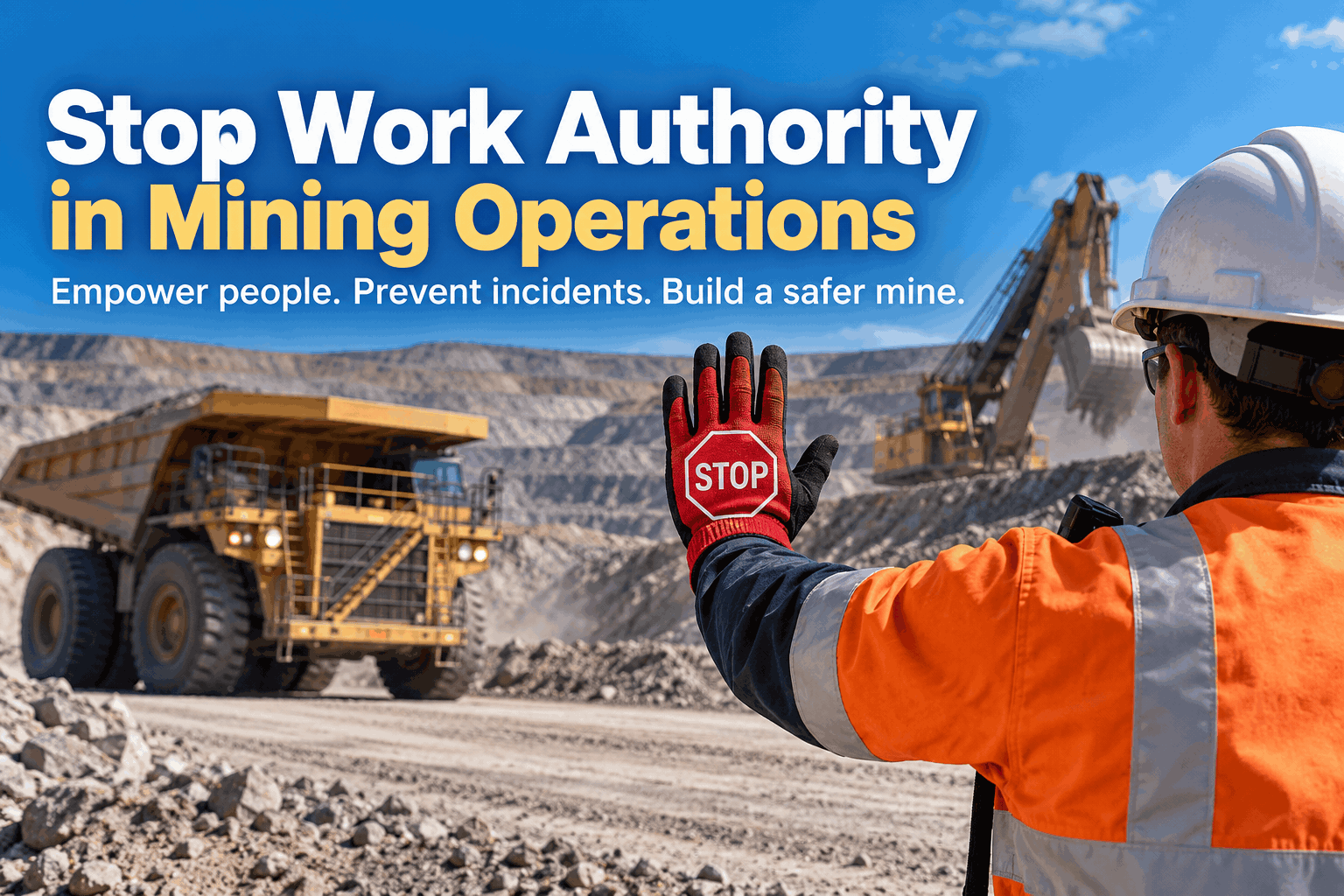
Stop work authority gives people at a mine site a clear way to halt a task when conditions become unsafe. A reversing haul truck with limited visibility, an unstable dump edge or a damaged lifting attachment can turn a routine job into a serious incident. This guide explains when to stop, how to communicate the hazard, who verifies the controls and what must happen before work resumes. Sign up free to track mining equipment inspections and defects with HVI.
Stop Work Authority in Mining Operations
Recognize the hazard. Stop the exposure. Verify the controls. Restart only when authorized.
Pedestrian entered the reversing zone of a haul truck.
What Is Stop Work Authority in Mining?the practical right and responsibility to interrupt unsafe work
Stop work authority (SWA) is a site policy and operating practice that empowers workers and contractors to pause work when they believe a hazard is not adequately controlled. It is not limited to an emergency or a confirmed violation. The purpose is to prevent exposure while a competent person assesses the concern.
If the task, equipment, ground conditions or people around it have changed in a way that may make the job unsafe, pause the affected activity, make the area safe and notify the appropriate person. Do not improvise a restart.
Site-specific SWA policies should identify who can call a stop, how to secure mobile equipment, whom to notify and who may authorize resumption. Mining regulations, worker rights and reporting obligations differ by jurisdiction; use the applicable mine safety rules and your approved site procedures.
Five Mining Conditions That Should Trigger a Stoprecognize exposure before a near miss becomes an incident
These are practical examples rather than an exhaustive list. The correct immediate action depends on the site risk assessment, equipment instructions and emergency plan.
From Stop-Work Call to Safe Restarta field-ready decision sequence for supervisors and crews
A consistent sequence prevents the common failure of treating the stop as complete as soon as the immediate activity has paused. Restart is a separate decision that requires confirmation.
State the hazard plainly over the approved communication channel. Identify the equipment, location and people affected.
Stop movement, secure equipment and keep others outside the exposure area without creating a second hazard.
Supervisor and relevant competent personnel investigate the condition, update the risk assessment and assign corrective action.
Confirm controls are effective, affected personnel understand the change and required inspections or permits are complete.
Use the site-defined approval process, record the decision and follow up on unresolved or recurring issues.
Who Does What During a Stop-Work Event?clear responsibilities prevent confusion on a busy mine site
A strong program makes the process predictable for employees, contractors and supervisors. Everyone needs to know that reporting a concern is welcome and that nobody should pressure a crew to bypass required controls.
- Raise the concern promptly and describe what changed.
- Stop the affected task and secure the immediate area.
- Notify the supervisor through the site channel.
- Participate in the briefing before work resumes.
- Respond without dismissing or penalizing a good-faith report.
- Identify affected equipment, people and work boundaries.
- Assign and verify corrective actions and required permits.
- Record the authorized restart decision.
Contractor induction should cover the same reporting channel, emergency escalation and restart rules used by employees. Where a serious or imminent danger is present, follow the site emergency response procedure immediately.
What a Useful Stop-Work Record Looks Likecapture facts that support corrective action and learning
A short, specific record is more useful than a lengthy narrative with no ownership. This illustrative event form shows the information a site can standardize.
When the stop involves equipment condition, connect the event to the machine's inspection and maintenance history. HVI can help teams maintain that equipment record; the mine should retain safety-event approvals in its designated safety management process.
Training That Makes Stop Work Authority Usablepractice the words, the response and the restart decision
Training should be more than a policy acknowledgment. Workers need to rehearse how to speak up during a live operation, while supervisors need to practice responding without blame or delay.
A loader operator notices that the normal pedestrian barrier has been moved while a maintenance crew approaches the loading area.
- Ask: What words should the operator use to stop the task?
- Decide: Which machines and people need to be kept clear?
- Assign: Who checks and restores the barrier and traffic controls?
- Confirm: What evidence and authorization are needed to restart?
Repeat drills across shifts and contractor groups. Review reports for response time, repeat hazards and the quality of corrective actions—not for how few stops a team records. Low reporting counts can indicate underreporting rather than better safety.
Equipment Inspections and HVI: Where the Records Connectmake the maintenance handoff visible without confusing it with safety approval
Not every stop-work event is an equipment defect. But when an operator reports damaged brakes, a missing guard or a steering problem, the maintenance handoff matters. The fleet system should help prevent an unresolved defect from disappearing between shifts.
Maintenance documentation supports the decision. It does not replace the mine's lockout, permit, isolation, competent-person inspection or formal authorization requirements.
HVI's fleet management, vehicle inspections, preventive maintenance and maintenance records can support this equipment-focused workflow. Book a demo of HVI mining inspection and defect tracking to evaluate how your current mine fleet processes would map to HVI.
Supervisor Restart Checklistuse before releasing affected work back to the crew
Site procedures and applicable rules take priority. This checklist is a planning aid, not a substitute for a permit or a competent-person assessment.
Stop Work Authority in Mining: Frequently Asked Questionspractical answers for workers, supervisors and mine safety managers
Who can exercise stop work authority at a mine?
A well-designed site program encourages employees and contractors to report and stop unsafe tasks within their responsibilities. The precise legal rights, escalation process and scope of authority depend on the jurisdiction and site policy.
When should a miner stop work?
When a worker observes a serious or uncontrolled hazard, unexpected equipment condition, unsafe interaction, compromised ground or another situation that may expose people to harm. Follow the site's immediate safety and emergency procedures.
Who decides when work can restart?
The person or role authorized by the mine's approved procedure. Restart should follow hazard assessment, effective controls, any required inspections or permits, and communication with affected personnel.
What should be included in stop work authority training?
Recognition of site-specific hazards, how to communicate a stop, securing equipment and work areas, supervisor escalation, corrective-action verification, documentation and restart approval. Scenario-based practice helps make the procedure usable.
Can HVI manage mining stop work authority?
HVI can support the equipment side through inspections, defect reporting and maintenance records. A complete stop-work authority program also needs site-specific safety policies, competent supervision, training, escalation and formal restart authorization.