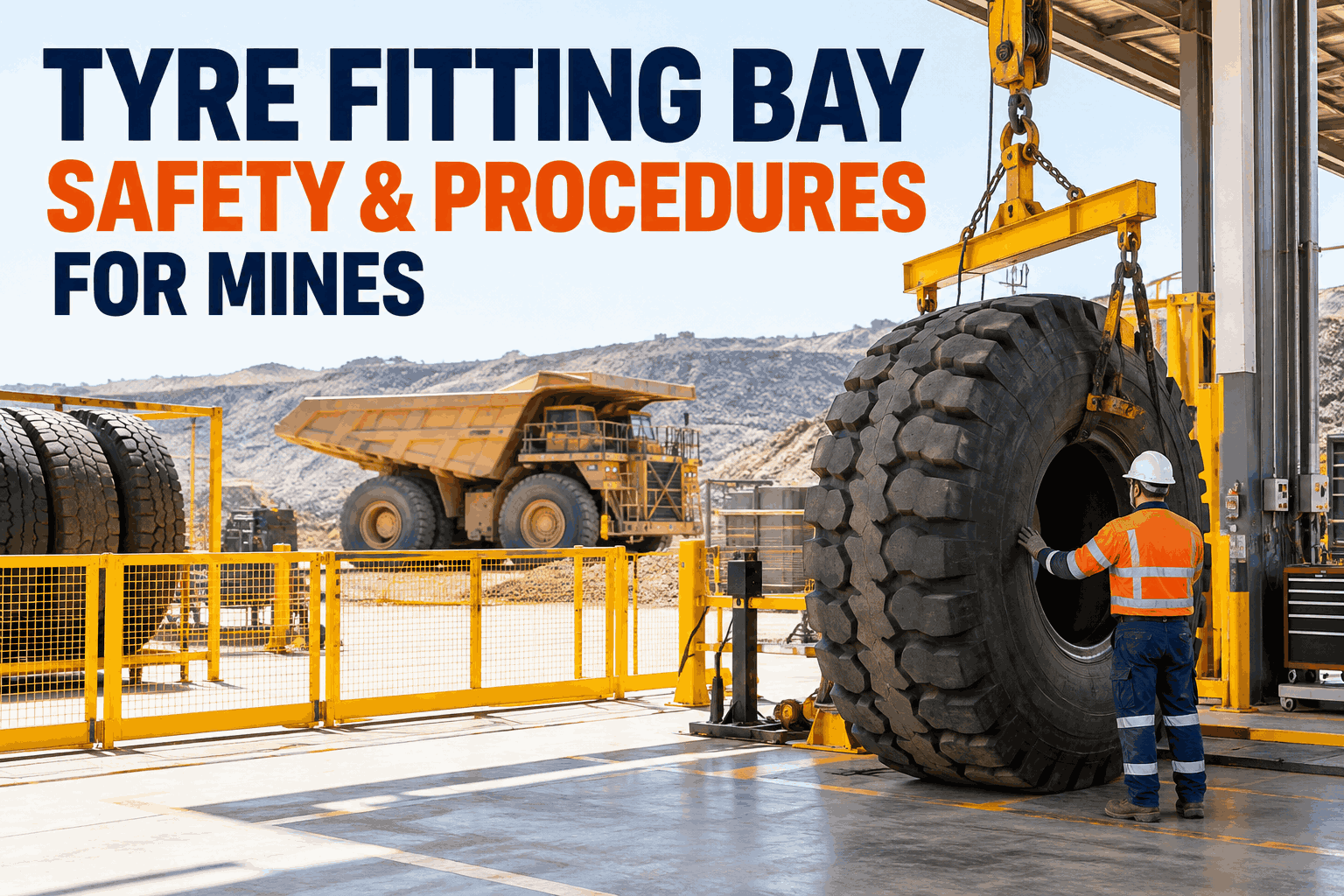
Tyre fitting bay safety is the difference between a routine wheel change and a funeral. A large OTR tyre holds enough stored energy to kill a person standing in the wrong place and it gives almost no warning before it lets go. This guide covers how to run a fitting bay safely — and how HVI helps you make every tyre safety check mandatory, logged and provable.
A Mining Tyre Gives No Warning. Your Procedure Has To Be the Warning.
Fitting bays combine stored pressure, three-tonne assemblies, lifting gear and a tight work zone. The teams that stay safe don't rely on experience alone — they run the same controlled procedure every time, and they can prove it.
CAGE
Most tyre fitters are careful people who have done the job a thousand times. That is exactly the risk: familiarity makes a controlled area start to feel ordinary, and the one time a damaged sidewall lets go during inflation, there is no second chance. A fitting bay stays safe not because the crew is lucky, but because the procedure, the exclusion zone and the records are the same on a rushed shift as on a quiet one.
Why Tyre Fitting Bay Safety Is a Stored-Energy Problem
A haul-truck tyre is not just big — it is loaded. Four hazards stack on top of each other in the same small bay, and OTR tyre safety means respecting all four at once, not just the one you can see.
The danger is real, not theoretical. Queensland's mining safety record includes a fitter killed in 2010 at the Foxleigh coal mine when a tyre failed during installation — one of several cases that reshaped OTR tyre handling standards across the industry. The lesson every bay took from those cases is the same: controls have to be built into the task, because the tyre will not tell you when it is about to go. HVI's safety management tools exist to make those controls routine, and you can see them applied to a tyre bay in a short demo.
The Safe Tyre Fitting Procedure, Step by Step
Tyre fitting procedures only protect people when they run in order, every time, without shortcuts under pressure. This is the controlled sequence a well-run mining tyre fitting bay follows — each step a checkpoint, not a suggestion.
Step three is where most silent failures are caught or missed. A fitter who photographs a suspect sidewall and flags it has created a record; a fitter who makes a mental note has not. That is the gap HVI closes — turning each checkpoint into documented tyre inspection and maintenance history instead of memory. Start a free HVI account and build your bay's sequence as a guided checklist.
Exclusion Zones, Restraint Devices and the Inflation Line
The single most important control in a tyre fitting bay is keeping people out of the blast path during inflation. Mine tyre workshop safety depends on three physical controls working together — and on everyone in the bay knowing where the line is.
A marked area in front of the tyre that no one enters while it is under pressure. Inflation is done from outside it, every time.
Contains the assembly if it fails during inflation, so stored energy is directed away from people.
A clip-on chuck and long air line let the operator set pressure while standing well clear of the trajectory.
These controls are only as good as the habit behind them. The value of a logged pre-task check is that it forces the question "is the cage in place and the zone clear?" before air goes in — on every shift, not just when a supervisor is watching. For mine sites, HVI ties these checks to the asset and the location, which fits naturally with broader mining fleet safety and maintenance records. If you want to see how the exclusion-zone check looks as a mandatory step, book a quick walkthrough.
Paper Checklists vs. Digitized Tyre Safety Records
Most bays already have a procedure. What they often lack is proof it was followed — and in a tyre workshop, the proof is what protects both the worker and the site after the fact. This is the clearest reason mining teams move tyre safety inspections off paper.
- Steps skipped under time pressure, invisibly
- No photo of the sidewall that was passed
- Defects noted verbally, then lost
- Records scattered, hard to find at audit
- No link between the check and the asset
- Guided checklist — a skipped step is flagged
- Photo evidence attached to each inspection
- Defects become tracked corrective actions
- Audit-ready records, searchable by asset
- Every check tied to the tyre and the bay
The point is not more paperwork — it is less. A guided check on a phone or tablet is faster than a clipboard, and it leaves a record that answers the question every safety manager dreads: "can you show me it was done right?" HVI's photo evidence and defect tracking turn that answer into a few taps.
Tyre Fitting Bay Safety Checklist
Run this as a guided digital check and it does double duty — it keeps the crew safe and it builds the maintenance record at the same time. You can see this exact checklist built in HVI on a short call.
What a Tyre Supervisor Watches in the Bay
The crews I worry about least are the ones who treat every tyre like it might be the bad one. My rule is simple: nobody inflates standing in front of the tyre, ever, and the cage is non-negotiable. The thing that changed for us was photos — before, a fitter would say "sidewall looked fine," and I had nothing. Now there's a picture on every check. When a rim came back with corrosion last month, it was flagged and off the machine the same shift, with the evidence to back the call.
Mining Tyre Fitting Bay Safety FAQs
What makes tyre fitting bay safety so critical in mining?
Large OTR tyres combine high stored air pressure, extreme mass, lifting hazards and the risk of silent sidewall (zipper) failure. A failure during inflation can release explosive force with little or no warning, so controlled procedures, exclusion zones and restraint devices are essential to protect fitters.
Why must a tyre be fully deflated before removal?
Loosening any rim component on a pressurized assembly can cause parts to be ejected with lethal force. Completely deflating the tyre and removing the valve core first removes the stored energy, so the removal and inspection steps can be done without that risk.
What is a tyre exclusion zone and why does it matter?
An exclusion zone is a marked area in front of the tyre that no one enters while it is under pressure. Because a failing tyre and rim release energy along a predictable trajectory, inflating from outside the zone — using a restraint cage and an extension line — keeps people out of the blast path.
Can a damaged tyre fail without visible warning?
Yes. A zipper failure from broken steel cords can occur with no visible bulge — sometimes the only hint is a faint metallic pinging as cords break. That is why inspecting and photographing the sidewall and rim before refitting, and inflating inside a restraint device, are core safety steps rather than optional ones.
How does HVI improve tyre fitting bay safety?
HVI turns your fitting procedure into a guided safety checklist with mandatory steps, photo evidence and defect tracking. Each check is tied to the specific tyre and bay, corrective actions are assigned and followed, and every job leaves an audit-ready maintenance and safety record — so following the procedure is both easier and provable.
Give Your Tyre Fitting Bay a Procedure It Can Prove
Standardize every tyre inspection and inflation check, capture photo evidence, track defects to closure, and keep an asset-level safety record — all from a phone in the bay.