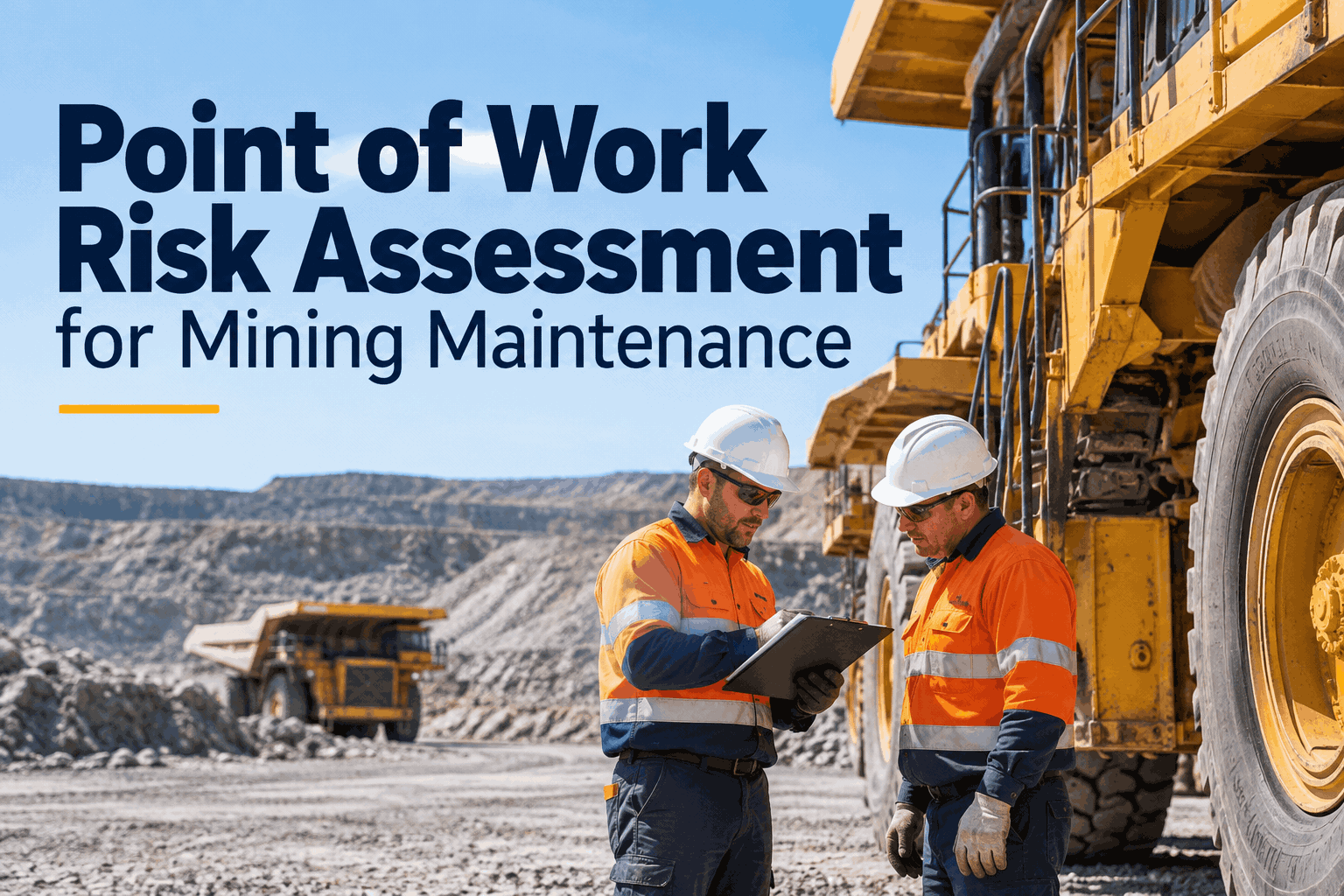
A point of work risk assessment exists because the plan was written at a desk and the job happens at the machine — and the two are never quite the same. The method statement assumed dry ground; it rained overnight. It assumed the excavator was isolated; the last shift left it live. The maintenance tech walking up to that track frame is the only person standing where the real hazards are, at the only moment they can be caught. That thirty-second check at the work face is the last line of defence between a planned task and an incident. Start free and run a digital point of work risk assessment on your next task.
Point of Work Risk Assessment for Mining Maintenance Tasks
The task risk assessment was written before anyone saw the site. A POWRA is the worker's own check — right at the machine, right before the spanner moves — that the plan still matches reality.
- Ground: dry & stable
- Machine: isolated
- Access: clear
- Weather: fine
- Ground: soft, rained overnight
- Machine: still showing live
- Access: blocked by a service truck
- Others working overhead
A point of work risk assessment doesn't replace the task risk assessment or the method statement — it checks that their assumptions still hold at the moment and place the work actually happens. On a mine site, conditions change by the hour: ground softens, a machine's isolation status shifts, a different crew starts working nearby. The desk plan can't see any of that. The POWRA is the short, personal, on-the-spot check — done by the worker, at the work point, right before starting — that catches what changed. Below is what a POWRA is, the SLAM steps that run it, what triggers a re-check, and how to make it a record instead of a forgotten clipboard tick.
What a Point of Work Risk Assessment Actually Isthe worker's last check — not another form from the office
A POWRA is small on purpose. It isn't a paperwork exercise; it's the thirty seconds where the person about to do the work looks up and asks whether it's actually safe to start. Three things define it.
Done right where the task happens — at the machine, in the trench, on the bench — not back in the office. The hazards you're checking for only exist at that spot.
The tech or operator completes it, not a supervisor at a distance. They're the one standing in the conditions, so they're the one who can see what's actually there now.
Every earlier control — the risk assessment, the permit, the method statement — assumed conditions. The POWRA is the final check that those assumptions survived contact with the real world.
That's the whole point: a desk assessment is written once for a task type; a POWRA is done every time, at the place, by the person. One can't do the other's job. It's the pre-task companion to on-the-ground mining equipment safety and incident tracking, and you can start free and build one into every task.
The SLAM Steps of a Point of Work Risk Assessmentstop · look · assess · manage — the thirty-second cycle
POWRA runs on a simple, memorable loop that fits on a pocket card: SLAM. Four moves, done in order, before the task starts — and run again if anything changes.
Pause before you start. Don't run the task on autopilot because you've done it a hundred times — the hundred-and-first is where the conditions changed.
Survey the work point for what the desk plan couldn't see: ground condition, machine state, people nearby, access and egress, weather, energy sources.
For each hazard, weigh how likely and how serious. Decide whether existing controls are enough or whether the work can't proceed as planned.
Put controls in place, modify the plan, or stop and escalate if it can't be made safe. Record what you found and what you did.
None of this takes long — that's the design. A POWRA that takes ten minutes won't get done; one that takes thirty seconds and is built into the task will. Book a demo to see the SLAM check run from a phone at the work face.
What Changes Between the Plan and the Work Pointthe conditions a POWRA is built to catch
A POWRA earns its thirty seconds because a mine site never holds still. These are the things most likely to have drifted from what the task risk assessment assumed — the ones a point of work risk assessment is there to catch.
If any of these has moved since the plan was written — and on a live site, something usually has — the POWRA is where it gets caught, before it becomes the incident report. Anything it surfaces should flow straight into a defect record, which is where it connects to hazard reporting and close-out rather than dying on a slip.
The POWRA, Done Right at the Machinewhat a digital point of work risk assessment looks like on a phone
The paper pocket card works until it's wet, lost, or never handed in. A digital POWRA does the same thirty-second check and keeps the record — completed at the task, signed, timestamped, and tied to the equipment.
Same quick check the crew already knows, now with a record a supervisor can review and an auditor can see. The hazard that got flagged doesn't vanish when the task ends — it's on the equipment's history. Start free and run your first digital POWRA today.
Point of Work Risk Assessment Checklistthe prompts to run before any maintenance task
Keep it short enough to actually use. Run these at the work point before you start — if any answer is wrong, you're at modify-and-proceed or stop-and-escalate, not go.
- I've paused and I'm not on autopilot
- Ground, access and egress checked here, now
- Machine isolation / energy state confirmed
- People and activity nearby accounted for
- Conditions still match the task risk assessment
- Weather, light and dust are workable
- Right tools, right PPE, right competence present
- No new equipment defect in front of me
- Controls in place for every hazard found
- Decision made: proceed / modify / stop
- Anything flagged logged as a defect
- POWRA recorded against the task & machine
If you can't tick the Assess column clean, the plan and the reality have drifted — that's exactly the moment the POWRA was made for. Book a demo to build this check into every task.
A Maintenance Supervisor on Point of Work Checkswhy the thirty-second version is the one that works
We had risk assessments for every task — binders of them. What we didn't have was anyone checking whether the day's conditions actually matched. The POWRA fixed that, but only once we made it fast. The first version was a page of questions and crews just ticked it blind. The thirty-second phone version they actually do, because it respects their time. Last month a tech stopped a bearing job because the ground had turned to soup overnight — the plan said dry. That's the whole job of a point of work check, right there.
Make the point of work risk assessment a habit, not a form
HVI puts the POWRA on the phone at the work face — quick SLAM check, a clear proceed/modify/stop call, and any hazard flagged straight into a defect record on the equipment. Fast enough that crews actually do it, recorded enough that it stands up. Live in under two weeks, no hardware.
No credit card · No hardware · Pre-task checks ready on day one
Point of work risk assessment — common questions
What is a point of work risk assessment (POWRA)?
It's a brief, on-the-spot safety check a worker completes right where a task happens, immediately before starting. It confirms the conditions still match what the task risk assessment assumed and catches new hazards — the last line of defence between a planned job and an incident.
What are the steps of a POWRA?
Most follow SLAM: Stop (pause before starting), Look (survey the work point for hazards), Assess (weigh likelihood and severity against existing controls), and Manage (apply controls, modify the plan, or stop and escalate). It ends in a clear decision: proceed, modify and proceed, or stop.
How is a POWRA different from a task risk assessment?
The task risk assessment is prepared in advance by a supervisor or safety professional for a type of job. The POWRA is done by the worker, at the location, every time — checking that the plan's assumptions still hold right now. They complement each other; a POWRA never replaces the main assessment.
Who completes a point of work risk assessment?
The person doing the task — the maintenance tech or operator — because they're the one standing in the actual conditions. A supervisor prepares the background risk assessment and may review POWRA records afterward, but the point-of-work check belongs to whoever is about to start work.
How does HVI support point of work risk assessments?
HVI runs the POWRA as a quick mobile check at the work face, with the SLAM steps and a proceed/modify/stop decision. Anything flagged becomes a defect logged against the equipment, and the completed check is recorded and timestamped — fast for crews to do, and documented for supervisors and audits.