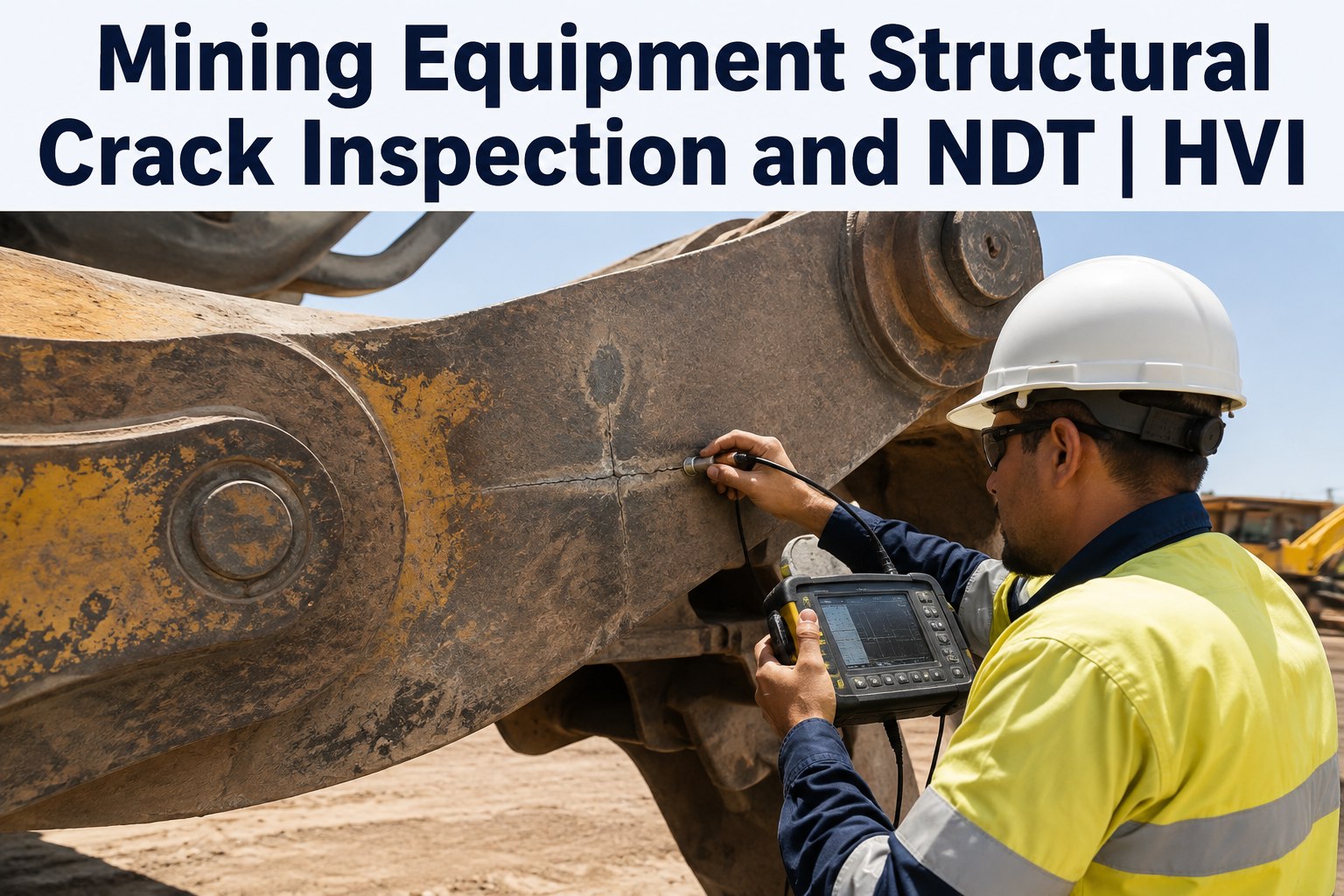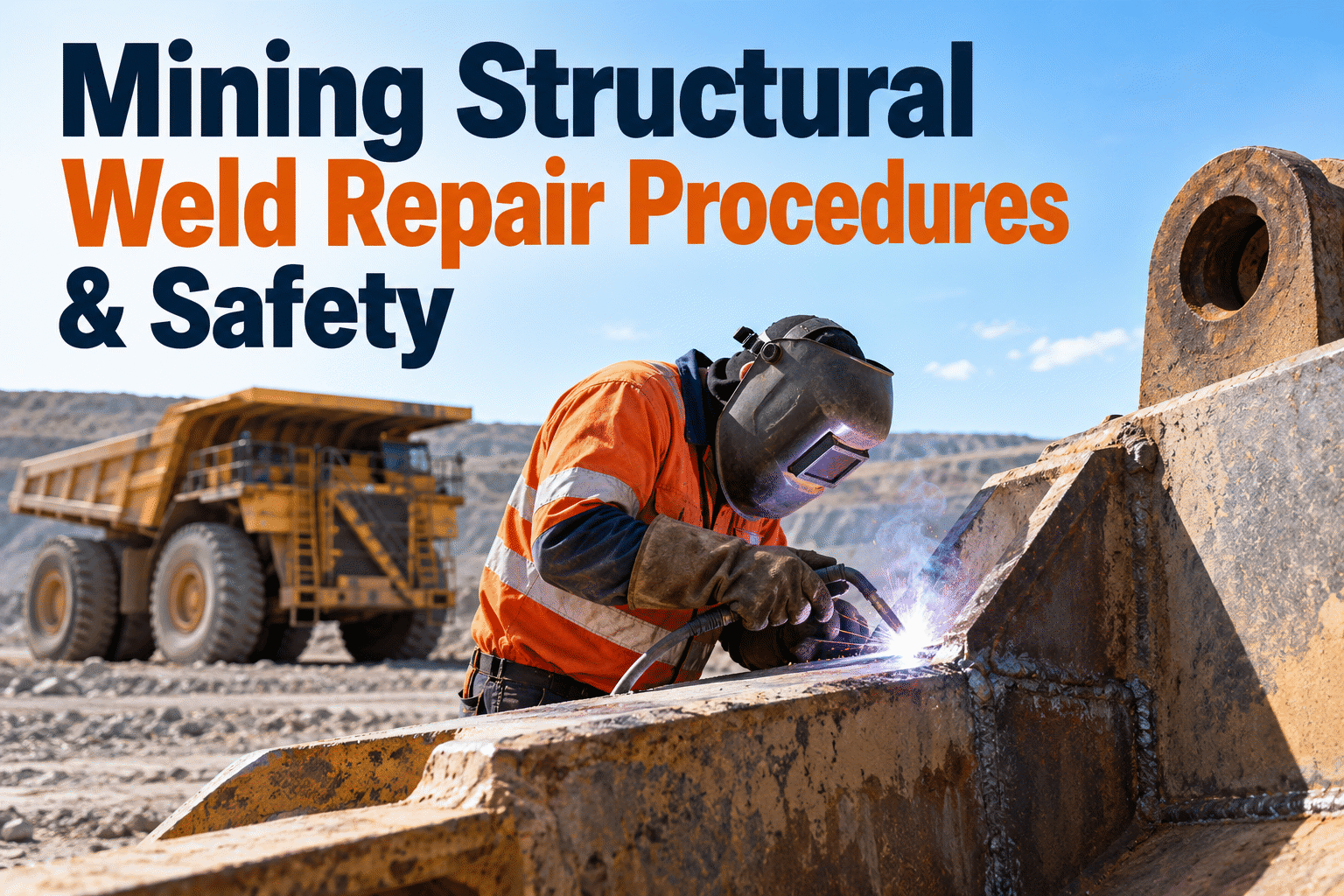
A crack appears near the attachment point of a mine excavator boom during a scheduled inspection. The machine is needed for the next shift, but an undocumented weld could create a much larger structural risk. Effective weld repair procedures begin with identifying the damage, confirming an approved engineering repair method and recording the inspection evidence before the machine returns to service. This guide explains the decisions and documentation involved—and how to book a demo to organize structural repair records with HVI.
Mining Structural Weld Repair: From Crack Discovery to Verified Release
Build a traceable process for engineering review, qualified welding, inspection hold points and maintenance closeout—without treating a weld as a routine cosmetic fix.
Why mining structural weld repairs need more than a work order
Frames, booms, loader arms, brackets, supporting structures and other load-bearing parts experience cyclic loading, impact and vibration. A visible crack can be only one indication of an underlying fatigue, overload, fit-up or design issue.
Confirm the asset and damage
Record the machine ID, component location, crack orientation, dimensions, operating hours, photographs and the conditions in which damage was found. Mark the equipment status and prevent unauthorized use while its condition is assessed.
Establish repair authority
Check OEM instructions, drawings, material identification and applicable engineering requirements. A competent engineer or other authorized authority must determine whether repair is permitted, replacement is required or further investigation is needed.
Plan verification before work
Define the approved welding procedure, qualified personnel, inspection method, acceptance criteria and release authority before the repair starts. Agree on hold points so critical evidence is not lost during welding or finishing.
Mining maintenance teams can book a demo to see how HVI connects equipment inspections with repair work orders while keeping engineering documents and acceptance decisions under the control of qualified personnel.
The six control gates in a structural weld repair
Use the gates as a coordination framework. They do not replace an approved welding procedure, technical drawings or site-specific safety instructions.
Detect
Inspection, photographs and equipment isolation
Assess
Crack extent, material and structural significance
Authorize
Engineer-approved repair plan and WPS
Execute
Qualified welders and controlled repair conditions
Inspect
Specified visual / NDT examination and disposition
Release
Acceptance, records and authorized return to service
What an approved WPS and repair package should establish
A welding procedure specification (WPS) describes the essential welding variables and controls for a defined application. Whether procedure qualification records, welder qualifications and specific testing are required depends on the applicable code, contract, material and repair engineering requirements.
Procedure and personnel evidence
- Component identity: asset, drawing revision, location and material grade where known
- Repair authorization: approved scope, drawings and engineering dispositions
- WPS identification: procedure number, revision and applicable supporting qualification records
- Welder qualification: evidence of authorization for the applicable process and position
- Consumable control: approved filler metal, storage and handling requirements
- Thermal controls: specified preheat, interpass and any post-weld treatment requirements
Quality and acceptance evidence
- Preparation: defect-removal verification, geometry and cleanliness criteria
- Access and restraint: safe access, support, fit-up and distortion management
- Inspection plan: visual and nondestructive testing methods when specified
- Acceptance criteria: engineering or code-defined limits, not improvised field judgments
- Hold points: designated checks before welding, during execution and after completion
- Closeout: inspection results, nonconformances, approvals and equipment release
The exact preheat temperature, welding parameters, excavation geometry and acceptance limits must come from the approved repair documentation; generic values are not safe substitutes.
Keep structural repair documentation with the equipment history
See how HVI can help your mining team record inspection findings, coordinate maintenance work orders and retain supporting repair evidence in one maintenance workflow.
Plan quality checks around the repair—not after the machine is needed
A structural weld repair inspection checklist should follow the approved inspection and test plan. The examples below show what the responsible team may need to document, not a universal inspection standard.
| Hold point | Evidence to capture | Responsible review |
|---|---|---|
| Before repair | Damage map, material identification, engineering disposition, equipment isolation | Maintenance lead and authorized engineer |
| After preparation | Confirmation that identified defects were addressed as required; approved geometry and fit-up | Qualified inspector / technical authority |
| During welding | WPS revision, welder identification, applicable thermal controls and process records | Welding supervisor / quality personnel |
| After welding | Specified visual examination, NDT results where required, any repair rework | Qualified examiner and acceptance authority |
| Before release | Final acceptance, open-item closure, release authorization and follow-up inspection plan | Authorized equipment release personnel |
Visual inspection and NDT serve different purposes
Visual examination can identify surface features and workmanship issues, while methods such as magnetic particle, liquid penetrant, ultrasonic or radiographic testing may be specified for particular materials and defect types. Method selection and interpretation require qualified personnel and an appropriate procedure.
Do not assume that passing a single NDT method proves the entire structure safe. Accessibility, inspection coverage, expected failure mechanisms and engineering acceptance requirements all matter.
Evidence before equipment release
Inspection reports, technician signatures, nonconformance resolution and authorized acceptance should be linked to the correct asset and repair event.
For digital coordination, sign up to explore HVI maintenance records and evaluate how attachments and work order fields fit your documentation requirements.
Example: a crack near an excavator boom attachment
The following scenario illustrates maintenance coordination, not a weld repair instruction. A qualified engineering authority must determine the actual repair scope and acceptance requirements.
Excavator EX-204
During a scheduled inspection, a technician identifies a surface indication near a boom attachment bracket. The machine is isolated pending assessment. The team needs to understand whether the indication is a structural crack, what caused it and whether repair is technically permitted.
Capture: location, images, operating context and inspection report are logged against EX-204.
Investigate: the engineer reviews the structure, material, load path and damage extent.
Plan: the approved repair package defines welding, inspection and acceptance requirements.
Verify: qualified personnel document the work and complete the required inspections.
Close: authorized personnel approve release and schedule any specified follow-up checks.
What to retain in a mining structural repair work order
Repair history should allow a future inspector, maintenance planner or engineer to reconstruct the reason for the repair, who authorized it, what was completed and how acceptance was confirmed.
Structural Repair / EX-204 / Work Order
Inspection ID, photos, location, severity and machine status
Engineering disposition, drawings, WPS and revisions
Qualified personnel, work dates and process evidence
Inspection results, NDT reports and acceptance decisions
Labor, materials, contractors and lost operating time
Release authority, follow-up inspection and retained attachments
For a practical review of digital repair records, book a demo to see HVI work order and maintenance history workflows. HVI helps organize maintenance information; it does not replace engineering certification, welding procedure qualification or independent inspection.
Evaluate repair cost, production impact and recurrence risk together
A low-cost weld is not necessarily a low-cost structural repair. Mining teams should compare engineering effort, specialist labor, testing, access, transport, component replacement and production disruption while giving structural safety precedence over schedule pressure.
Direct repair cost
Engineering review, preparation, welding, consumables, inspection, contractor mobilization and required rework.
Equipment downtime
Isolation, access, inspection hold points, repair execution, testing and approved return-to-service timing.
Long-term reliability
Failure mechanism, historical repairs, expected loading, follow-up checks and the potential value of component replacement.
Compare approved repair and replacement options using total expected cost and operational consequences—but reject any option that cannot meet the required structural acceptance criteria.
Turn repair findings into trackable maintenance actions
Organize inspection findings, work order status, repair attachments and maintenance history so supervisors can follow structural repairs from discovery through authorized closure.
What a complete structural weld repair record should prove
A repair record is useful only when the next maintenance team, inspector or engineering reviewer can reconstruct what happened. Organize evidence around the decisions that made the repair permissible, the work that was performed and the acceptance that authorized service.
Before the repair: establish the technical baseline
- Identify the asset, structural location, defect discovery date and operating-hour reading.
- Attach clear photographs and a dimensioned damage description; record who assessed the crack and how its extent was established.
- Reference the applicable OEM instructions, engineering disposition and approved repair drawing or method.
- Identify material information, the approved WPS and relevant welder qualification records.
- Record isolation, access and lifting arrangements in the site-approved safety documentation.
After the repair: prove acceptance and traceability
- Record the work order, repair location, personnel, WPS revision and material or consumable traceability where specified.
- Attach required process logs and inspection reports, including NDT technique, coverage, results and examiner identification.
- Document nonconformances, corrective work and reinspection rather than overwriting an earlier failed result.
- Capture the responsible engineering or inspection acceptance and formal return-to-service authorization.
- Set follow-up inspection requirements when the approved repair plan calls for them.
A useful audit test is to choose one completed structural repair and ask a reviewer to find the original defect, approval, qualified procedure, inspection result and release decision without searching separate email threads. If those records cannot be linked reliably, improve the process before the next high-priority repair. Book a demo to review HVI repair-history and inspection documentation workflows.
Avoid these common structural repair management gaps
Technical welding quality and maintenance administration must work together. The following gaps often weaken the evidence needed to manage future inspections and repeat damage.
Repairing before root-cause review
Restoring a visible crack without considering abnormal loading, misalignment or previous damage can leave the underlying failure mechanism unresolved. Record the engineering assessment and any operating restrictions or follow-up actions.
Keeping inspection results separately
An NDT report stored outside the work order can be hard to retrieve during later defect investigations. Link report identification, inspected locations, acceptance criteria and disposition to the same asset history.
Closing work without release evidence
Work order completion does not itself demonstrate structural fitness for service. Keep a separate, traceable acceptance and release step by personnel authorized under the approved repair process.
When comparing repair approaches, include engineering scope, machine access, isolation time, inspection availability, parts lead times and the consequences of another failure. The lowest quoted welding cost may not represent the lowest total operational risk. Maintenance software can organize these inputs, but it cannot replace qualified engineering judgment.
A practical 30-day plan for better weld repair records
Start by strengthening traceability and role clarity. A recordkeeping improvement program cannot substitute for a competent structural integrity management program.
Identify critical assets
List load-bearing structures, known crack locations, previous repairs and current inspection responsibilities.
Standardize evidence
Define defect-photo fields, engineering approvals, WPS references and required work order attachments.
Set quality gates
Clarify isolation authority, inspection hold points, acceptance responsibilities and release sign-off.
Review and improve
Audit a sample of completed repairs for missing documents, repeat damage and open corrective actions.
Teams ready to digitize this process can start free with HVI to organize mining equipment inspections and repairs and confirm the available fields and document workflows for their operation.
Mining structural weld repair FAQs
What are weld repair procedures for mining structures?
They are approved technical and quality-control requirements governing assessment, repair authorization, welding execution, inspection and acceptance of damaged structural components. The applicable procedure depends on the structure, material, loading, jurisdiction and engineering requirements.
Does every excavator boom crack need welding?
No. Some damage requires additional investigation, engineered replacement or withdrawal from service rather than welding. The equipment manufacturer and qualified engineering authority should determine whether a repair is permissible.
Why are WPS and welder qualifications important?
An applicable WPS identifies the controlled welding variables, while personnel qualification provides evidence of capability within a defined scope. Their exact requirements depend on the applicable code and approved repair plan.
Which inspections are required after a structural weld repair?
Inspection methods and acceptance criteria must be specified by the applicable engineering documentation. Visual examination and suitable nondestructive testing may be required, but no single generic test or pass criterion applies to every repair.
Can HVI approve structural welding or replace an engineer?
No. HVI is maintenance management software that can help organize inspections, work orders, equipment history and supporting documentation. Engineering approval, qualified welding, inspection acceptance and equipment release remain the responsibility of authorized personnel.
Keep mining weld repair evidence connected to every asset
Book a demo to explore HVI inspection records, maintenance work orders and repair history—or start free to evaluate a digital maintenance workflow for your mining team.