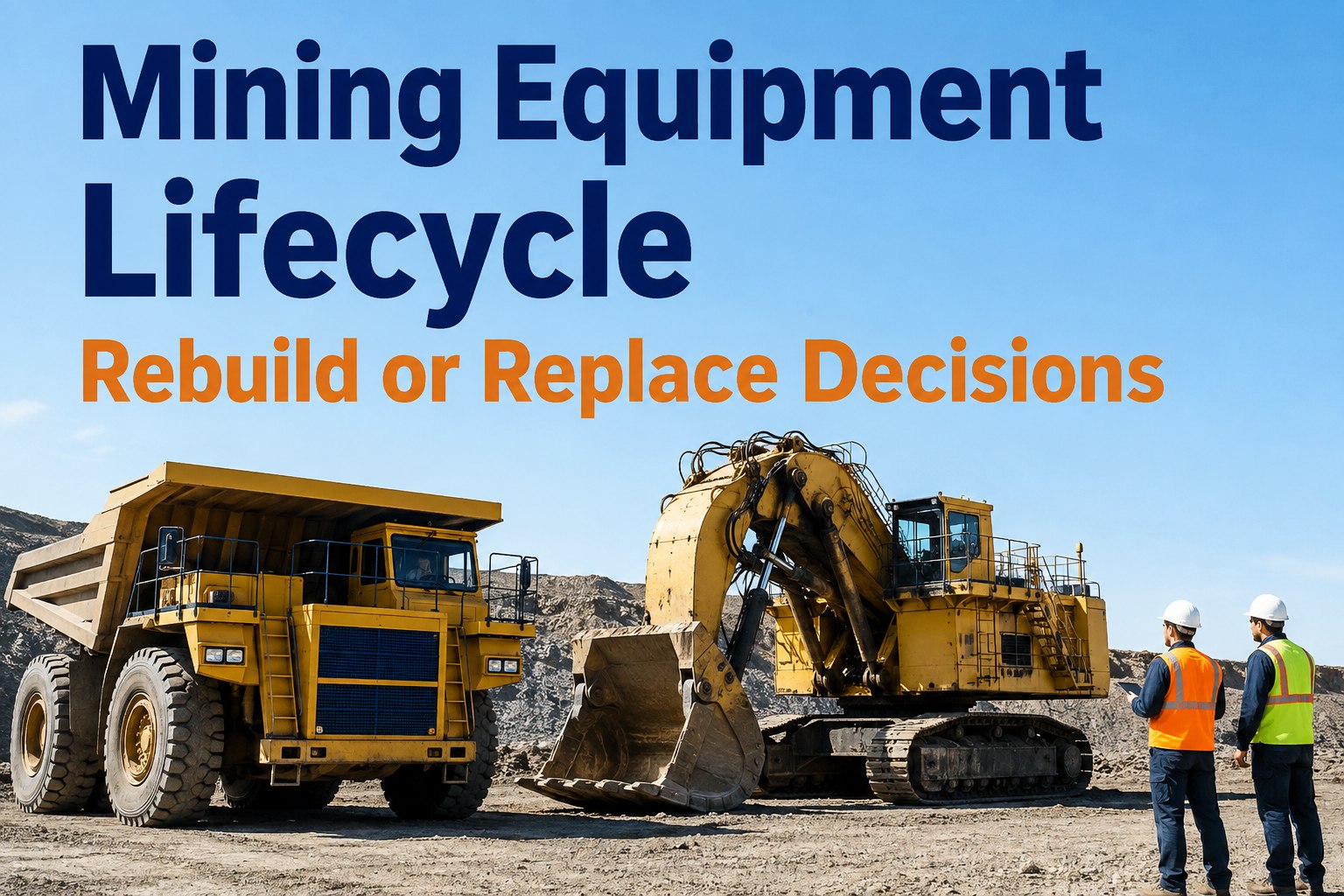
A haul truck that has already been rebuilt twice is sitting in your yard with a tired engine, and the question lands on your desk again: one more major overhaul, or a new machine? In mining, the rebuild-or-replace decision never really ends. A mining equipment rebuild is not a one-time rescue - it is a recurring capital decision that can repeat two, three, even four times across a machine's working life. Get it right and you stretch millions in capital across another 20,000 hours. Get it wrong and you sink rebuild money into a frame that gives you eighteen months of unplanned stoppages. The difference is not judgement or gut feel. It is whether you have the cost-per-hour trend, the reliability history and the component records to defend the call. If you want to see what that looks like on your own units, walk through a rebuild decision on real fleet data before your next budget meeting.
Rebuild again, or finally replace? The answer is already in your maintenance data.
Mining machines are built to be rebuilt - engines, hydraulics, frames, sometimes more than once. The fleets that get this decision right are not guessing. They are reading two signals: the cost-per-operating-hour curve and the unplanned-failure rate. This page shows you how to read both, scope the rebuild properly, and defend the decision to the people who sign the cheques.
The rebuild case
- Cost per hour still below replacement benchmark
- Frame and structures pass inspection
- Rebuild cost under 60-70% of new machine price
The replace case
- Cost per hour trending up for 3+ consecutive periods
- Unplanned events per 1,000 hours climbing
- New machine brings efficiency or autonomy you cannot retrofit
Rebuild vs replace: the numbers that decide it
How to read the equipment lifecycle cost curve
Every mining machine follows the same shape: cost per operating hour falls after commissioning, flattens through its prime years, then climbs as components age. A well-executed rebuild resets the curve - but never all the way back. Each second-life rebuild buys you a slightly higher floor. The decision point is the inflection: when the curve turns up and stays up across three consecutive reporting periods, the next rebuild stops paying.
The trend is the signal. A single expensive quarter can be one bad component; three rising periods is a machine telling you its economics have changed. This is exactly what HVI's Expense Track and Cost Analysis surface per asset - every work order, part and litre of fuel rolled into cost per hour, so you see the turn as it happens rather than at year-end. You can see the cost-per-hour curve on your own fleet in a demo.
Signal one: cost per operating hour
Total maintenance cost divided by engine hours, tracked monthly per asset. Include parts, labour, tyres, fuel variance and downtime cost. Compare against two benchmarks: the machine's own post-rebuild floor, and the published or quoted cost per hour of a current-model replacement. When your old machine's trend crosses the new machine's benchmark, the rebuild case is dead - no matter how healthy the frame looks.
Signal two: unplanned events per 1,000 hours
Cost can be masked by cheap parts or deferred work; reliability cannot. Count every unplanned stoppage - hydraulic hose failures, electrical gremlins, overheating shutdowns - per thousand engine hours. A machine whose unplanned-event rate climbs across consecutive periods is consuming availability even if the invoices look flat. For a haul truck in a production-critical circuit, that lost availability often costs more than the repairs themselves.
What each rebuild scope actually buys you
"Rebuild" covers everything from a single component swap to a frame-up restoration. Each level buys a different amount of life at a different price, and picking the wrong scope is how fleets either waste capital or strand a machine mid-life. Here is how the tiers stack up.
Component-level rebuild
Engine, transmission, final drive or hydraulic pump overhauled or exchanged as each reaches its hour limit. Buys you continued operation at the current cost curve. Right call when the rest of the machine is mid-life and the failed component is the only outlier. Typical spend: a fraction of machine value, scheduled around planned downtime.
Major overhaul / powertrain rebuild
Engine plus drivetrain done together, often with cooling and hydraulics. Buys a genuine second life: cost per hour drops back near the post-commissioning floor for another full component cycle. Right call when hours are high across the board but structures, cab and electrics are sound.
Full frame-up rebuild
Machine stripped to the frame; structures crack-tested and repaired, every system renewed, often with updated wiring, cab and safety systems. Buys near-new life at 60-70% of new price. Right call only when the frame passes inspection and the model still has parts and dealer support. If the quote creeps past 70%, replacement almost always wins on residual value alone.
| Decision factor | Component rebuild | Major overhaul | Frame-up rebuild | Replace with new |
|---|---|---|---|---|
| Capital outlay | Lowest | Moderate | 60-70% of new | Full price |
| Life bought | One component cycle | Full second life | Near-new life | Full first life |
| Downtime for work | Days | Weeks | Months | Delivery lead time |
| Technology gain | None | None | Partial updates | Full: efficiency, emissions, autonomy-ready |
| Residual value after | Unchanged | Modest lift | Strong rebuilt market | Highest, depreciating |
| Best when | One outlier failure | High hours, sound frame | Frame passes, support exists | Curve inflected, tech gap |
Your next rebuild decision is in your work order history
Book a 30-minute demo and we will show you cost per hour, unplanned-event rates and full per-asset history - the exact evidence pack you need to defend a rebuild or a replacement internally.
One haul truck, one decision, real money
Take a 220-tonne haul truck at 28,000 frame hours, already on its second engine. The numbers below are illustrative but typical of how the maths runs when you lay the options side by side.
Option A: third rebuild
Powertrain overhaul quoted at a substantial six-figure sum, plus six weeks of downtime. Post-rebuild cost per hour is projected to settle around 15% above the last floor, because the frame, hydraulics and electrics are all original. Expected life bought: roughly 12,000 hours before the next inflection.
Option B: replace
New truck at full capital, but with a warranty floor for the first years, better fuel burn per tonne moved, and factory autonomy readiness your site plan wants within five years. Current truck sells into the used market as a rebuild candidate, recovering part of the outlay.
The deciding data
Cost per hour has risen across the last four quarters. Unplanned events went from 2.1 to 3.8 per 1,000 hours over 18 months. Both signals point the same way: the rebuild buys a higher floor and a less reliable truck. Replacement wins - and the maintenance history is what makes the case undeniable in the capital meeting.
Notice what made this decision easy: not a spreadsheet built the night before the budget meeting, but a continuous record. Every inspection, defect, PM and repair on that truck since day one, tied to the asset. That is the difference between defending a decision with data and defending it with adjectives. If your records live in binders and inboxes, start building that asset history free - the truck you rebuild in three years will thank you for starting today.
The technology, residual and planning factors most fleets underweight
The technology gap
A rebuild restores the machine you bought; it cannot give you the machine being sold today. Newer models bring fuel efficiency gains, tighter emissions compliance for regulated sites, and autonomy or trolley-assist readiness that a 15-year-old frame cannot retrofit. If your site's five-year plan includes autonomous haulage, a frame-up rebuild on a non-compatible truck strands capital.
Residual value and the rebuilt market
There is an active global market for rebuilt mining equipment, and it cuts both ways. A documented rebuild with full records commands a real premium when you sell - buyers pay for proof. Equally, your ageing machine may be worth more sold now as a rebuild candidate than kept and run into the ground. Machines with complete, timestamped maintenance histories consistently move faster and price better.
The capital planning cadence
Rebuilds fail as surprises, not as decisions. The fleets that handle this well run a rolling fleet-renewal plan: every asset reviewed annually against its cost curve and reliability trend, with rebuilds forecast 12-24 months out so parts, labour and capital are approved before the machine forces the issue. A rebuild done on your schedule costs less than one done on the machine's.
All three factors depend on the same foundation: trustworthy per-asset data. When you can pull a machine's full lifecycle file in seconds - every inspection photo, every defect, every PM interval hit or missed - the technology question, the resale question and the timing question all get easier. Many fleet managers book a demo just to see the lifecycle file before their next fleet review.
The evidence pack for every rebuild-or-replace call
HVI (Heavy Vehicle Inspection & Maintenance, by JRS Innovation Inc.) is the cloud + mobile CMMS that turns daily inspections and work orders into the lifecycle record this decision needs - on any phone or tablet, at the pit, the shop or the port.
Complete per-asset history
Every inspection, defect, repair and PM ties to the machine forever - photo-backed and timestamped. When the capital committee asks why this truck and not that one, you show them the file, not a summary you typed up. Audit-ready for clients, insurers and regulators too.
Expense Track & Cost Analysis
Parts, labour, fuel and downtime rolled into cost per operating hour per asset, trended over time. You see the inflection point in the quarter it happens - not three quarters later when the money is already spent. That is the primary signal, automated.
Analytics for reliability
Unplanned events, PM compliance and availability by asset, by site, by fleet. The unplanned-events-per-1,000-hours signal stops being a gut feel and becomes a chart you can put in front of a director. Spot the climbers before they strand a production circuit.
PM scheduling by engine hours
Preventive maintenance triggered by date, mileage or engine hours with due and overdue alerts - so component life is tracked against plan and rebuild scopes are built from real wear data, not guesses. Defects convert to work orders instantly, keeping the record unbroken.
Mining equipment lifecycle decisions, in five lines
- The trend, not the threshold. Cost per operating hour rising across three consecutive periods is the inflection that ends the rebuild case - no absolute number applies to every fleet.
- Reliability is the second signal. Unplanned events per 1,000 hours expose machines whose invoices look fine but whose availability is bleeding out.
- Scope buys life. Component rebuild, major overhaul and frame-up rebuild each buy a different amount of life at a different price - past roughly 60-70% of new-machine cost, replacement wins on residuals.
- Technology and resale count. A rebuild cannot add autonomy readiness or emissions compliance, and documented history is what makes rebuilt equipment valuable in the market.
- Plan the cadence. A rolling fleet-renewal review, fed by real lifecycle data, turns the mining equipment rebuild question from a crisis into a calendar item.
None of this requires new discipline from your crew - it requires that the inspections and work orders they already do land in one place, tied to the asset. That is the whole job of a good CMMS, and it is why the rebuild-or-replace decision gets easier every year you run one. If you are weighing a machine right now, bring its history to a 30-minute demo and see the decision the data makes for you.
I keep one number per machine on a whiteboard: unplanned stoppages per thousand hours. Cost reports can flatter a dying truck for a year if parts are cheap. Stoppages never lie. Two years ago I killed a seven-figure rebuild on a loader everyone loved because that number had doubled in eighteen months - and I had the work orders to prove it. The director signed the replacement in one meeting. That used to take me three.
Daniel Mercer - Maintenance Manager, open-pit aggregates operation
Mining equipment rebuild and replacement FAQs
How many times can mining equipment be rebuilt before replacement makes more sense?
What is the best indicator that a machine should be replaced rather than rebuilt?
How much should a full frame-up rebuild cost compared to a new machine?
How do I build the internal business case for a rebuild or a replacement?
Does maintenance history really affect the resale value of rebuilt mining equipment?
Make your next rebuild-or-replace call with proof, not opinion
HVI ties every inspection, defect, PM and work order to the machine, and turns it into the cost-per-hour and reliability trends this decision needs. See it on your own fleet in 30 minutes.
Free to start - Works on any phone - No card needed