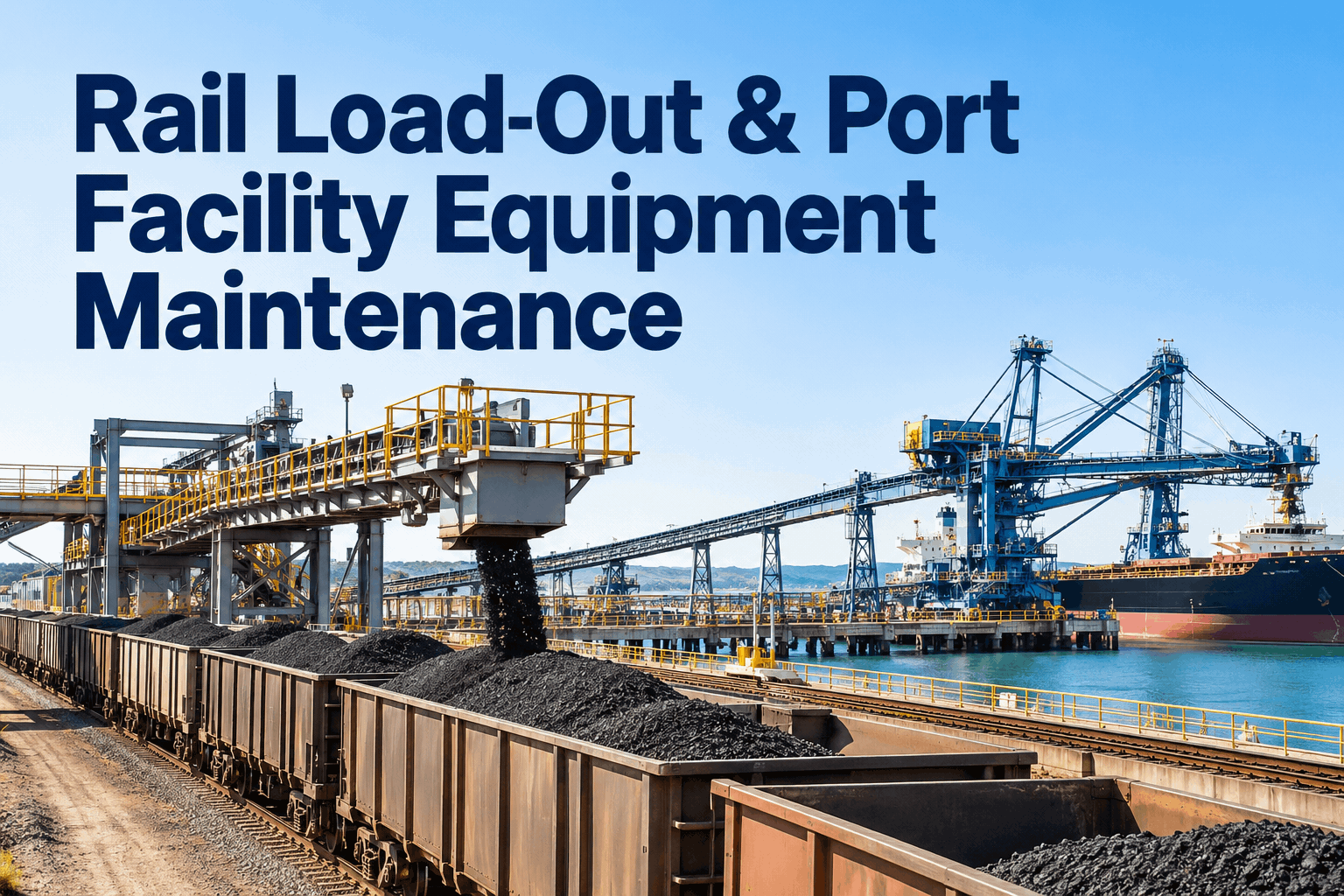
At a rail load-out or port terminal, everything upstream exists to get product into a wagon or a hull on schedule. When a transfer chute blocks or a load-out conveyor trips, it isn't one machine down — it's a loaded train holding a path or a chartered vessel burning demurrage while it waits. Load out facility maintenance keeps that last, highest-stakes stretch of equipment running. This guide covers the wear points, the inspection routine and the PM that protect it. Book a load-out maintenance demo to see it applied.
The last conveyor is the one that stops the train
Load-out and port equipment runs continuously under abrasive bulk, rarely stops for inspection, and sits at the point where a single failure holds a train path or a berthed ship. Keep it inspected, maintained and defect-tracked — before the demurrage clock starts.
- Reclaim conveyorOK
- Surge bin level72%
- Chute liner wearFlag
- Load-out gateOK
Load-out and port equipment is maintenance on hard mode: it runs near-continuously, carries abrasive product that eats liners and belts, and almost never comes offline for a proper look — because stopping it stops the export. Below is the chain it sits in, the wear points that actually fail, why downtime here costs more than anywhere upstream, and the inspection and PM routine that keeps it loading.
The chainwhere product moves through a load-out — and what stops it at each stage
Material runs a short, unforgiving path from stockpile to wagon or hull. Each stage has its own failure, and any one of them halts loading.
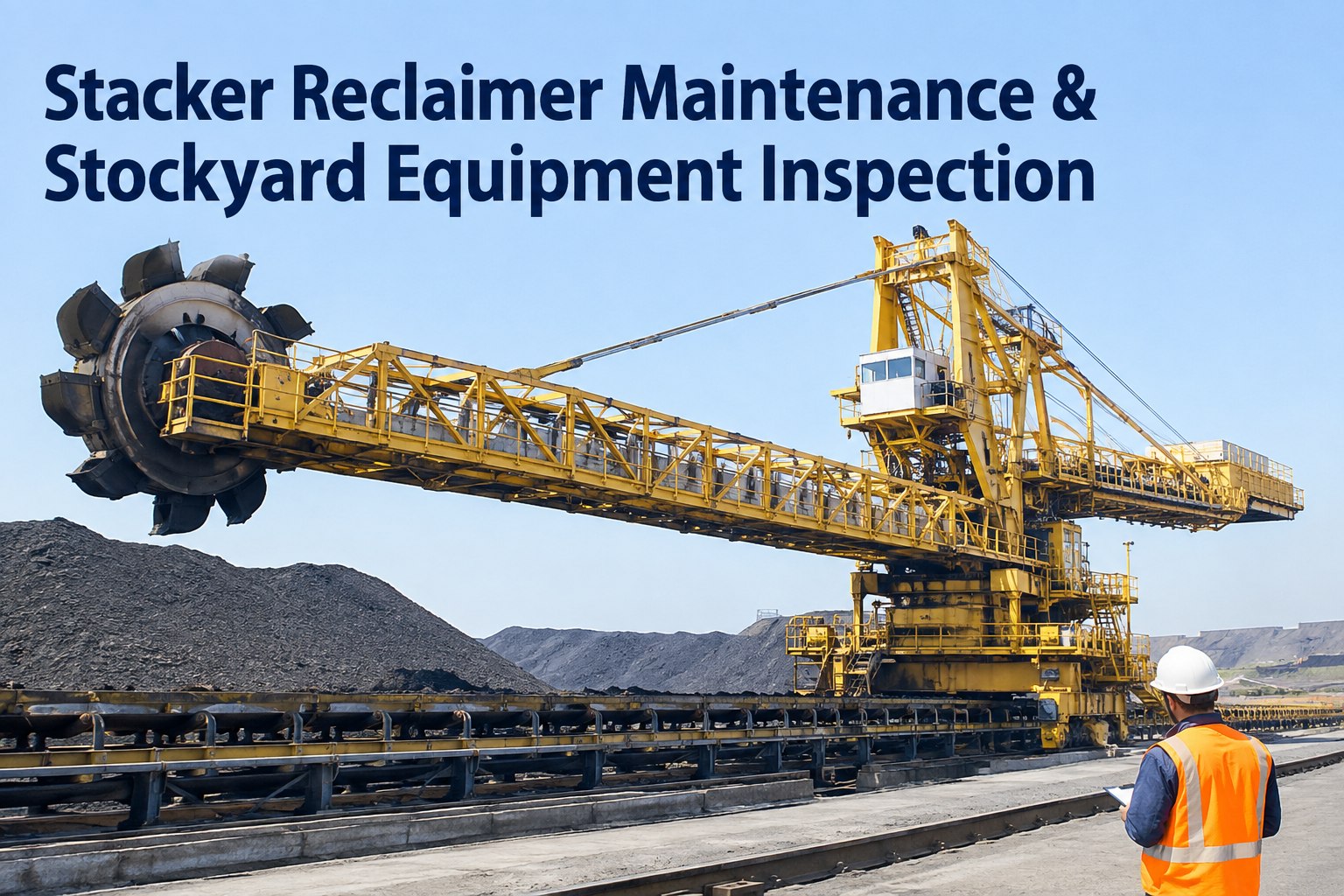
- ReclaimStacker-reclaimer lifts from the stockpile — bucket & slew wear
- ConveyorBelt carries it to the load-out — misalignment & idler failure
- Surge binBuffers flow to the loader — bridging & gate faults
- ChuteDirects product into the wagon/hold — liner wear & blockage
- Load pointTrain loader or ship loader fills — positioning & flow control
The chain is only as reliable as its weakest transfer point, and the chute is usually it — abrasive product grinds liners thin, build-up bridges the opening, and suddenly the loader is starved while a train idles. See inspection templates built for each stage, or book a demo of load-out inspections.
The wear pointswhat actually fails on load-out and port equipment
Generic maintenance misses these — they're specific to continuous bulk handling. Know them and your inspection template writes itself.
Conveyors
- Belt tracking & edge wear
- Idler seizure and roller flat spots
- Splice condition under load
- Scraper and skirt wear
Chutes & transfers
- Liner thickness at impact zones
- Build-up and bridging at the throat
- Dust seal and skirt integrity
- Flow-control gate operation
Ship & train loaders
- Travel and luffing drive wear
- Telescopic chute & spoon condition
- Positioning & limit systems
- Structural & slew-bearing checks
Stacker-reclaimers
- Bucket-wheel teeth & segments
- Slew and long-travel drives
- Boom conveyor & tripper
- Cable reel and rail condition
The pattern across all four is abrasion and continuous duty — components wear predictably, which is exactly why condition-based inspection catches them before failure. See how HVI covers mining fixed plant, or book a demo of wear-part tracking.
Why it costs more herethe downtime cascade that makes load-out failures expensive
A breakdown at the load-out doesn't just idle a machine — it stalls a queue of committed logistics. The cost cascades outward.
This is why load-out equipment earns a higher maintenance priority than its size suggests: the repair invoice is trivial next to a day of demurrage or a missed sailing. Downtime here is measured in logistics, not just labor. See downtime reporting that ties equipment status to loading availability.
The walk-downa load-out facility inspection checklist that catches wear early
Between loads or on a running inspection, this is what the team checks. Each line is observable, grouped by the asset it covers.
Conveyor run
- Belt tracking centered, no edge fray
- No seized or squealing idlers
- Scrapers contacting, skirts sealed
- No spillage building under the belt
Chute & transfer
- Liner thickness checked at impact zone
- No build-up narrowing the throat
- Dust seals and skirts intact
- Flow gate strokes fully, no sticking
Loader
- Travel and luffing drives smooth, no noise
- Telescopic chute/spoon seated, no damage
- Positioning & limit systems respond
- Slew bearing & structure — no cracks or play
Reclaimer & bin
- Bucket-wheel teeth present, not rounded
- Surge bin discharging, no bridging
- Cable reel feeds and retracts cleanly
- Rails clear, no debris on travel path
Logged on a phone against each asset, a flagged liner or seized idler routes straight to a work order with a photo — so the next planned stop fixes it instead of an unplanned one finding it. Sign up free and build your load-out checklist into every inspection.
Maintaining what won't stopPM for continuous load-out and port equipment
You rarely get the load-out offline, so PM is built around running checks, condition triggers and the short windows you do get.
Walk-down inspection, belt tracking, spillage, chute flow, loader function — while it runs.
Liner thickness, bucket teeth, idler condition — serviced when wear crosses a threshold, not a date.
Liner swaps, splice work, drive and bearing service batched into the scheduled outage window.
The art is landing the condition-based work in the planned stop before wear forces an unplanned one — which only works if the wear data is captured every shift. See preventive maintenance scheduling driven by condition and meter triggers, or book a demo of condition-based PM.
In practicea chute defect caught before it blocked the load
- Belt tracking & idlers — pass
- Dust seals & skirts — pass
- Chute liner — worn to minimum at impact zone
- Flow gate operation — pass
The liner is flagged at 09:12 with a photo while the train still loads, and the swap is booked into the next planned shutdown — not discovered when the chute blocks mid-load three days later. That's the whole value of catching wear on a running inspection. See defect-to-work-order flow for load-out equipment.
From the terminal
People think the big risk is the ship loader — the expensive machine. It's not. It's a worn chute liner nobody logged, bridging at the worst possible moment with a vessel on the berth. Once we put running inspections on every transfer point and tracked liner wear as a condition trigger, our unplanned load-out stops dropped sharply. The demurrage we didn't pay that year more than covered the whole system. It's the small wear parts that hold up the big logistics.
Load-out & port maintenance FAQs
What is load-out facility maintenance?
It's the inspection, preventive maintenance and defect tracking of the equipment that loads product into rail wagons or ships — reclaimers, conveyors, surge bins, chutes and loaders. Because this equipment sits at the point where a failure holds a train or vessel, its reliability is disproportionately valuable to the whole export chain.
Why is load-out downtime more costly than upstream downtime?
A failure here stalls committed logistics, not just a machine. A loaded train holds a path and a berthed ship accrues demurrage while the loader is down, and the backup cascades up to the stockpile and plant. The repair cost is usually trivial next to the logistics cost of the wait.
What are the main wear points on load-out equipment?
Abrasion drives most of it: conveyor belt tracking and idlers, chute liners and build-up at transfer points, loader travel and chute mechanisms, and bucket-wheel teeth on reclaimers. These wear predictably under continuous bulk duty, which is what makes condition-based inspection so effective.
How do you maintain equipment that rarely stops?
PM is built around running inspections, condition triggers and planned shutdowns. Walk-downs capture wear each shift, components are serviced when wear crosses a threshold rather than on a date, and liner swaps and splice work are batched into scheduled outage windows before wear forces an unplanned stop.
What should a load-out inspection cover?
Group it by asset: conveyor tracking, idlers and scrapers; chute liner thickness, build-up and gate operation; loader drives, chute and positioning systems; and reclaimer teeth, surge bin flow and rails. Logging each as a dated, photo-backed record turns a flagged wear part into a planned repair.
Protect your load-out before the demurrage clock starts
HVI gives rail load-out and port teams inspection templates for every transfer point, photo-logged defect tracking on wear parts, condition-based PM, and work orders that route a flagged liner into the next shutdown. Maintenance history, analytics and defect tracking — live in under two weeks.
No credit card · Load-out inspection templates from day one