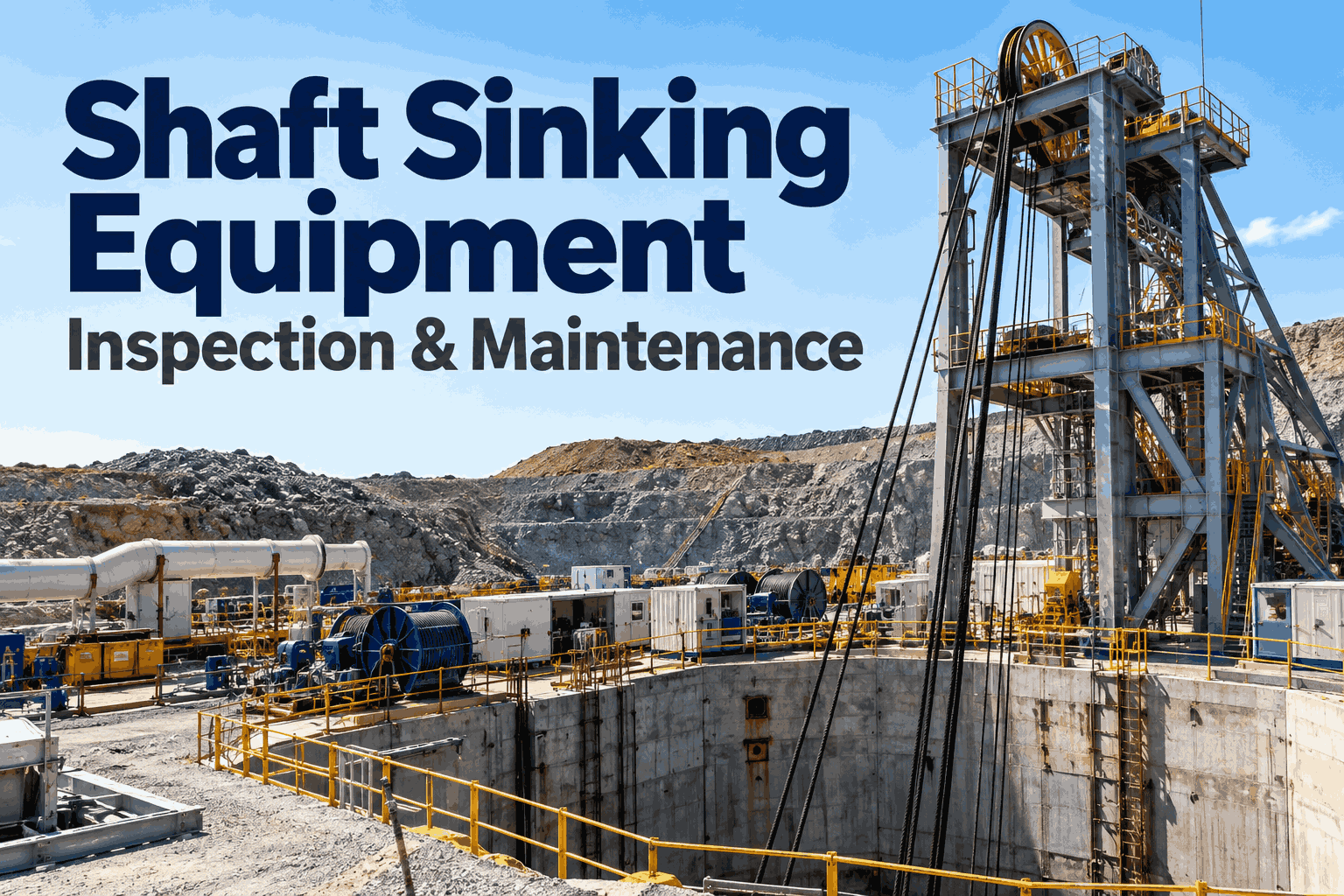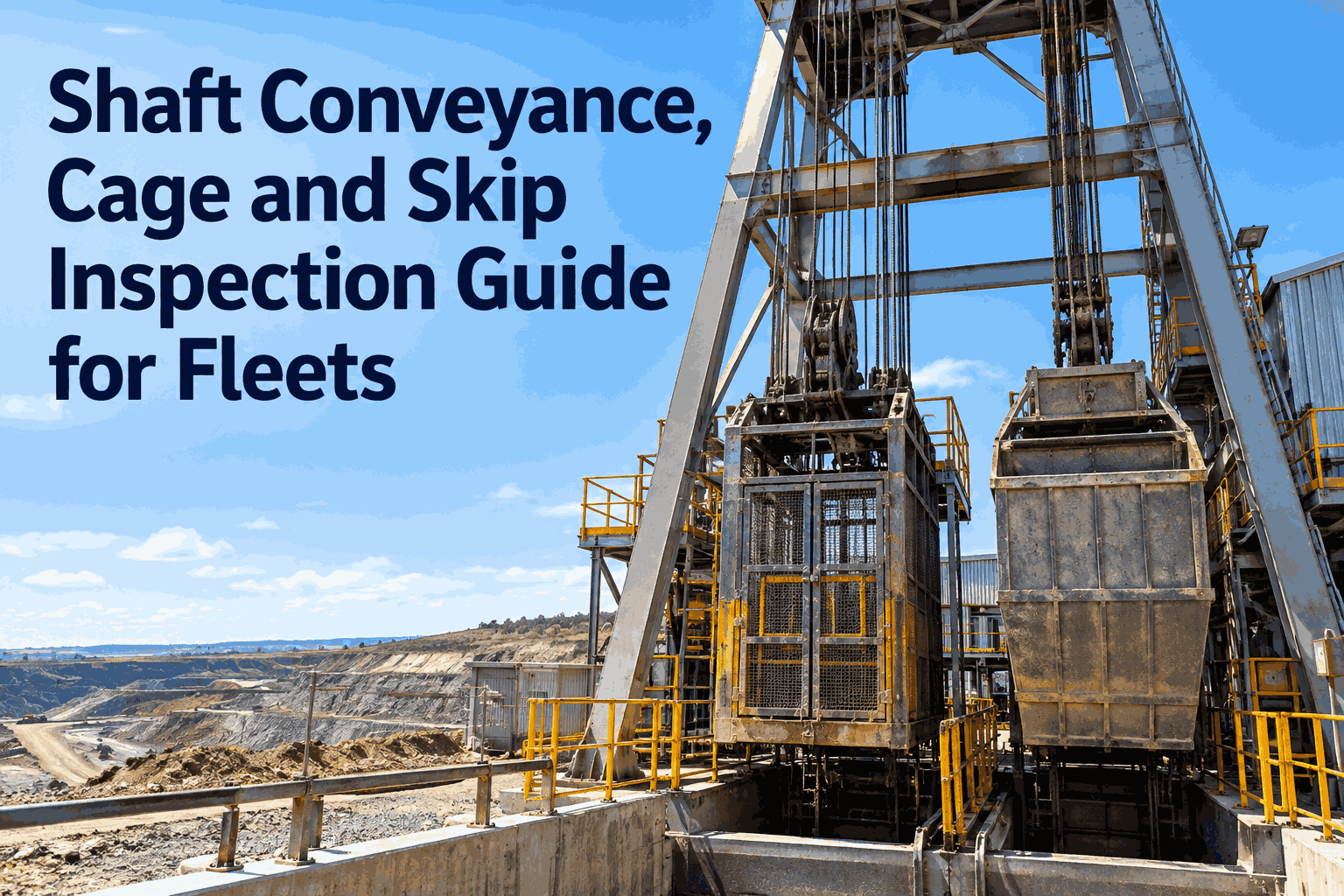
Shaft conveyance inspection is the check on the one part of the hoist you're standing inside — the cage or skip that hangs on the rope and carries people and rock through the shaft. Unlike the winder or the headframe, you can't watch it work; it's down the shaft, out of sight, riding the guides between the rope above and the safety catch that's meant to hold it if that rope ever lets go. Book a demo to keep every conveyance inspected and proven.
The Part of the Hoist You Ride In
A cage or skip is a travelling assembly of safety systems — suspension gear, structure, guides, doors and the safety catch. Every one is inspected on a schedule, and the record is what proves the conveyance is fit to carry a shift.
This is a practical guide to shaft conveyance inspection — why the cage and skip deserve their own program, the six inspection domains, how a man-cage and skip differ, why the safety catch is the item you can never let slide, and how the records prove the conveyance is fit to hoist.
Why the conveyance needs its own inspectionthe cage and skip are more than a box on a rope
In a lot of hoist programs the rope, brakes and drums get the attention, and the conveyance is treated as secondary — a box that hangs on the end. But shaft conveyance inspection is its own discipline: the cage or skip is a travelling structure with suspension gear, guide contacts, doors and safety devices, each of which can fail independently of a perfectly good rope and winder. It's also the part carrying the people.
The rope can be perfect and the conveyance still unsafe. A cracked suspension bracket, a worn guide shoe, a door that won't latch, or a safety catch that's seized are all conveyance faults that a rope-and-winder check never touches. That's why the cage and skip get inspected as their own safety system — not as an afterthought to the rope.
The six domains of a shaft conveyance inspectionwhat a full cage or skip check covers
A complete shaft conveyance inspection breaks into six domains. Each has its own failure modes, and a real program checks all six rather than eyeballing the frame and calling it done.
Structural frame
Members, welds, connections and floor for cracks, corrosion, distortion or impact damage that weakens the box.
Suspension gear
Rope attachment, capel or socket, pins, and the detaching hook where fitted — the critical link between rope and load.
Guide shoes / rollers
Shoes or rollers that hold the conveyance to the shaft guides — worn contacts cause rough, unstable travel.
Doors & gates
Man-cage doors, gates and their latches and interlocks — they keep people and material safely inside during travel.
Safety devices
Safety catches, arrest gear and the protective bonnet over a man cage — the systems that act when something else fails.
The record
Every domain checked, dated and signed — the proof the conveyance was fit on the day it carried a shift.
The record is the sixth domain for a reason: on shaft equipment that carries people, the inspection isn't finished until it's documented. Capturing all six the same way each time is exactly what a structured digital inspection app is built to do. Book a demo to build a conveyance check
A man-cage and a skip aren't inspected the samepeople-carrying versus rock-carrying duty
Both hang on a rope in the same shaft, but a man-cage and a material skip do different jobs and wear differently — so shaft conveyance inspection weights them differently. One is judged on protecting people; the other on surviving a brutal loading cycle.
- Doors, gates and interlocks that protect the riders
- Protective bonnet over the cage
- Safety catches / arrest gear tested to function
- Smooth, stable ride from good guide shoes
- Dump or discharge mechanism and its linkages
- Wear liners and body from abrasive rock
- Heavier structural and fatigue duty per cycle
- Suspension and guides under constant heavy loading
The shared items — suspension, structure and guide contacts — get checked on both, but the man-cage adds the people-protection layer and the skip adds the wear and dump-mechanism items. Running the right checklist for each is easier when the profile lives in your preventive maintenance schedule rather than a generic form. Start free and set a profile per conveyance.
The safety catch is the item you never let slidethe last line of defence in shaft conveyance inspection
Every domain matters, but one carries a special weight. The safety catch — the arrest gear that grips the guides and holds the conveyance if the rope or suspension ever fails — is the item that only matters on the worst day, which is exactly why it's the easiest to neglect. It never gets used in normal operation, so it's tempting to assume it works.
A safety catch that has quietly seized, corroded or fallen out of adjustment gives no warning — it simply won't engage when the moment comes. That's why shaft conveyance inspection treats it as a tested item, not a visual one: confirm it's free, correctly set and able to act, not just present. It's the definition of a check you can't afford to sign off on faith.
Because it's never exercised in service, the safety catch's only evidence of readiness is the inspection record — the dated proof it was checked and found able to function. Let that record go stale and you're trusting the most important device on the conveyance to luck, so it's worth putting safety-device checks on a tracked routine you can start free. Book a demo to track safety-device checks
How often the conveyance is inspectedlayered checks from daily to detailed
Shaft conveyance inspection runs in layers, like the rest of the hoist. A quick check happens often; the detailed, measured examination happens on a longer interval; and any damage or repair triggers an out-of-cycle inspection before the conveyance goes back into the shaft.
The daily check confirms the conveyance is safe to use today; it doesn't replace the periodic examination that measures wear and tests the safety devices. Keeping both layers on schedule — and triggering the out-of-cycle check whenever there's damage — is the discipline behind a defensible mine hoist and winder inspection program. Book a demo to schedule conveyance checks
Where conveyance records fall shortthe gaps that expose a cage or skip
The cage and skip are usually robust; it's the inspection regime and the records around shaft conveyance inspection that slip. Each of these gaps is what surfaces in an audit — or in the investigation after something goes wrong.
None of these is a fault with the cage itself — they're gaps in the system that inspects and records it. Close them and shaft conveyance inspection becomes something you can stand behind, not just hope holds up when it's examined.
From a mine safety manager
We were solid on the rope and winder — those got looked at religiously. The cage was the blind spot. It came back from a maintenance shift with a guide shoe worn well past limit that nobody had measured, just noted as "a bit rough," and on the same cage a safety catch that hadn't been function-tested in longer than I was comfortable with once I went looking. Neither had failed, but both could have. We rebuilt the conveyance inspection around all six domains, with the safety catch as a tested item every periodic exam and every check dated and signed on a tablet. Now the inspector's request for the cage's history is a one-minute answer, and I sleep knowing the last line of defence has been proven, not assumed.
How HVI runs shaft conveyance inspectioninspect all six domains, schedule it, prove it
Shaft conveyance inspection works when every cage and skip is checked across all six domains, on schedule, with the record always findable. HVI's inspection management, preventive maintenance and compliance tracking do exactly that for a shaft's conveyances.
Inspect by domain
A guided check across structure, suspension, guides, doors and safety devices, with photos of any fault.
Schedule & flag
Daily, periodic and in-depth inspections triggered on time, with a worn item raised as a work order.
Prove compliance
Every dated, signed conveyance record stored and ready to produce the moment it's asked for.
It's the same discipline the whole shaft runs on — see how conveyance inspection fits inside a full mining inspection and maintenance program. Walk through your own cages and skips in a quick demo
Shaft conveyance inspection: quick answers
What is shaft conveyance inspection?
Shaft conveyance inspection is the structured examination of a mine hoist's cage or skip — the assembly that hangs on the rope and carries people or material through the shaft. It covers six domains: the structural frame (cracks, welds, corrosion), the suspension gear (rope attachment, pins and detaching hook), the guide shoes or rollers, the doors and gates with their latches and interlocks, the safety devices (safety catches, arrest gear and the man-cage bonnet), and the record that proves each was checked. It's inspected as its own safety system because a conveyance can fail independently of a perfectly good rope and winder.
How often should a cage or skip be inspected?
On layers. A routine check happens daily or each shift before use — doors and gates, obvious damage, guide-shoe condition and a functional look at safety devices. A detailed examination happens on a longer periodic interval, measuring guide-shoe wear, examining structure, welds and suspension gear, and testing the safety catch to function. An in-depth inspection with non-destructive testing of critical structure and a competent-person sign-off happens on a longer interval again. And any impact, damage or repair triggers an out-of-cycle re-inspection before the conveyance returns to service. Exact intervals vary by jurisdiction, so confirm them against your shaft's design and local mining regulations.
Why is the safety catch so important?
The safety catch — the arrest gear that grips the shaft guides to hold the conveyance if the rope or suspension ever fails — is the conveyance's last line of defence. It's critical precisely because it's never used in normal operation, which makes it easy to assume it works. A catch that has seized, corroded or fallen out of adjustment gives no warning; it simply won't engage when it's needed. That's why a good shaft conveyance inspection treats it as a tested item, confirming it's free, correctly set and able to act — not just present. Its only evidence of readiness is the dated inspection record.
How is a man-cage inspection different from a skip inspection?
Both share the core items — suspension gear, structural frame and guide contacts — but they carry different duties. A man-cage is judged on protecting people, so its inspection weights doors, gates and interlocks, the protective bonnet, and function-testing the safety catches and arrest gear, plus a smooth stable ride from good guide shoes. A material skip is judged on surviving a brutal loading cycle, so its inspection adds the dump or discharge mechanism and linkages, wear liners and body condition from abrasive rock, and the heavier structural and fatigue duty it takes each cycle. Running the right checklist for each is easier when the profile is set per conveyance.
Can software manage shaft conveyance inspection and records?
Yes. HVI runs the conveyance inspection as a guided check across all six domains so structure, suspension, guides, doors and safety devices are examined the same way every time, with photos of any fault. Its preventive maintenance scheduling triggers the daily, periodic and in-depth inspections on time and raises a worn item as a work order. And its compliance tracking stores every dated, signed record and makes any cage's or skip's inspection history available to produce on demand — so a conveyance is never in the shaft without current proof it was found fit to carry a shift.
Never send a cage or skip down the shaft unproven
HVI turns shaft conveyance inspection into a program you can stand behind — every cage and skip checked across all six domains, the safety catch tested not assumed, the intervals scheduled so nothing lapses, and every signed record ready to produce the moment an inspector asks.
No credit card · Built for underground shaft-hoisting operations
- Structure: cracks, welds, corrosion, distortion
- Suspension gear, pins & detaching hook
- Guide shoes / rollers — wear measured
- Doors, gates, interlocks & bonnet
- Safety catch tested & every check recorded