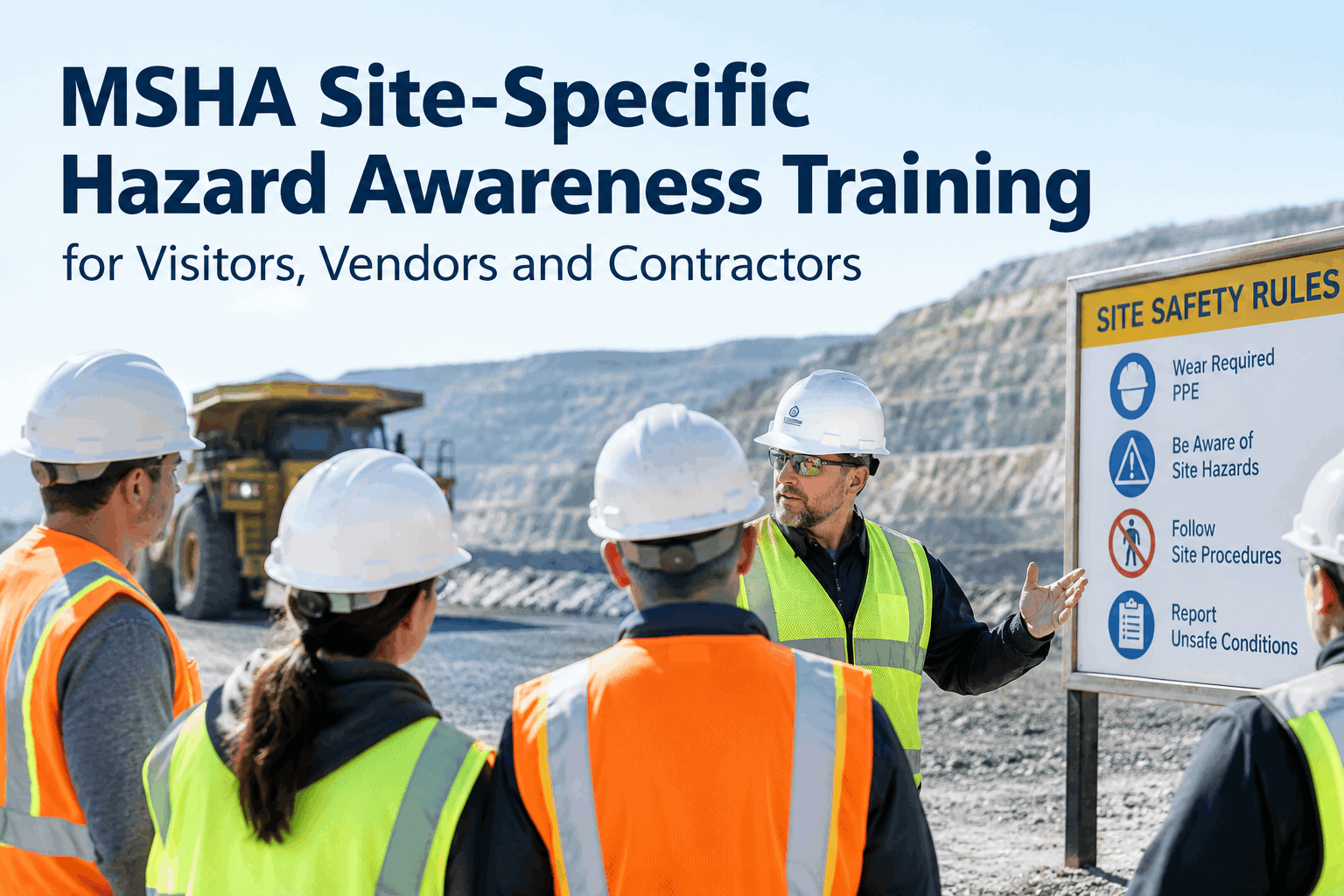
The delivery driver dropping a load, the vendor rep checking a pump, the office contractor fixing a printer — none of them are miners, and every one needs MSHA hazard awareness training before they set foot past the gate. Site-specific hazard awareness training under 30 CFR 46.11 is the short orientation the law requires for anyone who isn't a miner but is present at the mine — and one of the easiest requirements to overlook and the most awkward to prove after the fact. This guide covers who needs it, what it must cover, and the evidence trap that catches operators who did the training but can't show it. See who's trained and the evidence in one place
If They're on the Mine and They're Not a Miner, They Need Hazard Awareness Training
Not sure who counts? These are the people MSHA specifically names — every one needs site-specific HAT.
Who needs it — and the line that decides
The whole thing turns on one distinction: a miner works at the mine and is engaged in mining operations — and gets full Part 46 training. Anyone else who is present at the mine but isn't a miner needs the shorter site-specific hazard awareness training instead. MSHA names the groups explicitly so there's no guessing.
- Office and staff personnel and scientific workers on mine property
- Delivery workers and customers, including commercial over-the-road truck drivers
- Vendors and visitors of any kind at the site
- Maintenance or service workers not at the mine for frequent or extended periods
- Construction workers and contractor employees who are not miners under § 46.2
- Miners moving between mines — a driller or blaster needs HAT for each new site
One responsibility catch worth knowing: even when a contractor delivers the training to its own people, the production-operator remains responsible for making sure it happens — and must name that contractor in the training plan. So the operator can never fully hand off the obligation, only the delivery. Book a demo to track HAT across visitors and contractors.
What the training actually has to cover
Hazard awareness training isn't a generic safety video — the word that matters is site-specific. It has to be about the hazards a person could actually be exposed to at this mine, plus what to do in an emergency here. MSHA sets out what it must address.
Site-specific health & safety risks
Unique geologic or environmental conditions at this mine, and the hazards they create.
Recognising & avoiding hazards
Electrical and powered-haulage hazards especially — how to spot them and stay clear.
Traffic patterns & restricted areas
How haulage moves on site, where a visitor may go, and the areas that are off limits.
Warning signals & evacuation
What the warning and evacuation signals mean, and the emergency procedures for this site.
How you deliver it is flexible — written hazard warnings, oral instruction, posted signs, or a walk-around all qualify — as long as it's genuinely about this site's hazards. A canned orientation that never mentions the mine's actual powered-haulage routes or evacuation signals doesn't meet the standard, however slick it looks. Book a demo to standardise the content.
The evidence trap that catches good operators
Here's the part that surprises people, and it's written right into the rule. For hazard awareness training given to non-miners, MSHA does not require you to keep a formal training record on Form 5000-23. That sounds like a relief — until you read the next sentence.
No formal record is required — but you must still be able to prove, on request, that the training was given. MSHA accepts the training materials used, copies of the written information handed out on arrival, or a visitor log that shows training was provided. "We always do it" is not evidence; a log that shows it is.
That distinction is exactly where well-run mines get citations. The training genuinely happens — but months later, when an inspector asks to see that a particular delivery driver was trained, there's nothing to show for it. The fix isn't more training; it's a simple, reliable log that captures each person and the fact they were trained, so the evidence exists the moment it's needed. Book a demo to keep provable HAT evidence per visit.
Hazard awareness training vs. new miner training
These two get confused constantly, and mixing them up means either over-training a visitor or dangerously under-training an actual miner. The line is simply whether the person is a miner engaged in mining operations.
Hazard awareness training
A short, site-specific orientation on this mine's hazards and emergency procedures for visitors, vendors, delivery drivers, and contractors' non-miners — no set hours, evidence must be available on request.
Full Part 46 training
New-miner training, task training, and annual refresher for people engaged in mining operations — substantial required hours, formal records certified on Form 5000-23.
Getting the classification right is the whole game: train a genuine miner as if they were a visitor and you have a serious safety and compliance gap; put a delivery driver through full new-miner training and you've wasted a day. Knowing who is which — and holding the right record for each — is what a training program has to get right. Start Free — Sort Miners From Visitors.
Running HAT as a managed program
For a busy mine with a constant flow of visitors, vendors, and contractors, the challenge isn't the training itself — it's doing it every time, for every person, and having the evidence ready whenever it's asked for. Three HVI capabilities carry that.
Team management
Track every visitor, vendor, and contractor who receives hazard awareness training against your site — who they are, when they came, and that they were trained.
HVI: Team ManagementSafety management
Keep the site-specific hazard content consistent and current — the actual hazards, signals, and procedures every person needs to hear, delivered the same way each time.
HVI: Safety ManagementAudit-ready records
Hold the log, materials, and sign-offs as retrievable evidence — exactly the proof MSHA accepts, ready the moment an inspector asks.
HVI: Audit-Ready RecordsHeld together, these turn a scattered, easy-to-forget obligation into a routine the system carries: every non-miner is logged and trained, the content stays site-specific, and the evidence is one search away. On a requirement where the training is simple but the proof is everything, that's the difference between confident compliance and a citation you can't argue. Start free and run HAT as one managed log.
From a mine safety manager
We always did the hazard awareness training — every driver, every vendor got the talk. What we didn't have was proof. An inspector asked us to show a specific delivery driver from three months back had been trained, and we had nothing but "we always do it," which isn't evidence. Uncomfortable day. Now every visitor and contractor gets logged when they're trained, the site hazards we cover are standard, and if MSHA asks I pull the record in seconds. The training never changed — we just stopped being unable to prove it.
Frequently asked questions
Who needs site-specific hazard awareness training?
Under 30 CFR 46.11, anyone present at a mine site who is not a miner engaged in mining operations. MSHA names the groups: office and staff personnel, scientific workers, delivery workers and customers including over-the-road truck drivers, vendors and visitors, maintenance or service workers not at the site for frequent or extended periods, and construction workers or contractor employees who aren't miners. It also applies to miners like drillers and blasters who move between mines, needing site-specific training for each new site. If someone is on mine property and isn't a fully trained miner, they need hazard awareness training before exposure.
Do you have to keep records of hazard awareness training?
Not a formal training record, but you must be able to prove it happened. Under 30 CFR 46.9 you're not required to record hazard awareness training for non-miners on Form 5000-23. But the same rule says you must provide evidence to MSHA on request that the training was given — the materials used, copies of the written information handed out on arrival, or a visitor log book showing training was provided. So "no formal record required" doesn't mean "no evidence needed." A simple log capturing each person and confirming they were trained is exactly the proof MSHA accepts.
What must hazard awareness training cover?
It must be genuinely site-specific: information on the hazards a person could be exposed to at that particular mine, plus the applicable emergency procedures. MSHA requires it to address the site's health and safety risks such as unique geologic or environmental conditions; recognition and avoidance of hazards, especially electrical and powered-haulage; traffic patterns, control, and restricted areas; and warning and evacuation signals, evacuation, and emergency procedures. You can deliver it through written hazard warnings, oral instruction, posted signs, a walk-around, or other appropriate means. A generic orientation that doesn't address this mine's actual hazards doesn't satisfy the requirement.
Whose responsibility is contractor hazard awareness training?
The production-operator has primary responsibility for ensuring it happens, even when a contractor delivers it. An operator can arrange for an independent contractor to provide the training to the contractor's own non-miner employees, but must name that contractor in the training plan and remains responsible for making sure it's actually provided. In other words, the operator can hand off the delivery but not the obligation. That arrangement is common on busy sites, but only works if the operator still has visibility that every contractor's people were trained — which comes back to keeping a reliable log.
How is hazard awareness training different from new miner training?
The difference is who the person is. Hazard awareness training is a short, site-specific orientation for people present at the mine but not miners — visitors, vendors, delivery drivers, contractors' non-miners — with no set hours and evidence available on request. New miner training under Part 46 is for people engaged in mining operations: substantial required hours of new-miner, task, and annual refresher training, with formal records on Form 5000-23. Getting the classification right matters — training a real miner as a visitor is a serious safety gap, while putting a visitor through full miner training wastes a day.
Do the hazard awareness training — and be able to prove you did
HVI logs every visitor, vendor, and contractor who receives site-specific hazard awareness training against your site, keeps the hazard content consistent, and holds the materials and sign-offs as the exact evidence MSHA accepts. So every non-miner is trained before exposure, the content stays site-specific, and when an inspector asks you to show it, the proof is one search away.
No credit card · Visitor, vendor & contractor training log · MSHA-ready evidence