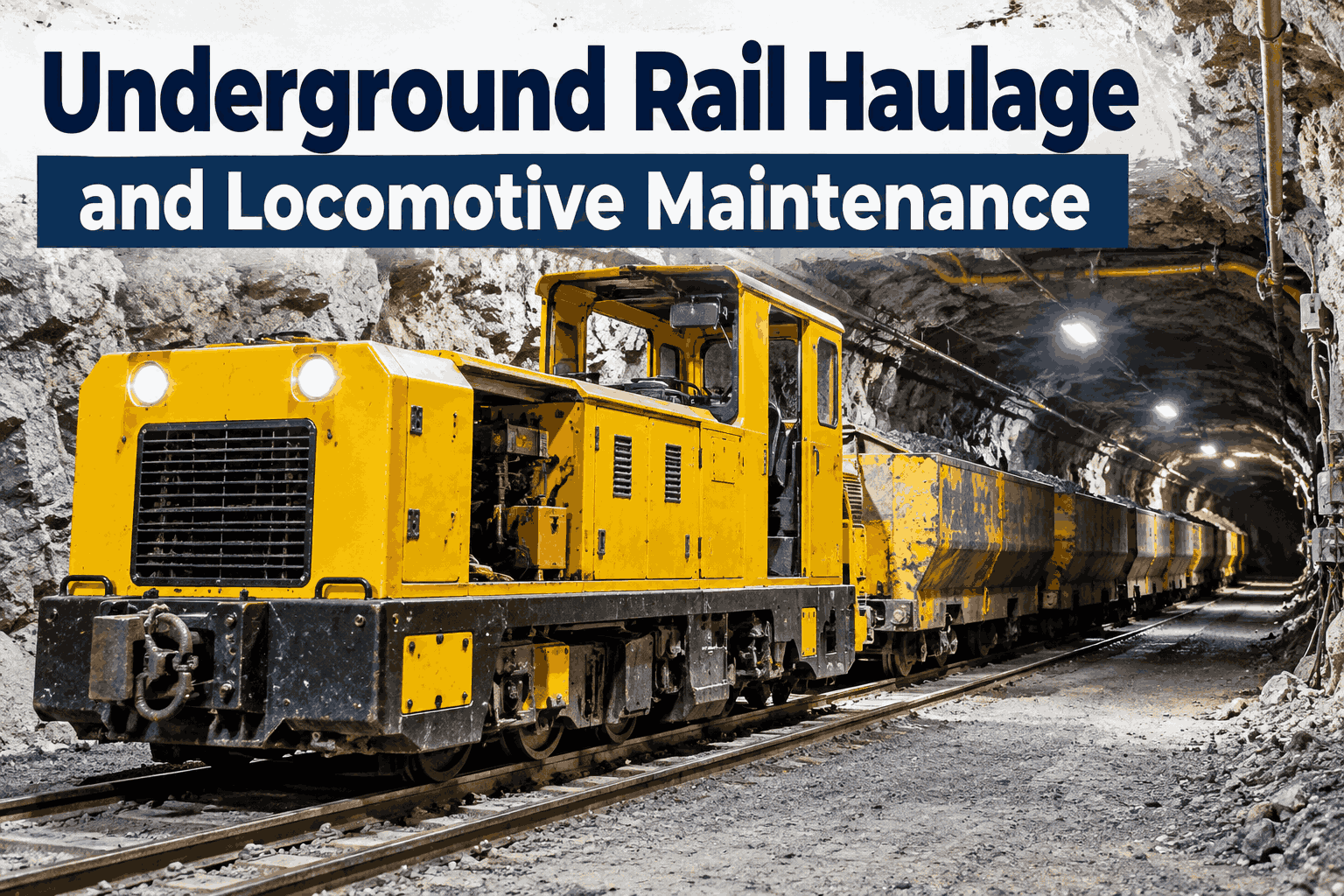
Underground locomotive maintenance has a blind spot that catches even good mines: teams service the machine beautifully and forget it runs on a road it can't leave. A haul truck can steer around a bad patch; a locomotive meets whatever the rail hands it. That's why derailments — most of them traced to track, not the loco — are the single biggest incident type in rail haulage. Real underground locomotive maintenance is two programs in one: the machine, and the track it's captive to. Book a demo to see loco and track checks tracked together.
Underground locomotive maintenance is the machine plus the track
A locomotive can't steer around a fault — it's captive to the rail. So the program has two halves: the loco's brakes, traction, and electrics, and the track it can never leave. Neglect either and the train comes off the road.
On rubber-tyred gear, the machine is the whole job — it carries its own road with it. Rail haulage is different: the locomotive is only half the system, and the rail it runs on is the other half, fixed in place and every bit as capable of putting the train on the ground. A perfectly serviced loco still derails on a spread gauge or a contaminated rail. This guide covers both halves — the locomotive's own systems and the track infrastructure — plus the inspection rhythm that keeps a rail-haulage fleet on the rails and running.
Why rail haulage is unforgivingthe loco is captive to the track
Before the checklist, the reason both halves matter. A locomotive's defining limit is that it has nowhere to go but forward or back along one fixed line — and that changes what maintenance has to prevent.
It can't steer around trouble
A truck avoids a bad spot; a loco meets whatever's on the rail — a spread joint, a contaminated section, an obstruction. The track's condition is the loco's fate.
Derailments lead the incidents
Derailments are the largest share of reportable rail-haulage incidents, and most straight-track derailments trace back to poor track standards — not the machine.
Brakes are graded to the grade
A loco should never haul a load up a gradient it can't safely brake back down. Brake performance and track gradient are one calculation, checked together — not assumed.
That's the case for treating track as maintenance, not scenery — and for testing brakes against the real grade they work on. Book a demo to see loco brake checks and track condition on one program.
The locomotive: six systems that keep it safehalf of underground locomotive maintenance
Battery, trolley, or diesel, the locomotive comes down to six systems that decide whether it stops, pulls, and runs safely. These are the machine half of underground locomotive maintenance.
Braking systems
Service, emergency, and parking brakes — the last designed to fail safe, never held on by fluid pressure alone. Test true brake effort against the load and grade, not just a stopping distance on a light run.
Check: daily · test weekly to loadTraction & drive
Traction motors, gearing, and controllers turn power into pull. Watch for overheating, current draw, and worn gears; a loco that can't develop rated tractive effort stalls loaded on a grade.
Check: temp · current · gearingElectrical & power
Battery, trolley pickup, or diesel — plus cables, contactors, and the deadman control. Inspect connections and protection, and confirm the deadman actually cuts power and applies the brake when released.
Check: power source · test deadmanWheels & running gear
Wheel profile, flange wear, and diameter uniformity govern how the loco tracks and grips. Uneven or worn wheels lose adhesion and climb the rail — inspect profiles and keep diameters matched.
Check: profile · flange · diameterCouplers & drawgear
Coupler height, drawbar condition, and coupling resilience move the load and hold the train together. Worn or mismatched couplers snatch loads, shed cars, and cut into the loco's usable adhesion.
Check: height · wear · securitySanders, lights & warning
Sanders restore grip and recover a skid; headlights light the stopping distance; the audible warning protects people on foot. All three are safety-critical — verify sand flow, lamp function, and horn every shift.
Check: sander flow · lights · hornServiced well, that's a loco that stops, pulls, and warns as designed. But it's still only running as well as the rail beneath it. Start free and put all six loco systems on one inspection form.
The track: the half a truck program never haswhere most derailments actually begin
This is what separates rail haulage from every other underground fleet — the road is part of the machine's maintenance. Poor track standards drive the majority of straight-track derailments, so the rail gets inspected as seriously as the loco.
Rail wear & joints
Worn rail and misaligned or spread joints lift wheels off the track. Inspect the rail head and every joint — a stepped or gapped joint is a derailment starting.
Gauge & alignment
Gauge that spreads or tightens, poor cant on curves, and misalignment all unload wheels and invite a climb. Check gauge on straights and curves, and watch tight radii.
Sleepers, ballast & drainage
Rotten sleepers, washed-out ballast, and standing water let the track move under load. Sound support keeps gauge and grade where they belong between repairs.
Gradient & points
Ground movement changes grades over time, and split or worn points cause a large share of point derailments. Re-check steep grades and prove every point locks and throws cleanly.
Clearances & contamination
Side clearances between train and roadway protect people; oil, water, and dust on the rail rob adhesion and cause runaways. Template the clearances and keep the railhead clean.
None of this is on a haul-truck checklist — and skipping it is why a well-maintained loco still ends up on the ground. Book a demo to give the track its own inspection route and history.
The rail-haulage maintenance scheduleloco and track, daily to periodic
Both halves run on layered checks. Treat this as a working frame — your mine's scheme of maintenance and regulator set the exact examination and brake-test requirements for locomotives and permanent track.
| When | What to check | Why it matters |
|---|---|---|
| Every shift | Loco pre-op: brakes, deadman, lights, horn, sander; railhead contamination | The frontline safety check |
| Daily | Statutory road exam, visual track and clearance walk | Catches spreading track early |
| Weekly | Loco examination and dynamic brake test to load | Proves real braking, not assumed |
| Periodic | Wheel profiles, traction, gauge survey, gradient re-check, points | Trends wear on loco and rail |
| Commissioning | Instrumented brake baseline; track survey before service | Sets the reference to test against |
| After any work | Re-inspect and re-test affected loco or track section | Confirms the fix before running |
The weekly brake test and the daily track walk are the two that keep a fleet on the rails — and the two most likely to slip when a mine gets busy. Start free and load the loco and track schedule onto every haulage road.
How HVI keeps rail haulage on the rails
The gap in underground locomotive maintenance is rarely the checklist — it's connecting the loco and the track into one record, and turning a spotted defect into a closed repair before the next train runs it. HVI links preventive maintenance, inspection, and repair tracking across both halves.
Inspect both halves
Crews run the loco pre-op and the track walk on a phone underground — brakes, deadman, wheels on the machine, joints, gauge, and clearances on the rail — flagging defects with photos, offline.
Flag to a work order
A spread joint or a soft brake becomes a repair work order on the spot, assigned and tracked to close — so it's fixed before the next shift runs the same road.
Schedule & prove
Weekly brake tests, PM, and track surveys fire on their own clock, and the full loco-and-track history exports on demand for an inspector.
It's the same discipline behind our underground haul truck inspection guide — applied to the rail-bound half of the haulage fleet — and it runs on HVI's preventive maintenance and fleet inspection tools, with defects flowing straight into tracked repairs and every check kept for the pre-shift examination record.
Our locos were spotless — we could rebuild a traction motor in our sleep. What put a train on the ground was a joint on a straight that had crept out of line, and nobody's daily walk had written it down. We spent a shift re-railing and cleaning up, and the loco that derailed had nothing wrong with it.
Now the track walk is on the tablet next to the loco pre-op, and a bad joint becomes a work order before the next train runs that road. We haven't derailed since. When I show the inspector, the loco brake tests and the track record are in the same place — machine and road, one history.
Underground locomotive maintenance FAQsthe questions rail-haulage teams ask most
What does underground locomotive maintenance involve?
Two halves: the locomotive — brakes, traction and drive, electrical and power, wheels and running gear, couplers, and sanders/lights/warning — and the track it runs on, including rail wear, joints, gauge, sleepers, gradient, points, and clearances. Both are inspected and maintained on a shift-to-periodic cadence.
Why is track maintenance part of locomotive maintenance?
Because a locomotive can't leave the rail. Derailments are the biggest share of rail-haulage incidents, and most straight-track derailments come from poor track standards, not the machine. A perfectly serviced loco still derails on a spread gauge or contaminated rail — so the track is maintained as seriously as the loco.
How often should a mine locomotive be inspected and brake-tested?
A pre-operation check every shift, and a locomotive examination with a dynamic brake test to load typically weekly, plus periodic wheel, traction, and track surveys. The brake test must build real brake effort against the load and grade, not just measure a stopping distance. Confirm exact intervals against your regulator.
What causes most underground rail derailments?
Track condition. The large majority of straight-track derailments trace to poor track standards and maintenance — worn or misaligned rail, spread gauge, defective points, and contamination — rather than the locomotive. It's the clearest reason the rail belongs in the maintenance program.
Can software manage locomotive and track maintenance together?
Yes. HVI runs the loco pre-op and the track walk on one platform, flags defects into repair work orders, schedules brake tests and PM for both, and keeps the combined history — so a spread joint becomes a tracked, closed repair and the loco-and-track record is ready for an inspector.
Maintain the machine and the road it can't leave
Run the loco pre-op and the track walk on one platform, turn every spread joint and soft brake into a tracked repair, and schedule the brake tests and surveys that keep a train on the rails. HVI makes underground locomotive maintenance one program for the machine and the track. Live for your mine in days.
No credit card · set up your first haulage road on day one