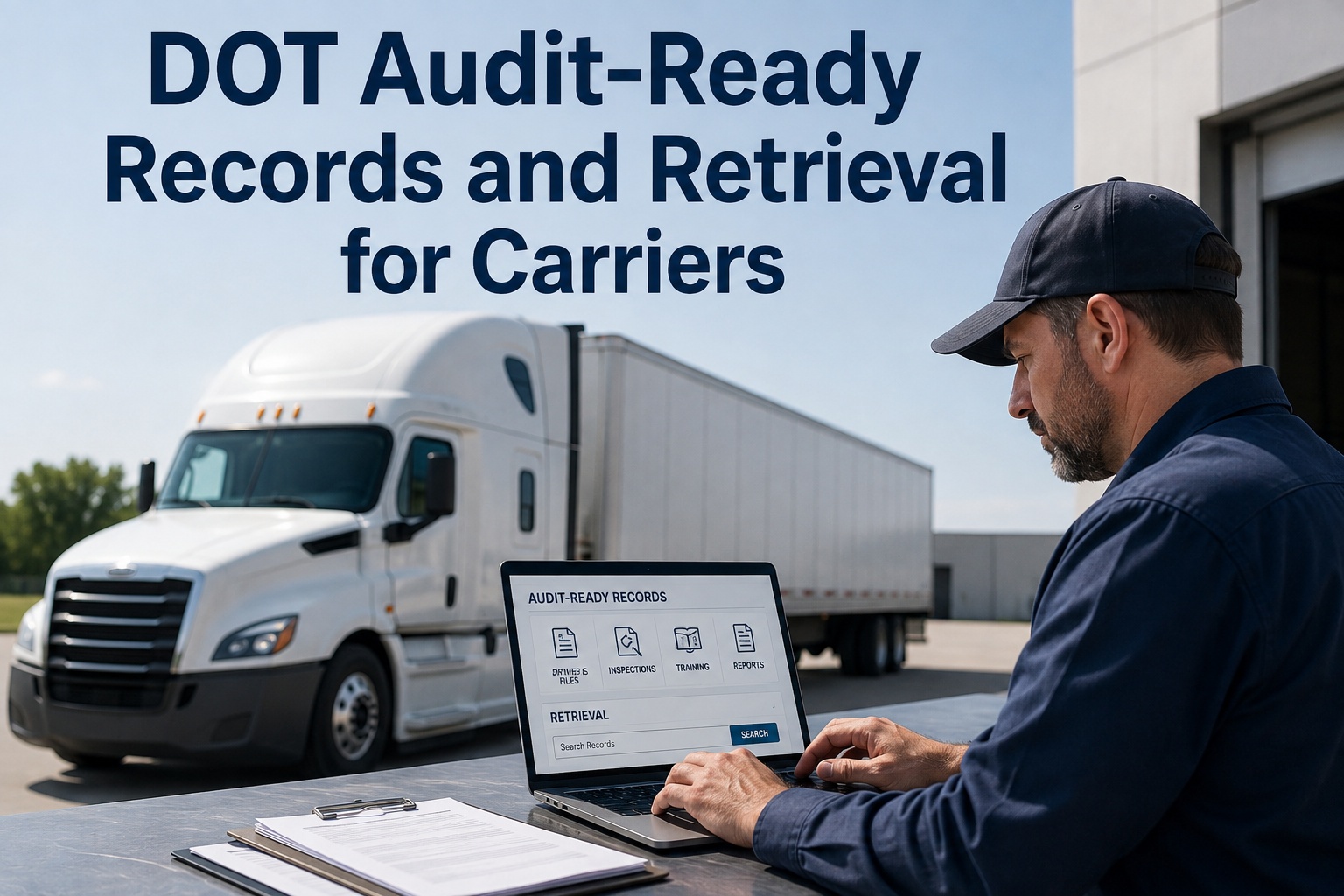
A DOT audit never starts with the auditor opening a single binder. It starts with them asking for four things at once — yesterday's DVIRs, the maintenance file on truck 14, last year's annual inspection sticker, and the paperwork from that roadside violation three states back. If any one of those four pillars has a gap, the auditor keeps digging, and ninety-three percent of carriers walk out with an average of six violations. DOT compliance software exists to close those gaps before the auditor arrives, and the right platform turns four disconnected paper chains into one auditable record you can pull up in seconds. See it run on your own fleet in a live walkthrough.
DOT & FMCSA COMPLIANCE
Four pillars. One audit. Zero gaps.
Auditors don't look at DVIRs, maintenance records, annual inspections and roadside management as separate boxes. They read them as a single chain — and a break in one link triggers findings across all four. HVI runs the entire chain on one platform, so retrieval that used to take a day takes seconds.
THE COST OF A BROKEN CHAIN
What a gap in one pillar really costs you
Every number below is tied to money, downtime or a CSA hit — not a generic statistic you read and forget.
THE FOUR-PILLAR CHAIN
Why DOT compliance software has to cover all four pillars at once
A carrier can have perfect DVIRs and still fail an audit because the annual inspection record for one trailer is missing. Here is exactly what auditors examine as a chain, link by link.
DVIRs & daily inspections
49 CFR 396.11 & 396.13
Every driver completes a written or electronic inspection report at the end of each day's work, covering steering, lights, tires, horn, wipers, mirrors and coupling devices. The report needs the three-signature chain: the driver who wrote it, the mechanic who reviewed any defects, and the driver on the next trip confirming the defect was either repaired or documented as safe to operate. Retain for three months. The most common finding here is not a missed inspection — it is a missing mechanic signature or a defect note with no corresponding repair record.
Vehicle maintenance records
49 CFR 396.3
Each power unit and trailer must have its own identified file containing the make, year, serial number, tire size and a record of all inspections, repairs and maintenance — including the date, the shop or technician, and the work performed. Parts replaced under a recall or warranty go in the same file. Retention runs for the service life of the vehicle plus six months after it leaves the fleet. Auditors don't just check that the file exists; they pull a random VIN and ask you to show the last six months of work. If your shop uses three different spreadsheets and a group chat, that retrieval eats half a day.
Annual DOT inspections
49 CFR 396.17, 396.19 & 396.21
Every commercial motor vehicle must pass a periodic inspection covering all fifteen categories in Appendix A — brake system, coupling devices, exhaust, frame, fuel system, lighting devices, steering, suspension, tires, wheels and rims, windshield wipers, mirrors, emergency equipment and more. The inspector must be qualified under 396.19, and you need to keep records proving that qualification. The inspection report and sticker are retained for fourteen months. Fleets get tripped up on two things: expired stickers on trailers that sit in the yard, and no documented proof the inspector who signed off was actually qualified.
Out-of-service & roadside management
49 CFR 396.9
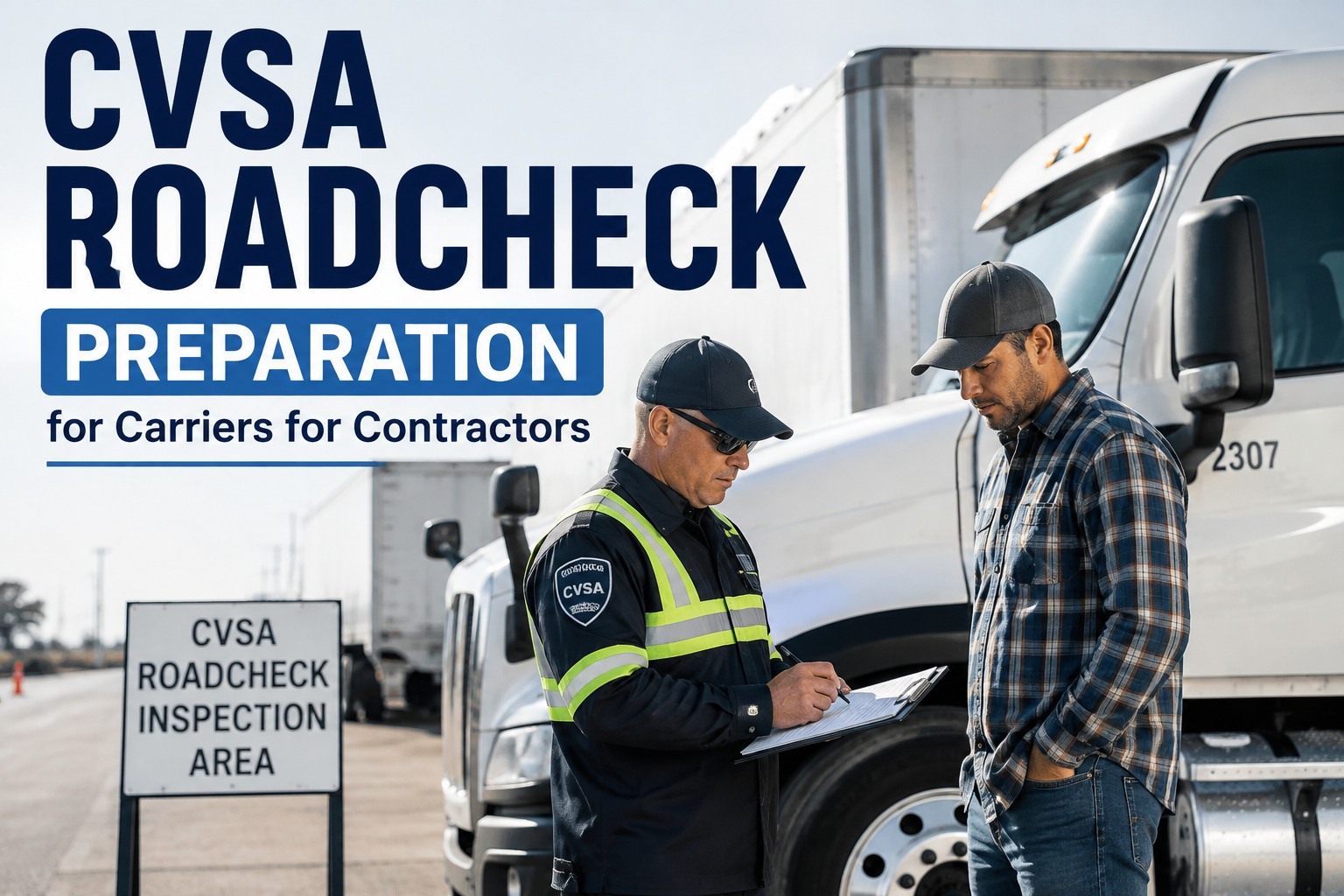
When a roadside inspector places a vehicle or driver out of service, you have fifteen days to correct the defect and file the required repair documentation. No repair record means the violation stays open, and every open violation feeds your CSA Behavior Analysis and Safety Improvement Categories score. The chain breaks here more than anywhere else: a driver hands the roadside form to a shop foreman, the foreman fixes the truck, and nobody files the paperwork or notifies the data source that the violation was cleared. You can walk through the roadside-to-repair workflow on your own units to see how HVI closes that loop.
REQUIREMENT-TO-RECORD MAPPING
How an auditor reads your records — and where paper breaks
This is the exact mapping an auditor uses. The left column is the regulation, the middle is what they ask for, and the right is where the paper process falls apart.
| Regulation | What the auditor asks for | Where paper breaks the chain |
|---|---|---|
| 396.11 — DVIR | Last 90 days of driver reports with all three signatures | Driver turned in the form but the mechanic never signed the defect section, or the form is sitting in a truck cab |
| 396.3 — Maintenance file | The complete repair history for a randomly chosen VIN | Work was done but logged in a spreadsheet that doesn't link to the VIN, or the invoice is in a different building |
| 396.17 — Annual inspection | Inspection report, sticker date and inspector qualification proof | Sticker is on the trailer but the paper report was never filed, or the inspector's qualification record expired |
| 396.9 — Out-of-service | Repair record proving the roadside defect was fixed within 15 days | The truck was repaired but the repair order was never tied back to the violation number, so the CSA hit stays open |
| 396.13 — Pre-trip review | Driver signature confirming prior defects were reviewed before the next trip | The driver reviewed it verbally but there is no timestamped, signed record tying the review to that specific unit and date |
DO THIS / DON'T DO THIS
Audit-ready habits vs audit-failing habits
Most audit findings aren't from ignorance of the rules — they're from small habits that leave a gap in the chain. Here is what passes and what fails.
- DVIRs filed electronically with timestamp, location, photo and three digital signatures the second a defect is noted
- Every work order auto-attached to the VIN's maintenance file the moment the technician closes it in the shop
- Annual inspection due dates visible on a dashboard with alerts 30 days before expiry, across every truck and trailer
- Roadside violation forms photographed on the spot and converted to a work order before the truck leaves the inspection site
- One search bar that pulls up any unit's full compliance history — DVIRs, repairs, annuals and violations — in under five seconds
- Paper DVIR booklets in the drivers' room with missing mechanic signatures and no photos of the defect
- Repair records split between a shop whiteboard, three Excel files and a folder of texted photos on the foreman's phone
- Annual inspection stickers tracked on a wall calendar — the one nobody checks after the shop foreman goes on vacation
- Roadside violation forms stuffed in a glove box, handed to the shop a week later, with no link to the CSA case number
- An auditor waits forty-five minutes while someone digs through a filing cabinet for a single trailer's annual report
Stop hunting for records when the auditor calls
See HVI pull any unit's full compliance chain — DVIRs, maintenance, annuals and roadside — in under five seconds.
HOW HVI HELPS
One platform across all four DOT compliance pillars
HVI doesn't bolt a compliance dashboard onto a paper process. It runs the actual inspection, repair and inspection-scheduling work, then turns every action into an audit-ready record automatically. Book a 30-minute demo to see the full chain on your own fleet data.
Digital DVIR with the three-signature chain built in
Drivers complete inspections on any phone or tablet, capture photos of defects on the spot, and the report routes to the mechanic for a digital signature. The next-trip driver signs electronically, confirming the defect was reviewed. Every step is timestamped and geo-tagged. No paper, no missing signatures, and you can start logging inspections free the same day you roll out.
Outcome: zero missing-signature findings on DVIRs
Work orders that auto-file to the VIN's maintenance record
When a technician closes a work order, HVI attaches it to the vehicle's permanent file — date, shop, technician, parts used, labor hours and photos — with no manual data entry. Pull any VIN and the complete 396.3 history is on screen in seconds. Parts pulled from inventory are deducted automatically, so the maintenance file and the parts ledger never drift apart.
Outcome: retrieval time drops from hours to under five seconds
Annual inspection scheduling with 30-day alerts
HVI tracks the annual DOT inspection due date for every truck, trailer and bus on a single dashboard, with alerts firing 30 days before expiry. Inspector qualification records live in the same system, so when 396.19 proof is requested it's one click away. No more expired stickers on trailers that sit in the back of the yard.
Outcome: no more expired-annual findings on surprise reviews
Roadside defect-to-work-order in the inspection lane
A driver photographs the roadside violation form at the inspection site and HVI creates a work order tied to the CSA case number before the truck moves. The fifteen-day clock starts in the system, the shop sees the repair priority immediately, and the completed repair record auto-files back to the VIN and the violation log. You can see the roadside-to-repair workflow on a live demo in under thirty minutes.
Outcome: open roadside violations closed inside the 15-day window, every time
THE NUMBERS ON ONE FLEET
What audit readiness looks like on a 40-truck fleet
Take a mid-size carrier running forty power units and twenty trailers across regional routes. Here is what happens to their compliance chain when they move from paper and spreadsheets to a single platform.
BEFORE HVI — PAPER & SPREADSHEETS
AFTER HVI — ONE PLATFORM
A 75% reduction in audit prep time on a 40-truck fleet means roughly three full shop-days back in the maintenance schedule every audit cycle — time that goes straight into preventive maintenance instead of digging through binders. The avoided cost of a single conditional safety rating — lost customer contracts, increased insurance premiums, restricted operating authority — dwarfs the platform cost. If you want to pressure-test those numbers on your own fleet size, book a walkthrough and we'll run the math live.
KEY TAKEAWAYS
DOT compliance is a chain, not four checkboxes
Auditors read DVIRs, maintenance records, annual inspections and roadside management as one chain. A gap in any pillar triggers findings in the others, which is why DOT compliance software must run all four on a single platform — not four disconnected tools.
Ninety-three percent of audited carriers fail with an average of six violations. The most common findings are not ignorance of the rules — they are missing signatures, expired annuals and roadside repairs with no filed proof.
Retention rules are non-negotiable: three months for DVIRs, service life plus six months for maintenance files, and fourteen months for annual inspections. If retrieval takes more than a few seconds, the record is effectively invisible during an audit.
HVI cuts audit preparation time by a reported 75% by turning every inspection, work order and roadside repair into a timestamped, photo-backed record that auto-files to the VIN — so the chain is never broken. Start logging inspections free or see the full workflow on a demo.
The worst audit I ever sat through started because one driver's DVIR had a defect noted but no mechanic signature. The auditor pulled on that thread and ended up finding three trailers with expired annuals and two roadside repairs we had no paperwork for. We weren't non-compliant on purpose — we just couldn't prove anything fast enough. Now I can pull any unit's full history in five seconds, and I sleep better for it.
— Daniel R., Safety & Compliance Manager, 48-unit regional flatbed carrier
DOT COMPLIANCE SOFTWARE FAQ
Questions fleet and compliance managers ask before switching
What does DOT compliance software actually need to cover?
It needs to cover all four pillars auditors examine as a chain: DVIRs under 396.11 and 396.13, vehicle maintenance records under 396.3, annual DOT inspections under 396.17, and out-of-service and roadside management under 396.9. A tool that only does digital DVIRs leaves three-quarters of the audit exposed. HVI runs all four on one platform so a single search pulls the complete chain for any VIN. See the four pillars on a demo.
How long does FMCSA require DVIRs and maintenance records to be kept?
Driver vehicle inspection reports must be retained for three months under 396.11. Vehicle maintenance files under 396.3 must be kept for the service life of the vehicle plus six months after it leaves the fleet. Annual inspection records under 396.17 are retained for fourteen months. HVI stores all of these electronically with no manual filing, so retention is automatic.
Can digital DVIRs replace paper inspection reports for FMCSA compliance?
Yes. FMCSA permits electronic DVIRs as long as the system captures the required information — driver identity, defect description, the mechanic's review and signature, and the next driver's confirmation that prior defects were addressed. HVI captures all three signatures digitally with timestamps and photos, which is actually stronger evidence than a paper form.
How does HVI handle the 15-day correction window for out-of-service violations?
When a roadside violation is logged, HVI creates a work order tied to the CSA case number and starts the fifteen-day clock visible on the compliance dashboard. The shop sees the priority immediately, the completed repair auto-files back to the VIN and the violation log, and the system flags any repair that is approaching the deadline so nothing stays open past the window.
How fast can a fleet roll out HVI for DOT compliance?
Most mixed fleets are live within a few days. Drivers and technicians use the mobile app on their own phones or tablets with minimal training, and the back office has a dashboard from day one. You can start logging inspections free or book a demo to see a rollout plan tailored to your fleet size and asset types.
Be audit-ready before the auditor calls
Book a 30-minute demo and watch HVI pull your full compliance chain — DVIRs, maintenance, annuals and roadside — in under five seconds.
Free to start — Works on any phone — No card needed