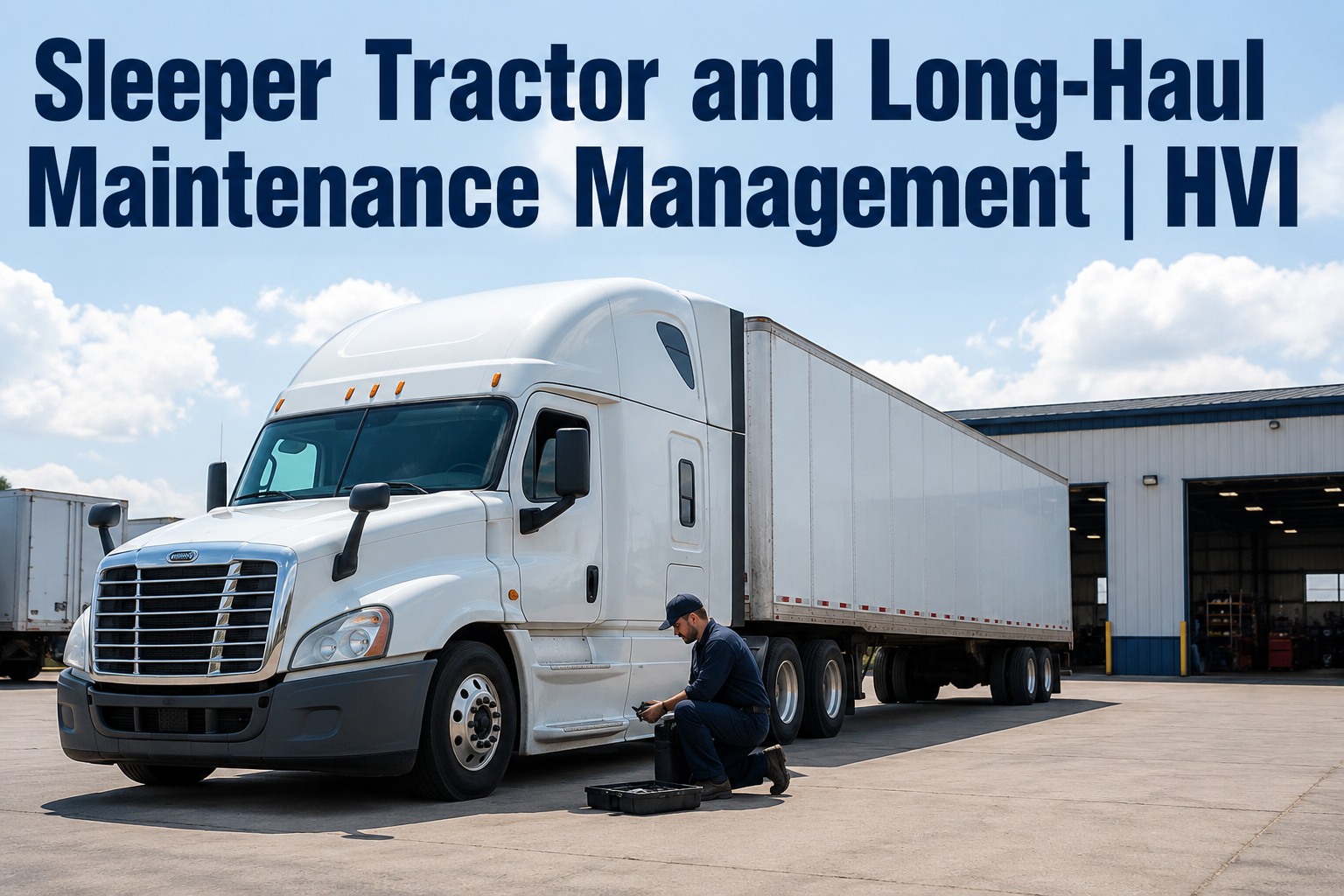
The call always comes at the worst time: a driver stranded on an interstate shoulder at 2 a.m., a reefer load at risk, and the nearest shop you trust is 400 miles away. Sleeper tractor maintenance is a different discipline from yard-based fleet work because long-haul trucks accumulate mileage faster than any other vehicle class and fail furthest from the people who can fix them. A tractor due for service may be two thousand miles from its home terminal, which means your PM plan has to anticipate where the truck will be, not just what the odometer says. This page breaks down how over-the-road maintenance actually works — the roadside repair premium, national account service networks, sleeper cab systems like the APU and bunk heater, and the breakdown prevention focus on the systems that strand trucks — and how HVI keeps every unit's schedule, defects and history in one place. If you want to see it running on your own lanes, you can book a 30-minute walkthrough with your own units.
LONG-HAUL & SLEEPER TRACTOR MAINTENANCE
Your truck is due for service. It's also 2,000 miles from your shop.
Long-haul PM planning fails when it only watches the odometer. HVI schedules by mileage, engine hours and location, routes roadside defects straight into work orders, and keeps a complete history per unit for every vendor that touches the truck.
WHAT THE MILES COST YOU
The numbers behind over-the-road maintenance
Every figure below lands on your P&L as either a planned cost or an emergency. The difference between the two is almost always scheduling and information, not luck.
THE SCHEDULING PROBLEM
Long-haul PM planning: schedule where the truck will be, not where it is
A day-cab fleet can pull a unit into the shop the week its interval hits. A sleeper tractor running coast to coast cannot. At 2,500 miles a week, a 25,000-mile PM interval closes in ten weeks — and the truck will be somewhere specific when it does.
Forecast the odometer against the dispatch plan
Take the unit's current mileage and engine hours, then project forward using its actual weekly average — not the fleet average. A team operation running 5,000 miles a week hits intervals twice as fast as a solo driver. HVI tracks mileage and engine hours per unit and fires due-soon alerts early enough to act on them.
Match the due date to a location window
If the PM lands in 1,800 miles and the truck is routed through your home terminal in 1,500, you have a window. If it lands mid-lane, you need a vendor. Planning this two weeks out is the whole game — see how due and overdue alerts work on a live demo and you will never chase an odometer by phone again.
Bundle work into the same stop
A tractor parked for an oil service is the cheapest downtime you will ever buy. Pull forward the tire rotation, the APU service, the DOT annual inspection and any open driver-reported defects into the same work order. Every item you bundle is a roadside call you do not take later.
Record it once, wherever it happened
Whether the work was done in your bay or by a vendor in another state, it lands on the same unit history in HVI. The next planner, the next shop and your next auditor all see the same record — no binder in a truck that is currently in another time zone.
THE ROADSIDE PREMIUM
What one over-the-road failure really costs
The invoice from the road service truck is only the start. Work through one realistic event — a coolant leak that shuts a tractor down 350 miles from home with a loaded trailer.
| Cost line | Planned in your shop | Roadside event |
|---|---|---|
| Repair itself (hose, clamp, coolant, labor) | $180 - $350 at your labor rate | $700 - $1,200 with callout and after-hours rates |
| Tow or mobile service dispatch | $0 — the truck drove in | $400 - $900 depending on distance |
| Driver downtime (hours-of-service burn, layover pay) | Scheduled, off-duty at home | 1-2 days of wages with no revenue |
| Load impact (late delivery, repower, spoiled freight risk) | None — planned around dispatch | Late fees, a repower truck, or a lost customer |
| Total realistic exposure | Under $500, planned | $2,000 - $4,000+, unplanned |
Run that math across a 40-truck fleet losing six truck-days a month to roadside events and you are looking at well over $100,000 a year in avoidable cost — before you count the customers who stop calling. Most of those events started as a defect a driver saw, mentioned, and nobody logged. When a driver can report a defect with photos from the shoulder, free to start, it becomes a work order instead of a breakdown.
See every unit's PM status, open defects and vendor history in one screen
Book a 30-minute demo and we will load one of your real lanes into HVI — PM by mileage and engine hours, defect routing from the road, and audit-ready history per unit.
NATIONAL SERVICE NETWORKS
Managing vendors when your shop is everywhere and nowhere
Most long-haul carriers end up with a patchwork: their own terminals, a national account with a truck-stop or dealer chain, and whoever answers the phone at 2 a.m. The problem is not finding a vendor — it is the cost and quality variance between them, and the records that never come back.
Without a system
- Invoices arrive weeks later with no photos, no defect link and no way to verify the work matched the complaint
- The same failure gets repaired twice because the first vendor's note never reached your planner
- PM compliance is a guess for any unit that has not touched your terminal in a month
- Warranty and core returns leak money because nobody tracked what came off the truck
With HVI per-unit history
- Every vendor repair is logged against the unit with date, mileage, photos and cost — searchable in seconds
- Repeat failures surface in the unit timeline, so you escalate to a real fix instead of paying for the same hose twice
- PM status updates no matter who did the work, keeping your compliance rate honest across the whole fleet
- Parts and warranty notes ride with the record, so cores and claims stop falling through the cracks
The practical move is to grade your network. Pull your last year of vendor spend per unit and rank shops by cost per repair and repeat-failure rate. Carriers who walk through HVI's unit history on a demo usually find two or three vendors who look cheap per invoice and expensive per mile.
THE DRIVER IN RESIDENCE
Sleeper cab systems: comfort, retention and idle compliance
A long-haul driver spends more waking hours in the sleeper than at home. The APU, bunk heater, inverter and cab HVAC are not luxury items — they are retention equipment, and in anti-idling jurisdictions they are compliance equipment too.
Auxiliary power unit (APU)
The APU carries hotel loads overnight so the main engine can stay off. It has its own oil, fuel filter, coolant and belt schedule — usually hour-based, which is exactly what odometer-only PM programs miss. A dead APU in August means an idling truck, a fuel bill, and a driver updating their resume.
Bunk heater & HVAC
Fuel-fired bunk heaters fail on carbon buildup and clogged fuel screens — cheap parts, miserable nights. Cab HVAC that blows warm in July is the single most common comfort complaint drivers report. Both belong on the inspection checklist with a photo field, not on a sticky note.
Inverter & batteries
Inverter failures usually trace back to weak batteries or corroded connections, and they take the driver's fridge, microwave and CPAP down with them. Battery and cable condition is a five-minute inspection item that prevents a very expensive hotel night and a very unhappy driver.
Driver turnover in long-haul runs notoriously high, and every experienced driver you keep saves you recruiting, onboarding and the accident risk that comes with a new hire. Fleets that treat comfort systems as maintenance items — scheduled, inspected, and fixed fast — hold drivers longer. You can add sleeper systems to your inspection template free and have drivers reporting them from the bunk this week.
BREAKDOWN PREVENTION
The systems that strand trucks — and the checks that catch them
Roadside failures are not random. Industry breakdown data consistently clusters around the same handful of systems, and every one of them gives warning before it lets go — if someone is looking and the report goes somewhere.
Tires & wheel ends
The top roadside call everywhere. Steer tire condition, inflation, irregular wear and hub temperature belong in every pre-trip. A photo of a cupped steer tire today beats a blowout call tomorrow.
Cooling system
Hoses, clamps, coolant level and condition, fan clutch and radiator fins. Coolant leaks are the classic "driver smelled it for a week" failure — catch it at the terminal, not the shoulder.
Brakes & air system
Air leaks, chafed lines, gladhand seals, slack adjuster stroke and lining thickness. Brake defects are also the fastest route to an out-of-service order at a scale — a compliance hit, not just a repair bill.
Electrical & charging
Batteries, cables, alternator output and the trailer umbilical. Voltage drop kills starters, APUs and liftgates, and it always picks the coldest morning of the year to do it.
Fuel & aftertreatment
Water in fuel, gelled filters in winter, DEF quality and derate warnings. A forced regen on the shoulder is a schedule killer; a flagged derate code in the yard is a planned repair.
Fifth wheel & coupling
Jaw wear, kingpin condition, release handle and mounting bolts. Coupling failures are rare and catastrophic — the inspection takes two minutes and there is no acceptable failure rate.
The pattern across all six: the warning sign is visible days or weeks before the failure, and the failure only happens when the warning goes nowhere. That is the entire case for defect routing — when a driver's pre-trip photo becomes a work order automatically, the shoulder call never happens. Book a demo and watch a defect become a work order in about ninety seconds.
HOW HVI HELPS
Built for trucks that are never home
Four capabilities that map directly to the long-haul problems above — each one measured in truck-days saved, not features listed.
PM by mileage, engine hours or date
Intervals that match how sleeper tractors actually run — including hour-based APU service. Due-soon alerts fire early enough to route the truck through a terminal or pre-book a vendor, cutting overdue PMs and the roadside events that follow them.
Defect routing from the road
A driver flags a coolant stain with a photo from a rest area; it lands as a work order with the unit, mileage and location attached. No paper DVIR in a cab 1,500 miles away, no defect lost in a group chat — the single biggest lever on unplanned downtime.
Complete history per unit
Every inspection, PM, vendor repair and part on one timeline per tractor. Repeat failures surface, vendor quality becomes comparable, and a DOT, insurance or client audit is a thirty-second search instead of a week of phone calls.
Telematics & GPS integrations
Odometer and engine-hour readings flow in automatically from your telematics provider, so PM forecasts use real miles instead of driver-reported guesses. Fault codes from the engine can raise a work order before the driver even feels the symptom.
KEY TAKEAWAYS
Sleeper tractor maintenance, in one paragraph
Long-haul tractors earn their keep far from your shop, so over-the-road maintenance has to be planned around geography as much as mileage: forecast intervals against dispatch, bundle work into planned stops, and hold every vendor to the same record-keeping standard you hold your own bays. Treat the APU, bunk heater, inverter and batteries as the retention and compliance equipment they are. And put your prevention effort where the breakdowns actually live — tires, cooling, brakes, air, electrical and aftertreatment — with driver-reported defects that become work orders the same hour. Do those four things and the 2 a.m. shoulder call becomes the exception instead of the routine. HVI was built for exactly this: PM by mileage and engine hours, defect routing from the road, and a complete, audit-ready history per unit. The fastest way to judge it is to see it on your own fleet in a 30-minute demo.
My rule is simple: no truck should ever be surprised by its own odometer. I used to find out a unit was due for service when the driver called from a truck stop asking where to go. Now I watch the due-soon list every Monday with my coffee, and I track one number religiously — roadside events per month. We went from nine or ten down to two, and both of those were tires picked up on debris, which no PM program on earth prevents. The other thing nobody tells you: fix the APU fast. Drivers forgive a lot, but they do not forgive sweating through a July night in a parking lot.
— Dale Merrick, Director of Maintenance, regional and long-haul dry van carrier
FREQUENTLY ASKED QUESTIONS
Long-haul and sleeper tractor maintenance FAQs
How often should a long-haul sleeper tractor get preventive maintenance?
What does a roadside breakdown really cost compared to a shop repair?
How do I handle PM when the truck is 2,000 miles from my terminal?
Should the APU and sleeper systems be on the PM schedule?
Can drivers report defects from the road without paperwork?
Stop planning maintenance around a truck you cannot see
HVI gives you PM by mileage and engine hours, defect routing from the road, and a complete audit-ready history per unit — on any phone, from the yard to the shoulder.
Free to start — Works on any phone — No card needed