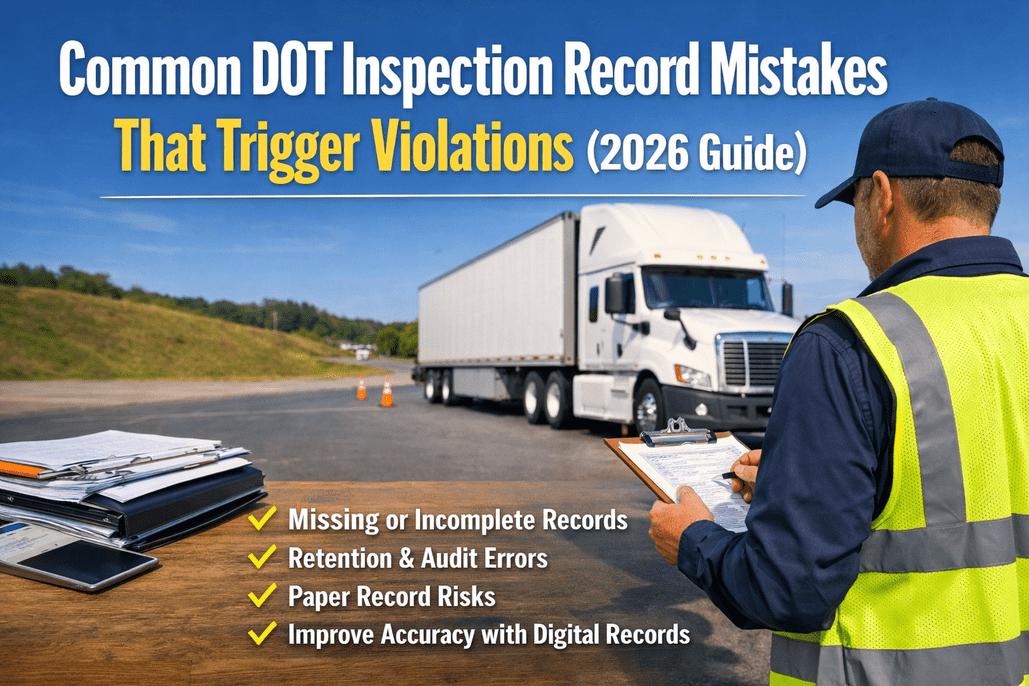
A perfectly maintained truck can still fail a DOT audit — because of paperwork. In fact, missing or incomplete driver qualification files account for nearly 12% of all FMCSA violations. Only 7% of motor carriers pass DOT audits without a single violation, and the most common gap isn't mechanical — it's documentation. Through June 2025, the FMCSA conducted 8,340 investigations that uncovered over 50,000 violations, and a disproportionate share of those were recordkeeping failures: missing DVIRs, incomplete maintenance files, expired credentials, and retention gaps that turned routine audits into five-figure fines. In 2026, with the CSA overhaul tying carrier scores more tightly to data accuracy and FMCSA's shift toward digital verification, record errors carry more weight than ever. This guide covers the specific documentation mistakes that trigger violations — and how to prevent each one.
Why Records Are the Foundation of DOT Compliance
Recordkeeping isn't a bureaucratic formality — it's the legal proof that your fleet is compliant. During a DOT audit, investigators don't ride along with your drivers or spend weeks watching your maintenance shop. They audit your records. If the record doesn't exist, the compliance doesn't exist — no matter what actually happened. Under 49 CFR Part 396, motor carriers must maintain systematic inspection, repair, and maintenance records for every commercial motor vehicle under their control. Under Part 391, driver qualification files must be complete, current, and accessible within 48 hours. Under Part 395, ELD and hours-of-service records must be retained for six months. Each requirement has specific retention periods, signature requirements, and documentation standards. Missing any one of them creates a citable violation — and in 2026, FMCSA is increasingly cross-referencing these records against roadside inspection data and Clearinghouse queries to identify patterns.
Stop guessing which records you need. Start your free trial of HVI's digital recordkeeping system — automated retention, signatures, and audit-ready documentation. Or book a demo to see the compliance dashboard.
The 7 Most Common Record Mistakes That Trigger Violations
These are the specific documentation errors FMCSA investigators cite most frequently. Each one is preventable — and each one carries real consequences for your CSA score, your audit outcome, and your bottom line.
Missing or Incomplete DVIRs
The most common recordkeeping violation in fleet audits. DVIRs must be completed at the end of each day's work, must cover all required inspection items (brakes, tires, lights, coupling, steering, etc.), and must be signed by the driver. If defects are noted, the carrier must certify repairs were made and the next driver must review and sign before operating the vehicle. Missing any of these three signatures — driver, mechanic, reviewing driver — is a separate citable violation.
Expired or Missing Medical Certificates
Under the 2025 Medical Examiner Integration Rule, medical certifications are now electronically submitted and reflected on the driver's MVR. The 60-day paper waiver expired January 10, 2026. If a medical certificate expires and the status isn't updated, the driver's CDL can be automatically downgraded — meaning they're operating without a valid license. Carriers must verify medical status through MVR checks within 15 days of hire and annually thereafter.
Clearinghouse Query Failures
Every CDL driver must have a full Clearinghouse query before performing safety-sensitive functions — and a limited query at least annually. Carriers that skip pre-employment queries or miss annual query deadlines are among the most heavily fined in 2025-2026 enforcement. With states now required to downgrade CDLs for drivers in "prohibited" status, missing a query means you could be dispatching a driver whose CDL has been revoked without knowing it.
Maintenance Records Missing Vehicle Identification
Every maintenance record must identify the specific vehicle by company number, make, serial number, year, and tire size. Carriers routinely get cited for records that reference "Truck 42" but lack the VIN, or that list repairs without connecting them to a specific unit. Work orders from third-party shops are especially prone to this — they may record the repair but not your fleet's identifying information.
DVIR Defect-to-Repair Chain Broken
When a DVIR identifies a defect, the chain of documentation must be unbroken: driver reports defect, carrier certifies repair, next driver reviews and signs before operating. If any link is missing — the defect was reported but no repair is documented, or the repair was made but the next driver didn't sign off — the record is incomplete. This is especially common when paper DVIRs get separated from repair orders, or when repairs happen at a different location than where the DVIR was filed.
Retention Period Violations
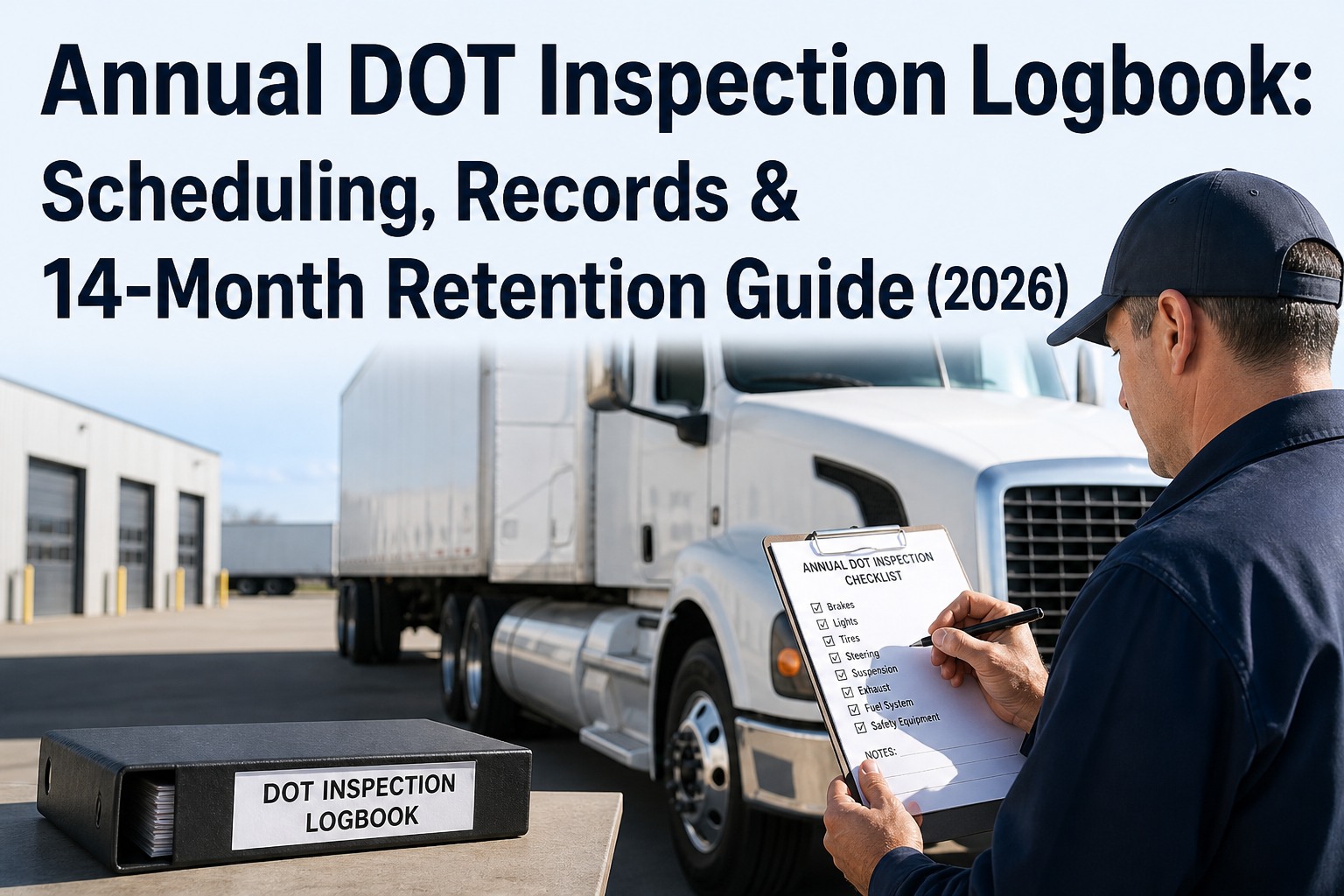
Different records have different retention requirements — 3 months for DVIRs, 6 months for ELD data, 14 months for annual inspections, 1 year plus 6 months post-disposal for maintenance records, 3 years post-termination for DQ files. Carriers that use a single retention schedule for all records either purge too early (creating violations) or retain too long (creating storage and liability issues). The worst scenario: purging DVIRs at 60 days instead of the required 90, creating a gap that auditors will find.
ELD Data Gaps & Missing Supporting Documents
ELD records of duty status must be retained for 6 months, along with supporting documents: fuel receipts, toll records, bills of lading, and dispatch records. Inspectors increasingly cross-reference ELD data against supporting documents to detect false logs. A driver showing 400 miles driven but no fuel purchase, or an ELD malfunction period with no paper backup logs, creates a documentation gap that raises scrutiny. Additionally, carriers using ELDs that were removed from FMCSA's registered list in 2025 face "operating without an ELD" citations if not replaced by the 2026 deadline.
Eliminate record errors before they become audit findings. Sign up free for HVI's inspection recordkeeping system — digital DVIRs with automatic signatures, repair chain tracking, and retention management. Or schedule a demo to see the audit-readiness dashboard.
Paper Records vs. Digital Records: The Risk Comparison
Paper-based recordkeeping is still technically compliant under FMCSA regulations. But it's also where the majority of documentation violations originate. Here's a direct comparison of how paper and digital systems perform against the most common audit failure points.
Building an Audit-Ready Recordkeeping System
The goal isn't just to avoid violations — it's to build a system where violations are structurally impossible. Here's the framework that top-performing fleets use to maintain audit-ready records every day, not just during audit prep.
Centralize All Records Digitally
One system for DVIRs, maintenance records, DQ files, ELD data, and Clearinghouse documentation. When records live in multiple locations — filing cabinets, email threads, third-party shop systems, driver gloveboxes — gaps are inevitable. Centralization makes retrieval instant and audit preparation unnecessary because you're always ready.
Automate Expiration & Renewal Alerts
Set automated alerts at 90, 60, and 30 days before any credential expires: medical certificates, CDL renewals, annual inspections, insurance policies, ELD registrations. Don't rely on spreadsheets or memory. The system should escalate to a supervisor if the driver hasn't responded by the 30-day mark. No truck dispatches with an expired credential attached to it.
Enforce the Defect-to-Repair Chain
Every DVIR defect must trigger a work order, every work order must reference the originating DVIR, every repair must be certified by the mechanic, and the next driver must review and sign before departure. Digital systems that auto-generate work orders from DVIR defects eliminate the most common chain break — the defect that gets reported but never reaches the shop.
Match Retention to CFR Requirements
Configure separate retention schedules for each record type: 3 months for DVIRs, 6 months for ELD data, 14 months for annual inspections, 1 year plus 6 months for maintenance records, 3 years post-termination for DQ files. Auto-archive when retention periods end. Auto-flag records approaching expiration. Never purge earlier than required, and don't burden your system by retaining indefinitely.
Run Monthly Self-Audits
Don't wait for FMCSA to find your gaps. Run a monthly records audit: randomly select 10% of vehicles and check DVIR completion, repair chain integrity, and annual inspection currency. Review 10% of driver files for credential completeness. Check Clearinghouse query logs against your driver roster. Document the audit itself — it demonstrates a systematic compliance program and can mitigate penalties if violations are later found.
Build an audit-ready system that catches errors before investigators do. Start your free HVI trial for digital DVIRs, automated retention, and compliance dashboards — or book a demo to see the full audit-readiness platform.
Records Are Compliance. Compliance Is Records.
The difference between a carrier that passes a DOT audit and one that receives a Conditional rating is almost never mechanical — it's documentation. The trucks might be identical. The drivers might be equally skilled. But the carrier with complete, accurate, accessible records proves their compliance. The one with gaps, missing signatures, broken repair chains, and premature purges can't prove anything — and in an audit, what you can't prove didn't happen. In 2026, as FMCSA accelerates its shift toward data-driven enforcement, electronic verification, and cross-referenced records, the margin for documentation error is narrower than ever. Build the system now. The next audit isn't a question of if — it's when.
Make Every Record Audit-Ready from Day One
HVI's digital recordkeeping eliminates the documentation gaps that trigger DOT violations. Digital DVIRs with enforced signatures, automatic defect-to-work-order chains, configurable retention schedules, and instant retrieval for any vehicle or driver. Your records are always complete, always current, always accessible.