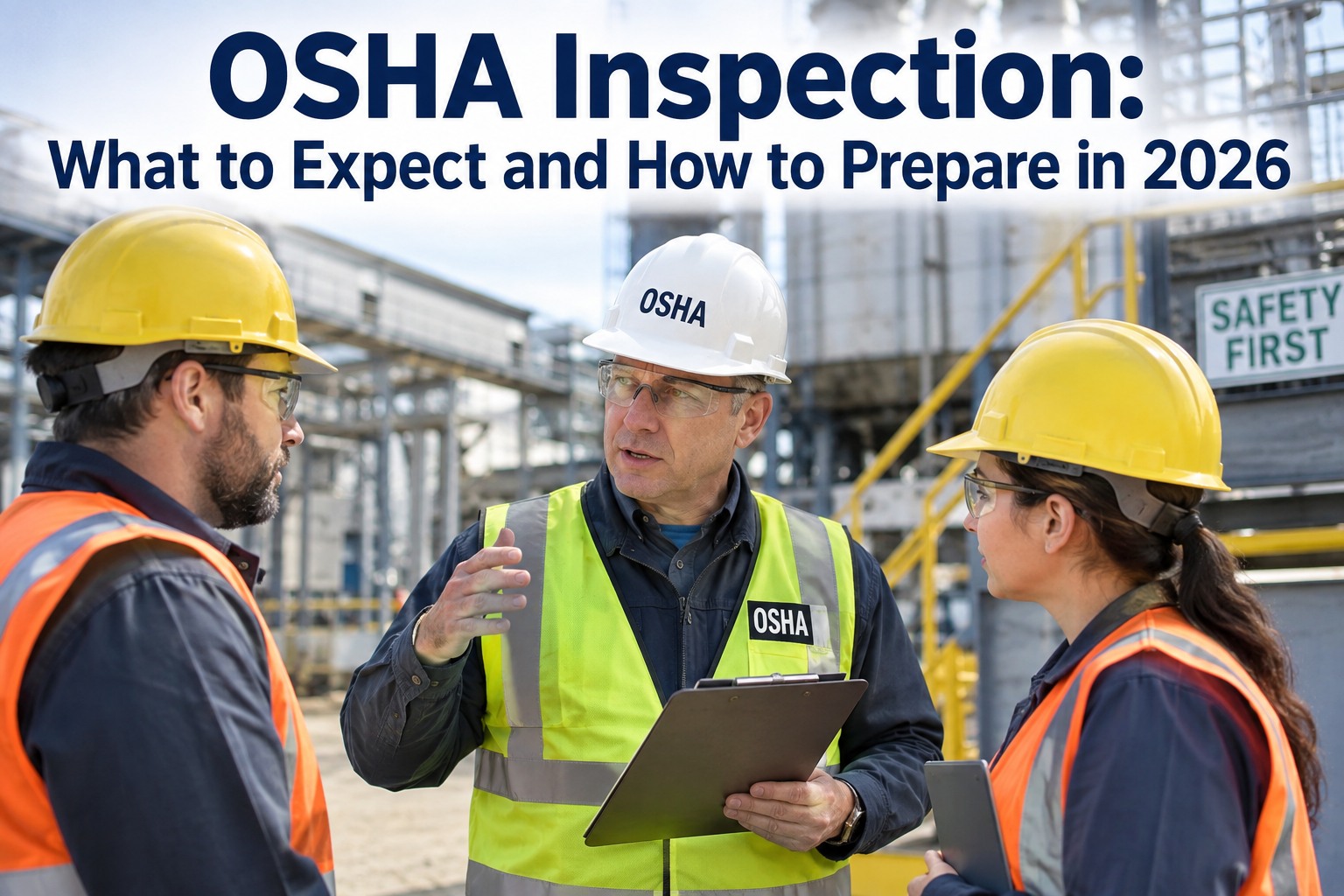
The compliance officer is at your front desk with credentials out, and the next few hours will go one of two ways. If your safety records are scattered across filing cabinets and three inboxes, it's a scramble. If you can produce inspection logs, training records, and corrective-action history on request, it's a routine visit. That difference is what OSHA inspection preparation is really about — not memorizing regulations, but being ready to prove you follow them. This 2026 guide walks the whole inspection and how to be ready before anyone knocks. Book a demo to see audit-ready records in HVI.
OSHA Inspection: What to Expect & How to Prepare in 2026
Most of an OSHA inspection is predictable. Knowing the stages, what's requested, and the 2026 penalties turns a stressful surprise into a managed process.
Educational overview — not legal advice. Verify current OSHA procedures and penalty amounts at osha.gov and consult counsel on any specific citation.
An OSHA inspection is far easier to manage when you understand the process before the compliance officer arrives. Inspections aren't random raids — they follow a defined structure, prioritize specific triggers, and center on records you should already have. The employers who handle them well aren't the ones with perfect workplaces; they're the ones who can quickly demonstrate a functioning safety program. This guide covers why inspections happen, exactly what unfolds on the day, what OSHA may request, the 2026 penalty landscape, and a practical readiness plan.
Why OSHA shows up: inspection triggers
OSHA can't inspect every workplace, so it prioritizes. Knowing which category you fall into tells you a lot about the likely scope — a complaint about one hazard looks very different from a fatality investigation. These are the priorities, roughly in the order OSHA weights them.
A hazard that could cause death or serious harm immediately. Highest priority — OSHA acts fast to remove the danger.
A work-related death or a serious incident hospitalizing workers. These are reportable and typically draw an investigation.
Worker allegations of a hazard or violation. Scope often focuses on the specific complaint, though it can broaden.
Hazard information from another agency, a professional, the media, or an inspector who noticed something.
Planned inspections targeting high-hazard industries or specific emphasis programs, not tied to a single event.
A return visit to verify that previously cited hazards were actually abated. Unresolved items get expensive here.
The trigger shapes the scope, but scope can expand. A compliance officer arriving on a specific complaint who sees an unrelated hazard in plain view during the walkaround can broaden the inspection. That's exactly why general readiness matters more than preparing for one anticipated issue — you don't fully control what gets looked at once the visit begins. Book a demo to keep your whole safety-records picture inspection-ready, not just one area
What happens on inspection day
A typical inspection moves through four predictable phases. Knowing the sequence lets you respond calmly and assign roles in advance instead of improvising while a compliance officer waits.
The compliance officer presents official credentials on arrival. It's reasonable and expected to verify them. This is where your inspection-response plan kicks in — the right people are notified and an employer representative is designated.
The officer explains the purpose and general scope of the inspection, the reason for it where appropriate, and discusses employer and employee representation. This is your chance to understand what's being examined and why.
The core of the inspection: a physical walkthrough of relevant areas, photographs and measurements where appropriate, a review of requested records, and employee interviews — including private interviews with non-managerial employees. An employer and an employee representative may accompany the walkaround.
The officer discusses observations, apparent violations, and likely next steps. Citations, if any, come later in writing — but this is where you learn what to expect and can begin planning corrections.
Two practical notes. First, accompany the walkaround: take your own notes, and duplicate the officer's photos and measurements where you can, so your record matches theirs. Second, the private employee interviews are a normal part of the process — non-managerial employees can be interviewed privately, and preparing your team to answer honestly and factually beats trying to script anything. Start free on HVI to have inspection and maintenance records ready to pull during the walkaround.
The records OSHA may request
This is where inspections are quietly won or lost. What OSHA asks for depends on the scope, but a records request is standard — and "we have it, give us a few days to find it" is a much weaker position than producing it on the spot. Here's what commonly gets requested.
OSHA 300 log, 300A summary, and 301 incident reports where required for your establishment.
Records showing required training was delivered — who, when, on what, and by whom — for the standards that apply to your operation.
Required written programs — hazard communication, lockout/tagout, respiratory protection, and others applicable to your hazards.
Documentation that required equipment inspections and maintenance actually happened — the proof behind your safety claims.
Evidence that identified hazards or prior findings were actually resolved — the record that closes the loop on a defect.
Whatever else supports the specific standards in scope — exposure monitoring, certifications, program-specific records.
Notice the pattern: nearly all of it is documentation you should already be generating in the normal course of operating safely. The problem is almost never that the work didn't happen — it's that the proof is scattered, incomplete, or slow to retrieve. An inspection turns "where is it?" into an expensive question. This is precisely the gap a centralized records system closes. Book a demo to make every one of these record types retrievable in seconds
Citations and 2026 penalties
If the inspection finds violations, citations arrive in writing after the visit, each with a proposed penalty and an abatement date. Here are the current federal maximums — with an important 2026 wrinkle. Always confirm the latest figures at osha.gov, since these adjust.
Two things make these numbers bite harder than they first look. Penalties are assessed per violation, not per inspection, so a single visit that finds ten serious issues multiplies fast — and multiple willful citations from one fatality inspection can reach seven figures. Reductions exist for smaller employers, good-faith safety efforts, and clean history, but the math still rewards being ready. After a citation, employers generally have a limited window — commonly 15 working days — to contest, so the response clock starts immediately; confirm the exact deadline on your citation and with counsel. Book a demo to keep abatement and corrective-action deadlines tracked, not missed
Your OSHA readiness plan
You can't control when OSHA arrives, but you can control whether you're ready. Readiness isn't a binder you build the week you get inspected — it's an ongoing state. These are the practical steps that separate a calm inspection from a chaotic one.
Inspect the way OSHA would, on a schedule. Finding and fixing hazards yourself is the single best preparation — and it generates the records that prove diligence.
It's not enough to have records — you have to find them fast. Confirm injury logs, training, programs, and maintenance records are current and pullable on demand.
Unclosed corrective actions and un-abated prior findings are exactly what a follow-up inspection targets. Know what's open and close the gaps before someone else finds them.
Make sure required training documentation and equipment inspection/maintenance records are complete, dated, and match the standards that apply to you.
Decide in advance who greets the officer, who's the employer representative, who pulls records, and who accompanies the walkaround — so nobody improvises on the day.
Understand credentials verification, scope, representation, and the citation and contest timeline, so you engage the process knowledgeably rather than reactively.
Every item on this list has documentation at its core, which is why readiness is fundamentally a records problem. The operations that sail through inspections are the ones where internal inspections, training, maintenance, and corrective actions all live in one searchable system — so "prove it" is answered by a search, not a scramble. That's the entire premise of what HVI does for inspection readiness. Start free and turn scattered safety paperwork into audit-ready records.
From an EHS manager who's been through it
The first OSHA inspection I handled early in my career was a disaster — not because our workplace was unsafe, but because when the officer asked for training records and equipment maintenance logs, I spent two days pulling paper from four different offices, and half of it was incomplete. We got cited on recordkeeping when the actual work had been done. We just couldn't prove it fast enough.
Now everything's in one system. Last time an officer asked for fourteen months of inspection and corrective-action history, I pulled it up on a laptop while we were still in the opening conference. The whole tone of the visit changed. Being able to instantly show a functioning, documented program is the best position you can be in.
Readiness beats reaction
An OSHA inspection is far less intimidating once you know the shape of it. Inspections are prioritized by clear triggers — imminent danger, fatalities and catastrophes, complaints, referrals, programmed inspections, and follow-ups — and they move through a predictable sequence: arrival and credentials, an opening conference explaining purpose and scope, a walkaround with photographs, records review, and employee interviews including private ones with non-managerial staff, and a closing conference. What OSHA requests is largely documentation you should already have: injury and illness records, training, written programs, equipment inspection and maintenance records, and corrective-action evidence. And the 2026 penalty maximums — $16,550 per serious violation and $165,514 per willful or repeated one, assessed per violation and unusually unchanged from 2025 — make being ready a genuine financial decision, not just a compliance nicety. Always verify current figures and procedures at osha.gov.
The through-line in all of it is documentation and retrieval. The employers who manage inspections well can prove, quickly, that they run a real safety program — and that proof lives in records. That's exactly the readiness HVI is built to deliver: searchable inspection and maintenance records, training documentation, corrective-action history, and fast evidence retrieval, so an OSHA records request becomes a lookup instead of a fire drill. HVI is an inspection-and-maintenance records platform, not a law firm or a guarantee of any inspection outcome — it doesn't provide legal advice, and applicable OSHA standards and your own counsel govern how you respond to a specific citation. Used as your readiness backbone, though, it turns the scariest question in an inspection — "can you show me?" — into the easiest one to answer. Book a demo to make your records audit-ready in HVI.
Frequently asked questions
What triggers an OSHA inspection?
OSHA prioritizes inspections rather than conducting them randomly, and understanding the priority categories tells you a lot about what to expect. The highest priority is imminent danger — a hazard that could reasonably be expected to cause death or serious physical harm immediately — which OSHA moves quickly to address. Next are fatalities and catastrophes, meaning work-related deaths or incidents that hospitalize workers, which are reportable and typically prompt an investigation. Third are worker complaints alleging a hazard or a violation, where the inspection scope often focuses on the specific complaint but can broaden. Fourth are referrals, which are hazard reports from other agencies, professionals, the media, or an inspector who observed something. Fifth are programmed inspections, which are planned inspections targeting high-hazard industries or specific emphasis programs rather than responding to a single event. And sixth are follow-up inspections, conducted to verify that previously cited hazards were actually corrected. It's worth remembering that the trigger shapes but doesn't strictly limit the scope: a compliance officer who arrives about a specific complaint and observes an unrelated hazard in plain view during the walkaround can expand the inspection. That's why maintaining general readiness across your whole operation matters more than preparing only for a single anticipated issue.
What happens during an OSHA inspection?
A typical OSHA inspection moves through four fairly predictable phases. It begins with arrival and credentials: the compliance officer presents official credentials, which it's entirely reasonable to verify. Next is the opening conference, where the officer explains the purpose and general scope of the inspection, the reason for it where appropriate, and discusses employer and employee representation — this is your opportunity to understand what's being examined and why. The core of the inspection follows: a walkaround that includes a physical inspection of relevant areas, photographs and measurements where appropriate, a review of requested records, and employee interviews, which can include private interviews with non-managerial employees. An employer representative and an employee representative may generally accompany the walkaround, and it's wise to take your own notes and duplicate the officer's photos and measurements where you can, so your record matches theirs. Finally, the closing conference is where the officer discusses observations, apparent violations, and likely next steps; any citations come later in writing, but this is where you learn what to expect and can begin planning corrections. Knowing this sequence in advance lets you assign roles and respond calmly rather than improvising while the officer waits.
What records will OSHA ask for during an inspection?
What OSHA requests depends on the inspection's scope, but a records request is a standard part of most inspections, and the categories are fairly consistent. Commonly requested records include injury and illness records — the OSHA 300 log, the 300A annual summary, and 301 incident reports where required for your establishment; training documentation showing that required training was delivered, including who was trained, when, on what, and by whom; written safety programs such as hazard communication, lockout/tagout, respiratory protection, and other programs applicable to your specific hazards; equipment inspection and maintenance records that document required inspections and maintenance actually occurred; corrective-action documentation proving that identified hazards or prior findings were genuinely resolved; and other compliance evidence supporting the specific standards in scope, such as exposure monitoring or certifications. The important insight is that nearly all of this is documentation you should already be generating simply by operating safely. In most cases the underlying work has been done — the risk is that the proof is scattered across systems, incomplete, or slow to retrieve. Being able to produce these records promptly and completely during the inspection, rather than asking for days to assemble them, materially strengthens your position, which is why centralized, searchable records are so valuable to inspection readiness.
What are the OSHA penalty amounts in 2026?
For 2026, the maximum federal OSHA civil penalties are $16,550 per serious or other-than-serious violation, $165,514 per willful or repeated violation, and up to $16,550 per day for failure to abate a hazard past its abatement date. There's a notable wrinkle specific to 2026: OSHA normally adjusts these maximums upward each January for inflation under the Federal Civil Penalties Inflation Adjustment Act, but for 2026 no inflation increase was applied, so the amounts carried forward unchanged from the January 2025 levels. This made 2026 the first year since the modernized penalty system began that the maximums didn't rise. Two features make these figures more significant than they first appear. First, penalties are assessed per violation, not per inspection, so a single inspection that identifies multiple serious violations can produce a total well into six figures, and multiple willful citations from a serious-incident investigation can reach seven figures. Second, the citation penalty is often only part of the total cost, which can also include abatement expenses, lost productivity, and other consequences. Reductions are available for smaller employers, demonstrated good-faith safety efforts, and a clean compliance history. Because these amounts are subject to change and can be affected by policy updates, always verify the current figures directly at osha.gov, and treat any specific citation as a matter for qualified counsel.
How can I prepare my workplace for an OSHA inspection?
Effective OSHA inspection preparation is an ongoing state rather than a last-minute project, and it centers on a handful of practical steps. First, conduct your own internal inspections on a regular schedule, examining your workplace the way OSHA would; finding and fixing hazards yourself is the best preparation there is, and it generates records demonstrating diligence. Second, verify that your records are both complete and quickly retrievable — it isn't enough to have injury logs, training documentation, written programs, and maintenance records if you can't produce them promptly, so confirm they're current and pullable on demand. Third, review open corrective actions and any un-abated prior findings, since those are exactly what a follow-up inspection targets. Fourth, confirm that training and equipment inspection and maintenance records are complete, dated, and aligned with the standards that apply to you. Fifth, establish an inspection-response team with defined roles decided in advance — who greets the compliance officer, who serves as the employer representative, who retrieves records, and who accompanies the walkaround. Finally, understand your rights and the inspection process itself, from credentials verification and scope through the citation and contest timeline. Because every one of these steps has documentation at its core, readiness is fundamentally a records-management challenge, and keeping inspection, training, maintenance, and corrective-action records in one searchable system is what lets you answer the toughest question in any inspection — prove it — with a search instead of a scramble.
Make your safety records audit-ready in HVI
HVI keeps inspection records, maintenance history, training documentation, and corrective-action trails in one searchable, timestamped place — so an OSHA records request is a two-minute lookup, not a two-day scramble. Run internal inspections, track corrective actions to closure, and retrieve evidence on demand. An inspection-and-maintenance records platform, not a legal-advice substitute. Mobile-first for the floor and the office, live in under two weeks.
No credit card · Searchable inspection, training & corrective-action records · Evidence retrieval on day one