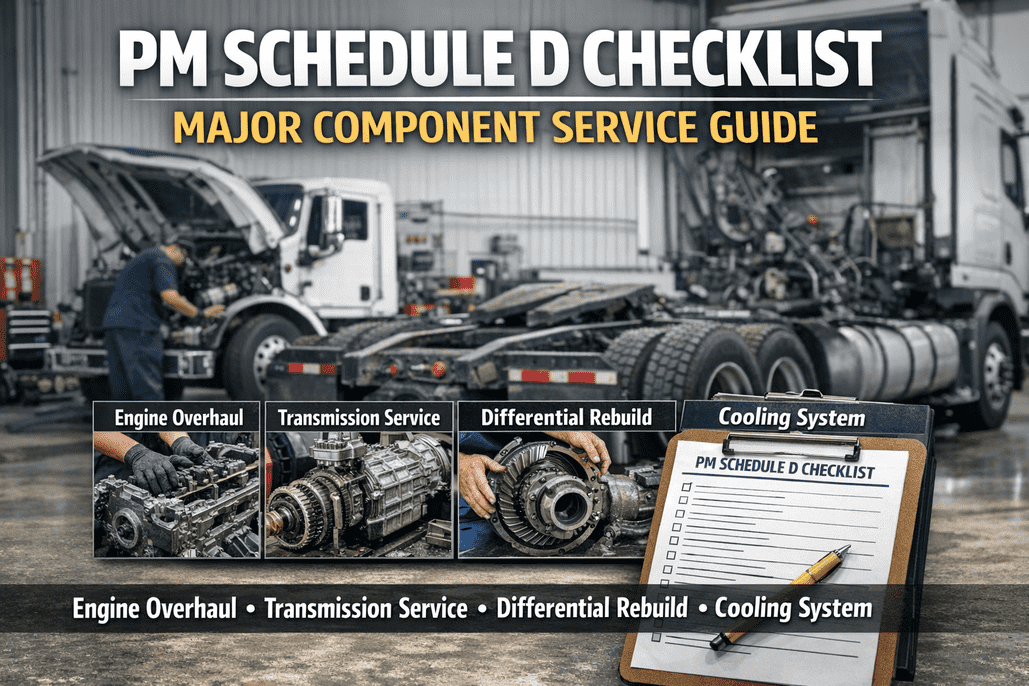
PM Schedule D is the highest tier of preventive maintenance — major component rebuilds, replacements, and specialized services that happen at 100,000+ mile intervals or when condition-based diagnostics signal end-of-life for a critical system. Unlike PM-A through PM-C, which follow relatively fixed schedules, PM-D is triggered primarily by component condition: oil analysis trends showing accelerating wear, transmission shift quality degrading beyond adjustment range, differential noise or vibration developing, or cooling system capacity falling below operational thresholds. These are the $5,000-$25,000+ services that determine whether a vehicle gets another 300,000-500,000 miles of productive life or enters a spiral of escalating reactive repairs. In-frame engine rebuilds now run $15,000-$25,000 for current-generation heavy-duty diesels, transmission rebuilds $8,000-$15,000, and rear axle overhauls $4,000-$8,000 — with vocational and severe-duty fleets landing at the higher end. This guide provides the complete PM-D checklist organized by major component system, explains the rebuild-vs-replace decision framework, covers condition-based triggers that signal when PM-D is needed, and shows how to plan these services to minimize downtime impact.
Where PM-D Fits: Major Component Overhaul
PM-D is the fourth and final tier in the preventive maintenance framework. Unlike PM-A/B/C which follow mileage or calendar schedules, PM-D is condition-triggered — scheduled when diagnostics, oil analysis, or performance data indicate a major component is approaching end-of-life. Some fleets also use PM-D for seasonal services (winterization, summerization) and major system upgrades.
A
Safety Inspection
Brakes, tires, lights, fluids, belts, air system
5-15K mi | 1-2 hr | $250-$500
B
Intermediate Service
All A + engine diagnostics, driveline, ECM, oil analysis
10-20K mi | 2-3 hr | $500-$1,200
C
Comprehensive / Annual
All B + transmission, differential, alignment, DOT annual
50-60K mi / annual | 4-8 hr | $1,500-$3,500
D
Major Overhaul
Engine, transmission, axle rebuild/replace, frame, cooling, cab, wiring harness, seasonal
100K+ mi | 1-5 days | $5,000-$25,000+
PM-D Cost Ranges by Component (2025-2026 Heavy-Duty)
Engine In-Frame Rebuild
$15K-$25K
Pistons, liners, rings, bearings, head gasket, cylinder head, oil pump. Engine stays in chassis.
Engine Out-of-Frame / Reman
$30K-$60K
Complete teardown or replacement. Required for cylinder scoring, crankshaft damage, catastrophic contamination.
Transmission Rebuild
$8K-$15K
Clutch packs, bearings, seals, torque converter, valve body. Automated transmissions higher end.
Rear Axle / Differential
$4K-$8K
Ring and pinion, carrier bearings, side gears, seals. Per axle — tandem = double.
Cooling System Overhaul
$3K-$6K
Radiator, charge air cooler, water pump, thermostat, all hoses, EGR cooler.
Aftertreatment / DPF
$3K-$8K
DPF replacement, SCR catalyst, DOC, DEF injector, sensors. Cleaning vs. replacement decision.
PM-D Checklist by Major Component System
PM-D services are organized by the major system being overhauled. Unlike PM-A/B/C where all items are performed at once, PM-D services are typically performed one system at a time based on condition — you may rebuild the engine at 500,000 miles, the transmission at 600,000, and the rear axle at 700,000.
Engine Rebuild / Overhaul
1-5 DAYS | $15K-$60K
Oil analysis trend review — confirm rebuild is warranted
ECM data review — fuel consumption, boost, exhaust temps
Compression and leak-down test all cylinders
Cylinder liner and piston replacement
Piston rings, rod bearings, main bearings
Cylinder head service — valves, seats, injector cups
Camshaft and cam followers inspection/replacement
Oil pump replacement
Turbocharger rebuild or replacement
Injectors — test, rebuild, or replace (6 units)
Water pump and thermostat replacement
All gaskets and seals — head, pan, main, valve covers
Engine break-in and post-rebuild oil analysis at 500 mi
Transmission Rebuild
2-4 DAYS | $8K-$15K
Transmission fluid analysis — metals, friction material
Shift quality evaluation — ECM adaptation data
Clutch pack inspection and replacement
Bearing replacement — input, output, countershaft
Synchronizer inspection/replacement (manual)
Torque converter rebuild/replacement (auto/AMT)
Valve body service — clean, test, solenoids
Seals and gaskets — all shafts, shift tower, PTO
Transmission mount replacement
Clutch release bearing and actuation system
Flywheel inspection — resurface or replace
Post-rebuild TCM calibration and adaptation reset
Axle & Differential Rebuild
1-3 DAYS | $4K-$8K/AXLE
Differential fluid analysis — metals, viscosity
Ring and pinion — inspect/replace, set backlash
Carrier bearings and races replacement
Side gears and spider gears inspection
Differential lock mechanism service
Pinion seal and bearing replacement
Axle shaft inspection — twist, spline, bearing surfaces
Wheel end bearings and seals
Power divider rebuild (tandem — inter-axle diff)
Axle housing inspection — cracks, alignment
Cooling & Aftertreatment
1-2 DAYS | $3K-$8K
Radiator — rod-out or replace, pressure test
Charge air cooler — pressure test, contamination
Water pump replacement and fan clutch service
All coolant hoses and clamps replacement
EGR cooler service or replacement
DPF — bake/blow cleaning or substrate replacement
DOC evaluation and replacement
SCR catalyst efficiency test and replacement
DEF injector and dosing line service
Exhaust gaskets and clamps — full replacement
Frame, Cab & Electrical
1-5 DAYS | $2K-$12K
Frame NDT inspection for cracks at stress points
Frame rail straightening or section replacement
Fifth wheel rebuild — plate, lock, pivot bushings
Complete suspension overhaul — springs, bushings, shocks
Cab mount replacement — isolators, bolts, alignment
Wiring harness — replace corroded/brittle sections
Starter and alternator rebuild or replacement
Complete chassis lubrication and hardware retorque
Door hinges, latches, window regulators
HVAC — compressor, condenser, evaporator evaluation
Seasonal / Special Services
SCHEDULE-BASED
Winterization — block heater, coolant, battery CCA, fuel additive, air dryer
Summerization — A/C charge, cooling pressure test, fan clutch
Emissions system upgrade or retrofit
Telematics / ELD hardware upgrade
Safety tech — cameras, collision mitigation, lane departure
HVI tracks component history from PM-A through PM-D — every oil analysis result, measurement trend, and ECM download in one vehicle record.
Book a demo to see lifecycle tracking. Or
start free.
Rebuild vs. Replace: The PM-D Decision Framework
The most expensive decision in PM-D isn't the work itself — it's choosing whether to rebuild the existing component, install a remanufactured unit, or buy new. The right choice depends on component condition, remaining vehicle life, downtime tolerance, and total cost of ownership.
Rebuild In-Frame
Best when: Block sound, crank/cam salvageable, no catastrophic contamination
Cost: 40-60% of replacement
Downtime: 2-5 days (engine stays in chassis)
Expected life: 300,000-500,000 miles to next overhaul
Risk: Unknown conditions discovered mid-rebuild can escalate cost
Remanufactured Unit
Best when: Faster turnaround needed, core exchange available, severe damage
Cost: 60-80% of new
Downtime: 1-3 days (swap unit)
Expected life: Same as new — factory specs restored
Risk: Core exchange logistics, warranty terms vary
New Replacement
Best when: Vehicle has 5+ years remaining, reliability paramount
Cost: Full price ($30K-$60K engine)
Downtime: 1-3 days (similar to reman)
Expected life: Full OEM lifecycle
Risk: Highest cost, may exceed vehicle's remaining value
Condition-Based Triggers: When to Schedule PM-D
PM-D isn't scheduled on a calendar — it's triggered by data. Oil analysis trends, ECM performance data, and PM-B/C measurement history tell you when a component is approaching the point where proactive rebuild costs less than reactive failure.
Oil Analysis Trends
Rising wear metals (iron, copper, lead) across 3+ consecutive samples signal accelerating wear. Coolant in oil (glycol/sodium) = immediate action. Fuel dilution above 3% = injector or ring problem. Fleets running analysis every PM-B catch degradation 10,000-30,000 miles before failure.
ECM Performance Data
Declining boost pressure, rising exhaust temps at same load, increasing fuel consumption, and rising DPF regen frequency indicate engine condition decline. Transmission adaptation data showing shift quality at TCM limits means rebuild is imminent.
PM-B / PM-C Measurement Trends
Brake measurements approaching minimum, suspension showing progressive wear, electrical test values declining across services. Cumulative PM-B/C data builds the case for PM-D timing — not single readings, but trajectory across multiple services.
Operational Indicators
Maintenance CPM exceeding $0.25-$0.35/mi for high-mileage vehicles signals PM-D territory. Oil consumption over 1 quart per 1,000 miles, coolant loss without visible leak, increasing breakdown frequency, and driver complaints of power loss or vibration.
HVI trends oil analysis, ECM data, and PM-B/C measurements across every service — showing when components cross from "monitor" to "rebuild."
Book a demo to see condition-based PM-D planning.
Engine Rebuild Costs Rising: Labor + Emissions Complexity
In-frame rebuilds by brand: Cummins X15 ($18K-$25K), Detroit DD15 ($16K-$23K), Paccar MX-13 ($16K-$22K), Volvo D13 ($15K-$22K), International A26 ($14K-$21K). Out-of-frame/reman: $30K-$60K. Legacy CAT C15: $18K-$28K in-frame, $30K-$45K out-of-frame. Vocational fleets trend 15-25% higher due to dust, heat, and high idle hours.
Rebuild vs. Replace Vehicle: Economics Favor Rebuilds
New Class 8 tractors at $170,000-$200,000+ make component rebuilds more attractive. A $25,000 engine rebuild on a solid-frame truck adds 300,000-500,000 miles at $0.05-$0.08/mi — far cheaper than new vehicle acquisition. Total rebuild lifecycle (engine + transmission + axle staggered over intervals) typically runs 25-35% of replacement vehicle cost.
Oil Analysis Driving Predictive PM-D Scheduling
Fleets integrating oil analysis at every PM-B report catching 85% of developing engine failures before roadside breakdown. Labs offer 48-hour turnaround with trending software. The data makes PM-D timing predictive rather than reactive — schedule rebuilds during low-demand periods with parts pre-staged.
FMCSA Audits: Documented PM-D History Matters
49 CFR 396.3 requires "systematic" maintenance — which includes evidence of planned major component services. Carriers with documented PM-D history showing condition-based rebuild decisions fare better in audits than those with only emergency repair records. Average audit penalty:
$7,155 per violation.
Book a demo.
PM-D: Planned Rebuilds Beat Emergency Replacements
The difference between a $15,000 planned in-frame rebuild and a $40,000+ emergency engine replacement with towing and lost revenue is PM-D planning. Oil analysis, ECM trends, and PM-B/C measurement data tell you when major components approach end-of-life — giving time to source parts, schedule downtime during low-demand periods, and control costs. PM-D is where your entire PM program pays off: data from PM-A, PM-B, and PM-C feeds the decisions that make PM-D planned rather than panicked.
Track Component Life from PM-A Through PM-D
HVI provides complete lifecycle tracking — from daily DVIRs through PM-A/B/C measurements to PM-D rebuild decisions. Every oil analysis, brake measurement, and ECM download builds the data that tells you when to schedule major service.
Frequently Asked Questions
Q: When should PM-D service be scheduled?
PM-D is condition-triggered rather than strictly mileage-based. General ranges: engine rebuild 400,000-700,000 miles, transmission 500,000-800,000 miles, differential 600,000-1,000,000 miles. Severe-duty fleets hit PM-D earlier. Use oil analysis trends and ECM data rather than fixed mileage — highway engines may run 800,000+ miles, vocational engines 350,000.
Q: How do I know if my engine needs a rebuild?
Three converging signals: oil analysis showing accelerating wear metals across 3+ samples, oil consumption above 1 quart per 1,000 miles, and ECM data showing declining performance (lower boost, higher fuel consumption, increased regen). Any single indicator = monitor. All three together = plan rebuild. Coolant in oil or metal fragments = immediate action.
Q: What's the difference between in-frame and out-of-frame rebuilds?
In-frame ($15K-$25K): engine stays in truck, pistons/liners/bearings/head replaced, 2-5 days. Best when block and crank are sound. Out-of-frame ($30K-$60K): engine removed, fully disassembled, block/crank/cam machined or replaced, 5-10 days. Required for cylinder scoring, crankshaft damage, or catastrophic contamination.
Q: Should I rebuild components or replace the truck?
Compare PM-D cost to replacement. A $25K engine rebuild on a truck with solid frame adds 300,000-500,000 miles at $0.05-$0.08/mi. A new Class 8 costs $170K-$200K+. If total staggered rebuild cost (engine + transmission + axle) stays under 30-40% of replacement value and frame is good, rebuilding wins economically.
Q: How long is the truck out of service?
Engine in-frame 2-5 days, out-of-frame 5-10 days, transmission 2-4 days, axle 1-3 days, cooling system 1-2 days. Plan during seasonal low-demand. Pre-order and stage parts. Some fleets maintain "PM-D ready" inventory for high-volume components.
Start free with HVI to plan PM-D scheduling.
Q: Does PM-D include seasonal services?
Yes — many fleets classify winterization and summerization as PM-D sub-categories (PM-D1, PM-D2). Winterization: block heater test, coolant concentration, battery CCA test, fuel additive, air dryer service. Summerization: A/C charge, cooling pressure test, fan clutch check. Some fleets use PM-E/PM-F designations instead.

.png)

.png)