Transport companies running paper inspections in 2026 are operating with a structural disadvantage that compounds every shift. The data is unambiguous: 94% of FMCSA audits find at least one violation in fleets without digital inspection systems, average fines per case exceed $5,000-$7,155, and 30-40% of driver qualification files have documentation gaps when first audited digitally. Meanwhile, fleets running modern inspection software see 90% reduction in violations, 75% faster audit preparation, 35-40% better defect detection, and 300-500% ROI within 18-24 months — with 47% achieving full payback in under six months. The gap between paper-based fleets and digital-first fleets is no longer marginal; it's the difference between an audit-ready operation and a quarterly fire drill. This guide covers the five concrete benefits HVI's fleet inspection software delivers for transport companies in 2026 — grounded in real industry data, mapped to actual HVI capabilities, and benchmarked against the regulatory environment every fleet now operates in. Start your free HVI trial to digitize inspections today, or book a 30-minute demo to see all five benefits live.
HVI replaces paper DVIRs, filing cabinets, and spreadsheet trackers with one digital platform — automated alerts, photo-verified inspections, audit-ready reports, and structural compliance enforcement. Most fleets recover the subscription cost within 60-90 days.
What is fleet inspection software and how does HVI work?
Fleet inspection software is a digital platform that replaces paper-based vehicle inspection workflows with mobile-first, photo-verified, GPS-stamped digital DVIRs. HVI specifically handles every aspect of the inspection lifecycle — pre-trip and post-trip DVIRs, defect detection, work order generation, mechanic certification, driver acknowledgment, audit-ready reporting, and compliance dashboards. The platform replaces clipboards, filing cabinets, and email-attached PDFs with one cloud system that drivers, mechanics, dispatchers, and compliance managers access from any device.
Pre-trip inspection launches with guided checklist for that specific vehicle. Photo-required checkpoints. Offline mode for dead zones.
Driver documents any defects with severity, photo evidence, and notes. GPS-tagged. Timestamped. Routed automatically to maintenance.
HVI creates the work order with vehicle, defect, photo evidence, and assigned technician. Mechanic completes repair, signs original DVIR.
Every DVIR, repair certification, signature, and timestamp stored permanently. One-click export for auditors. Single export, every record.
5 key benefits of using fleet inspection software for transport companies
Below are the five measurable benefits HVI delivers — each grounded in 2026 industry data and mapped to specific HVI capabilities. These aren't theoretical advantages; they're the operational outcomes transport companies report within the first quarter of deployment.
94% of FMCSA audits find at least one violation in paper-based fleets. HVI's digital DVIRs, automated 90/60/30-day document expiry alerts, and one-click audit export turn audit preparation from days of scrambling into minutes of report generation. Driver qualification files, DVIR histories, maintenance records, and inspection reports produce on demand — eliminating the documentation gaps that cause 92% of paper-based filing systems to fail modern FMCSA audits.
Industry data shows automated documentation reduces administrative labor by 60-75% while improving accuracy and completeness. HVI eliminates manual DVIR transcription, paper-to-spreadsheet data entry, filing cabinet retrieval, expiration date tracking, and audit document hunting. What previously consumed 18 hours of compliance manager time per week becomes a 28-minute automated process. Compliance teams shift from paperwork to strategic priorities — fleet safety, driver coaching, predictive maintenance review — that paper systems made impossible to focus on.
Photo-required checkpoints cut defect miss rates from 35-40% on paper inspections to 5-10% with HVI. AI-assisted photo analysis catches 35% more defects than human-only inspections — worn tires, brake adjustment issues, lining wear, structural damage. Every flagged defect routes immediately to maintenance with visual evidence, creating the structural prevention that turns potential roadside OOS orders into scheduled shop work. Brakes (30% of OOS), tires, and lighting issues — the three highest-frequency OOS categories — all benefit from HVI's photo-evidence requirement.
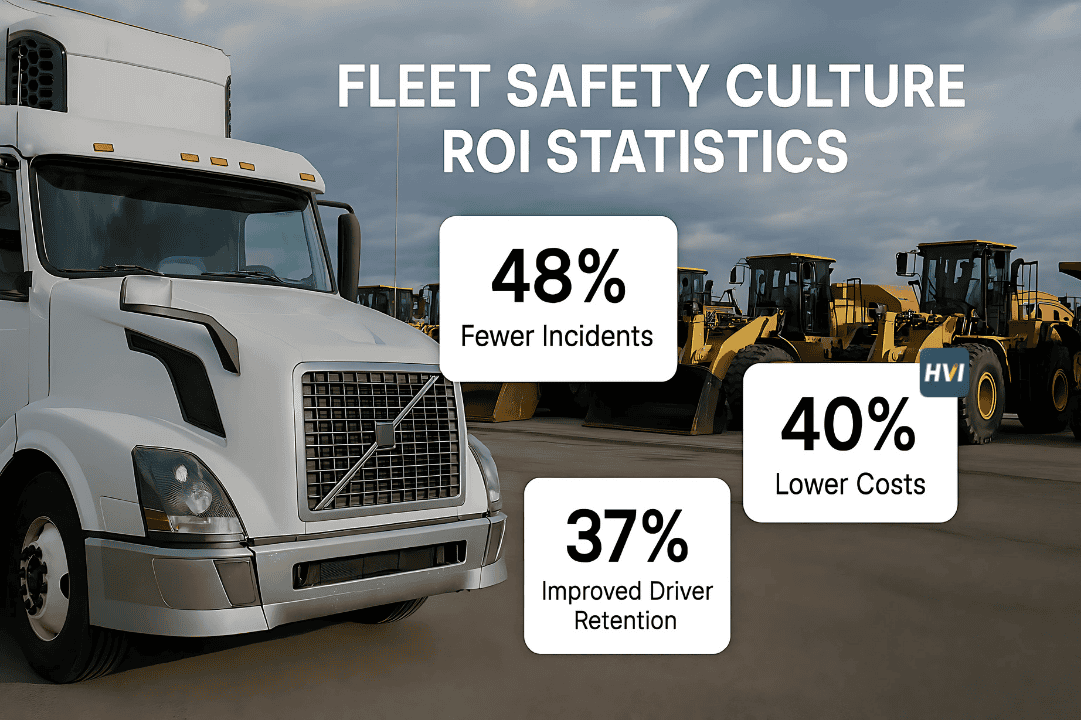
Fleets using HVI typically recover the entire subscription cost within 60-90 days from violation prevention alone. The ROI compounds across five value streams: reduced FMCSA fines ($45K+ annually for typical mid-size fleets), insurance premium discounts (15-20% for documented digital inspection programs), eliminated manual documentation labor (75% reduction), faster audit preparation (35+ hours saved per audit event), and improved maintenance outcomes (30% maintenance cost reduction through earlier defect catch). For a 50-vehicle fleet, the cumulative 5-year ROI typically runs 300-500%.
The February 2026 CSA methodology update split Vehicle Maintenance into "Driver Observed" and "Inspector Detected" categories — DVIR quality now directly affects CSA scores. Paper inspections cannot document driver-level defect detection, leaving fleets invisible to the new scoring category even when drivers are actually catching defects. HVI automatically maps every inspection finding to the correct CSA category. GPS-stamped, time-stamped, photo-evidenced inspections provide undeniable proof that inspections actually happened at the vehicle — eliminating the "signed from the cab" failure mode that plagues paper systems. Read our customer case studies to see how transport companies achieve these outcomes.
How much does fleet inspection software actually save?
Total savings depend on fleet size and current inspection practices, but the math is consistent across deployment data. A representative 50-vehicle transport company sees the following annual savings versus paper-based operations.
Is fleet inspection software worth it for small transport companies?
This is the question fleet operators ask most often — and the answer in 2026 is unambiguous yes, with sharper economics than most expect.
FMCSA recordkeeping obligations are identical for 5 drivers and 500 — a single expired medical card puts any driver out of service. Small fleets save 15-25 hours per week on compliance administration. Subscription cost typically recovered in under 90 days.
Sweet spot for fleet inspection software ROI. Full feature utilization, meaningful insurance discount on documented programs, multi-location compliance dashboard, mature defect-to-work-order workflow. 300-500% cumulative ROI within 18-24 months.
Enterprise-scale fleets see the largest absolute returns. Audit automation, multi-state compliance, sub-fleet performance benchmarking, AI predictive maintenance integration. Cumulative 5-year savings often exceed $1M+ on 200-vehicle operations.
Frequently asked questions
Choose the platform built for 2026 transport company compliance.
HVI delivers every benefit covered in this guide on day one — digital DVIRs, automated expiry alerts, photo-evidenced defect detection, 3-signature chain enforcement, ELD integration, insurance-ready documentation, and one-click audit export. Most transport companies recover the entire annual subscription cost within 60-90 days. Stop running paper inspections at risk; start running HVI inspections at scale.
No credit card required · First digital inspection live in 24 hours · 95% driver adoption within 30 days