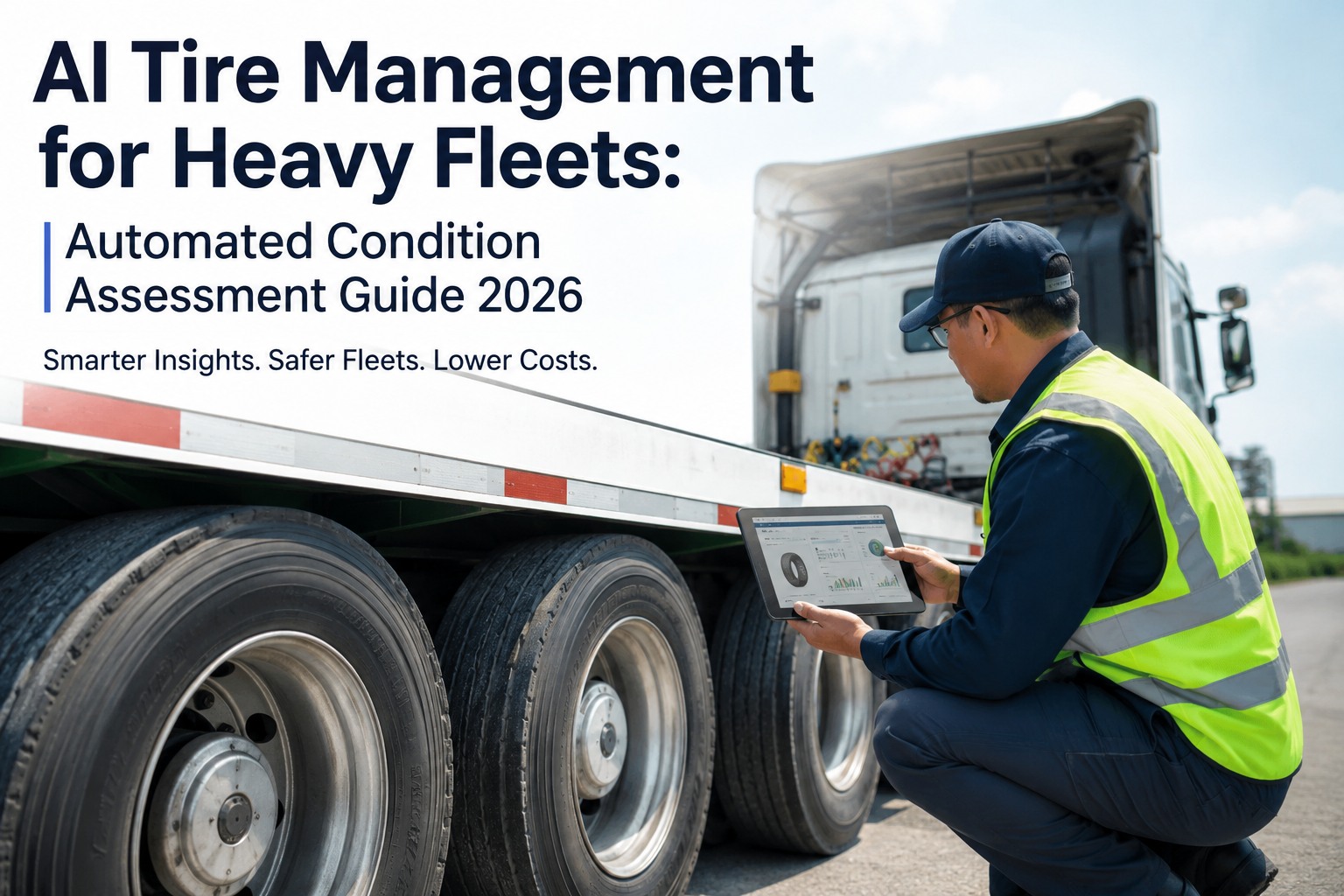
Tires are the single largest controllable expense in heavy fleet operations after fuel — and the single most preventable cause of roadside out-of-service orders, expensive emergency repairs, and CSA score damage. Yet 60%+ of commercial fleets in 2026 still manage tires the same way they did in 2010: manual gauge checks, walk-around inspections, paper logs, and reactive replacement when a tread wears bald or a blowout happens. The 2026 alternative is AI tire management — real-time TPMS sensor data combined with machine learning models that predict 90% of tire failures days or weeks before they would occur, recommend optimal pressure per load and route, detect slow leaks invisible to basic monitoring, and integrate directly into the broader fleet maintenance workflow. Fleets that deploy AI tire management report 28% reduction in annual tire budget, 2x longer intervals between tire-related downtime, sub-12-month ROI, and elimination of nearly all preventable tire OOS roadside violations. This guide covers exactly how AI tire management works for heavy fleets, the six core capabilities that separate AI platforms from basic TPMS, the 2026 trends reshaping the category, and how HVI's tire management module integrates with your existing maintenance workflow. Start your free HVI trial or book a 30-minute demo to see it live.
HVI's AI Tire Management predicts 90% of failures before they happen, monitors pressure and temperature 24/7, detects slow leaks invisible to basic TPMS, and integrates with your maintenance workflow. 28% lower tire budget, 2x longer uptime intervals.
What is AI tire management for heavy fleets?
AI tire management for heavy fleet condition assessment combines real-time TPMS sensor data with machine learning models that analyze pressure, temperature, tread wear, alignment, and operating conditions across every tire position — predicting failures days or weeks before they occur, recommending optimal pressure per load and route, detecting slow leaks invisible to basic threshold-based monitoring, and integrating directly into work order and inspection workflows.
Unlike basic TPMS that only alerts when pressure crosses a fixed threshold (typically 25% below recommended), AI tire management learns what "normal" looks like for each tire position, vehicle type, load profile, and operating condition. The system identifies subtle trend changes — gradual pressure loss, unusual temperature patterns, abnormal behavior compared to similar tires — that signal developing problems before traditional monitoring would alert. HVI integrates this AI tire intelligence into the broader maintenance platform you already use, so tire defects route automatically to work orders, parts inventory, and your DVIR workflow.
Why do heavy fleets need AI tire management in 2026?
The cost equation has shifted dramatically. With FMVSS 138 mandating TPMS across commercial vehicles, rising insurance premiums for fleets without preventive systems, the February 2026 CSA methodology overhaul, and tire prices up 12-18% year-over-year, the case for AI tire management has moved from "nice to have" to operational necessity.
Of tire failures can be predicted days or weeks ahead with AI tire monitoring vs basic TPMS.
Documented annual tire budget reduction reported by fleets running AI tire wear prediction.
Vehicles with automatic tire inflation + AI monitoring run 2x farther without tire-related downtime (ATA benchmark).
Average direct cost of a single heavy-vehicle tire blowout including roadside service, tow, and lost revenue.
Fuel economy loss per 1 PSI of underinflation across all tire positions. Compounds rapidly fleet-wide.
Of annual operating hours lost to breakdown repairs in heavy equipment fleets — tire issues a leading cause.
What are the 6 AI capabilities that separate it from basic TPMS?
Genuine AI tire management platforms deliver six capabilities that basic FMVSS-mandated TPMS systems cannot. HVI integrates all six on the same platform that handles inspections, work orders, and PM scheduling — so tire intelligence flows naturally through the entire maintenance lifecycle.
Every tire position monitored continuously — not just during inspections. Pressure and temperature streams flow into HVI 24/7, building per-tire baselines that reveal trends invisible to point-in-time gauge checks.
The most common precursor to tire failure is gradual air loss too small for threshold-based TPMS to catch. AI detects 0.5-2 PSI/day drift patterns days or weeks before traditional alerts would fire.
AI models analyze load, route, alignment, and consumption patterns to predict tire wear with 90-98% accuracy. Schedule replacement during planned downtime — never roadside.
AI calculates ideal pressure for each tire position based on actual load and route — not generic manufacturer specs. Maximizes fuel economy AND tire life simultaneously across varying duty cycles.
Uneven tread wear patterns reveal alignment issues, suspension wear, and load imbalances. AI flags vehicles consuming tires abnormally, surfacing root causes humans miss during visual walk-arounds.
Hub temperature analytics catch wheel-bearing failures before they cause wheel-end fires or tire detachment. Critical for heavy haul operations where wheel separations are catastrophic.
How does AI tire management actually save money?
The savings break down across six distinct value streams. Below is the documented annual breakdown for a representative 50-vehicle heavy fleet running HVI AI Tire Management versus the same fleet on manual gauge-check inspections and basic threshold TPMS.
What are the 2026 AI tire trends every fleet manager should know?
The category moved fast in 2025-2026. Five trends are reshaping what "AI tire management" actually means in 2026 — each affecting how fleets should evaluate platforms.
TPMS now federally mandated across commercial vehicles. The mandate creates a data layer every fleet must collect — but most fleets aren't yet using that data for predictive analytics. The compliance floor becomes the platform foundation.
March 17, 2026 launch of AI-driven retread inspection + Smart Predictive Tire monitoring for Classes 7 and 8. Major OEM endorsement that retread + AI prediction is now mainstream, not experimental.
2026 AI tire diagnostics expand beyond TPMS air pressure to include tread depth tracking, alignment angle monitoring, and physical rubber degradation analysis from embedded sensors.
Tire defect detected = work order auto-generated with parts reserved, technician assigned, repair window scheduled. The closed loop eliminates the 40-60% of maintenance delays caused by manual handoffs.
February 2026 CSA methodology update affects tire OOS scoring. Insurance underwriters now offer 15-20% premium discounts for documented preventive tire programs. Data integration becomes financial leverage.
How does AI tire management improve safety and compliance?
Tire-related safety incidents and roadside violations carry compounding costs — direct repair, lost freight, OOS orders, CSA score damage, and insurance premium impact. AI tire management addresses each at the source.
90% of tire failures predicted days/weeks ahead. Slow leak detection + thermal monitoring catch developing problems before they become safety incidents on the highway.
Continuous monitoring data + photo-evidenced inspections create the documented preventive program that auditors recognize under the February 2026 CSA methodology update.
Tires under 2/32" tread, sidewall damage, and underinflation are top OOS triggers. AI catches them before vehicles dispatch — the only way to structurally eliminate roadside surprises.
Documented AI tire programs qualify for 15-20% insurance premium discounts in 2026. Underwriters increasingly require preventive monitoring data for competitive rates on heavy fleets.
Frequently asked questions
Turn every tire into a monitored, predicted, optimized asset.
HVI AI Tire Management delivers every capability covered in this guide on one integrated platform — real-time pressure and temperature monitoring, slow leak detection, 90-98% accurate tread wear prediction, optimal pressure calculation, alignment analytics, wheel-bearing thermal monitoring, and closed-loop work order integration. Most heavy fleets recover the annual subscription cost from a single averted blowout within the first 60-90 days.
No credit card required · Live in 2-4 weeks · 90% failure prediction accuracy · Under 12-month ROI