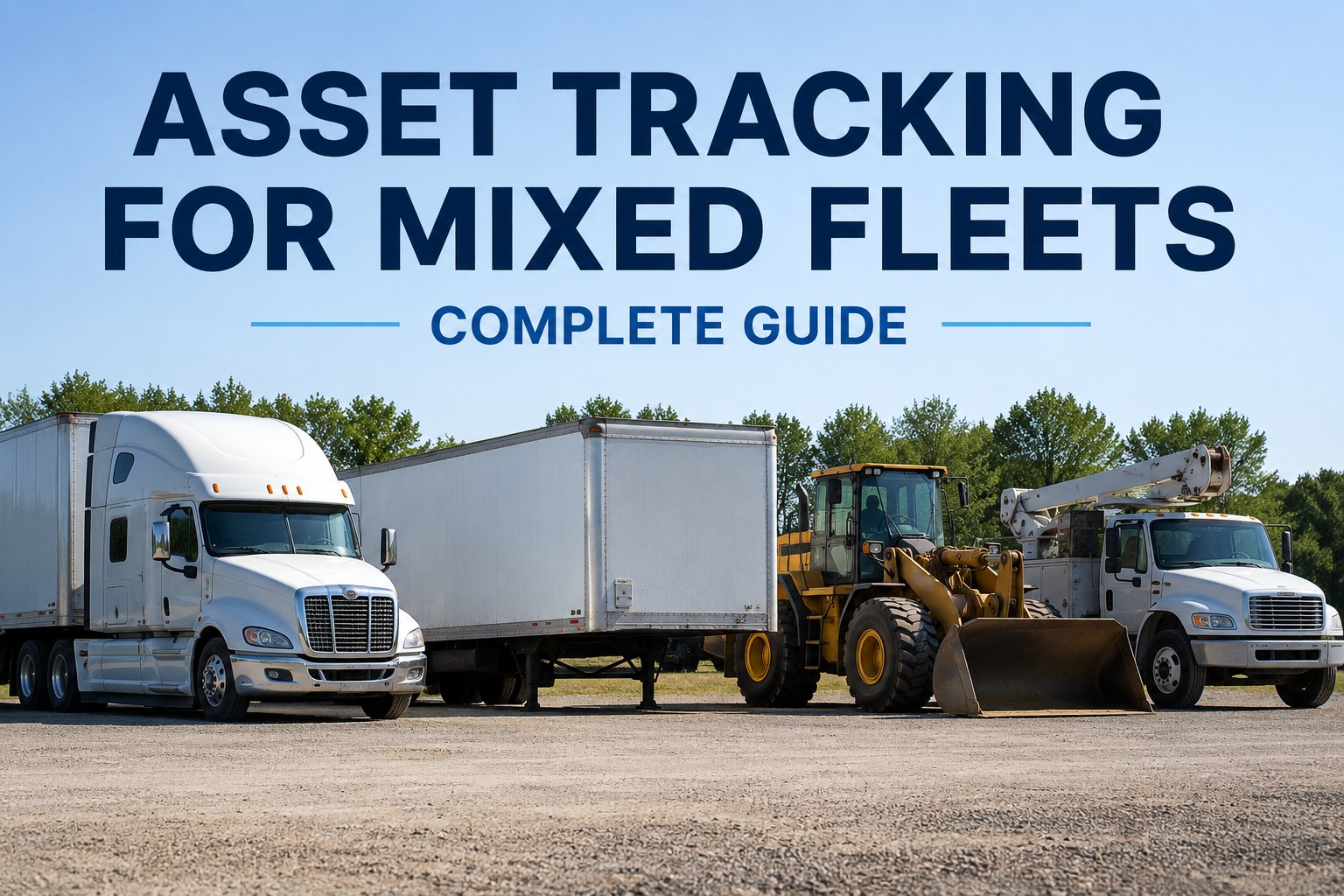
Most fleets aren't just trucks. A construction contractor runs Class 8 tractors and excavators and wheel loaders and service vans and generators and tools. A utility fleet has bucket trucks, cable trailers, digger derricks, hydro-vac units, and small compressors. Mixed fleets are the norm, not the exception — and the operational failure most of them share is that asset tracking is done in fragmented systems designed for just one asset type. Trucks live in the ELD platform, trailers on a separate trailer-tracker, heavy equipment on the OEM's telematics portal, small equipment on nothing at all. Nobody has a complete asset picture. Utilization suffers. Maintenance falls through the cracks. Assets get lost, literally — a $40K trailer sitting on a job site nobody remembers moving it to. This guide walks through why mixed fleets are uniquely hard to manage, the six asset categories most fleets track together, the five data types that matter across every category, and how to build unified asset tracking that actually works across every asset class. Book a demo to see every asset class in one connected view.
Every asset class. One connected roster.
Trucks, trailers, heavy equipment, light vehicles, small equipment, yard assets — visible together, tracked together, maintained together
What makes mixed fleets uniquely hard to track
A pure trucking fleet is manageable because every asset in it is the same shape. Same ELD requirements, same PM cadence, same telematics data structure, same regulatory framework. A mixed fleet doesn't get that convenience. Six specific dimensions differ across asset categories, and every difference creates a tracking gap.
Trucks talk J1939 CAN bus. Heavy equipment uses OEM-specific telematics protocols (Caterpillar VisionLink, John Deere JDLink, Komatsu Komtrax, Volvo CareTrack). Trailers use standalone GPS beacons. Small equipment has BLE tags or none at all. Six data protocols, six data schemas, six vendor portals.
A Class 8 tractor gets serviced every 25K miles. An excavator gets serviced every 250 engine hours. A generator gets serviced every 500 runtime hours. A trailer gets an annual DOT inspection plus mid-year tire and brake checks. Calendar-based PM systems can't accommodate this heterogeneity.
Trucks face FMCSA rules (49 CFR Parts 390-396). Trailers get annual DOT inspections. Heavy equipment falls under OSHA jurisdiction (29 CFR 1926). Light vehicles need state DMV compliance. Small equipment has manufacturer-specific requirements. One tracking system needs to speak all of them.
A truck's utilization = miles driven. A trailer's utilization = time under load. An excavator's utilization = engine hours minus idle. A generator's utilization = runtime hours. Each metric requires different data capture, different thresholds, different reporting.
A tractor typically runs 5-7 years / 750K-1M miles. A trailer runs 12-20 years. An excavator runs 15,000-20,000 engine hours over 8-12 years. A generator runs 25,000 hours. Different depreciation, different resale, different replacement decisions.
A tractor stays with one driver. A trailer moves between drivers and terminals. Equipment moves between job sites. Small tools move between technicians. Some assets sit idle for weeks. Tracking who has what, where, and when is a distinct problem per class.
Any one of these differences is manageable in isolation. It's the combination that breaks single-purpose tracking systems — and the reason mixed fleets typically run 5-8 separate software tools that don't share data with each other. Book a demo to see all six dimensions unified in one platform
The 6 asset categories most fleets track together
Mixed fleet composition varies by industry, but six categories cover the vast majority of assets across construction, utility, transportation, oil & gas, agriculture, and waste-management operations.
Federally regulated under FMCSA. ELD mandatory. Rich telematics data available: HOS, engine diagnostics, fuel consumption, hard events, GPS. Most sophisticated tracking of any asset class — and typically the anchor asset around which the rest of the fleet system is built.
Legally separate assets under FMCSA (annual DOT inspection required). Track via battery-powered GPS beacons, cargo sensors, or fifth-wheel-integrated telematics. Utilization patterns differ dramatically from tractors — trailers spend more time stationary than moving.
Runs OEM telematics (VisionLink, JDLink, Komtrax, CareTrack). Different data structure per manufacturer. Engine-hour-based PM. Job-site utilization measurements. Depreciation-heavy assets requiring precise usage tracking for warranty and resale.
Not FMCSA-regulated in most cases (unless GVWR crosses thresholds). Track via aftermarket GPS or OBD-II devices. Simpler telematics than heavy trucks but still critical for service dispatch, technician routing, and personal-use tracking.
Traditionally untracked or tracked on paper. Modern approach: Bluetooth Low Energy (BLE) beacons or RFID tags scanned at check-out/check-in. Runtime hours logged via operator-facing app. High theft risk asset class — tracking value is disproportionately high.
Semi-mobile assets that move between yards, job sites, or customer locations. Tracked via low-frequency GPS pings (once daily) or QR-code / RFID scans at movement events. Chain-of-custody more important than real-time location.
Mixed-fleet tracking has to accommodate the full range: from an ELD streaming 200 data points per hour on a tractor, to a QR-code scan once a week on a storage container. Both are legitimate tracking scenarios — the system needs to handle both without forcing either into the wrong tracking model. Start a free trial to unify all six asset categories on one platform this week, or book a demo to see the specific setup for your composition.
The 5 data types every asset needs tracked
Across every asset category, five data types define what "tracking" actually means. Not every asset needs all five in real-time, but every asset needs each of them captured somehow.
The matrix reveals the mixed-fleet challenge in one view: no single tracking approach covers all five data types across all six asset classes. A unified system has to combine real-time telematics, periodic GPS pings, and scan-based check-in workflows depending on the asset class.
4 common mixed-fleet tracking failures
Fleets running mixed asset portfolios typically hit four specific failure modes before consolidating on unified tracking. Each is avoidable once you know what to look for.
Small equipment and yard assets frequently drift out of the tracking system entirely. A $12K welder that walked off a job site six months ago that nobody flagged missing. A trailer parked at a customer yard that hasn't billed rental in three months. Untracked assets aren't just security risks — they're rolling depreciation.
The truck's oil change is in the ELD platform. The trailer's DOT inspection is in a spreadsheet. The excavator's 500-hour service is in the Komatsu portal. Nobody sees the complete maintenance picture across the mixed fleet. Audits become archaeology exercises.
Truck utilization sits in the TMS. Equipment utilization sits in the OEM telematics portal. Trailer utilization sits nowhere. Comparing "which assets are earning their keep across the fleet" requires manual data assembly. Underutilized expensive assets get missed for months.
A tractor is dispatched with a trailer that hasn't had its annual DOT inspection. The safety violation surfaces at a roadside inspection. The tractor system knew the truck was compliant; nobody's system was cross-checking the trailer. Mixed-fleet compliance has to see across categories.
Every failure mode above traces back to fragmented tracking — assets managed in isolation instead of as one connected fleet. Start a free trial to close every category gap in one setup this week.
Where unified asset tracking pays off — by industry
Mixed-fleet composition varies by industry, and so does the specific value of unifying tracking across categories. Four industries where the ROI is most immediate.
Construction & General Contracting
Class 8 tractors for material hauling + excavators / loaders / dozers on active sites + service pickups + small equipment (compactors, generators, tools). Unified tracking eliminates the constant "where is the mini-ex we need on the Riverside job today" phone calls.
Utility & Infrastructure
Bucket trucks + cable trailers + digger derricks + hydro-vac units + generators + small tools. Storm-response coordination requires knowing exactly what equipment is where in real time — unified tracking is the difference between 2-hour and 8-hour restoration times.
Oil & Gas Services
Wireline trucks + vacuum tankers + specialty equipment (frac tanks, wireline units, coil tubing) + light service vehicles + tools. Job-site billing accuracy depends on precise chain-of-custody tracking. Unified tracking turns per-asset billing from an argument into an audit trail.
Waste, Recycling & Environmental
Roll-off trucks + collection routes + container inventory + heavy equipment (loaders, balers) + specialty vehicles (vacuum, hazmat). Container-tracking accuracy directly drives revenue — every unbilled container placement is lost margin. Unified tracking recovers that visibility.
Every industry benefits from unified tracking for slightly different reasons — but the common thread is that tracking gaps between asset classes create direct P&L impact that fleet-only tracking systems can't recover. Book a demo to see the specific value model for your industry composition.
From a fleet director who unified 340 assets across 6 categories
We're a mid-sized utility contractor. 340 assets: 62 tractors, 88 trailers, 41 heavy equipment units, 74 service pickups, 51 small equipment, 24 storage containers. We were running Samsara for the tractors, a trailer tracker for the vans, Komtrax and CareTrack for the equipment portals, a spreadsheet for small stuff, and honestly no system for containers.
Every Monday morning was a hunt-and-gather exercise to figure out what we had, where it was, and what needed service. Consolidating onto one platform took 3 months. First quarter after go-live: equipment utilization up 19%. Container billing recovered $47K in previously-unbilled placements. And we found 3 pieces of small equipment that had been "lost" in the system for over a year but were sitting on a customer yard. The consolidation paid for itself in the first quarter, and we've never looked back.
Frequently asked questions
What is a mixed fleet, and why is it harder to track?
A mixed fleet is any operation running more than one asset category — typically some combination of Class 6-8 trucks, trailers, heavy equipment (excavators, loaders, dozers), light vehicles (pickups, service vans), small equipment (generators, compressors, welders), and yard assets (containers, storage trailers). Mixed fleets are the norm across construction, utility, oil and gas services, waste and recycling, agriculture, and any operation where the primary business isn't purely trucking. Mixed fleets are harder to track than pure trucking fleets for six specific reasons: (1) different telematics standards per asset class (J1939 for trucks, OEM protocols for equipment, BLE for small tools, GPS beacons for trailers); (2) different maintenance economics (mileage-based vs engine-hour-based vs runtime-based); (3) different regulatory frameworks (FMCSA for trucks, OSHA for equipment, DMV for light vehicles); (4) different utilization signals per class; (5) different lifecycle economics (5-year truck vs 15-year excavator vs 20-year trailer); (6) different chain-of-custody patterns. Any tracking system built for one asset class only handles that class well — mixed fleets need unified platforms that speak all six languages.
Does asset tracking software work with existing telematics and OEM systems?
Modern asset tracking platforms like HVI are built specifically to integrate with existing telematics investments across every asset class. For trucks, native API integration with major ELD/telematics providers (Samsara, Motive, Geotab, Verizon Connect, Omnitracs) preserves the existing hardware and driver workflow. For heavy equipment, API connections to OEM telematics platforms (Caterpillar VisionLink, John Deere JDLink, Komatsu Komtrax, Volvo CareTrack, Hitachi ZXLink) pull engine hours, fuel usage, location, and fault codes directly from the manufacturer's data feed. For light vehicles, OBD-II devices or aftermarket GPS systems feed data through standard APIs. For small equipment and yard assets, BLE beacons, RFID tags, or GPS pings feed a common tracking layer. The unified platform normalizes all these disparate data sources into a single asset schema so the fleet manager sees one view regardless of where each data point originated. This means fleets don't have to rip out or replace existing telematics investments to consolidate — they add the unified tracking layer on top of what they already have. Migration typically runs 6-12 weeks depending on fleet size and number of source systems being consolidated.
How do you track small equipment and hand tools that don't have telematics?
Small equipment (generators, compressors, welders, pumps, small pieces of construction tooling) is traditionally the hardest asset category to track because it doesn't have built-in telematics like a truck or excavator. Three approaches work well depending on asset value and mobility patterns. Bluetooth Low Energy (BLE) beacons are the most common — small battery-powered tags ($15-30 each) attached to the asset that broadcast identity to nearby readers. When the asset moves near a reader (truck-mounted, terminal-mounted, or smartphone-based), the platform captures a location and timestamp. RFID tags work similarly at higher scale but require dedicated readers. QR-code check-in/check-out workflows work for assets that move between technicians or job sites — the operator scans the code on their phone at check-out, and again at return, creating a chain-of-custody record. Runtime hours can be logged via operator-facing app entries when the asset is used. For very high-value small equipment (large generators, specialized welders), standalone GPS trackers with 12-month battery life ($100-200) provide truck-level tracking on a small-equipment budget. The mixed-fleet platform accepts all these tracking modes as legitimate data sources — real-time GPS from trucks and daily QR-scan updates from tools both feed the same asset roster.
Can one asset tracking platform handle trucks under FMCSA rules and equipment under OSHA?
Yes, and this is precisely why unified asset tracking platforms exist. Compliance framework varies dramatically by asset class — trucks fall under FMCSA rules (49 CFR Parts 390-396 governing ELDs, DVIRs, HOS, maintenance retention), trailers get separate DOT annual inspections under 49 CFR 396.17, heavy equipment falls under OSHA jurisdiction (29 CFR 1926 for construction, 29 CFR 1910 for general industry), light vehicles need state DMV compliance, and small equipment has manufacturer-specific inspection requirements. A unified platform maintains separate compliance record structures for each asset class while presenting a single unified fleet view. A truck's DVIR record lives in the FMCSA-compliant format; an excavator's daily walkaround inspection lives in the OSHA-compliant format; a trailer's annual DOT inspection has its own retention rules. The platform enforces the correct compliance workflow per asset class rather than forcing a one-size-fits-all approach. During a mixed audit — say, an FMCSA compliance review that also touches OSHA jurisdiction because the fleet operates on job sites — the platform produces separate audit-ready exports for each regulatory framework from the same unified data foundation. This eliminates the manual reconciliation work that fleets running separate systems typically face when regulators from different agencies coordinate an audit.
What's the ROI of unified asset tracking for a mixed fleet?
Return on investment for unified mixed-fleet tracking comes from five distinct categories, and typical mid-sized fleets see the platform pay for itself within the first quarter. First, utilization improvement: fleets typically see 15-25% higher utilization on previously-siloed asset categories once visibility becomes fleet-wide. An excavator that sat idle for 6 days at a completed job site would have been dispatched to a waiting project 3 days sooner. Second, maintenance cost reduction: 15-25% drop in maintenance cost per operating hour or per mile as PMs run against actual usage across all asset classes. Third, recovered billing accuracy: for asset-billing operations (equipment rental, container rental, wireline services), unified tracking typically recovers 3-10% of previously-unbilled placements or usage — one utility contractor recovered $47K in the first quarter alone on container placements. Fourth, reduced ghost-asset losses: assets that "walk off" or drift out of active tracking typically represent 2-5% of small-equipment portfolio value annually. Recovering that visibility protects capital. Fifth, admin time recovery: fleet managers typically recover 8-15 hours per week previously spent reconciling reports across multiple tracking systems. Combined, most mixed fleets see 6-12 month payback on unified tracking, with compounding benefits as data quality improves and cross-category insights become available.
One roster. Every asset. From tractor to tool.
HVI unifies asset tracking across every category in your fleet — native integration to ELDs, OEM telematics, GPS beacons, and BLE trackers. One dashboard for utilization, maintenance, and compliance across trucks, trailers, heavy equipment, light vehicles, small tools, and yard assets. Live for your fleet in under two weeks — typical mixed fleets recover the platform cost inside the first quarter through utilization and billing accuracy alone.
No credit card · Works with any ELD, OEM telematics, or GPS beacon · 6-12 week deployment