A reefer doesn't fail like an engine — it fails like an insurance claim. One temperature excursion nobody caught in time can turn a full load into a total loss and a dispute you can't win without records. Carrier Transicold maintenance software catches the unit's defects and alarm codes at inspection, schedules PM by the hours that actually wear it, and keeps the proof that pays the claim.
The repair is cheap. The spoiled load behind it isn't.
HVI tracks your Carrier Transicold reefer inspections, captures setpoint readings and alarm codes per unit, schedules PM by engine hours, and keeps the cold-chain record that holds up when a load gets disputed.
- Capture setpoint, box temp & alarm codes at pre-trip
- Flag a low-charge or airflow fault before it's a claim
- Keep an FSMA-ready record on every reefer
You already know the asymmetry that makes reefer work different: a dry van's worst day is a late delivery, but a reefer's worst day is a $45,000 produce load turned to compost because the box drifted seven degrees and nobody saw it until the dock. Refrigerated cargo claims usually mean the entire load — if the meat arrives out of temp, it's all gone, not part of it. That's why reefer maintenance can't be an afterthought bolted onto trailer basics; it needs its own digital inspection and its own schedule — you can book a demo to see it set up for your Carrier Transicold units.
The repair isn't the cost — the cargo iswhy a reefer failure bills nothing like the part that failed
Here's the number that should drive every reefer PM decision: the belt, the sensor, the charge are pocket change next to what rides behind them. One rejected load can run from $30,000 into six figures in product value alone — before disposal, redelivery, detention, and the claim dispute itself.
And it rarely ends with the pallet: the trailer gets pulled for inspection, the next scheduled load slips behind it, and the shipper relationship takes the real hit. Catching the fault while there's still time to act is the whole game — you can start free and log your first reefer defect today .
What the alarm code is really telling youfour failure families behind the Carrier Transicold display
A Carrier Transicold unit talks to you in alarm codes, and almost every one traces back to one of four root causes. Reading the code to the right family is how a driver flags the real problem at pre-trip instead of resetting it and rolling.
Low suction pressure. Low charge from a slow leak, a restricted expansion valve, or an iced evaporator — the unit can't pull the box down to setpoint.
Check refrigerant system. A leak or undercharge, often with oil residue at the leak point — cooling capacity drops and the box warms under load.
High pressure. Dirty condenser coil, blocked airflow, or a condenser fan failure — heat isn't rejecting, so discharge pressure climbs.
Microprocessor board fault. A hardware or firmware failure in the unit's brain — or belt, compressor and engine wear on the mechanical side.
There's also a fifth cause that throws no code at all — a torn ceiling air chute short-cycling cold air at the nose of the trailer. Capturing the code, the setpoint and the box temp together in connected maintenance management is how the repeat units and recurring codes surface. Book a demo to see alarm codes tracked per reefer unit
A reefer runs on engine hours, not your odometerthe unit is a diesel engine with its own schedule
This is the mistake that quietly kills reefer units: servicing them on the truck's mileage. The Carrier Transicold unit has its own diesel engine that keeps running at a dock or a drop lot while the truck sits still — so it wears by run hours, not miles. Preventive maintenance scheduled by engine hours is what keeps the belt, oil and coils ahead of a failure instead of behind one.
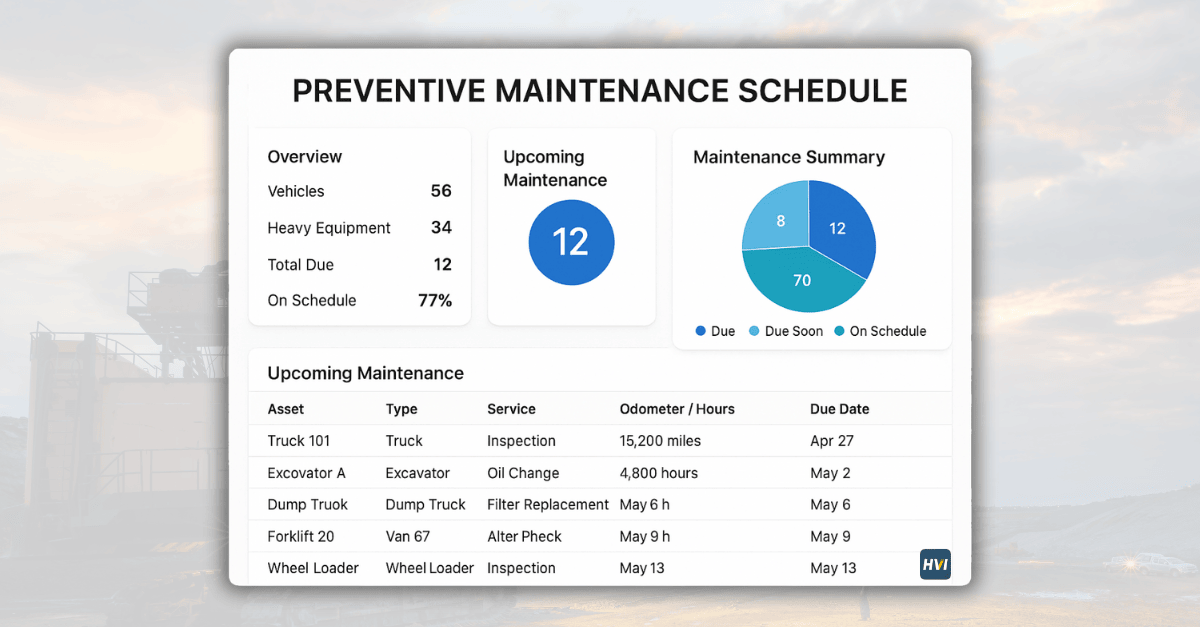
Set these by engine hours and HVI auto-assigns them to every unit, so the coil cleaning that prevents a high-pressure alarm happens on schedule — and the reefer fuel it burns is tracked too. Book a demo to see reefer PM triggered by engine hours
When the load's disputed, records win the argumenthow one reefer defect becomes claim-proof in HVI
Flagged at pre-trip
The driver logs the setpoint, box temp and any alarm code on the digital inspection — with a photo — before the load is on.
Becomes a work order instantly
A low-charge or airflow fault generates a work order the moment it's logged — assigned, prioritized, with the unit's full alarm history attached.
Repaired with the right part
Belt, filter, sensor or charge comes from parts inventory; the fix is logged against the work order and stock updates.
The record that defends the claim
The closed work order plus the temp log becomes a timestamped, FSMA-ready record — the due-diligence proof that decides a claim, in analytics and reporting.
When a receiver disputes a load, the fleet with records wins the argument. That paper trail is the difference between a partial denial and a full one. Book a demo to see the claim-ready record on a reefer unit
The Carrier Transicold pre-trip checklistthe recurring check that keeps the box at setpoint
Build this once as a preventive maintenance template, trigger it by engine hours or calendar, and it auto-assigns to every reefer. For the full 27-point walkthrough, see the reefer trailer inspection checklist.
On paper, this is only as good as the last person who filed it. In HVI, every failed line becomes a tracked defect, a work order and a documented repair — automatically.
Build This Checklist Free in HVIFrom a reefer fleet maintenance manager
We lost a full produce load to a slow refrigerant leak that had been throwing an intermittent AL-1 for two weeks. Drivers kept acknowledging the alarm and rolling because the box still felt cold enough on short runs.
Now every alarm code a driver sees becomes a work order with the unit's history attached, and the setpoint and box temp are logged at every pre-trip. We catch the slow leaks now — and the last time a receiver tried to charge us back, our record ended the conversation in five minutes.
Frequently asked questions
What does Carrier Transicold maintenance software do?
It lets drivers log setpoint, box temp and alarm codes during digital reefer inspections, turns each defect into a work order automatically, and schedules PM by engine hours. The result is fewer temperature excursions and a claim-ready record per unit.
Does it work with Carrier Transicold alarm codes?
Yes. HVI captures the alarm codes your Carrier Transicold units display — low suction, refrigerant, high pressure, control faults — so recurring codes on a specific unit surface instead of getting reset and forgotten.
Why schedule reefer PM by engine hours instead of mileage?
Because the reefer unit is its own diesel engine that runs at docks and drop lots while the truck sits still. It wears by run hours, not miles, so engine-hour PM catches belt, oil and coil issues before they cause an excursion.
How does it help when a load gets disputed?
Every inspection, temperature reading and repair is timestamped and tied to the unit, giving you an FSMA-ready due-diligence record. When a receiver disputes a load, that paper trail is often the difference between a partial and a full claim denial.
How long does it take to get set up in HVI?
Most fleets are live across their reefers in under two weeks, with no new hardware. You build the Carrier Transicold inspection and engine-hour PM checklist once, and it auto-assigns to every unit on schedule.