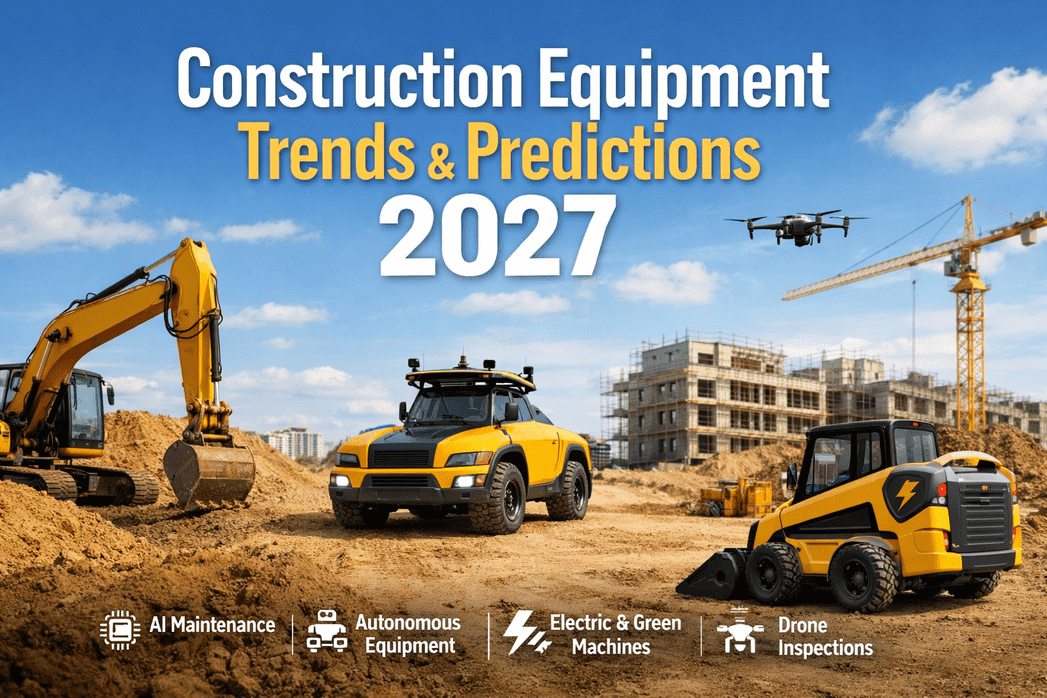
CONEXPO-CON/AGG 2026 confirmed what the data already showed: construction equipment is being redefined by technology and connectivity as much as by horsepower and hydraulics. 140,000+ professionals walked the Las Vegas show floor to see electric machines from every major OEM, AI-powered operator assistance systems, autonomous earthmovers, and drone inspection platforms that were pilot programs two years ago and are now shipping to job sites. The numbers reinforce the trajectory: the AI construction market is projected to surpass $4.5 billion by 2026. The electric construction equipment market was valued at $13.6 billion in 2024 and is projected to reach $106.9 billion by 2034 at a 23.3% CAGR. The autonomous construction equipment market is valued at $10 billion in 2025, growing at 7.9% CAGR through 2032. Battery pack prices fell below $100/kWh in 2024 and continue declining. Construction faces a projected 2.2 million worker gap by 2026 in North America — making autonomous and AI-powered systems a business continuity necessity, not an upgrade. The Deloitte 2026 Engineering and Construction Industry Outlook confirmed firms are accelerating investments in autonomous equipment, robotics, AI-powered scheduling, and prefabrication. But the report also flagged the critical gap: poor-quality data continues to undermine analytics and AI solutions, reducing ROI and limiting competitive advantage. The machines are getting smarter. The question is whether your maintenance data, inspection records, and fleet management systems are ready for what these machines need. This guide covers the 7 predictions shaping construction equipment management through 2027, what each trend means for fleet operators, and how to prepare your operation today. Book a demo to see how HVI prepares your construction fleet for AI-powered equipment management, or start your free trial of HVI's connected inspection and maintenance platform.
Construction Equipment Management: Trends and Predictions for 2027
AI maintenance, autonomous equipment, electrification, drone inspections, digital twins, and agentic AI — what is arriving, what is maturing, and what your fleet needs to be ready for.
Prediction 1: AI-Powered Predictive Maintenance Becomes Standard
What is happening: AI predictive maintenance is moving from pilot programs to production deployments. Smart scheduling and predictive maintenance already cut downtime by up to 60%. AI systems analyze hydraulic fluid temperatures, pressure anomalies, vibration patterns, and engine performance data to predict component failures 2-4 weeks before they occur. Komatsu's "Smart Construction" ecosystem and Cat's AI-enabled VisionLink platform lead implementation. By 2027, AI-based predictive maintenance systems are expected to cut equipment downtime by 28%.
Market data: The AI construction market is projected to surpass $4.5 billion by 2026. Over 53% of organizations say predictive maintenance alerts are the most important telematics feature when selecting a vendor (ABI Research). The AI vehicle inspection market is projected to reach $6.9 billion by 2033.
What it means for fleet operators: Predictive AI needs structured historical data to learn from — inspection records, work orders, parts replacement history, fluid analysis trends. Fleets that have been collecting digital maintenance data for 2+ years will have the training dataset. Fleets still on paper will have nothing for the AI to learn from. The data you collect today determines whether predictive AI works for you in 2027.
Prepare now: Digitize inspections and maintenance records. Connect OEM telematics. Build the machine-specific history that AI models require. Book a demo to see how HVI builds the predictive maintenance data foundation for construction fleets.
Prediction 2: Autonomous and Semi-Autonomous Equipment Scales Beyond Mining
What is happening: Autonomous bulldozers, excavators, and haul trucks are moving from mining-only deployments to general construction. The autonomous construction equipment market is valued at $10 billion in 2025, growing at 7.9% CAGR through 2032. Semi-autonomous and fully autonomous machines now feature GPS guidance, LiDAR sensors, and AI algorithms for navigation, obstacle avoidance, and repetitive task execution. Develon premiered its cabinless Concept-X 2.0 at Intermat 2024. Caterpillar's autonomous mine trucks have logged millions of productive hours. Trimble-ready hardware on Liebherr dozers enables factory-integrated autonomous operation.
Market data: 48% of newly developed electric excavators and loaders feature semi-autonomous or fully automated capabilities. Fully autonomous equipment captured 60.4% of the autonomous equipment market in 2026. Coordinated autonomous fleets have surpassed 1 million meters of automated drilling. Autonomous operations raise productivity 25-30% vs human-directed crews.
What it means for fleet operators: Autonomous machines still need inspection and maintenance — they just do not have an operator who walks around them each morning. Digital inspection workflows become even more critical when there is no human in the cab to notice a hydraulic leak or hear an unusual noise. Maintenance data feeds the autonomous system's self-monitoring capabilities.
Prepare now: Establish digital inspection protocols that work independently of operators. Ensure your maintenance system captures data that autonomous control systems can ingest. Start your free trial of HVI's construction equipment inspection platform.
Prediction 3: Electrification Moves Beyond Compacts to Mid-Size and Large Equipment
What is happening: Electric mini excavators and compact loaders are commercially proven. Now the industry is scaling to mid-size and large equipment. Volvo's EC230 Electric (23-ton excavator), Cat's 320 Electric, Komatsu's PC210E, and Volvo's L120 Electric wheel loader (up to 9 hours runtime) are shipping. Battery pack prices fell below $100/kWh in 2024. Lithium-ion and solid-state battery integration delivers 42% improvement in energy efficiency vs diesel. Electric drivetrains simplify motion control and reduce maintenance complexity.
Market data: The electric construction equipment market was valued at $13.6 billion in 2024, projected to reach $106.9 billion by 2034 at 23.3% CAGR. IDTechEx forecasts the sector climbing to $81 billion. Battery-electric units are projected to surge at 19.3% CAGR. Hydrogen fuel cell machinery is emerging as an alternative for equipment with 8+ hour duty cycles — JCB, Liebherr, Komatsu, and Cat are all investing in hydrogen combustion engines.
What it means for fleet operators: Electric machines eliminate diesel maintenance items but add battery SOH monitoring, high-voltage cable inspection, thermal management, charging infrastructure management, and inverter diagnostics. Your inspection checklists and work order system must handle both powertrains — diesel items for existing fleet, EV items for new acquisitions — in one platform.
Prepare now: Deploy inspection and maintenance systems that support mixed diesel/electric fleets from day one. Book a demo to see HVI's mixed-fleet EV and diesel inspection workflows for construction equipment.
Prediction 4: Drone Inspections Become Routine for Heavy Equipment and Structures
What is happening: Drones equipped with cameras, thermal sensors, and AI are replacing manual inspection of cranes, booms, structural elements, rooftops, and hard-to-reach equipment components. AI-powered drones identify wear, structural flaws, and damage from aerial imagery — detecting problems that would require scaffolding, lifts, or shutdown for human inspectors. Thermal imaging detects energy inefficiencies, water leaks, and electrical system faults. Regular drone flights generate 3D site models for progress monitoring and digital twin integration.
Market data: FAA-certified drone operators earn up to 20% higher salaries. Aerial mapping has become routine on major projects. Drone surveys capture data in minutes that would take manual inspectors days. AI-enabled drones monitor video feeds for safety hazards, equipment problems, and structural flaws in real time.
What it means for fleet operators: Drone inspection data needs to feed into your maintenance system — defects found by drones must become work orders with the same urgency and tracking as defects found by human inspectors. If drone data lives in a separate silo, the inspection was wasted. Integration with your CMMS/inspection platform is essential.
Prepare now: Establish an inspection platform that can ingest data from multiple sources — human walk-arounds, drone surveys, telematics alerts, and sensor data — into one unified defect-to-work-order pipeline. Book a demo to see HVI's multi-source inspection integration for construction fleets.
Prediction 5: Digital Twins Move from BIM to Equipment Lifecycle Management
What is happening: Digital twins — virtual replicas of physical assets — are expanding from building design (BIM) to individual equipment lifecycle management. NVIDIA and Siemens announced the "Physical AI Factory" concept. 60% of OEMs are adopting cloud-based fleet management platforms to gather performance data for predictive diagnostics. Digital twins of individual machines combine real-time telematics data, inspection history, maintenance records, and operating conditions to simulate future performance and optimize maintenance timing.
Market data: BIM adoption exceeds 60% nationwide with projects finishing 20% faster and 15% cheaper. Companies report up to 20% improvement in resource utilization through digital twin simulation. Timeline reductions of up to 20% from integrated BIM/digital twin workflows (Deloitte).
What it means for fleet operators: A digital twin of your excavator is only as good as the data feeding it. Without complete inspection records, maintenance history, parts consumption, and operating hours per machine, the digital twin has nothing to simulate. The fleet that has 3+ years of structured digital records builds meaningful equipment twins. The fleet on paper has nothing to model.
Prepare now: Build machine-specific digital histories today. Every inspection, every work order, every PM event, every parts replacement contributes to the data model. Start your free trial of HVI to build equipment-level digital histories for your construction fleet.
Prediction 6: Agentic AI Moves from Monitoring to Autonomous Decision-Making
What is happening: Agentic AI — systems that make autonomous decisions and perform complex tasks without human supervision — is the frontier trend. Unlike traditional AI that reports data and suggests actions, agentic AI takes actions: issuing work orders, triggering maintenance schedules, coordinating material logistics, ordering parts, scheduling technicians, and adjusting operations based on real-time conditions. Deloitte's 2026 E&C Outlook confirmed firms are piloting agentic AI to autonomously manage scheduling, coordinate workflows, and mitigate risk.
Market data: The agentic AI market is projected to grow from $5.2 billion in 2024 to $200 billion by 2034. Construction companies deploying agentic AI report the system can oversee foundation pours, coordinate materials, alert crews to changes, and predict hazards in real time — without requiring constant human contribution.
What it means for fleet operators: Agentic AI needs structured workflows to automate — it follows the playbook your fleet has already established. If your inspection-to-work-order-to-parts-to-repair chain is documented digitally with thousands of completed examples, agentic AI can learn and optimize it. If your processes exist only in people's heads, there is nothing for the AI to follow.
Prepare now: Document your workflows digitally. Every inspection, work order, parts transaction, and PM event creates the operational playbook that agentic AI will eventually orchestrate. Book a demo to see how HVI creates the structured maintenance workflows that power future AI automation.
Prediction 7: Data Quality Becomes the Competitive Differentiator
What is happening: Every prediction above shares one dependency: structured, complete, machine-specific digital data. Deloitte's 2026 E&C Outlook explicitly flagged that poor-quality data continues to undermine the reliability of analytics and AI solutions, reducing ROI and limiting competitive advantage. Robust data governance frameworks are required to realize the full benefits of digital tools. 82% of construction companies still rely on manual tracking for maintenance and parts, resulting in 40% higher failure rates. Only 28% of fleets achieve 95%+ PM compliance. The technology is ready. The data is not.
Market data: The construction equipment telematics market is projected to grow from $7.76B (2025) to $20.59B (2034). 6.8 million telematics units installed globally, growing to 12.1M by 2028. The data is flowing from the machines — the question is whether your systems capture, structure, and use it.
What it means for fleet operators: The fleet that starts collecting structured digital data today has a compounding advantage that competitors cannot shortcut. Every digital inspection record, every closed work order, every parts transaction, every PM completion builds the dataset that AI, digital twins, and predictive analytics will consume. The fleet that waits until 2027 to start will be 2+ years behind the fleet that starts today.
Prepare now: Deploy digital inspections and maintenance management immediately. This is the single highest-ROI investment for any construction fleet planning to benefit from AI, autonomy, or any technology trend on this page. Start your free trial of HVI today — the data foundation every future technology needs.
Frequently Asked Questions
Digital inspection and maintenance management. Every future technology — AI predictive maintenance, digital twins, autonomous equipment, agentic AI — depends on structured historical data per machine. Without 2+ years of digital inspection records, work orders, and parts history, no AI model has anything to learn from. Digitization is the prerequisite for everything else. Start your free trial of HVI's digital inspection and maintenance platform for construction equipment.
No — autonomous equipment increases the need for systematic inspections. Without a human operator in the cab, there is no one to notice a hydraulic leak, hear an unusual noise, or feel abnormal vibration. Digital inspection protocols that work independently of operators become even more critical. Autonomous machines also require new inspection items: sensor calibration, LIDAR cleanliness, communication systems, and emergency stop verification. Book a demo to see how HVI handles autonomous equipment inspection workflows.
$13.6 billion in 2024, projected to reach $106.9 billion by 2034 at 23.3% CAGR. Battery pack prices fell below $100/kWh in 2024. Every major OEM — Cat, Volvo, Komatsu, JCB, Liebherr — is shipping battery-electric models. Electric machines eliminate diesel maintenance items but add battery SOH monitoring, HV cable inspection, and thermal management. Your inspection system must handle both powertrains. See HVI's mixed diesel and electric fleet inspection capabilities.
Agentic AI goes beyond monitoring and suggesting — it takes autonomous actions. In fleet management: detecting a developing fault, ordering the replacement part, scheduling the technician, notifying the project manager of planned downtime, verifying the repair was completed, and updating the machine's health profile — all without human intervention for routine cases. The market is projected to grow from $5.2B (2024) to $200B by 2034. It requires structured digital workflows to automate. See how HVI creates the structured workflows agentic AI needs.
Phase 1 (now): Deploy digital inspections and maintenance management. Phase 2 (3-6 months): Connect OEM telematics for automatic engine hour tracking and fault code integration. Phase 3 (6-12 months): Implement parts inventory management linked to work orders for cost-per-hour tracking. Phase 4 (12+ months): Evaluate predictive analytics and AI capabilities using the data foundation you have built. The fleet that starts Phase 1 today reaches Phase 4 by 2027. Start Phase 1 today with HVI's free trial.
Construction faces a projected 2.2 million worker gap by 2026 in North America. This is the primary driver of autonomous equipment and AI adoption — not cost reduction but business continuity. Autonomous earthmovers reduce reliance on 2-3 operators per shift. AI maintenance reduces the diagnostic burden on scarce technicians. Digital inspections eliminate 15-30 minutes of paper per inspection per driver. Technology is filling the labor gap that hiring cannot close. Book a demo to see how HVI saves labor hours across your construction fleet.
The Machines of 2027 Are Smarter. Is Your Data Ready for Them?
AI maintenance needs inspection history. Digital twins need machine-specific records. Autonomous equipment needs sensor-calibrated inspection protocols. Agentic AI needs documented workflows. Every prediction on this page starts with the same prerequisite: structured digital data. The fleet that builds this foundation today leads in 2027. The fleet that waits builds nothing.
No credit card • No hardware • Digital inspections from day one • The data foundation every future technology needs