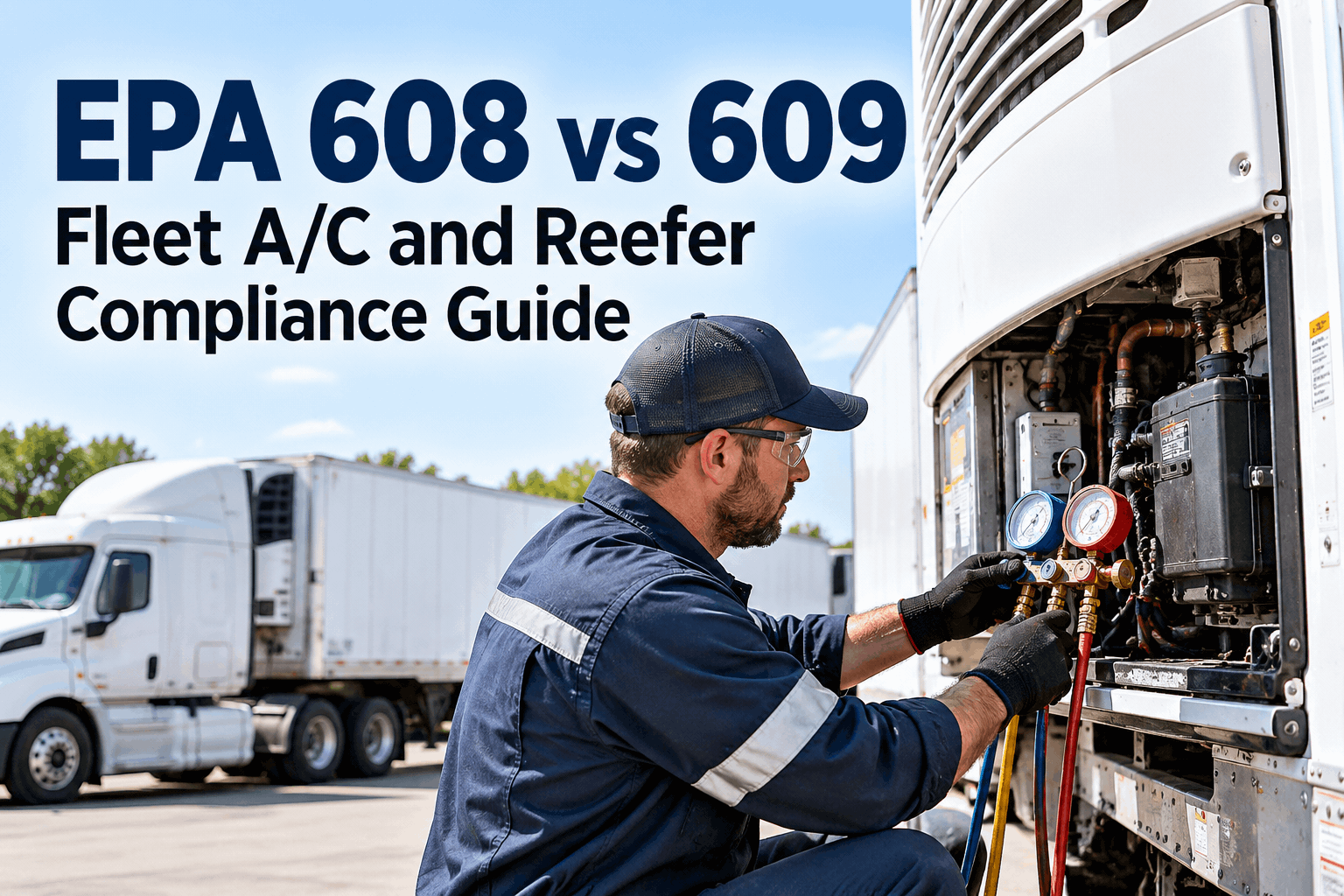
EPA Section 608 vs 609 trips up almost every reefer fleet the same way: one truck sits under two rules at once. The cab A/C is Section 609, the reefer cargo unit is Section 608 — so the same EPA card can't legally cover both. Get the wrong cert on the wrong system and it's an uncertified repair on your record. Book a demo of per-unit refrigerant records.
Two EPA Rules Live On One Refrigerated Truck
Section 608 vs 609 isn't a pick-one choice. On a reefer unit, both apply — to different parts of the same vehicle. Here's which rule governs which system.
- 40 CFR Part 82, Subpart B
- Cars, trucks, buses, off-road cabs
- Section 609 technician cert
- 40 CFR Part 82, Subpart F
- Treated as stationary refrigeration
- Section 608 Type II / Universal cert
Whichever card a technician is holding, the question an auditor actually asks is simpler than the regulation: can you prove the right certified person serviced the right system, and did you log every gram of refrigerant that went in? That's where a fleet wins or loses the audit — not on knowing the rule, but on having the record. Below is the clean version of both rules, mapped to the equipment on your lot.
1 truck · 2 ruleswhy Section 608 vs 609 isn't an either/or for reefer fleets
The confusion is understandable. Both rules cover air conditioning, both come from the Clean Air Act, both ban venting refrigerant. But the EPA splits them by what the system is bolted to, not by the vehicle it rides on. A reefer trailer carries one of each.
The system keeping the driver cool. It's a Motor Vehicle A/C — so it's Section 609, full stop, no matter how big the truck is.
The Thermo King or Carrier Transicold box cooling the freight. The EPA treats this cargo unit as refrigeration — so it's Section 608.
One rig, two certifications. A technician certified only under 609 is not authorized to recover refrigerant from the reefer unit — and vice versa. The record for each system has to name the cert that legally covers it. Book a demo of split-system service logs.
4 cert typesthe Section 608 ladder — and the one that covers reefer work
Section 609 is a single credential — pass one MVAC exam and you're certified for cab A/C. Section 608 is a ladder of four, each tied to a class of equipment. For a reefer fleet, the rung that matters is Type II or Universal.
-
IType I — Small appliances< 5 lb charge
Service of small, factory-sealed systems holding under five pounds of refrigerant. Not the rung for transport refrigeration.
-
IIType II — High-pressure systemsReefer units
High-pressure refrigeration and A/C. A transport refrigeration unit is a high-pressure system — so Type II is the certification a reefer technician needs under 608.
-
IIIType III — Low-pressure systemsChillers
Low-pressure equipment such as large building chillers. Rare on a fleet lot; not used for reefer boxes.
-
UUniversal — All of the aboveTypes I + II + III
Covers every 608 class. The practical choice for a shop tech who services mixed equipment — and still separate from the 609 MVAC card for the cab.
All four 608 types and the 609 card are permanent — EPA certifications don't expire. What does lapse is your proof that the right card serviced the right unit, unless each service event is logged against that asset. Book a demo of technician-cert tracking on work orders.
608 vs 609the side-by-side a fleet maintenance manager actually needs
Strip away the exam prep and study-guide noise. Here is the practical comparison for someone who has to keep refrigerant work legal across a mixed fleet — reefers, cab A/C, and farm or construction equipment.
| What it covers | Section 609 | Section 608 |
|---|---|---|
| Systems | Motor vehicle A/C (cab) | Stationary & transport refrigeration (reefer box) |
| Regulation | 40 CFR Part 82, Subpart B | 40 CFR Part 82, Subpart F |
| On a reefer truck | The driver's cab air conditioning | The refrigerated cargo unit |
| Certification | Single MVAC credential | Type I, II, III, or Universal |
| Cert for reefer work | Not valid for the box | Type II or Universal |
| Venting refrigerant | Prohibited | Prohibited |
| Certification expiry | Does not expire | Does not expire |
| Records live with | The service entity / owner | The appliance owner / operator |
Edge case worth knowing: A/C on farm and off-road equipment (an MVAC-like appliance) can be serviced under either a 609 card or a 608 Type II card — the EPA allows both for that category. For your road tractors and trailers, though, the split above is firm. Explore preventive maintenance scheduling to keep reefer PM on a fixed cadence.
The recordsthe refrigerant compliance checklist an auditor walks through
Certification is the easy part — it's permanent and it's a card in a wallet. The part fleets fail on is the service record. Under Section 608, a refrigeration system at or above 50 lb of charge pulls in recordkeeping, leak-rate math, and repair deadlines. Run this checklist against your current reefer paperwork.
- Technician name recorded on every refrigerant service event
- EPA certification number and type logged against the work order
- Cert type matches the system — 609 for cab, 608 Type II for the reefer box
- Type of refrigerant and quantity added captured at the event
- Date of the service tied to the specific unit ID
- Leak rate recalculated each time refrigerant is added to a 50 lb+ system
- 20% annual leak-rate threshold flagged for commercial refrigeration
- 30-day repair window opened and tracked to close
- Verification test and repair documentation retained with the asset history
- Full refrigerant history kept per unit, retrievable on demand
- Records survive technician turnover and shop changes
- Signed service history exportable as a report for an inspector
If any line above lives only on a paper ticket in a drawer, that's the line an audit finds. HVI's Explore maintenance records and history keeps every one of these attached to the unit it belongs to. Sign up free and log your first reefer service.
Before the finewhere preventive maintenance beats a leak-rate violation
The cheapest way to stay compliant is to stop the leak before it ever crosses a threshold. A reefer that's inspected on a schedule rarely surprises you with a 20% annual leak rate and a 30-day clock. That's a preventive maintenance problem, not a paperwork one.
- Reefer runs low, driver notices freight warming
- Tech adds refrigerant, no leak-rate math done
- Repeated top-offs quietly blow past 20%
- Audit finds additions with no repair record
- Recurring inspection catches a weeping fitting early
- Work order opens, certified tech assigned
- Repair logged with refrigerant type and amount
- Leak rate stays well under threshold — no clock
The same platform that holds the records schedules the checks that prevent the violation. Recurring reefer inspections, auto-generated work orders, and a complete See digital inspection checklists trail mean the leak gets caught at an inspection instead of at an audit. Book a demo of recurring reefer PM.
From a fleet maintenance manager who runs a mixed reefer fleet
For years our guys treated the whole truck as "one A/C job" — same card, same ticket. An EPA refresher set us straight: the cab's a 609 system and the reefer box is a 608 system, two different certs on the same VIN. The real fix wasn't the training, it was the record. Now every refrigerant add is tied to the unit and the tech's cert type automatically, so I'm not reconstructing a paper trail the week an auditor shows up.
EPA Section 608 vs 609 — fleet FAQs
Does a 608 certification let a technician work on cab A/C?
No. A 608 card covers stationary and transport refrigeration, not motor vehicle A/C. The cab's air conditioning is an MVAC system under Section 609, so it needs a 609 certification — even if the same tech holds Universal 608.
Which rule covers a refrigerated trailer's reefer unit?
Section 608. The EPA treats a transport refrigeration unit as refrigeration equipment, not motor vehicle A/C. A technician needs a 608 Type II or Universal certification to recover or recharge refrigerant in the reefer box.
Do EPA 608 and 609 certifications expire?
Neither expires — both are permanent once earned. What a fleet still has to maintain is the service record: who serviced which unit, with what cert, and how much refrigerant was added. That record is the part an audit actually checks.
What refrigerant records does Section 608 require for reefers?
For systems at or above 50 lb of charge, you track refrigerant type and quantity added, the servicing technician and cert, and recalculate the leak rate at each addition. Cross the 20% commercial threshold and a 30-day repair window with verification applies.
How does HVI help with EPA refrigerant compliance?
HVI isn't a certification program — it's the recordkeeping layer. It ties every refrigerant service event to the specific unit and technician, schedules reefer inspections, and keeps an exportable history, so the paper trail an EPA audit asks for already exists.
Keep your reefer and cab A/C work audit-ready
You now know which EPA rule governs which system. HVI makes the proof automatic — every refrigerant event tied to the unit and the certified tech who did it, so the record an auditor asks for already exists.
No credit card · No hardware · Unit-level records from day one